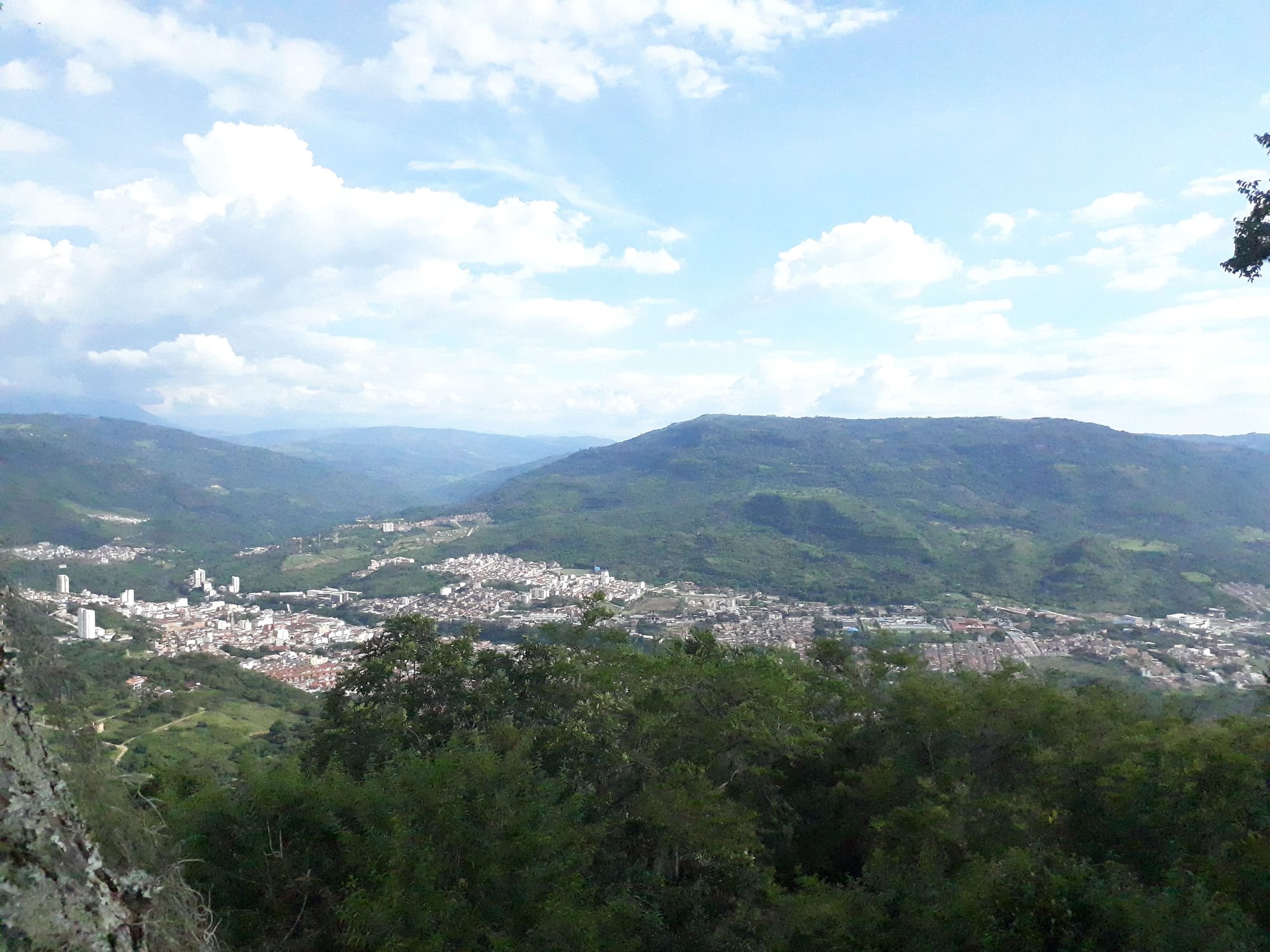
The town of San Gil spread across a green valley floor, seen from a wooded hillside with forested ridges and clouds beyond

Bogotá & the Andean Heartland, Colombia

San Gil

San Gil in the valley of the Fonce river, Santander. (Pedro Alejandro Ariza Rubiano / Wikimedia Commons · CC BY-SA 4.0)

A market town in southern Santander on the Fonce river, on the main road between Bogotá and Bucaramanga. Founded in 1689, it is the commercial centre of the south of the department and, since 2004, its officially named tourist capital, the base for rafting, kayaking, caving and hiking in the rivers and canyons around it.

Neighbourhoods

  • The centre around Parque La Libertad
    • First-time visitors
    • Best for food
    • Close to public transport

    The old core around the main square and the Cathedral of the Holy Cross, with shops, cheap restaurants, banks and many hostels and small hotels. Street life is busy all day, and long-distance buses to Bucaramanga leave from the riverfront nearby.

    Open in Maps
  • The riverfront and El Gallineral
    • Adventure sports
    • Parks

    The malecón along the Fonce river, where the entrance to the Gallineral park is ringed by the tour companies that sell rafting, caving and paragliding trips; it is a short walk from the centre and greener and quieter in the evenings.

    Open in Maps

Things to do

In the town

  • Parque El Gallineralpark

    A riverside park of about ten acres on the Fonce, named after the gallinero trees planted there in 1867, whose branches hang with grey moss like long beards, with paths along the water.

    Open in Maps
  • Cathedral of the Holy Crosslandmark

    The town's main church on the central square, built in 1791 and remodelled in 1965.

    Open in Maps
  • Rafting on the Fonceattraction

    The river running through town, with a rafting trip of about 11 km on class 2–3 rapids, depending on the season; harder trips on other rivers of the area reach class 4–5.

    Open in Maps

Short trips from the town

  • Cascadas de Juan Curíattraction

    A waterfall in the hills outside town, off the road to Charalá, reached by a walk of about 20 minutes, with a pool at the bottom where visitors swim.

    Open in Maps
  • Curití caves and Pescaderitoattraction

    Near the village of Curití, the Cueva de Vaca and other caves are explored on guided caving trips, and Pescaderito has river swimming holes.

    Open in Maps
  • Baricharaattraction

    The colonial town of yellow stone about 14 km away, whose historic centre has been a national monument since 1978, linked to the village of Guane by the old Camino Real path.

    Open in Maps
  • Chicamocha National Parkpark

    A park on the edge of the Chicamocha Canyon with viewpoints, a museum, paragliding and a 6.3 km cable car across the canyon to the Mesa de los Santos plateau.

    Open in Maps

Eat and drink

Long-standing places and food districts in San Gil. Hours, ratings and directions come from your maps app, always current.

Santander classics

  • Restaurants around Parque La Libertadneighborhood

    Around the main square, small restaurants serve the menú del día, roast chicken, bakery snacks and Santander dishes such as carne oreada and mute.

    Open in Maps
  • Hormigas culonasneighborhood

    Large roasted queen ants, a traditional food of the Guanentá province, harvested during the rainy season.

    Open in Maps

Experience San Gil

History

San Gil was founded on 17 March 1689 by Don Gil Cabrera Dávalos and Leonardo Correa de Betancourt, on land between the Sogamoso and Fonce rivers. It was established as a town of Spaniards, and it grew as a market and administrative centre for the surrounding farming country of the Guanentá province.

The Comuneros revolt of 1781 against new colonial taxes broke out in nearby Socorro, and its rebels marched on Bogotá. San Gil's main church, the Cathedral of the Holy Cross, was built in 1791. The town remained the commercial centre of southern Santander, helped by its position on the road between Bogotá and Bucaramanga.

Its modern identity came from tourism. The rivers and canyons around it offer rafting, kayaking, caving and hiking, and in 2004 the government of Santander officially named San Gil the tourist capital of the department. Commercial charter flights began at its small airport, Los Pozos, in September 2023.

Culture & Customs

San Gil's culture is that of the Santander countryside. Santandereanos have a reputation across Colombia for bluntness and a quick temper, and the local speech can sound abrupt to outsiders. The central square and the riverside Gallineral park are the town's gathering places, and the cathedral remains the focus of religious life.

Adventure tourism has given the town a second, younger character. Backpackers and Colombian visitors arrive to raft the Fonce and harder rivers, to explore caves near Curití, to swim beneath waterfalls and to paraglide over the Chicamocha Canyon, and tour companies, hostels and cafés cluster near the entrance to the Gallineral park. Rafting trips on the rivers of the area range from gentle class 1 water to class 5 rapids.

The Guane past is remembered in place names and in foods such as the hormigas culonas, the large ants eaten as a snack. Tejo, Colombia's traditional throwing sport, in which metal discs are thrown at targets set with small charges of gunpowder, is also played here.

Daily Life

The 2018 census counted about 56,000 people in the municipality, the large majority of them in the town itself, making San Gil the third-largest urban area of Santander after Bucaramanga and Barrancabermeja. Official projections put the population above 60,000 by 2022, with growth in the town while the rural population shrinks. It is the main urban and economic centre of the south of the department, serving farming towns for many kilometres around with shops, banks, schools, hospitals and transport.

Commerce, services, agriculture and tourism make up the economy. The town's tourism businesses — rafting and caving operators, guesthouses, restaurants and transport — employ many residents. The town is spread along the valley of the Fonce, which, with smaller streams, also supplies its drinking water.

Days are warm, and life starts early, with the centre busy from the morning. At weekends and on public holidays the town fills with visitors from Bogotá and Bucaramanga, and hotels and buses are crowded, while the weekdays are calmer.

Food

San Gil eats the hearty food of the Guanentá province. Carne oreada, a traditional thin cut of beef, is a regional staple. Mute santandereano is a hearty soup of chickpeas, beef rib and tripe with plenty of vegetables, sometimes with white maize; goat (cabro) is a local favourite, and pepitoria is a stew of rice, vegetables and goat offal and blood. The arepa santandereana is made of yellow maize with cassava and pork crackling, which makes it thick and crunchy.

The best-known local food is the hormiga culona: large queen ants, eaten since the time of the Guane people, with legs and wings removed, soaked in salt water and roasted. They are harvested for about nine weeks of the rainy season each year.

For everyday eating, the menú del día — soup, main course and juice — is served in restaurants around the central square, alongside bakeries and roast-chicken shops. Obleas, thin wafers spread with arequipe caramel, are sold along the region's highways, and aguapanela and guarapo are traditional drinks.

Planning tools

Budget

San Gil is one of the cheaper bases in Colombia's tourist circuit, with hostels, set lunches and local buses at modest prices. The main costs are the adventure trips — rafting, caving, paragliding — and hotel prices in most of the town double on long holiday weekends.

Daily Budget Midrange
USD 90–180 (comfortable hotel, restaurant dinners, a rafting or caving trip)
Daily Budget Shoestring
USD 35–60 (hostel bed, menú del día lunches, local buses)

Avoid long holiday weekends if possible, when rooms are heavily booked and prices rise.

Best Time to Visit

San Gil is warm all year. The drier spells, roughly December to March and July to August, are best for walking and paragliding; river levels, and so rafting conditions, change with the rains of April–May and October–November. Easter and long weekends bring crowds from the cities.

Suggested Number of Days

Two or three days are enough for the town and a couple of outdoor trips. Allow four or five to include more of the surrounding rivers, caves and colonial villages. Weather and river levels can change plans, so a spare day helps.

First Visit
2–3 days
With Surroundings
4–5 days

Transportation

The centre is small and walkable. Minibuses (busetas) and taxis cover the town and its edges, and frequent local buses run from the local transport centre to Barichara, Curití and other nearby villages. Tour companies provide transport for rafting, caving and canyon trips.

Book adventure trips with established operators and ask what safety equipment and guides are included.

Airport & Station Connections

San Gil lies on the main highway between Bogotá and Bucaramanga, about 300 km from the capital and about 95 km from Bucaramanga. Buses from Bogotá take six to seven hours and arrive at the long-distance terminal about 2 km west of the centre; buses to Bucaramanga take about two and a half hours. The small Los Pozos airport north of town has charter and seasonal flights; Bucaramanga's airport has regular ones.

Walkability

The centre, the main square, the riverfront and El Gallineral are all within easy walking distance of each other, though some streets climb steeply and the midday heat can be tiring. The long-distance bus terminal and the waterfalls and caves outside town need a taxi or bus.

Safety

Colombia is far safer for visitors than its reputation, and the main cities and tourist regions are well travelled, but crime requires attention. San Gil, like the other Santander tourist towns, is calm. The real risks are those of the sports the town is known for — rafting, caving and paragliding — and the heat and sun on outdoor trips.

Choose licensed adventure operators, wear the safety equipment provided, and keep valuables out of sight at the bus terminal. Check current official travel advice before travelling.

Climate

At about 1,100 metres San Gil is warm, with an average temperature of about 24°C, rising to around 32°C in the low areas beside the Chicamocha, Suárez and Sogamoso rivers and falling to about 15°C at the coolest. Rainfall varies widely across the municipality.

Summer
no true summer; the drier spells of December–March and July–August are sunny and warm, around 24°C on average
Winter
no true winter; the wetter months bring showers and higher rivers, with the average still around 24°C

Local Customs

Santandereanos are known for directness, and conversation can sound brusque to outsiders without being unfriendly. A greeting comes before any question, and 'usted' is the normal form of address with strangers. Churches are working places of worship, so modest dress is expected inside.

Check whether service is already included on a restaurant bill before tipping, and ask before photographing people.

Common Payment Methods

The currency is the Colombian peso (COP). The town has banks and ATMs; many tour operators and hotels take cards, but buses, small restaurants and shops expect cash, and the villages around San Gil may have no ATMs at all.