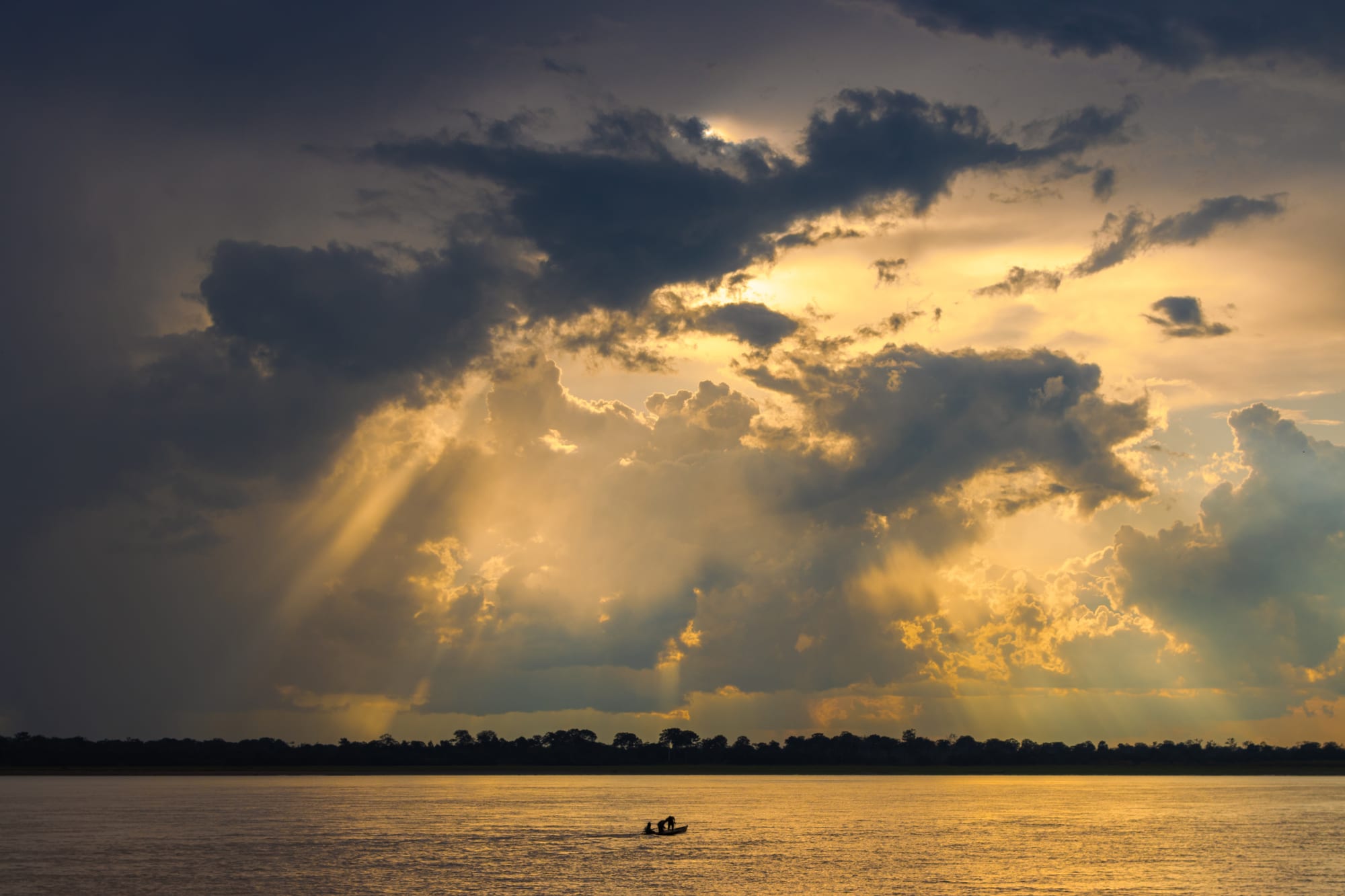
Sun rays breaking through storm clouds over a wide river, with a small fishing boat and a dark line of forest

Colombia

The Amazon & the South

Fishermen on the Amazon at sunset near Leticia. (Josefordonez / Wikimedia Commons · CC BY-SA 4.0)

Colombia's south, running from the upper Magdalena valley in Tolima and Huila over the Andes into the rainforests of Caquetá and Putumayo and down to Leticia on the Amazon — a region of ancient stone statues, a red-earth desert, Andean-Amazonian valleys and the tri-border river port where Colombia meets Brazil and Peru.

Explore The Amazon & the South

History

The south holds some of Colombia's oldest monuments. Around the upper Magdalena, a culture now known by the name of the town of San Agustín raised mounds, tombs and hundreds of carved stone figures, mostly in the first millennium AD, and its work stretched into what is now Tierradentro. The Pijao of Tolima fought the Spanish for decades. The Spanish founded Ibagué in 1550 and Neiva in the 1610s, and Honda, on the Magdalena, became the colonial river port where goods for Bogotá were unloaded.

The Amazon remained Indigenous until the rubber boom of the late 19th and early 20th centuries, when rubber companies, above all the Peruvian Amazon Company of Julio César Arana, enslaved and killed thousands of Uitoto, Bora and other Indigenous people around the Putumayo; the atrocities were exposed in 1912. Leticia, founded as a Peruvian settlement in 1867, passed to Colombia by treaty in 1922, and its seizure by Peruvian civilians in 1932 led to a short war, settled in Colombia's favour in 1934.

In 1964 the army's assault on Marquetalia, a peasant settlement in southern Tolima, is seen as the founding moment of the FARC, and the guerrillas later made Caquetá and Putumayo strongholds. Around San Vicente del Caguán, in Caquetá, a demilitarised zone was ceded to the FARC during peace talks from 1998 to 2002. Coca spread through the region, bringing aerial spraying under Plan Colombia. In 1985 a lahar from the Nevado del Ruiz buried the Tolima town of Armero, killing more than 20,000 people, and in 2017 a landslide in Mocoa killed over 300.

Culture & Customs

The upper Magdalena is the home of Andean folk music: the bambuco, a lilting string style, and the sanjuanero, the courtship dance of Huila, performed at Neiva's San Pedro festival in June. Ibagué calls itself Colombia's musical capital, with its conservatory and annual folk festival. Catholic devotion is strong in the towns.

The Amazon and Putumayo have dozens of Indigenous peoples — Ticuna, Uitoto, Yagua, Cocama, Inga, Kamëntšá, Siona and others — with their own languages, crafts and ceremonies. The Kamëntšá and Inga make up most of the people of Sibundoy, where fallen tree trunks in the town park are carved with symbols from their mythology. Yagé, the plant brew known elsewhere as ayahuasca, is central to the healing traditions of Putumayo and Caquetá, although its use in ceremonies for visitors has become commercialised.

Leticia's life is bound up with its neighbours: Brazilian Tabatinga runs into the town without a formal border crossing, Peruvian Santa Rosa sits across the river, and Spanish, Portuguese and Ticuna mix in the markets.

Daily Life

Ibagué, with about 550,000 people, and Neiva, with around 390,000, are the main cities of the Andean part of the region; Florencia and Mocoa are the capitals of Caquetá and Putumayo, and Leticia has about 34,000 people. Much of the Amazon has almost no roads, and many Indigenous communities live in reserves (resguardos) along the rivers.

Huila is one of Colombia's leading coffee-producing departments, and Tolima and Huila also grow rice, cacao and fruit and raise cattle, with oil wells around Neiva and hydroelectric dams on the Magdalena. Caquetá and Putumayo have cattle ranching, oil and, in their remote areas, coca. Deforestation — for cattle pastures, coca and land speculation — is heaviest along the frontier between the Andes and the Amazon, in Caquetá and neighbouring departments, and is one of Colombia's biggest environmental concerns.

In Leticia, life turns on the river: markets fill with fish at dawn, motorbikes are the main transport, and prices follow imports flown in from Bogotá or shipped from Brazil.

Food

Tolima and Huila share a love of pork. The lechona tolimense is a whole pig stuffed with its own meat, rice or peas and spices, roasted for hours and eaten at celebrations; the tamal tolimense is a large tamale of maize dough, pork, chicken, egg and vegetables wrapped in plantain leaf. The asado huilense is pork marinated in bitter orange and spices and roasted in a wood-fired oven, especially during the San Pedro festival. Achiras, small crunchy cheese biscuits made from the starch of the achira plant, are Huila's best-known snack, and insulso, a sweet pudding of wheat flour and sugar, is served with lechona in Tolima.

In the Amazon, the rivers provide pirarucú (arapaima), one of the world's largest freshwater fish, which is fished under seasonal controls, as well as catfish and tambaqui, grilled or wrapped in leaves (moqueado). Fariña, toasted cassava flour, and casabe, cassava bread, accompany meals, and juices are made from Amazonian fruits such as copoazú and camu camu.

Coffee from Huila is prized by specialty roasters, and the region's other drinks include chicha and cane-sugar aguardiente.

Attractions & Natural Wonders

Leticia is the base for the Amazon: boat trips on the river, the Isla de los Micos, canopy walks, and visits to Ticuna communities. Upriver, Puerto Nariño is a car-free village near the Tarapoto lakes, where pink river dolphins feed, and Amacayacu National Park covers flooded and upland forest nearby.

In southern Huila, San Agustín Archaeological Park, a UNESCO World Heritage Site, has hundreds of stone figures — guardians, animals and deities — spread across the park and the surrounding hills at sites such as Alto de los Ídolos. Nearby, the Magdalena squeezes through a rock gap only a couple of metres wide at the Estrecho del Magdalena. In the north of the department, the Tatacoa Desert near Villavieja has the red gullies of Cuzco and the grey ones of Los Hoyos, fossil finds and an observatory.

Putumayo's capital Mocoa sits at the foot of the Andes, where trails lead to waterfalls such as the Fin del Mundo, and the Sibundoy valley lies above it. Caquetá's rainforest includes Chiribiquete National Park, a UNESCO World Heritage Site known for its rock paintings and tabletop mountains. In Tolima, the colonial river port of Honda and the ruins of Armero are the main sights, and Ibagué is a base for climbing the snow-capped Nevado del Tolima.

Cities in The Amazon & the South

Planning basics

Budget

Huila and Tolima are among the cheapest parts of Colombia, with low prices in San Agustín, Neiva and the Tatacoa's simple lodgings. The Amazon is different: Leticia can only practically be reached by air, and jungle lodges, guides and boat trips are priced for visitors. Mocoa and Florencia fall in between.

Daily Budget Midrange
USD 80–180 and more for Amazon lodge packages with guides and boats
Daily Budget Shoestring
USD 30–50 (hostels, set lunches, buses) in Huila and Tolima

Book Amazon trips through established operators in Leticia and compare what each includes before paying.

Safety

San Agustín, the Tatacoa, Neiva, Ibagué and Leticia are visited without serious trouble by most travellers, though Leticia is a trafficking route across three borders. Rural Caquetá, Putumayo and parts of southern Tolima and Huila have armed groups — mainly FARC dissident factions and trafficking networks — linked to coca and illegal logging, and remote areas away from the main towns are best avoided. In the Amazon, go with licensed guides.

Keep to the main tourist towns and routes, travel by day, and take anti-malarial and yellow fever advice before visiting the Amazon. Check current official travel advice before travelling.

Climate

The upper Magdalena valley is hot and dry: the Tatacoa Desert regularly passes 35°C at midday, while Neiva and Ibagué are hot and humid and San Agustín, at around 1,700 metres, is mild and wet. The Amazon is hot, humid and rainy all year, with the river rising several metres in the high-water months and falling in the dry season. The Andean foothills around Mocoa and Florencia are among the wettest parts of the country.

Summer
the drier months, broadly July–September in the Amazon and June–August in Huila, bring hot sunny days of 30–35°C in the valleys
Winter
the wetter months bring heavy rain in the Amazon and the Andean foothills and cooler, cloudier days in San Agustín

Transportation

Leticia has no road connection to the rest of Colombia and is reached by flights from Bogotá; boats run upriver to Puerto Nariño and to Peru and Brazil. Neiva, Florencia, Ibagué and Mocoa have airports, and buses link Neiva with San Agustín in about five hours and with Villavieja, the Tatacoa gateway, in about one. Ibagué is a few hours by road from Bogotá. The road from Mocoa up to Pasto is steep, narrow and prone to landslides.

Fly to Leticia, and travel by day on mountain roads between Huila, Putumayo and Nariño.

Best Time to Visit

The Amazon can be visited all year: the high-water months, roughly March to June, allow canoe trips into flooded forest, while the low-water months from around August to October expose beaches and trails. For San Agustín and Tatacoa the drier months of June to September and December to February are best. The San Pedro festival and the bambuco folk festivals fill Neiva and the Huila towns in late June.