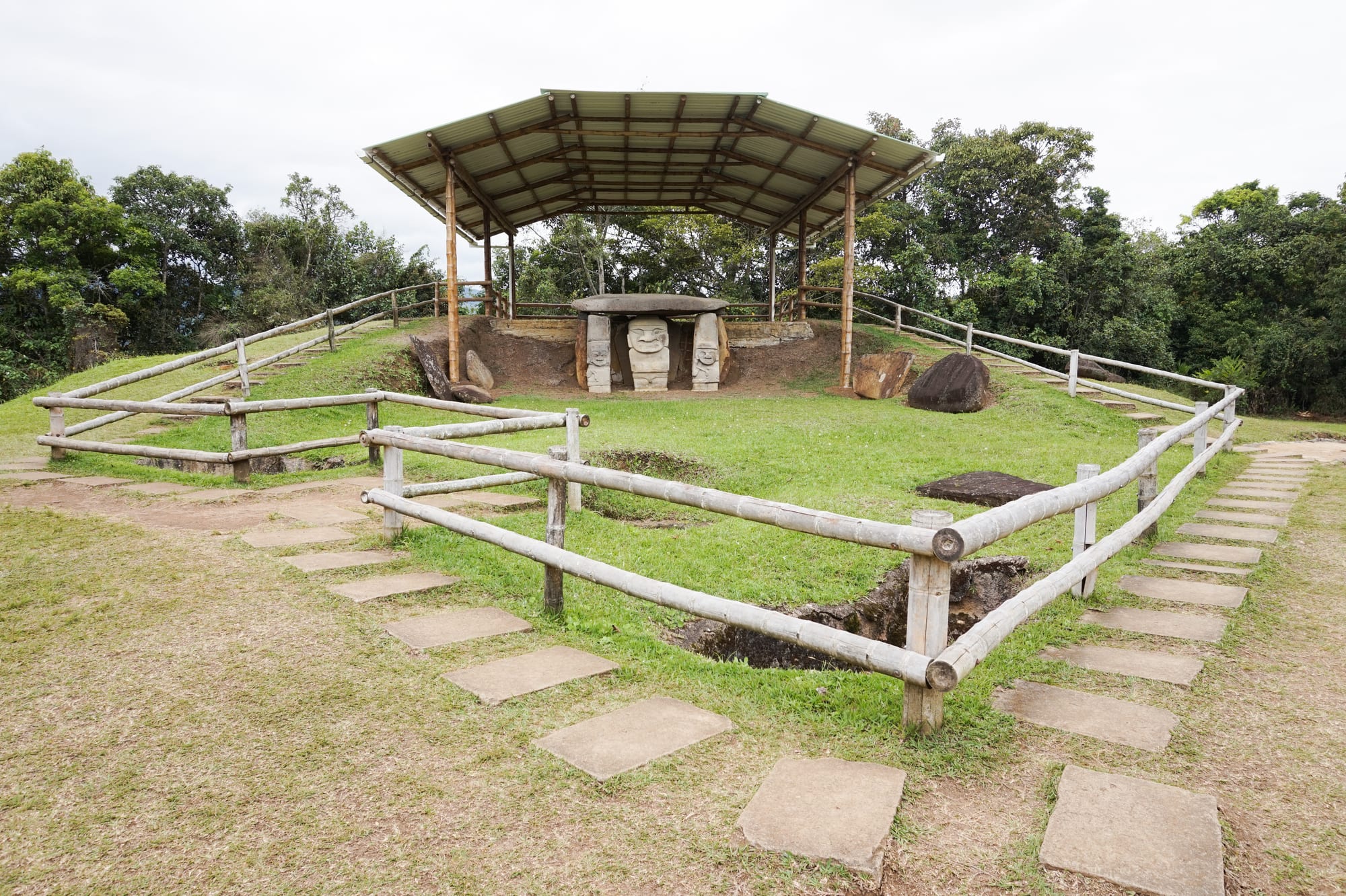
Carved stone guardian figures under a roofed shelter on a grassy mound, ringed by bamboo railings and stepping stones

The Amazon & the South, Colombia

San Agustín

Statues at Mesita A in San Agustín Archaeological Park. (Bernard Gagnon / Wikimedia Commons · CC BY-SA 4.0)

A small highland town in southern Huila, at about 1,730 metres near the upper Magdalena, surrounded by the tombs and carved stone figures of a pre-Columbian culture. The archaeological park outside town, a UNESCO World Heritage Site since 1995, made it Huila's best-known destination; today it is a coffee and farming town whose hills are walked and ridden by visitors between the scattered sites.

Neighbourhoods

  • Town centre
    • First-time visitors
    • Close to buses
    • Local life

    A grid of low houses around the main square and the parish church, with shops, simple hotels, hostels and set-lunch restaurants. Shared taxis and buses to Pitalito and beyond leave from here, and the town is quiet after dark.

    Open in Maps
  • The road to the archaeological park
    • Close to the park
    • Countryside stays

    The road running about 3 km west from the town to the main park, lined with guesthouses, farm hostels and grills serving asado huilense. Staying here puts the park within walking distance, among coffee plots and green hills.

    Open in Maps
  • The Magdalena countryside
    • Quiet and rural
    • Walking and riding

    Farm stays scattered along the tracks towards El Estrecho and the outlying sites, above the canyon of the Magdalena. Rooms here look over the valley, and they are reached on foot, on horseback or by jeep.

    Open in Maps

Things to do

The archaeological park

  • San Agustín Archaeological Parklandmark

    The main park, about 3 km west of town and a UNESCO World Heritage Site since 1995, with burial mounds, tombs and dozens of carved figures believed to date from around AD 5–400.

    Open in Maps
  • Bosque de las Estatuastrail

    A woodland path inside the main park lined with carved stone statues.

    Open in Maps
  • Fuente de Lavapataslandmark

    A ceremonial fountain inside the main park: a system of channels over rock carved with human, amphibian and reptile figures.

    Open in Maps
  • Casa Museo Luis Duque Gómezmuseum

    The main park's archaeological museum, with statues, pottery and utensils from the excavations.

    Open in Maps

Walks around the town

  • El Tablón and La Chaquiraviewpoint

    Two small sites within walking distance of town; at La Chaquira, about 4 km out, faces and figures are carved into rocks high above the Magdalena valley.

    Open in Maps
  • La Pelota and El Purutallandmark

    Hillside sites about 9 km from town whose statues, including an eagle holding a snake, keep some of their original colouring.

    Open in Maps
  • Estrecho del Magdalenaviewpoint

    The point where rock walls squeeze the Magdalena into a channel only a little over 2 metres wide, on the road towards Obando.

    Open in Maps

Short trips from the town

  • Alto de los Ídoloslandmark

    A separate, less visited site about 4 km from the town of Isnos, with the tallest statue of all the parks, about 7 metres high, and wide views; it shares a ticket with the main park.

    Open in Maps
  • Alto de las Piedraslandmark

    A site about 7 km from Isnos known for the statue called the 'Doble Yo'.

    Open in Maps
  • Obandomuseum

    A village about 15 km from town with an archaeological park of underground tombs and a small museum of pottery and funeral urns.

    Open in Maps
  • Isnosattraction

    The neighbouring town and municipality, part of the same UNESCO-listed archaeological area and the base for the Alto de los Ídolos, the Alto de las Piedras and the Salto de Bordones waterfall.

    Open in Maps
  • Pitalitoattraction

    Huila's second most populous municipality, about 27 km away, a coffee town whose bus terminal serves onward routes.

    Open in Maps

Eat and drink

Long-standing places and food districts in San Agustín. Hours, ratings and directions come from your maps app, always current.

San Agustín classics

  • Asado huilenserestaurant

    The traditional roast of Huila, served in big plates at the grills on the way to the archaeological park.

    Open in Maps
  • Achirasrestaurant

    The traditional Huila snack: small, crunchy biscuits made from achira flour, with a slightly salty taste of achira and cheese.

    Open in Maps

Cafés and drinks

  • Cafés around the main squareneighborhood

    Coffee from the farms of southern Huila, alongside jugo de caña — freshly pressed sugar-cane juice with a little lemon — and guarapo, a fermented cane drink.

    Open in Maps

Experience San Agustín

History

The hills around San Agustín were home to the people now called the San Agustín culture, whose beginnings may go back to the fourth millennium BC. Over many centuries they built burial mounds and stone tombs and carved hundreds of statues — guardian figures, animals such as jaguars and birds, and figures thought to be gods — spread across plateaus on both sides of the upper Magdalena. The statues are believed to have been carved between about AD 5 and 400, and they were once painted yellow, red, black and white. Much about the carvers and their society remains uncertain.

The first Spanish settlement, founded in 1752 by Alejo Astudillo, was destroyed by attacks from Indigenous people, and the present town dates from 1790. In 1756 the Spanish friar Juan de Santa Gertrudis passed through and described the statues in his book Maravillas de la naturaleza, one of the first written accounts of them.

Scientific digging began in the 20th century. In 1913 the German ethnologist Konrad Theodor Preuss excavated here for the Ethnological Museum of Berlin and took 21 smaller sculptures, which reached Berlin in 1919; in 2022 the Colombian government said it would seek their return. The archaeological park was declared a UNESCO World Heritage Site in 1995, together with nearby Isnos, and it now forms part of an archaeological corridor with Tierradentro. Tourism has since grown into one of the town's main livelihoods alongside farming.

Culture & Customs

San Agustín calls itself the archaeological capital of Huila, and its identity is bound up with the statues: their eagle-and-snake motif appears on the municipal coat of arms. Local guides lead visitors to the sites on foot or on horseback, and riding along the country tracks is part of everyday life in the surrounding veredas, the rural districts.

The San Agustín culture worked not only stone but also pottery and gold, and the park's museum and the small museum at Obando keep some of these finds. For local people the statues are both heritage and a source of pride, and the removal of some to Europe a century ago is still a live question.

The town shares the Andean traditions of Huila, whose capital Neiva holds the national bambuco festival with the Sanjuanero as its anthem, and Catholic feast days centre on the parish church. Some of the hostels and farm stays around the town are run by settlers from abroad, and the visitor trade gives it a relaxed, outdoor character.

Daily Life

The municipality had about 34,000 inhabitants according to a 2019 projection by DANE, Colombia's statistics agency. It covers about 1,574 square kilometres, running west to the high peaks of the Central Cordillera, close to the source of the Magdalena, and the town itself stands at about 1,730 metres on the eastern side of the Colombian Massif, the knot of mountains where the Andes divide into three ranges.

The economy rests on coffee, sugar cane, cattle and tourism. Coffee grows on small farms across the hills, and southern Huila is one of Colombia's leading coffee areas. Tourism brings hostels, guiding, horse hire and craft shops, and it is busiest in Colombian holiday periods and the drier months.

Life follows the rhythm of a farming town, with quiet evenings on the main square. Pitalito, the larger town about 27 km away, is the place for banks and onward transport, and shared taxis run between the two through the day. Away from the town, families live on scattered farms reached by dirt roads, and many households combine a coffee plot with cattle, cane or work in the visitor trade.

Food

San Agustín eats like the rest of Huila. Asado huilense, the traditional roast of the department and a fixture of the San Juan and San Pedro festivities in Neiva, is the dish most visitors seek out, and grills on the way to the archaeological park serve it in big plates.

Achiras, small crunchy biscuits made from achira flour with a taste of cheese, are the classic Huila snack. Simple restaurants in town serve set lunches, and the grills on the park road offer grilled meat with grilled fruit and vegetables, which make a filling meal after a long walk between the sites.

Drink is local too. Coffee is grown on the surrounding farms and is the everyday drink in the countryside, and Huila's beans are prized by specialty roasters. Jugo de caña is sugar-cane juice pressed fresh with a squeeze of lemon, and guarapo and chicha are fermented drinks made from cane and maize, long brewed in the countryside and still drunk by local people.

Planning tools

Budget

San Agustín is one of the cheaper stops in Colombia. Hostels and farm stays are inexpensive, set lunches and grilled meat cost little, and the main costs are the archaeological park ticket, which also covers the Alto de los Ídolos, and any jeep tour, horse ride or guide to the more distant sites.

Daily Budget Midrange
USD 70–130 (private room in a country guesthouse, a jeep tour or horse ride, park ticket, sit-down dinners)
Daily Budget Shoestring
USD 25–45 (hostel or farm-stay dorm, set lunches, walking to the sites)

The main park ticket is valid for several days and also covers the Alto de los Ídolos, so there is no need to rush the sites.

Best Time to Visit

The town can be visited all year, but the drier months — around June to September and December to February — are best for walking between the sites, when the tracks are less muddy. The rest of the year brings more rain and cloud, and Colombian holiday weekends fill the guesthouses.

Suggested Number of Days

Two or three days are enough for the main park and the sites within walking distance. Allow four or five to reach the more distant sites as well. The number depends on whether the sites are walked, ridden or visited by jeep.

First Visit
2–3 days
With Surroundings
4–5 days

Transportation

The town is small enough to walk, and minibuses run frequently along the road to the main park. The outlying sites are scattered over a wide area of hills: many visitors walk or hire horses, which guesthouses can arrange, and local agents run jeep tours to the more distant sites, waterfalls and Obando. There is no public transport straight to the Alto de los Ídolos, only to the town of Isnos.

Walking between the sites takes hours on hilly tracks; start early and carry water and rain gear.

Airport & Station Connections

Buses link San Agustín with Neiva in about five hours and with Popayán in about five hours over a rough mountain road; the trip from Bogotá is about ten hours. Shared taxis run to Pitalito, about 27 km away, whose bus terminal serves onward routes and which has an airport, Pitalito (Contador) Airport.

Walkability

The town centre is compact and easy on foot. The main park is about 3 km west along a road, and the nearer sites are linked by country tracks that are pleasant but steep and muddy after rain. The more distant sites, around Isnos and Obando, are too far for most walkers.

Safety

Colombia is far safer for visitors than its reputation, and the main cities and tourist regions are well travelled, but crime requires attention. San Agustín is visited without serious trouble by most travellers, though rural parts of southern Huila have armed groups, and remote areas away from the main towns are best avoided. The practical risks are muddy, slippery tracks and travel on mountain roads after dark.

Keep to the known sites and routes, use guides for remote walks, and travel by day on mountain roads. Check current official travel advice before travelling.

Climate

Mild highland weather at around 1,730 metres, with a mean temperature of about 18°C through the year. Days are warm in sunshine and evenings cool, and rain falls in every month, more heavily in the wet seasons.

Summer
the drier months, broadly June–September, bring more sunshine and firmer tracks, around the yearly mean of about 18°C
Winter
the wetter months bring heavy showers and cloud over the hills, with cooler days than the yearly mean of about 18°C

Local Customs

San Agustín is a Catholic farming town, quiet and conservative, where greetings in shops and on country tracks are expected. The statues are protected archaeological heritage and must not be climbed or touched. Statues taken abroad remain a sore point: some removed in the early 20th century are now sought back from Germany by the Colombian government.

Ask before photographing people, and dress modestly in the church.

Common Payment Methods

The currency is the Colombian peso (COP). Cash is needed for buses, shared taxis, hostels, horse rides and small restaurants. The town's ATMs are not always reliable and can run out of cash on long weekends, when the nearest alternative is Pitalito, so it is best to arrive with enough pesos.