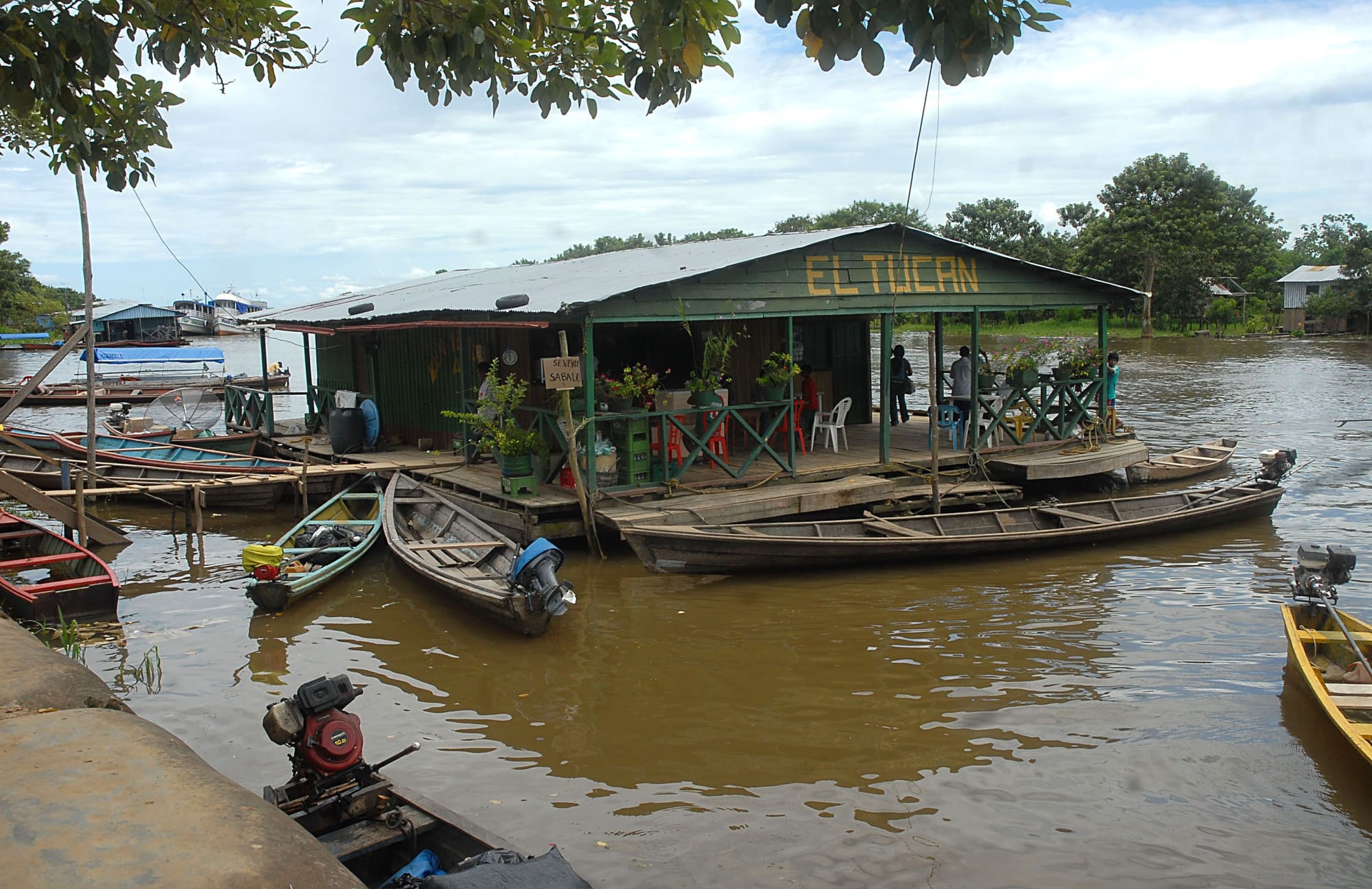
Wooden canoes with outboard motors moored at a green floating café on a brown river, with trees and riverboats behind

The Amazon & the South, Colombia

Leticia

Boats moored at the river port of Leticia, on the Amazon in southern Colombia. (Valter Campanato / Wikimedia Commons · CC BY 3.0 br)

Colombia's southernmost city and the capital of Amazonas, a river port on the Amazon where Colombia, Brazil and Peru meet. Founded by Peru in 1867 and awarded to Colombia after a short war in the 1930s, it has no road link to the rest of the country and is now the base for trips into the rainforest.

Neighbourhoods

  • Town centre and the port
    • First-time visitors
    • Close to the river
    • Tour agencies

    The compact centre between Parque Santander, Orellana Park and the river port, with the cathedral, the Banco de la República museum, hotels, restaurants and the agencies that sell river trips. Boats to Puerto Nariño, Santa Rosa and the lodges leave from the waterfront.

    Open in Maps
  • The border with Tabatinga
    • Local life
    • Markets
    • Crossing to Brazil

    Leticia runs straight into the Brazilian city of Tabatinga along a busy avenue. Street life mixes Spanish and Portuguese, and both pesos and reais are used.

    Open in Maps
  • The Tarapacá road
    • Nature
    • Quiet

    The road from Leticia towards Tarapacá leads out of town into the forest, with the Mundo Amazónico ecological park at kilometre 7.7, served by local buses.

    Open in Maps

Things to do

In town

  • Parque Santanderpark

    The main square, where thousands of small parrots fly in at sunset to roost in the trees; the neighbouring church tower gives a view over the town and the river.

    Open in Maps
  • Our Lady of Peace Cathedrallandmark

    The town's cathedral, beside Parque Santander.

    Open in Maps
  • Orellana Parkpark

    A small park in the town, one of its listed sights.

    Open in Maps
  • Banco de la República ethnographic museummuseum

    A small museum near the centre with exhibits in Spanish and English on the cultures of the Amazon's Indigenous peoples.

    Open in Maps

Forest and lakes near town

  • Parque Ecológico Mundo Amazónicopark

    An ethnobotanical park on the road north of town, with guided tours on Amazon plants, medicinal plants, Indigenous culture and aquatic life.

    Open in Maps
  • Yahuarcaca lakespark

    Lakes near the town, explored by kayak.

    Open in Maps

Across the borders

  • Tabatinganeighborhood

    The larger Brazilian town that adjoins Leticia, reached on foot, by bicycle or by mototaxi, with its own airport and flights to Manaus.

    Open in Maps
  • Santa Rosa de Yavaríneighborhood

    A small settlement on an island in the Amazon opposite Leticia, administered by Peru and reached by boat; it serves as the Peruvian border post of the triple frontier and has been disputed by Colombia since 2024.

    Open in Maps

Short trips from the city

  • Amacayacu National Parkpark

    A national park created in 1975 along the Amazon upriver from Leticia, covering about 4,220 square kilometres of jungle, much of it flooded each year, and partly home to the Ticuna people.

    Open in Maps
  • Puerto Nariñoattraction

    Amazonas department's only other municipality, a car-free town of about 6,000 people on the Loretoyaco river, 67 km from Leticia.

    Open in Maps
  • Lago Tarapotopark

    A lake reached by boat up the Loretoyaco river from Puerto Nariño, where pink river dolphins can be seen.

    Open in Maps

Eat and drink

Long-standing places and food districts in Leticia. Hours, ratings and directions come from your maps app, always current.

Amazon food

  • Grilled river fishrestaurant

    Restaurants in the town serve mostly fish, from the Amazon's pirarucú to gamitana and tucunaré, with plantain and casabe, cassava bread.

    Open in Maps
  • Brazilian food in Tabatinganeighborhood

    A short walk across the border, Tabatinga adds Brazilian cooking to the food of the two towns.

    Open in Maps

Experience Leticia

History

Leticia began as a Peruvian settlement. Captain Benigno Bustamante, governor of the Peruvian department of Loreto, founded it on 25 April 1867 as the river port of San Antonio, and in December of that year the engineer Manuel Charón renamed it Leticia, by Peruvian records after his wife, Leticia Smith of Iquitos. Other stories credit a Colombian soldier in love with an Indigenous woman of that name, or a saint.

After border incidents in 1911, Peru and Colombia signed a secret agreement in 1922 that gave the Leticia area to Colombia in return for Colombian recognition of Peru's claims south of the Putumayo. It was ratified in 1928 but remained unpopular in Peru. In September 1932 two hundred Peruvians, followed by troops, occupied the town's public buildings, starting the Colombia–Peru War. Fighting lasted until a ceasefire negotiated by the League of Nations in May 1933, and in June 1934 the League awarded the area to Colombia.

Wary of Peru, the Colombian government then settled Leticia with people from Bogotá, many of whom arrived between the 1940s and 1965 and stayed. The town grew, gained a new main street, and became capital of the Amazonas department. Tourism has since boomed, and students come to study the Amazon and to learn Spanish. The border question has not entirely gone: since 2024 Colombia has disputed Peru's administration of Santa Rosa island, across the river.

Culture & Customs

Leticia's culture is shaped by the three-border setting known as Tres Fronteras. Brazilian Tabatinga runs straight into the town, Peruvian Santa Rosa sits on an island across the river, and together the three settlements have more than 100,000 people. Colombian, Brazilian and Peruvian money all change hands in the three towns, and Leticia and Tabatinga cooperate closely.

The town is also a meeting place of peoples. Most residents have migrated from elsewhere in Colombia, many from Bogotá, Medellín and Tolima, while a significant part of the population is Indigenous. The region is home to the Ticuna, Uitoto, Inga, Tucano and other peoples, and Yagua families from Peru settled in the riverside village of La Libertad in the 1990s. Many Indigenous people have moved into town from distant villages in search of a better living.

Leticia has long been Colombia's shipping point for tropical aquarium fish, and it is an important centre for the study of the Amazon, with a campus of the National University of Colombia among its colleges. Its daily rituals are tied to nature: at sunset thousands of parrots fly into the trees of Parque Santander, one of the town's best-known sights.

Daily Life

Leticia had more than 42,000 inhabitants in 2018 and is the largest Colombian settlement in the Southern Hemisphere. Agriculture and tourism remain the main sources of income. Leticia and Tabatinga lie so close together that they form a single urban area of a little over 100,000 people, and the two towns keep the same time. The town is the area's main hub, with its only large hospital, airport and secondary schools.

Life turns on the river. Mototaxis are the main way around town, and boats link it with the villages and lodges along the river. The Amazon rises in the high-water months and falls in the dry season, changing which channels and lakes boats can reach and which beaches appear.

The town is still growing as people move in from rural communities. Cross-border trade is central to the local economy, the triple frontier is also a trafficking route, and deforestation along the frontier between the Andes and the Amazon is one of the region's biggest environmental concerns.

Food

Leticia eats from the river. Fish such as gamitana, dorado, tucunaré and pirarucú, or arapaima, one of the largest freshwater fish in the world, are the base of the region's main dishes. They are served with casabe, a bread made from bitter cassava, plantain and exotic fruit. The pirarucú and the pink river dolphin appear together on the town's coat of arms as symbols of the Amazon.

Everyday cooking also reflects a town of migrants. Families from across Colombia bring their own versions of dishes such as sancocho, a hearty soup, and Brazilian and Peruvian influences are strong in this border town. Staples include river fish, meat, rice, plantain, potatoes and locally grown vegetables, and a typical Sunday meal might be meat grilled over charcoal with rice and plantain.

Amazonian fruits such as arazá, copoazú and açaí are part of the local diet. Across the border, Tabatinga adds Brazilian dishes and drinks to the mix.

Planning tools

Budget

Leticia itself is moderately priced, though many goods are flown in or shipped from Brazil and cost more than elsewhere in Colombia. The real expense is the jungle: flights, guides, boat trips and lodge stays are priced for visitors, and multi-day lodge packages cost far more than a stay in town.

Daily Budget Midrange
USD 80–180 and more (hotel or lodge, guided river trips and boats, restaurant meals)
Daily Budget Shoestring
USD 35–60 (hostel bed, set lunches, mototaxis, public boats)

Book Amazon trips through established operators in Leticia and compare what each includes before paying.

Best Time to Visit

The Amazon can be visited all year. In the high-water months, roughly March to June, canoes can travel into the flooded forest; in the low-water months from around August to October, beaches and trails appear. It rains heavily in every month, most of all around March and least around July.

Suggested Number of Days

Three or four days suit a first visit. Five days to a week allow longer stays further up the river, where travel by boat takes up much of the day and plans depend on water levels.

First Visit
3–4 days
With Surroundings
5–7 days

Transportation

Mototaxis, recognisable by the spare helmet they carry, are the main way around town, alongside covered motocarros and taxis; bicycles and motorbikes can be hired. Buses run along the road north of town. Everything beyond is reached by boat: public boats to Puerto Nariño and launches to the lodges, Santa Rosa and points along the river.

Confirm public boat times locally and buy the return ticket early, as boats back from Puerto Nariño are limited.

Airport & Station Connections

Leticia is not connected to the rest of Colombia by road. Alfredo Vásquez Cobo International Airport, on the edge of town, has direct flights from Bogotá, and Tabatinga's airport across the border has flights to Manaus. Visitors pay a tourism tax on arrival, in cash only. Boats run along the Amazon to Peru and Brazil.

Walkability

The centre is small and flat, and the walk from Parque Santander to the river and to the border with Tabatinga is short, though hot and humid by midday.

Safety

Colombia is far safer for visitors than its reputation, and the main cities and tourist regions are well travelled, but crime requires attention. Leticia is visited without serious trouble by most travellers, though it is a trafficking route across three borders. In the forest, go with licensed guides.

Use licensed guides and established operators, carry proof of yellow fever vaccination, which regulations require for the area, and take anti-malarial advice, and keep to the town and organised trips. Check current official travel advice before travelling.

Climate

A hot, humid tropical rainforest climate with an average temperature of about 27°C and little change through the year. Rainfall is above 150 mm in every month; March is the wettest and July the driest.

Summer
the driest months, around July, bring more sun and falling rivers, with temperatures still around 27°C on average
Winter
the wetter months, around March, bring heavy rain, high water and temperatures still around 27°C on average

Local Customs

Leticia is a town of migrants from across Colombia, with a large Indigenous population — Ticuna, Uitoto, Yagua and others — and neighbours who speak Portuguese and Peruvian Spanish. Visits to Indigenous communities are best arranged through guides who work with them.

Ask before photographing people, especially in Indigenous communities, and buy crafts directly from the makers where possible.

Common Payment Methods

The currency is the Colombian peso (COP), but Brazilian reais are widely used in trade with Tabatinga. Cash is important: the tourism tax charged on arrival is paid in cash and there is no ATM at the airport. Cards are accepted in larger hotels and some restaurants.