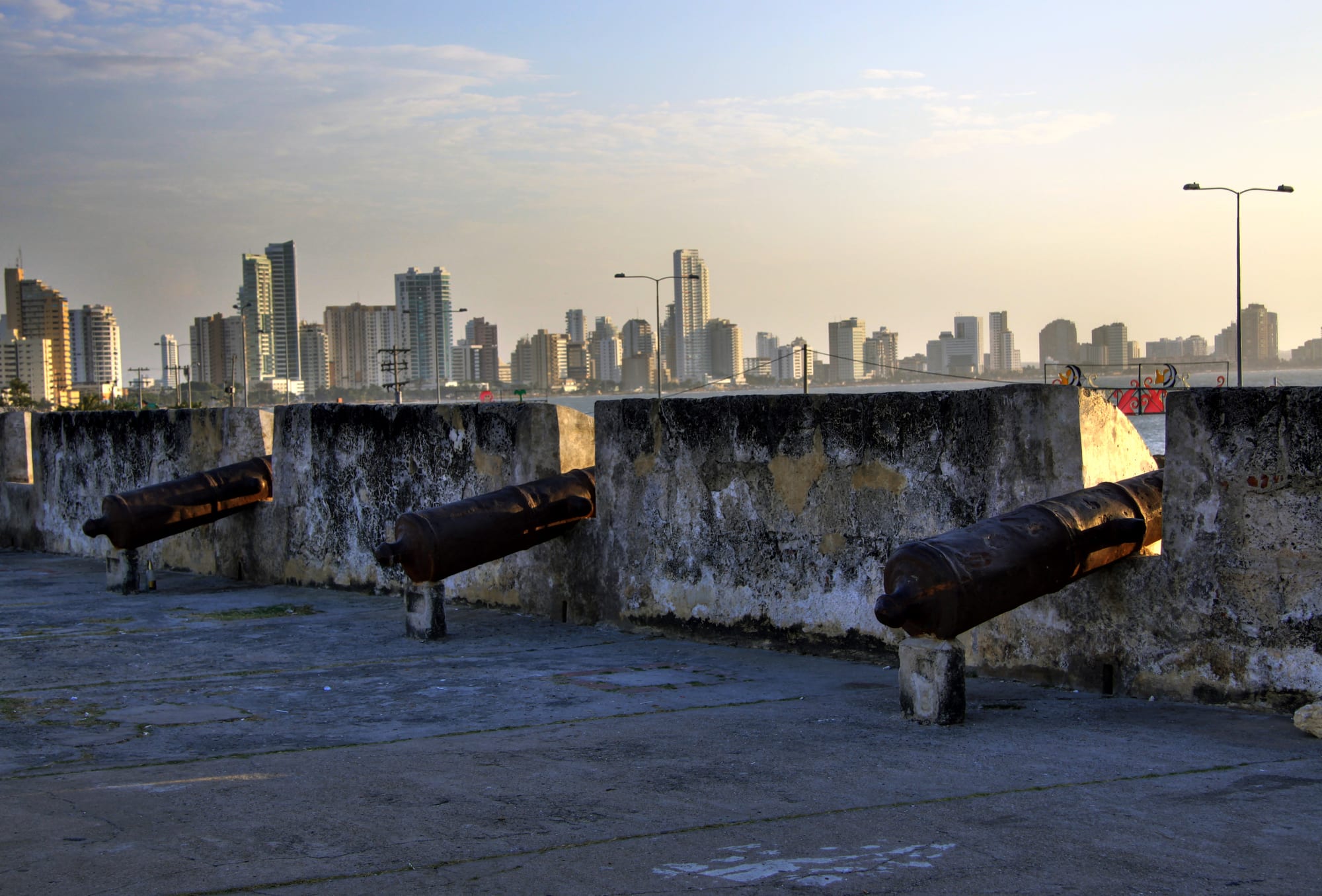
Old iron cannons on the weathered stone walls of Cartagena, with the high-rise towers of Bocagrande across the water

Cartagena & the Caribbean Coast, Colombia

Cartagena

Cannons on the walls of Cartagena's old city, with the towers of Bocagrande beyond. (Martin St-Amant (S23678) / Wikimedia Commons · CC BY-SA 3.0)

The capital of Bolívar department on Colombia's Caribbean coast, founded by the Spanish in 1533 and fortified into the chief port of their empire on the Spanish Main. Its walled colonial city and forts are a UNESCO World Heritage Site; around them spread the beach towers of Bocagrande, a busy industrial port and a large, mostly working-class modern city.

Neighbourhoods

  • El Centro
    • First-time visitors
    • Historic district
    • Architecture

    The heart of the walled city, entered through the Clock Gate from the Plaza de los Coches. The cathedral, the Palace of the Inquisition on Plaza de Bolívar, the church of San Pedro Claver and street after street of balconied colonial houses are here, along with many boutique hotels and fancy restaurants.

    Open in Maps
  • San Diego
    • Historic district
    • Quieter evenings
    • Best for food

    The northern part of the walled city, historically the quarter of traders and the middle class, named after a former convent that now houses a fine-arts university. It has bars and restaurants around its plaza and Las Bóvedas, the old vaults built into the walls, at its edge.

    Open in Maps
  • Getsemaní
    • Nightlife
    • Budget stays
    • Street art

    The old working-class quarter just south of the walled centre, once known for crime and now one of the city's most fashionable districts. Its plazas, murals, small hotels, hostels and bars draw travellers, and the area around Plaza de la Trinidad is the oldest part of Cartagena.

    Open in Maps
  • Bocagrande and Castillogrande
    • Beaches
    • Modern hotels
    • Families

    A peninsula of high-rise hotels and flats south of the old town, between the bay and the Caribbean. Avenida San Martín carries the shops and restaurants, the beaches are of greyish volcanic sand, and Castillogrande, its most expensive zone, is mostly residential.

    Open in Maps

Things to do

The walled city

  • Puerta del Relojlandmark

    The clock-towered main gate and original entrance of the fortified city, opening onto the Plaza de los Coches, once a slave market.

    Open in Maps
  • Cartagena Cathedrallandmark

    The cathedral beside Plaza de Bolívar, built between 1577 and 1612 and badly damaged while still under construction when Francis Drake attacked the city in 1586.

    Open in Maps
  • Iglesia de San Pedro Claverlandmark

    A church built between 1580 and 1654 where the body of the Jesuit Peter Claver, who ministered to enslaved Africans, is kept, with a cloister and museum beside it.

    Open in Maps
  • Church of Santo Domingolandmark

    The Dominican church on the Plaza de Santo Domingo in the walled city, beside its former convent.

    Open in Maps
  • Las Bóvedaslandmark

    A row of 23 vaults built into the walls between the forts of Santa Clara and Santa Catalina between 1789 and 1795, built as dungeons and now housing shops.

    Open in Maps

Forts, museums and viewpoints

  • Castillo San Felipe de Barajaslandmark

    The great fortress on San Lázaro hill, built in 1639 and dominating the approaches by land and sea, where the British assault of April 1741 failed.

    Open in Maps
  • Palace of the Inquisitionmuseum

    The 18th-century seat of the Holy Office on Plaza de Bolívar, completed in 1770, now housing the city's history museum.

    Open in Maps
  • Museo del Oro y Arqueologíamuseum

    A museum of pre-Columbian gold and archaeology on Plaza de Bolívar.

    Open in Maps
  • Convento de la Popaviewpoint

    A 17th-century convent and chapel on top of La Popa hill, about 150 metres high, with a wide view over the city, the bay and the harbour.

    Open in Maps

Beaches and the bay

  • Bocagrande beachbeach

    The long city beach of the Bocagrande peninsula, backed by hotel towers, the easiest place for a swim without leaving town.

    Open in Maps
  • Tierra Bomba Islandbeach

    The island just south of Bocagrande across the Bocagrande channel, reached by boat; in the 17th century a sand bar joined it to the Bocagrande peninsula.

    Open in Maps

Short trips from the city

  • Rosario Islandspark

    A coral archipelago south-west of the city and one of Colombia's national parks, created to protect its coral reefs and visited by boat for its beaches and clear water.

    Open in Maps
  • Isla Barú and Playa Blancabeach

    A former peninsula south of the city, cut off by the Canal del Dique but joined by a bridge, with the white-sand beach of Playa Blanca, reached by boat or by road.

    Open in Maps
  • El Totumo mud volcanoattraction

    A small mud volcano near the coast north-east of the city, where visitors climb in for a mud bath.

    Open in Maps
  • San Basilio de Palenqueattraction

    Described by UNESCO as the first free African town in the Americas, founded by escaped slaves, with its own Palenquero language, proclaimed a Masterpiece of the Oral and Intangible Heritage of Humanity in 2005.

    Open in Maps

Seasonal events

  • Cartagena International Music FestivalJanuary

    A classical music festival with concerts in the Teatro Heredia, old convents and public squares of the walled city.

  • Fiesta de la Candelarialate January to early February

    The feast of the city's patron, Our Lady of La Candelaria, ending with a large procession up La Popa hill on 2 February.

  • Cartagena International Film FestivalMarch

    Founded in 1959, the oldest film festival in Latin America, focused on Colombian and Latin American cinema.

  • Independence festivitiesNovember

    The city's biggest street party marks the declaration of independence of 11 November 1811, with street festivities across the city and neighbourhood beauty contests to choose Miss Independence.

Eat and drink

Long-standing places and food districts in Cartagena. Hours, ratings and directions come from your maps app, always current.

Cartagena classics

  • Fried fish with coconut ricerestaurant

    The typical coastal plate: fried fish, chicken or meat with arroz de coco and patacones, served across the city and on the beaches.

    Open in Maps
  • Plaza San Diego restaurantsneighborhood

    Bars and restaurants around the square in San Diego, the northern part of the walled city, lively at weekends.

    Open in Maps

Food districts and markets

  • Getsemaníneighborhood

    The old working-class quarter outside the walls, with small restaurants, bars and hostels around Plaza de la Trinidad.

    Open in Maps
  • Mercado de Bazurtomarket

    The big market of Cartagena, about ten minutes from the centre.

    Open in Maps
  • Bocagrandeneighborhood

    Beachfront restaurants along the peninsula, with seafood and international menus beside the hotel towers.

    Open in Maps

Experience Cartagena

History

Settlement around Cartagena Bay dates from about 4000 BC, and the Calamarí village stood on the site when Pedro de Heredia founded the Spanish town on 1 June 1533, naming it after Cartagena in Murcia, home of most of his sailors. The new port, between the Magdalena and Sinú rivers, soon became one of the chief harbours of the Spanish Empire: it shipped silver to Spain and imported enslaved Africans under the asiento system, and from 1610 it was a seat of the Inquisition.

Its wealth drew attackers. Francis Drake took the city in 1586, burned some 200 houses and the cathedral and left only when a ransom was paid, and a French expedition forced its surrender in 1697. The Spanish answered with walls around the centre and, from 1631, around Getsemaní, and forts around the bay, crowned by the Castillo San Felipe de Barajas. In 1741 a large British fleet under Admiral Edward Vernon besieged the city; the defenders under Sebastián de Eslava and Blas de Lezo held, and after a failed assault on San Felipe on 20 April Vernon withdrew.

On 11 November 1811 Cartagena declared itself independent of Spain, pushed by the Getsemaní artisan Pedro Romero. Independence brought decline: without its colonial military funds, and later overtaken by the port of Barranquilla, the city lost people and did not regain its pre-1811 population until the 20th century. In 1984 the walled city and fortress were named a UNESCO World Heritage Site, and tourism, the port and the petrochemical industry have driven its growth since.

Culture & Customs

Cartagena's identity is Caribbean and strongly Afro-Colombian. Champeta, a music and dance that originated on the coast in the early 1980s, took shape in Cartagena from chalusonga, a style born in San Basilio de Palenque, the village of escaped slaves inland whose culture UNESCO has recognised. Getsemaní has become a "Ciudad Mural", its walls painted with the stories and characters of the neighbourhood.

The city's Catholic heritage is strong. The Jesuit Peter Claver, who worked among the enslaved Africans landed in the port, is honoured by Colombia's National Day of Human Rights on 9 September and lies in the church that bears his name, and the patron of the city, the Virgin of La Candelaria, is honoured each February with a procession up La Popa hill.

Cartagena is also a city of festivals and spectacle. The film festival, founded in 1959, is the oldest in Latin America; a classical music festival fills the convents and the Teatro Heredia each January; and the national beauty contest, the Concurso Nacional de Belleza, is held in the city, while November's independence celebrations fill the streets. The walled streets have served as a film set for productions from The Mission to Love in the Time of Cholera.

Daily Life

The 2018 census counted about 877,000 people, making Cartagena the fifth-largest city in Colombia and the second on the Caribbean coast after Barranquilla. It is the capital of Bolívar department. Only a small share of the population lives in the walled city, Getsemaní and Bocagrande; most people live in the spreading neighbourhoods inland and along the bay.

The economy rests on three things. The port handles containers, grain and the raw materials of chemical companies along the bay; the petrochemical industry is a major part of the economy; and tourism, from cruise ships to boutique hotels, has grown steadily. Free-trade zones on the mainland and on Barú attract further business.

Days start early to beat the heat and slow in the afternoon. In the evening the old city fills with diners and street musicians, while in the neighbourhoods families sit outside their front doors and music plays from shops and homes. Transcaribe and ordinary buses and taxis carry people to work, and weekends mean the beach at Bocagrande or a boat out to the islands.

Food

Cartagena cooks with the sea, coconut and plantain. The classic plate is fried fish — or chicken or meat — served with arroz de coco, rice cooked with coconut, patacones, flattened slices of fried green plantain, and a little salad. Seafood restaurants in the old city serve ceviche, langoustines, crab and fish, and on the beaches vendors sell seafood and fruit platters.

Street food is fried and filling. The arepa de huevo, a maize arepa fried with an egg sealed inside, is the coastal snack, and carimañolas, cassava fritters stuffed with meat or cheese, and steamed bollos of maize or cassava are sold from carts across the city. Sweets are a local passion: cocadas, baked coconut confections, and other local sweets are sold in the old city.

Mercado de Bazurto, the big market of Cartagena, lies about ten minutes from the centre. To drink there are fresh juices of tropical fruit mixed with water or milk, cold beer and rum, and tinto, sweet black coffee sold by street vendors.

Planning tools

Budget

Cartagena is one of Colombia's more expensive places to stay, above all inside the walls, where boutique hotels in restored colonial houses dominate. Getsemaní is cheaper and Bocagrande has the widest range of hotels. Boat trips to the islands, with their port taxes and park fees, are the other main cost; food from street stalls and set-lunch places remains inexpensive.

Daily Budget Midrange
USD 110–220 (boutique or beach hotel, restaurant dinners, a fort or museum visit, an island boat trip)
Daily Budget Shoestring
USD 40–70 (hostel bed in Getsemaní, street food and set lunches, city buses)

Stay in Getsemaní rather than inside the walls to cut costs, agree taxi and boat prices before setting off, and expect prices to rise sharply over Christmas, New Year and Easter.

Best Time to Visit

December to April is the dry season and the busiest, with the Christmas, New Year and Easter holidays packed. The rains fall mainly between May and November, usually as heavy downpours rather than whole days of rain. Early February brings the Candelaria festivities and March the film festival.

Suggested Number of Days

Two or three days cover the walled city, Getsemaní and the forts at an easy pace in the heat. Allow four to six for island and beach trips by boat, an overnight on the coast, or the mud volcano and Palenque inland.

First Visit
2–3 days
With Surroundings
4–6 days

Transportation

The walled city and Getsemaní are best seen on foot, and taxis are the usual way to reach Bocagrande, the fortress of San Felipe, the airport and the bus terminal. Transcaribe, a bus-rapid-transit system, and many ordinary buses cross the wider city. Boats to the Rosario Islands and Playa Blanca leave from the tourist docks near the old town.

Agree the taxi fare before getting in, as fares are usually agreed rather than metered, and carry pesos — most drivers take cash only.

Airport & Station Connections

Rafael Núñez International Airport, the largest airport on the Caribbean coast by passengers, lies in the Crespo district about 3 km north-east of the old city, around ten minutes' drive away. It has flights to almost all Colombian airports, including Bogotá, and international routes to North, Central and South America. The bus terminal is about 11 km east of the old city; buses from Barranquilla take about two and a half hours, and cruise ships dock at the harbour south-east of the old town.

Walkability

The walled city and Getsemaní are compact and best explored on foot, though the heat and humidity make midday walking tiring. Bocagrande is walkable within itself and a short taxi ride from the walls; the fortress of San Felipe is about a 20-minute walk from the centre. La Popa hill is reached by taxi.

Safety

Colombia is far safer for visitors than its reputation, and the main cities and tourist regions are well travelled, but crime requires attention. In Cartagena the busy tourist districts see pickpocketing, phone snatching and overcharging, beach vendors can be persistent, and drink-spiking is a known risk in nightlife areas. Getsemaní is safe by day but can become seedy at night.

Keep phones and valuables out of sight, agree boat, taxi and vendor prices in advance, never accept drinks from strangers, and swim only where locals do. Check current official travel advice before travelling.

Climate

Tropical wet and dry, hot and windy, with humidity averaging around 80 per cent and daytime highs of about 32°C and nights of about 23°C all year. The dry season runs from December to April, and the rainy season usually from May to November, with September and October the wettest months.

Summer
the rainy season, roughly May–November: daytime highs around 32°C, nights around 23°C, very humid
Winter
December–April is the dry season and the peak season, with daytime highs around 32°C and nights around 23°C

Local Customs

A service charge of about 10 per cent is often added to the bill in better restaurants; elsewhere tipping is mostly rounding up, and taxi drivers are not usually tipped. Costeños see themselves as warmer, louder and more relaxed about time than people from the Andean interior, and the heat sets the pace of the day.

Ask before photographing people. Private tour guides are often tipped if the tour was good, though it is not required.

Common Payment Methods

The currency is the Colombian peso (COP). Most hotels and upscale restaurants take cards, but taxis, buses, markets and street vendors want cash. ATMs are widespread; withdraw inside banks or shopping centres by day.