A crowded sandy beach lined with palm trees, with high-rise apartment towers and a green headland behind a calm sea

Cartagena & the Caribbean Coast, Colombia

Santa Marta

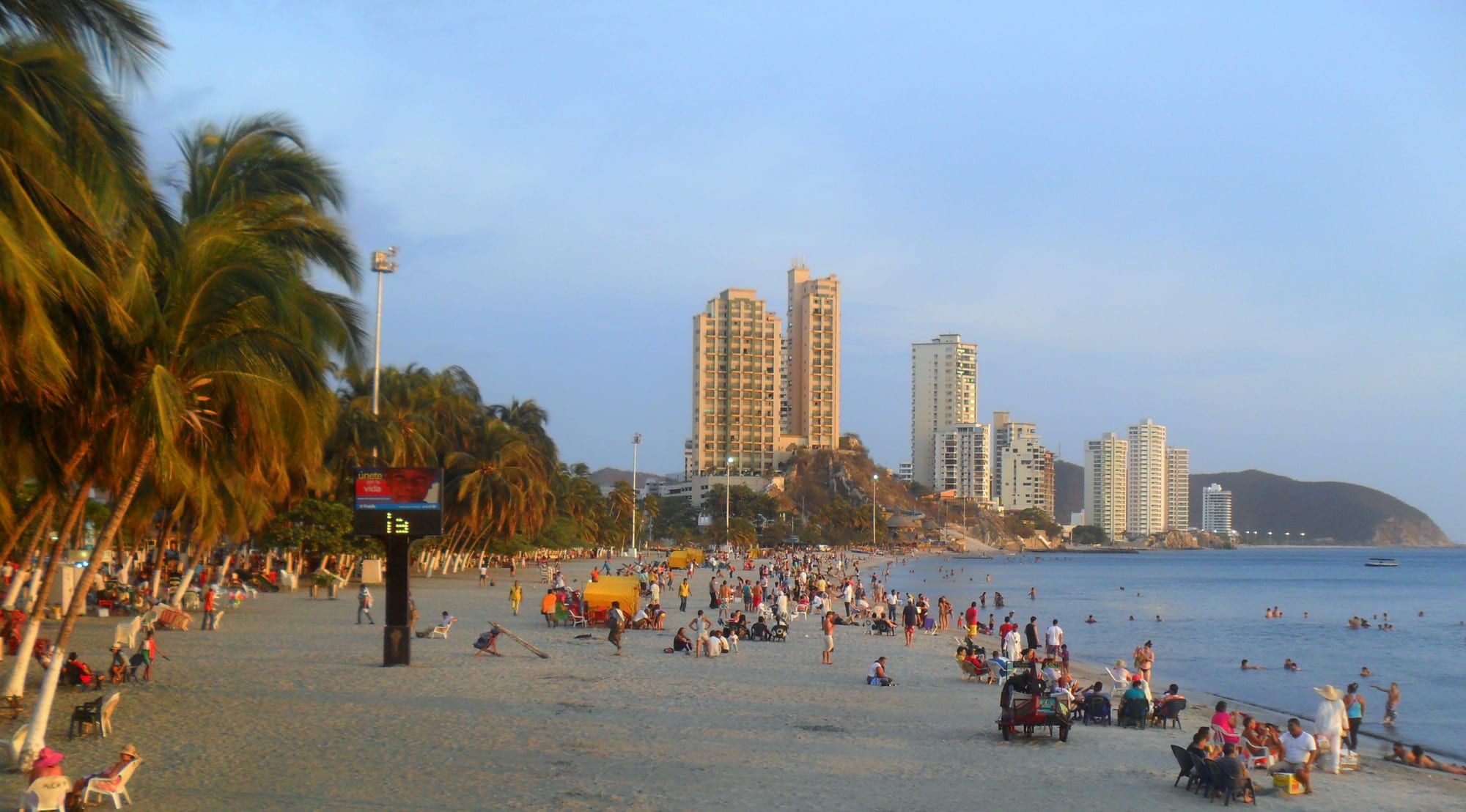
Crowds on the beach at El Rodadero, south of central Santa Marta. (Julieth Gómez Durán / Wikimedia Commons · CC BY 2.0)

A port city on a bay of Colombia's Caribbean coast, founded in 1525 and the country's oldest surviving city, where Simón Bolívar died in 1830. Backed by the Sierra Nevada de Santa Marta, it combines a compact colonial centre, the beach towers of El Rodadero, a coal and banana port and the gateway to Tayrona and the Lost City.

Neighbourhoods

  • Centro Histórico
    • First-time visitors
    • Historic district
    • Best for food

    The old centre behind the city beach and the bayside promenade, with the cathedral, the Casa de la Aduana on Plaza de Bolívar and the Parque de los Novios, renovated in 2008 and now one of the city's main dining areas. Hostels and small hotels are spread through its grid of low colonial and republican buildings.

    Open in Maps
  • El Rodadero
    • Beaches
    • Families
    • Modern hotels

    A beach resort south of the centre, beyond the hill of Ziruma, developed from the 1950s and now lined with apartment towers, hotels and private clubs that cater mostly to wealthy Colombians. The beach is busy, vendors are persistent, and the airport is a short ride further south.

    Open in Maps
  • Taganga
    • Backpackers
    • Diving
    • Sunsets

    A traditional fishing village about 3 km north of the city over the hill, founded on the same day as Santa Marta. It has become a backpacker base full of hostels and diving schools, known for its sunsets and as a base for Tayrona.

    Open in Maps
  • Minca
    • Mountain air
    • Birdwatching
    • Quiet stays

    A small village in the foothills of the Sierra Nevada above the city, on the Minca river, about 15 km from the centre, used as a quieter base with hostels and walks into the forest, including birdwatching at the El Dorado reserve higher up.

    Open in Maps

Things to do

The historic centre

  • Casa de la Aduanamuseum

    The customs house of 1730 on Plaza de Bolívar, where Bolívar's body lay in state in 1830, now the Tayrona Gold Museum with pre-Columbian gold, pottery and a scale model of Ciudad Perdida.

    Open in Maps
  • Cathedral Basilica of Santa Martalandmark

    The 18th-century cathedral in the centre, one of the oldest structures in the city, which held the remains of the founder Rodrigo de Bastidas and, until they were taken to Caracas, of Bolívar.

    Open in Maps
  • Quinta de San Pedro Alejandrinomuseum

    A hacienda built in 1608 in Mamatoco, just outside the centre, where Simón Bolívar died on 17 December 1830.

    Open in Maps
  • El Morroviewpoint

    The rocky islet with a lighthouse off the northern end of the bay, the backdrop to sunsets seen from the city beach.

    Open in Maps

Beaches and the sea

  • Playa El Rodaderobeach

    The city's main resort beach, a busy stretch of sand below apartment towers, with street food and persistent vendors.

    Open in Maps
  • Rodadero Sea Aquarium and Museumattraction

    A public aquarium and maritime museum opened in 1965 in a cove off El Rodadero, reached by boat, with an exhibition on the Tairona and the sea.

    Open in Maps
  • Tagangabeach

    The fishing village over the hill to the north, where the area's scuba-diving operators are gathered.

    Open in Maps

Short trips from the city

  • Tayrona National Natural Parkpark

    One of Colombia's most visited national parks, about 34 km from the city centre, where forest trails lead to beaches below the Sierra Nevada; it was created partly to protect Indigenous spiritual centres and closes for set periods each year.

    Open in Maps
  • Ciudad Perdidatrail

    The terraced city of the Tairona in the Sierra Nevada, also called Teyuna, reached by a guided multi-day trek and a climb of about 1,200 stone steps.

    Open in Maps
  • Mincaattraction

    The foothill village above the city, with guesthouses, forest walks and birdwatching in the foothills of the Sierra Nevada.

    Open in Maps
  • Ciénagaattraction

    The second town of Magdalena, south of the city, where striking banana workers were killed in 1928.

    Open in Maps
  • Aracatacaattraction

    The town where Gabriel García Márquez was born in 1927, the inspiration for the fictional Macondo.

    Open in Maps
  • Palominobeach

    A small beach town on the coast of La Guajira, between the Sierra Nevada and the sea.

    Open in Maps

Eat and drink

Long-standing places and food districts in Santa Marta. Hours, ratings and directions come from your maps app, always current.

Santa Marta classics

  • Shrimp cocktail from the beachfront vendorsneighborhood

    Long-standing street vendors near the city beach sell shrimp cocktails, a local habit.

    Open in Maps
  • Seafood restaurants in El Rodaderoneighborhood

    Simple local restaurants and street food near the resort beach, with set lunches of soup, a main dish and a drink.

    Open in Maps

Food districts and markets

  • Parque de los Noviosneighborhood

    Since its renovation in 2008 one of the city's main dining areas, a square in the historic centre surrounded by restaurants and bars.

    Open in Maps
  • Night street food in the centreneighborhood

    In the evenings street vendors in the centre sell meat skewers, grilled sausages, rice in coconut milk and fried snacks.

    Open in Maps

Experience Santa Marta

History

The Tairona built stone-paved towns with terraces and water channels in the Sierra Nevada long before Europeans arrived, and their goldwork and pottery are still being recovered. Rodrigo de Bastidas, who had sailed this coast with Juan de la Cosa around 1501, founded Santa Marta on the bay by tradition on 29 July 1525, the feast of Saint Martha, making it one of the first Spanish settlements in Colombia and its oldest surviving city. Its cathedral and customs house date from the 18th century.

On 17 December 1830 Simón Bolívar, ill with tuberculosis, died at the Quinta de San Pedro Alejandrino just outside town. His body lay in state in the Casa de la Aduana and was buried in the cathedral before being moved to Caracas. Between about 1840 and 1870 the city was the main import and export port of the new republic, but an earthquake in 1834, cholera in 1849 and floods cut its population.

The 20th century brought the banana boom of the United Fruit Company in the plains to the south, which ended in tragedy in 1928, when striking banana, railway and port workers were killed by the army in the square at Ciénaga. Tourism began in the 1950s with hotels on the beach at El Rodadero; the University of Magdalena opened in 1958 and Tayrona park was created in 1964. From the early 2000s Santa Marta became one of the country's main coal ports, and a new airport terminal opened in 2017, the year the city hosted the Bolivarian Games.

Culture & Customs

Santa Marta's identity is bound up with the sea and the mountains behind it. The city's white and blue flag stands for peace and for the sky, the sea and the snow-capped Sierra Nevada, which rises to about 5,700 metres within 42 km of the coast. The Kogi, Arhuaco, Wiwa and Kankuamo, descendants of the Tairona, still live in the Sierra and regard it as the heart of the world; the national park was created partly to protect their spiritual centres, and it closes for set periods each year to let the land rest.

The city is proud of its Bolívar story — the Quinta, the customs house and an equestrian statue of the Liberator — and of its founding, marked by a statue of Bastidas on the bayside promenade. Two of the best-known modern Colombians come from here: the vallenato singer Carlos Vives and the footballer Carlos Valderrama.

Life is costeño in tone: relaxed, informal and lived outdoors, with music from shopfronts and families on the beach at weekends. Sunset on the city beach, with the islet of El Morro and its lighthouse in the bay, is a daily gathering, and the evening is the time for street food and walks along the promenade. Taganga adds a cosmopolitan layer of backpackers and diving schools.

Daily Life

The 2018 census counted about 500,000 people in the district of Santa Marta, the capital of Magdalena department and one of the four largest cities of the Caribbean coast. The economy rests mainly on tourism, followed by trade, the port, fishing and farming. The deep natural harbour ships coal — by 2005 more than half of Colombia's coal exports — and the main farm products of the district are bananas, coffee, mango, citrus, cocoa and cassava.

The city stretches along the coast in distinct parts. The historic centre, with its commercial streets and plazas, sits around the bay between the port and the Manzanares river; El Rodadero, to the south, is a district of apartment towers built for holidaymakers from the interior; and the newer residential neighbourhoods spread inland towards the hills. Taganga to the north and Minca in the foothills are separate villages within the district, both reshaped by tourism.

Days start early and slow down in the afternoon heat, and the beaches fill at weekends and in the holiday seasons, when Colombian holidaymakers crowd El Rodadero. Students of the University of Magdalena give parts of the city a younger feel. Buses without fixed stops and taxis carry most journeys, and the coast road east to Tayrona and La Guajira is busy with shared vans.

Food

The cooking of Santa Marta draws on the sea, the plantain and the maize of the coast. Cayeye, a speciality of Magdalena, is made from mashed green bananas. Green plantain is also fried into tajadas and patacones. Fried fish with coconut rice is the classic beach lunch, and fish soups and sancocho, a thick stew of meat or fish with root vegetables, are everyday dishes.

Maize flour makes arepas, empanadas and bollos, and at night street vendors in the centre sell meat skewers, sausages, rice in coconut milk and fried snacks. A local habit is the shrimp cocktail, sold by vendors near the city beach who have worked the same corner for decades. The Parque de los Novios has become the centre of the restaurant scene, with everything from Colombian dishes to international menus.

Drinks follow the coastal pattern: fresh fruit juices made with water or milk, cold beer and rum, and coffee. Hot chocolate and tinto, sweet black coffee, are sold everywhere.

Planning tools

Budget

Santa Marta is considerably cheaper than Cartagena, with plenty of hostels in the centre, Taganga and Minca and set-lunch places charging local prices. The real costs are excursions: Tayrona entry fees, boats along the coast and, above all, the guided Lost City trek, which is sold as a package including food and camps.

Daily Budget Midrange
USD 100–200 (hotel in the centre or El Rodadero, restaurant dinners, a Tayrona day trip or guided tour)
Daily Budget Shoestring
USD 35–60 (hostel bed, set lunches and street food, city buses)

Book the Lost City trek through a licensed operator, and check Tayrona's closure dates before planning a visit.

Best Time to Visit

December to April is the dry and busiest season, packed over Christmas, New Year and Easter. The wet season runs from May to November, with June, July, September and October the rainiest months. Tayrona closes for set periods each year — as of 2024 for the first half of February, the first half of June and from late October to early November — so check the dates before planning.

Suggested Number of Days

Two or three days are enough for the city itself and its beaches. The surroundings change the number: the national park, the hill villages and the coast towards La Guajira each add days, and the Lost City trek alone takes four to five.

First Visit
2–3 days
With Surroundings
6–8 days

Transportation

City buses stop anywhere along their routes, as there are no fixed stops; the fare is paid to the driver. Buses and minibuses link the centre with Taganga, El Rodadero and the airport, and taxis fill the gaps. Shared vans and buses run east along the coast road towards Tayrona and Palomino.

Agree taxi fares before setting off, and flag buses down by hand — the route is written on a sign in the front window.

Airport & Station Connections

Simón Bolívar International Airport lies on the coast about 14 km south of the city centre, close to El Rodadero, with direct flights from Bogotá, Medellín and other cities; its runway is the shortest of any international airport in Colombia. A public bus runs from outside the terminal to El Rodadero and the centre. Long-distance buses use the intercity terminal, and Barranquilla is roughly two hours away by road.

Walkability

The historic centre is compact and flat, and its plazas, the cathedral and the seafront promenade are all within a few minutes' walk of each other, though the midday heat is hard work. El Rodadero and Taganga are walkable in themselves but are reached from the centre by bus or taxi.

Safety

Colombia is far safer for visitors than its reputation, and the main cities and tourist regions are well travelled, but crime requires attention. In Santa Marta the practical risks are pickpocketing and phone theft in busy areas, overcharging, persistent beach vendors and drink-spiking in nightlife. The remoter corners of the Sierra Nevada have armed groups linked to drug trafficking, and heat, sun and sea currents are everyday hazards.

Use licensed guides for the Lost City and the Sierra, keep valuables out of sight on beaches and in the centre at night, and swim only where locals do. Check current official travel advice before travelling.

Climate

Tropical savanna bordering on semi-arid, with fairly uniform temperatures all year: the average is about 28°C. The dry season from December to April is breezy; the wet season runs from May to November, with June, July, September and October the rainiest months. The Sierra Nevada rises from coastal heat to cooler hill villages and snow peaks.

Summer
the wetter part of the year, roughly May–November: average highs around 33°C, humid, with afternoon downpours
Winter
December–April is dry and breezy, nights around 24°C, and the peak season

Local Customs

A service charge of about 10 per cent is often added in better restaurants; elsewhere tipping is mostly rounding up, and taxi drivers are not usually tipped. The Kogi, Arhuaco and other peoples of the Sierra regard its mountains and sites as sacred; Tayrona park was created partly to protect their spiritual centres and closes at set times of year.

Ask before photographing Indigenous people met on the trek or in the Sierra, and respect the rules at sacred sites. Private guides are often tipped if the trip was good.

Common Payment Methods

The currency is the Colombian peso (COP). Cards are taken in hotels, supermarkets and better restaurants, but buses, street vendors, beach sellers and village guesthouses want cash. There are ATMs in the centre, El Rodadero and at the airport; carry enough cash for Tayrona, Minca and the trek.