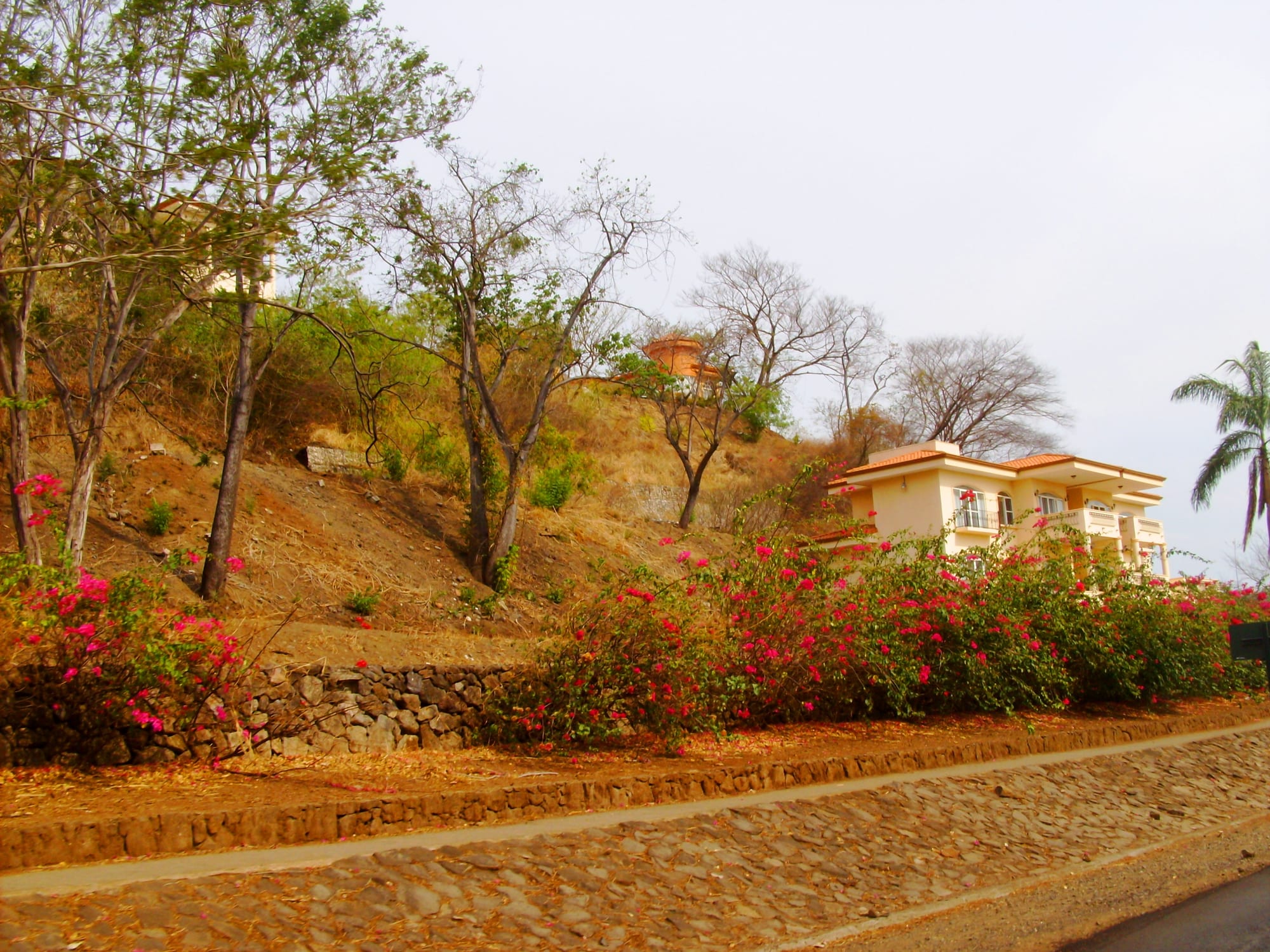
A cobbled roadside verge lined with pink bougainvillea below a dry, tree-covered hillside and a cream-coloured villa

Guanacaste & the Nicoya Peninsula, Costa Rica

Playas del Coco

Bougainvillea and hillside houses on a road in El Coco, Guanacaste. (Peloy (Allan H.M.) / Wikimedia Commons · CC BY-SA 3.0)

The largest community on the Gulf of Papagayo, a beach town in Guanacaste's Carrillo canton a short drive from Liberia and its airport. Founded by pearl divers and fishermen, it was a holiday spot for Costa Ricans long before foreign visitors arrived in the 1990s, and is now a base for dive boats, sailing trips, sport fishing and the resort bays nearby.

Neighbourhoods

  • Downtown Coco and the seafront
    • First-time visitors
    • Nightlife
    • Best for food

    The flat centre behind the beach, where the main street runs down to the sand and the seafront promenade. Restaurants, bars, supermarkets, banks, dive shops and tour offices are here, and the town is at its liveliest after dark.

    Open in Maps
  • The hillside residences
    • Quiet and residential
    • Views

    The small hills around the town, where condominiums and holiday homes stand above the low-lying streets where local workers live.

    Open in Maps
  • Ocotal
    • Beaches
    • Quiet stays
    • Diving

    A small beach community close to Coco and within the same district, quieter than the town and an easy drive from its restaurants.

    Open in Maps
  • Playa Hermosa
    • Beaches
    • Families

    A separate beach village on the Gulf of Papagayo, a short drive from Coco and in the same district, with dive boats and a more relaxed pace than the town.

    Open in Maps

Things to do

The bay and the beaches

  • Coco beach and the Amor de Temporada promenadebeach

    The town beach, with a seafront walk of about 420 metres built after illegal buildings were cleared from the public zone, with benches, native trees, lighting and sports courts; it is named after a popular Costa Rican song by a Guanacaste composer.

    Open in Maps
  • Gulf of Papagayoviewpoint

    The large Pacific bay off north-western Guanacaste, part of a national tourism project since 1972, with Ocotal, Coco, Playa Hermosa and Playa Panamá among its best-known beaches.

    Open in Maps
  • Ocotal and Playa Hermosabeach

    The two nearest neighbouring beaches, reached by car in five to ten minutes.

    Open in Maps

On the water

  • Dive and snorkel tripsattraction

    Several dive centres in the town run boat trips to dive sites in the gulf and along the coast.

    Open in Maps
  • Sailing and sport fishingattraction

    Sailing tours and deep-sea fishing trips leave from the beach; captains are found along the sand in the late afternoon.

    Open in Maps
  • Surf trips to Witch's Rock and Ollie's Pointattraction

    Boat trips from Coco to two world-famous surf breaks up the coast.

    Open in Maps

Short trips from the town

  • Papagayo Peninsulabeach

    A volcanic peninsula on the gulf with dozens of beaches, luxury homes and resort developments; all Costa Rican beaches are public, so its sands can be reached by visitors.

    Open in Maps
  • Santa Rosa National Parkpark

    A national park created in 1966 that protects dry forest and the La Casona hacienda, site of the 1856 battle against William Walker's filibusters.

    Open in Maps

Eat and drink

Long-standing places and food districts in Playas del Coco. Hours, ratings and directions come from your maps app, always current.

Food districts and markets

  • Downtown Coco restaurantsneighborhood

    The centre has a wide choice of restaurants and bars, from seafood to international menus aimed at visitors and foreign residents.

    Open in Maps
  • Sodas of Coconeighborhood

    The small diners serving typical Costa Rican food that were the town's first tourist restaurants, still found on the side streets.

    Open in Maps
  • Supermarkets of the centremarket

    Well-stocked supermarkets in the centre supply the many visitors staying in self-catering condominiums.

    Open in Maps

Experience Playas del Coco

History

El Coco began about 150 years ago, when its first settlers came to dive for pearls and to fish from small boats; logging was another early livelihood. It was already a holiday place by the 1930s, when Costa Rican families travelled to the Guanacaste coast on horseback, a time remembered in a song by the Guanacaste composer Héctor Zúñiga Rovira. A wider expansion of tourism came from the 1960s, when local people offered simple services — cabins, campsites and sodas serving typical food.

The hotelier Claudio Rojas, who moved to the coast in the late 1950s, built one of the first tourist complexes, which grew to include cabins, a pier and a restaurant, and other local promoters helped the growth of the government's Gulf of Papagayo tourism project, which began in 1972. Foreign visitors and residents began arriving in numbers in the 1990s, and from 1995 the airport near Liberia gave the town a strong push. Between 2006 and 2007 property companies accelerated the building of residential developments and condominiums on the hills around the bay.

In 2008 the municipality of Carrillo began clearing illegal buildings from the 50-metre public zone along the beach, and from 2011 a project to give the town a new face built a seafront promenade named Amor de Temporada. Streets have since been paved, pavements built, and policing and beach cleaning improved through a partnership of residents, volunteers, investors and the local council.

Culture & Customs

Playas del Coco has long been a place where Costa Ricans go on holiday as well as foreigners. It is the fastest-growing tourist area on the Gulf of Papagayo and one of the most popular holiday destinations for Costa Rican and foreign visitors alike. It began as a small resort for Costa Ricans and was transformed by the growth of international tourism.

The sea is central to local identity. The celebration of the Virgen del Mar, a story of local sailors lost at sea, was born in Playas del Coco, although it is now most closely associated with Puntarenas, which adopted it. The town's seafront promenade takes its name, Amor de Temporada, from a popular traditional Costa Rican song by the Guanacaste composer Héctor Zúñiga.

Today the town mixes Guanacaste ways with an international beach culture. English is almost the dominant language in the tourist areas, and the bars, casinos and nightclubs of the centre stay busy after dark.

Daily Life

Playas del Coco is a community in the district of Sardinal, in the canton of Carrillo; no separate population figure is published for the town itself. Sardinal district as a whole had about 14,900 people at the 2011 census and an estimated 21,100 in 2022; its villages include Coco, Ocotal, Playa Hermosa and many inland settlements.

Tourism is the main activity, chiefly adventure tourism and hotels, along with residential tourism: condominiums and houses occupied all year or for a large part of it by foreign owners. The town has a wide choice of hotels and restaurants, supermarkets, banks, a harbour master's office, medical centres and a post office. The geography divides it clearly: condominiums and holiday homes on the small hills, and local workers' homes in the low-lying parts of town.

The day follows the sea and the heat. Dive and fishing boats leave early, the beach and the promenade fill in the late afternoon, and the town comes alive after dark, when locals and visitors gather along the seafront and the main street.

Food

The sea sets the menu. Fresh fish is cooked whole and fried with patacones, the flattened, twice-fried plantain slices, or cut into ceviche, raw fish marinated in lime with onion and coriander, and seafood fills the menus of the town's restaurants. Seafood places sit alongside international restaurants aimed at the many foreign residents and visitors, and well-stocked supermarkets supply those cooking for themselves in rented condominiums.

The town's first restaurants were its sodas, the small diners serving typical Costa Rican food, and they still feed local workers: gallo pinto, rice and beans fried together, at breakfast, and the casado at lunch, a plate of rice, beans, salad, fried plantain and a piece of meat or fish.

Guanacaste's maize traditions reach the coast too, in hand-made tortillas, tamales and rosquillas, crunchy rings of corn dough. Frescos, drinks of fresh fruit blended with water or milk, are found at sodas and restaurants alike.

Planning tools

Budget

Playas del Coco is cheaper than the resorts of the Papagayo Peninsula and Tamarindo, with simple cabinas and sodas alongside condominiums and hotels, but prices for diving, sailing and fishing trips are aimed at foreign visitors. Self-catering in a rented condominium keeps costs down for longer stays, and prices peak over Christmas and Easter.

Daily Budget Midrange
USD 130–250 (hotel or condominium, restaurant meals, a dive or sailing trip, taxis)
Daily Budget Shoestring
USD 50–85 (cabina or hostel, soda meals, local buses)

Ask on the beach in the late afternoon to compare fishing and boat trips for the next day.

Best Time to Visit

The dry season from about November to May is sunny and busy; the wet season from late May to early November brings intermittent rain, with October the wettest month. The dry season is the classic beach season across Guanacaste, with strong winds early in the year, while the green months are quieter and cheaper.

Suggested Number of Days

Two or three days suit a beach stay with a boat or dive trip. Five or six allow time for neighbouring bays, surf trips and the national parks inland. Divers and anglers often stay longer, and the town makes an easy first or last stop near the airport.

First Visit
2–3 days
With Surroundings
5–6 days

Transportation

The centre is small and walkable, and taxis cover Ocotal and Playa Hermosa in minutes. Buses run between Coco and the nearby beaches, though they are often crowded. A hire car is the easiest way to reach the Papagayo Peninsula and the parks inland.

Use the buses for the nearby beaches only when not in a hurry, and keep valuables out of sight in a parked car.

Airport & Station Connections

Daniel Oduber Quirós International Airport near Liberia is about half an hour away by taxi, which makes Coco one of the most convenient beach towns for arriving visitors. Buses run from Liberia, hourly in the morning and less often later, taking around an hour, and direct buses from San José take about five hours.

Walkability

Downtown Coco is flat and compact, with the main street, the beach and the promenade within a few minutes of each other on foot. The hillside condominiums involve steep walks, and the neighbouring beaches are best reached by car or taxi.

Safety

Costa Rica still compares well with its Central American neighbours, and crime that reaches visitors is usually petty theft or the occasional armed robbery — break-ins to parked rental cars, bag-snatching on beaches, and pickpocketing in San José. Guanacaste is generally calm, but its beach towns share the country's problem of theft: break-ins to rental cars at beaches, bags taken from the sand and burglaries of holiday rentals. Drug-related violence has risen in parts of the province in recent years, mostly among local criminal groups. Rip currents are strong on many open beaches, and crocodiles live in river mouths.

Leave nothing in a parked car or on the sand, lock holiday rentals carefully, and choose licensed dive and boat operators. Check current official travel advice before travelling.

Climate

Playas del Coco is warm all year, with an average annual temperature of about 27°C. It is dry from about November to May and humid from late May to early November, with intermittent rain and October the wettest month. Across Guanacaste, the Papagayo winds blow hard from the north-east early in the dry season.

Summer
dry season (November–May): hot, sunny and dry; across Guanacaste, around 30–35°C by day
Winter
wet season (late May–early November): humid, with intermittent rain; across Guanacaste, around 28–32°C

Local Customs

English is almost the dominant language in the tourist areas, but Coco remains a Guanacaste town where Spanish greetings are appreciated and locals and visitors share the seafront in the evenings. It is also a popular holiday spot for Costa Ricans. Beachwear belongs on the sand rather than in shops and banks.

All beaches in Costa Rica are public, including those in front of resorts; respect private property behind the beach and take rubbish home.

Common Payment Methods

The currency is the Costa Rican colón, and US dollars are accepted for most larger purchases, with change often in colones. Cards are taken in hotels, restaurants, dive shops and supermarkets, and the town has banks with cash machines; carry colones for buses, sodas and small shops.