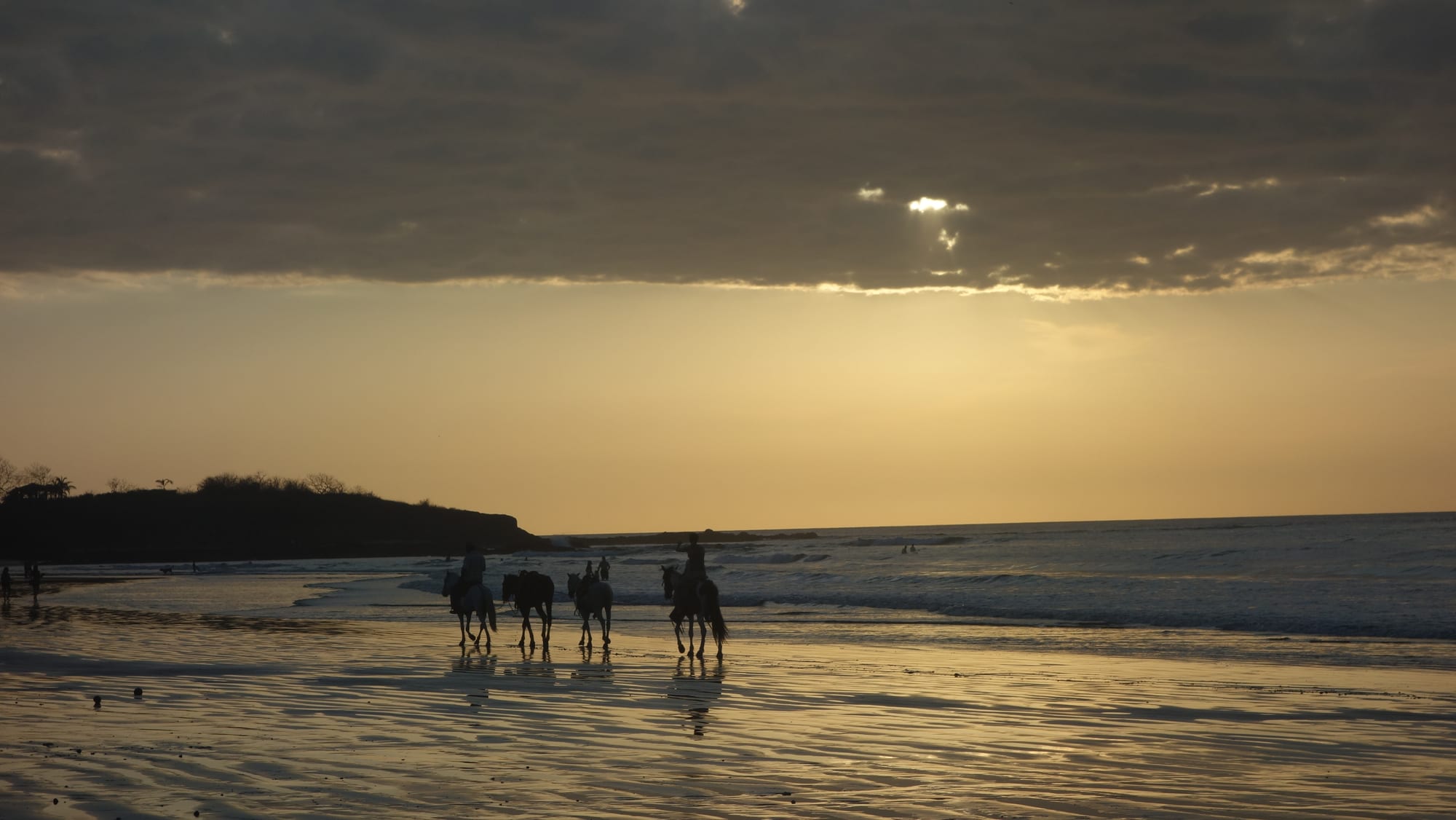
Riders on horseback silhouetted on the wet sand of Tamarindo beach at sunset, below a heavy band of cloud

Guanacaste & the Nicoya Peninsula, Costa Rica

Tamarindo

Horse riders on the beach at Tamarindo at sunset. (Rômulo Gama Ferreira from Vitória-ES / Wikimedia Commons · CC BY 2.0)

The largest developed beach town in Guanacaste, on a wide bay on the Pacific side of the Nicoya Peninsula. A small fishing village until the 1990s, it grew on surfing, a famous surf film and international flights into Liberia, and is now a busy resort of surf schools, restaurants and bars beside the turtle beaches of Las Baulas.

Neighbourhoods

  • Central Tamarindo
    • First-time visitors
    • Nightlife
    • Beaches

    The main strip behind Playa Tamarindo, packed with surf shops, restaurants, bars, hostels and tour desks. Most of the beachfront restaurants face the sand and the sunset, and the night market and food trucks are here too. It is lively, walkable and the busiest part of town.

    Open in Maps
  • Playa Langosta
    • Quiet and residential
    • Beaches

    The quieter beach just south of the town centre, reached by the road that turns right at the junction east of the centre. Holiday homes and hotels sit back from a beach of sand and rock pools, inside the Las Baulas marine park.

    Open in Maps
  • Playa Grande
    • Surfing
    • Nature

    A small beach community across the estuary to the north, inside Las Baulas National Park, with a long beach of consistent waves. It is reached by a short water-taxi crossing or a drive of about 17 km round through Villarreal, and stays much quieter than Tamarindo.

    Open in Maps
  • Villarreal
    • Local life
    • Budget stays

    The inland town a short drive east where many local families live, with the area's schools, football pitches, church, hardware shops and a small Friday-morning produce market at the corner of the football field.

    Open in Maps

Things to do

Beaches and surf

  • Playa Tamarindobeach

    The town's long main beach on Tamarindo Bay, where most of the surf schools work; the bay has waves for beginners and advanced surfers.

    Open in Maps
  • Playa Grandebeach

    A beach across the estuary, known for its consistent surf breaks, and part of the Las Baulas park since 1990.

    Open in Maps
  • Playa Langostabeach

    A quieter beach of sand and dark rock just south of the town, also within the marine park.

    Open in Maps

Nature and the water

  • Las Baulas Marine National Parkpark

    A national park and Ramsar site covering four beaches, the Tamarindo estuary and its mangroves; it holds the largest nesting colony of leatherback turtles on the Pacific coast of the Americas, with nesting between about October and May.

    Open in Maps
  • Tamarindo estuarypark

    The mangrove-lined mouth of the Matapalo River between Tamarindo and Playa Grande, a wetland of international importance explored on boat tours.

    Open in Maps
  • Catalina Islandsattraction

    A group of rocky islands off the coast that is one of the area's most popular scuba-diving spots, with a wide variety of sea life.

    Open in Maps

Short trips from the town

  • Playa Flamingobeach

    A popular white-sand beach along the coast, with lagoons, coves and dive shops that run trips to the Catalina Islands.

    Open in Maps
  • Playa Negrabeach

    A beach south of Tamarindo near the village of Los Pargos, whose surf break became known worldwide after it appeared in the film The Endless Summer II.

    Open in Maps

Eat and drink

Long-standing places and food districts in Tamarindo. Hours, ratings and directions come from your maps app, always current.

Food districts and markets

  • Tamarindo Saturday farmers' marketmarket

    A fair-sized market held on Saturday mornings near the start of the road to Langosta, selling fruit, vegetables, prepared food and crafts.

    Open in Maps
  • Tamarindo night market and food trucksmarket

    An evening market and a food-truck park in the town, part of Tamarindo's night-time scene.

    Open in Maps
  • Beachfront restaurantsneighborhood

    Restaurants along the beach serve fresh fish, ceviche and international food with a view of the sunset.

    Open in Maps
  • Sodas in Villarrealneighborhood

    The small local diners of the inland town, serving casados and other everyday Costa Rican dishes.

    Open in Maps

Experience Tamarindo

History

Tamarindo began as a small village of a few families who lived largely from fishing. Its change began in the mid-1980s, when a businessman from Texas bought land by the beach and started building cabins, and the surfer Robert August, star of the 1966 film The Endless Summer, later settled in the town. The opening scenes of The Endless Summer II, released in 1994, were filmed here, and the film is generally credited with starting the tourism boom. In 1997 the area had only about four places to stay and a couple of places to eat.

Tamarindo was made a district of the Santa Cruz canton on 27 November 1995, carved from the north of the district of Veintisiete de Abril because its population had grown. Another turning point came in 2003, when the airport at Liberia began handling international flights and put the town within a few hours of Miami. Hotels, surf schools and holiday homes followed.

Growth brought problems. In 2004 the beach lost its Blue Flag, the national award for clean beaches, because of pollution; it regained the flag in 2006 but lost it again a year later, when tests found high levels of sewage contamination in parts of the water. The town received a clean bill of health from the government in 2008, and after years of work is reported to have regained the Blue Flag in 2018. The estuary beside the town was declared a wetland of international importance in 1993 and is now part of the Las Baulas marine park.

Culture & Customs

Surfing made Tamarindo and still shapes it. Four surf spots are identified in Tamarindo Bay, from gentle beach waves for beginners to faster breaks for experienced surfers, and the town hosts national competitions sponsored by the Costa Rican Surfing Federation, including rounds of the national circuit. Boat trips to the well-known waves further north along the Guanacaste coast also leave from here, and running races and triathlons have been held in the town as well.

The other culture is the night. Tamarindo has a busy strip of bars and clubs, a night market, a food-truck park, a skate park and regular fire shows on the beach at night. It has become a stage for electronic dance music, including the Ocaso Underground Music Festival; The BPM Festival was held here from 2020, but its permits for Tamarindo were not renewed for January 2025. The town also has a small gay bar.

The town is international in character. Many foreign residents live here, and surfers, digital nomads and long-stay visitors give the streets a mix of languages; a high share of Costa Ricans in the town speak English as a second language. Guanacaste's own traditions — the sabanero cowboy, the marimba, the fiestas of Santa Cruz a short drive inland — sit alongside this newer beach culture, and the contrast between the resort and the inland villages is a real one.

Daily Life

Tamarindo district had about 6,400 people at the 2011 census, and an estimate for 2022 put it at about 7,100; the number in town rises sharply in the high season with visitors. Besides Tamarindo itself the district includes Villarreal, Santa Rosa, Hernández, San José de Pinilla and other villages. The town is small but densely built for a coastal place, with a degree of development unusual in a village that lived from fishing only a generation ago.

Tourism is the economy: hotels and holiday rentals, restaurants, bars, surf schools, tour and fishing boats, car-hire offices, spas, golf at the resort communities nearby and a great deal of building work. Many workers live inland in Villarreal, which has the area's schools, football pitches, church, police station and petrol station, and the farmers' markets in both places supply local kitchens.

The day starts early, with surfers in the water at dawn and work done before the midday heat, and ends with crowds on the beach for sunset. The questions the town argues about are those of fast growth: water quality and sewage, the pressure of building on the coast, and keeping the beach clean enough to hold its Blue Flag.

Food

Tamarindo eats from the sea. Fresh fish is the staple of the beachfront restaurants: ceviche of sea bass or snapper marinated in lime with onion and coriander, whole fried fish with patacones, the flattened, twice-fried plantain slices, and prawns and lobster on more expensive menus.

Away from the strip, the sodas — small family diners — serve the Costa Rican everyday: gallo pinto, rice and beans fried together, at breakfast, and at lunch the casado, a plate of rice, beans, salad, fried plantain and a piece of meat or fish. Guanacaste's maize cooking turns up in tortillas, tamales and rosquillas, crunchy rings of corn dough and cheese eaten with coffee.

Because of its foreign residents, Tamarindo also has a wide range of international food, much of it found at the night market and the food trucks. The Saturday farmers' market sells tropical fruit — mangoes, papaya, pineapple — along with bread, prepared food and crafts. Frescos, fruit blended with water or milk, are the everyday drink.

Planning tools

Budget

Prices in Tamarindo are high, many of them aimed at foreign visitors and comparable to those in the United States or Europe. Rooms cost most in the high season. Hostels, sodas and the Saturday market keep a cheaper stay possible, and Villarreal and the inland towns are less expensive than the beach strip.

Daily Budget Midrange
USD 140–270 (beach hotel, restaurant meals, a surf lesson or estuary tour, taxis or a hire car)
Daily Budget Shoestring
USD 50–85 (hostel dorm, soda meals and market food, local buses)

Eat a street or two back from the beach to save money, and compare surf-lesson and tour prices along the main strip before booking.

Best Time to Visit

The dry season from December to April is the sunniest and busiest time, with the highest prices. The wet season from May to November is greener, quieter and cheaper, with rain mostly in the afternoons and evenings and good surf on the Pacific swells; September and October are the wettest months. Leatherback nesting on the park's beaches falls between about October and May.

Suggested Number of Days

Three or four days suit a first beach-and-surf stay. Six or seven allow time for neighbouring beaches, diving and a trip inland. Surfers often stay much longer, and the wet-season roads can slow travel along the peninsula.

First Visit
3–4 days
With Surroundings
6–7 days

Transportation

The centre is small enough to walk, and taxis and hire cars cover the rest. A water taxi crosses the estuary to Playa Grande. Buses run to Santa Cruz, and to Liberia every couple of hours, stopping often along the way. A hire car is the easiest way to reach other beaches on the coast.

Ask locally before driving unpaved coastal roads in the rains, and avoid driving them at night.

Airport & Station Connections

Liberia's international airport is the closest, about an hour away by road, and many visitors arrive by shuttle, taxi or hire car from there. Tamarindo also has an airstrip for small domestic flights. Daily buses run from San José; by road the drive takes about three and a half to six hours, depending on traffic.

Walkability

Central Tamarindo is compact, and the main strip, the beach and most restaurants are close together on foot. Walking along the sand at low tide is the pleasant way to move along the bay. Langosta is a longer walk south, Playa Grande needs the water taxi or a drive, and the heat makes the middle of the day hard going.

Safety

Costa Rica still compares well with its Central American neighbours, and crime that reaches visitors is usually petty theft or the occasional armed robbery — break-ins to parked rental cars, bag-snatching on beaches, and pickpocketing in San José. Guanacaste is generally calm, but its beach towns share the country's problem of theft: break-ins to rental cars at beaches, bags taken from the sand and burglaries of holiday rentals. Rip currents are strong on many open beaches, and crocodiles live in river mouths.

Leave nothing in a parked car or unattended on the sand, swim away from river mouths and only where locals do, and use taxis late at night. Check current official travel advice before travelling.

Climate

Tamarindo has two seasons: wet, generally from May to November, and dry, from December to April. Across Guanacaste, the driest and hottest part of Costa Rica, the dry season is almost rainless, with strong winds early in the year, while the wet months bring afternoon storms that peak in September and October.

Summer
dry season (December–April): across Guanacaste, sunny and hot, around 30–35°C by day
Winter
green season (May–November): across Guanacaste, humid, around 28–32°C, with afternoon storms

Local Customs

Tamarindo is relaxed and informal, and English is widely spoken because of the many foreign residents, though a greeting in Spanish is appreciated. Swimwear belongs on the beach, and more covered clothing is usual in shops and restaurants.

Keep well away from nesting turtles and follow the park rangers' rules on the beaches of Las Baulas; a licence from INCOPESCA is required for sport fishing.

Common Payment Methods

The currency is the Costa Rican colón, and US dollars are accepted almost everywhere in Tamarindo, with change often given in colones. Cards are widely taken in hotels, restaurants and shops, and the town has banks with cash machines. Carry some colones for buses, sodas and the markets.