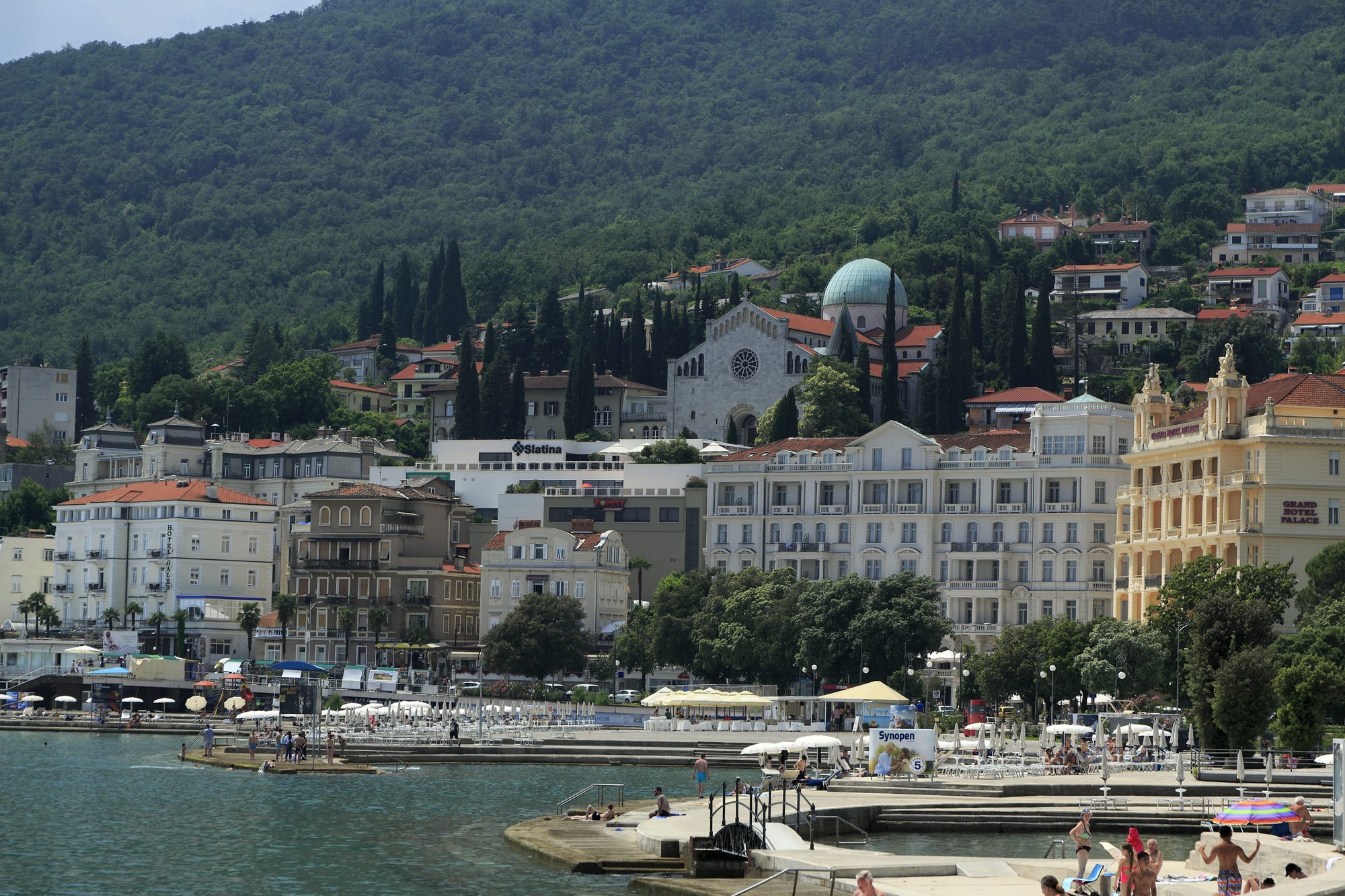
Opatija's seafront bathing terraces below pastel hotels and villas, a domed church and a steep wooded hillside

Istria, Kvarner & Plitvice, Croatia

Opatija

The seafront at Opatija, with the Church of the Annunciation on the slope behind. (Falk2 / Wikimedia Commons · CC BY-SA 4.0)

A seaside resort on the Kvarner Gulf, 18 kilometres north-west of Rijeka, sheltered by the wooded Učka massif. A hamlet around a Benedictine abbey until the railway arrived in 1873, it became a winter resort of the Habsburg empire, and its villas, parks and long coastal promenade still set the tone of a small, year-round resort town.

Neighbourhoods

  • Central Opatija and Slatina
    • First-time visitors
    • Beaches
    • Historic district

    The heart of the resort along the main coast road, where the Villa Angiolina park, St Jacob's Park, the late 19th-century hotels and the Slatina square, beach and bus station sit within a few minutes of each other. The town climbs steeply uphill behind the seafront.

    Open in Maps
  • Volosko
    • Quiet and residential
    • Best for food
    • Harbour village

    The old fishing settlement at the northern end of Opatija, on the road towards Rijeka and Kastav, with a small harbour where the Lungomare begins. Its bay on the edge of Preluka is known for its morning windsurfing winds.

    Open in Maps
  • Ičići and Ika
    • Beaches
    • Quiet stays

    Villages south of the centre at the foot of Učka, Ika once a fishing village, now part of Opatija and linked to it by the Lungomare. Ika has two beaches divided by an old pier, with restaurants along the waterfront.

    Open in Maps

Things to do

Villas, parks and landmarks

  • Villa Angiolinamuseum

    The villa built in 1844 by the Rijeka merchant Iginio Scarpa, where the resort began; it now houses the Croatian Museum of Tourism, and its park of plants from around the world has been protected since 1968.

    Open in Maps
  • St Jacob's Church and Parklandmark

    The church of 1506, enlarged in 1937, on the site of the Benedictine abbey that gave Opatija its name, set in St Jacob's Park.

    Open in Maps
  • Fountain of Helios and Selenalandmark

    A fountain of 1889 by the Austrian sculptor Hans Rathausky, one of the town's Habsburg-era landmarks.

    Open in Maps
  • Church of the Annunciationlandmark

    A neo-Romanesque church with a green cupola, designed in 1906 by Karl Seidl, standing on the hillside above the seafront.

    Open in Maps
  • Maiden with the Seagulllandmark

    Zvonko Car's statue of 1956, a girl holding a seagull, on a promontory by the Juraj Šporer art pavilion, and one of the sights the town is known for.

    Open in Maps

Walks and the coast

  • Lungomaretrail

    A seaside promenade of about 12 kilometres from Volosko through Opatija, Ičići and Ika to Lovran, passing villas, coves and small beaches with views over the Kvarner Gulf.

    Open in Maps
  • Carmen Sylva forest pathtrail

    A woodland trail of about 7 kilometres in the hills above the town, named after the literary name of Queen Elisabeth of Romania, who stayed in Opatija in 1896.

    Open in Maps
  • Slatina beachbeach

    One of the town's two most popular beaches, on the seafront by Slatina square and its fountain.

    Open in Maps

Short trips from the town

  • Učkapark

    The limestone massif rising behind the riviera, a nature park with sweet chestnut forests around Lovran; its highest peak, Vojak, looks over Istria, the Kvarner islands and as far as the Julian Alps.

    Open in Maps
  • Lovranneighborhood

    One of the oldest coastal settlements on the eastern shore of Istria, at the far end of the Lungomare, with a medieval old core, a parish church with frescoes and Glagolitic inscriptions, and turn-of-the-century villas.

    Open in Maps
  • Kastavneighborhood

    A small hill town on a 365-metre hill above the Kvarner Gulf, in the area where the zvončari bell-ringers keep their carnival custom.

    Open in Maps
  • Rijekaneighborhood

    Croatia's main seaport and third-largest city, European Capital of Culture in 2020, a short bus ride along the coast.

    Open in Maps
  • Trsatlandmark

    A steep hill above the Rječina gorge in Rijeka, with a castle and the pilgrimage church of Our Lady of Trsat.

    Open in Maps
  • Mošćenička Draganeighborhood

    A former fishing village under Učka, south-west of Opatija, now a resort with two beaches, with the hilltop town of Mošćenice above it.

    Open in Maps

Seasonal events

  • Day of the City of Opatijalate July

    The feast of St Jacob, patron of the old abbey and of travellers, celebrated as the town's own day.

  • Rijeka Carnivalbefore Lent, between late January and early March

    Croatia's biggest carnival, centred on Rijeka, when the zvončari — bell-ringers on UNESCO's intangible heritage list — march from village to village through the area to chase away winter.

Eat and drink

Long-standing places and food districts in Opatija. Hours, ratings and directions come from your maps app, always current.

Food districts

  • Opatija seafrontneighborhood

    Cafés and restaurants along the main coast road and around Slatina, in the heart of the old resort.

    Open in Maps
  • Ika waterfrontneighborhood

    Restaurants by the beaches and old pier of a former fishing village on the Lungomare south of the centre.

    Open in Maps
  • Lovranneighborhood

    The neighbouring resort at the end of the Lungomare, known for its sweet chestnuts, maruni, celebrated at an autumn festival.

    Open in Maps

Experience Opatija

History

Pre-Roman Liburnians held this stretch of coast, and in Roman times patrician villas stood near the town of Castrum Laureana, today's Lovran. Croats settled the area from about 700. In the Middle Ages the land was divided between Veprinac and Kastav, and the hamlet of Opatija grew up around a Benedictine abbey of St Jacob, first mentioned in 1453; its name means "abbey". While Venice took western Istria, this corner fell to the Habsburgs and later formed part of the Austrian Littoral.

The modern town began in 1844, when Iginio Scarpa, a merchant from Rijeka, built the Villa Angiolina in a large park. The Southern Railway reached nearby Matulji in 1873, the railway company bought the villa in 1882, and its director Friedrich Julius Schüler built the first grand hotels, the parks and the seafront promenade. In 1889 the Austrian government declared Opatija a climatic seaside resort. Villas followed, a tram ran along the coast from 1908, and Emperor Franz Joseph spent several winter months here; in 1894 he met the German emperor Wilhelm II in the town, and Empress Elisabeth and the kings of Romania and Greece were among the royal guests.

Opatija was assigned to Italy in 1920 and to Yugoslavia under the 1947 peace treaty, after which most Italian speakers left. The Yugoslav era added new hotels, a casino and, in 1981, a marina, and the town became part of Croatia when Yugoslavia broke up from 1991.

Culture & Customs

Opatija's identity is its resort history. The Habsburg villas, hotels and parks that survive from the late 19th century, and the Croatian Museum of Tourism in the Villa Angiolina, make it a living record of how the Adriatic coast first became a holiday destination. The sailing club founded in 1886 was the first on the Adriatic coast, and the town hosted a famous chess tournament in 1912 devoted to the King's Gambit. From 1931 to 1977 its streets formed a motor-racing circuit, once called the Monaco of motorcycle Grand Prix racing.

Culture today runs to festivals, concerts and exhibitions through the year, with the Liburnia Jazz association among about ten cultural groups active in the town. The statue of the Maiden with the Seagull, made in 1956, is one of the sights the town is known for. The area keeps older customs too: in the villages around Rijeka the zvončari, men in sheepskins, some in masks, march with clanging bells at carnival time, a tradition on UNESCO's intangible heritage list.

Local life follows the rhythm of the sea and the season — regattas with long traditions, football at NK Opatija, founded in 1911, and on summer evenings the promenade busy with walkers.

Daily Life

Opatija is small: in 2021 its urban settlement had about 5,700 residents, with more in the surrounding settlements of the municipality, such as Volosko, Ičići, Ika and the hill village of Veprinac. In summer the number of people in town is many times higher. It sits at the foot of Učka, whose forested slopes rise to about 1,400 metres directly behind the houses, and the coast to the north and south is rocky.

Tourism is the economy, as it has been since the 1880s. Hotels, rented apartments, restaurants, cafés and the marina employ much of the town, and a faculty of tourism and hospitality management is based here. Unlike many Kvarner resorts, Opatija stays open in winter, so its working year is longer and steadier.

The day is unhurried: coffee on the seafront, a swim from the paved bathing terraces or rocky coves in summer, and a walk along the Lungomare. Houses climb steeply up the hillside, so much of daily life involves stairs and short, steep streets. Volosko, at the northern end, keeps more of a village feel around its harbour.

Food

Opatija eats from the Kvarner Gulf. Seafood leads on this coast, including scampi na buzaru, a dish of neighbouring Istria, and fish and shellfish fill the menus along the seafront and in Volosko, Ika and Lovran. From the Istrian side come home-made pasta such as fuži and maneštra, a vegetable stew made with spring corn, along with Istrian truffles. The cooking of Istria, next door, is often compared with that of Italy, a reminder of the long ties across the northern Adriatic.

The slopes of Učka are known for their sweet chestnut forests around Lovran, and the chestnuts called maruni are celebrated each October at Lovran's Marunada. Laurel woods surround the town, and the name of Lovran itself comes from the laurel.

The wines are those of the northern Adriatic: Istrian Malvazija, a white, and the red Teran, with Žlahtina, the white wine of Vrbnik on the nearby island of Krk. Rakija fruit brandy is served as an aperitif or after a meal, and strong coffee is constant.

Planning tools

Budget

Opatija is one of the more expensive places on the northern Croatian coast in July and August, when room rates rise far above their spring level. Because it stays open in winter, it is also one of the few resorts in the area where an off-season stay is easy and cheaper. Rijeka, a short bus ride away, offers lower-priced rooms and food all year.

Daily Budget Midrange
USD 150–300 (apartment or mid-range hotel, konoba dinners, cafés and day trips by bus or hire car)
Daily Budget Shoestring
USD 65–110 (private room or apartment share, bakery and supermarket food, local buses)

Visit in May, June or September for warm days with fewer crowds; the Lungomare, the parks and the seafront cost nothing.

Best Time to Visit

May to September for swimming, with June and September quieter and easier on the budget. July and August bring the most visitors and the highest prices. Opatija was built as a winter resort and stays open out of season, when its mild, sheltered climate makes walking the promenade pleasant even as many other Kvarner resorts close.

Suggested Number of Days

One or two days cover the town and its seafront at an easy pace. Three or four allow for the mountain behind it, the neighbouring coastal villages and the nearby port city. A beach stay or a winter rest naturally runs longer.

First Visit
1–2 days
With Surroundings
3–4 days

Transportation

Opatija is small and best explored on foot, though it is built on a slope and walks back uphill can be tiring. Local buses run along the coast road from Rijeka through Opatija to Lovran and sometimes on to Mošćenička Draga, taking about 20 minutes from Rijeka. Intercity buses go to Zagreb, Pula and Trieste. A car is useful for the mountain and inner Istria.

Use the coastal bus rather than driving in summer, when parking in the centre is scarce; tickets bought at a kiosk are usually cheaper than from the driver.

Airport & Station Connections

Rijeka Airport, on the island of Krk, has mainly seasonal flights, and Pula, Trieste, Ljubljana and Zagreb airports are alternatives. The nearest railway station is Opatija-Matulji in the village of Matulji, with trains to Ljubljana and a bus link to the centre. Most visitors arrive by road via Rijeka, 18 kilometres away, or through the Učka tunnel from Istria.

Walkability

The seafront is level and easy to walk, and the Lungomare makes it possible to walk the whole riviera from Volosko to Lovran beside the sea. Away from the shore, streets climb steeply up the hillside, so accommodation high above the centre means stiff walks. Stone paths can be slippery after rain.

Safety

Croatia is a very safe country for visitors, with low levels of violent crime. In Opatija the practical concerns are petty theft from cars and beach bags in summer, rocky shores, and the strong bura wind, which can disrupt travel along the coast.

Wear water shoes on rocky beaches, keep valuables out of sight, and check the bura forecast before driving the coast road or taking a boat. Check current official travel advice before travelling.

Climate

Mediterranean and notably mild, sheltered from the north by Učka, which made the town a winter resort. Summers are hot and dry; winters are mild and wetter, with occasional cold bura winds.

Summer
hot — average highs of about 32°C at the peak of summer
Winter
mild — average highs of about 10°C, with some rain and bura spells

Local Customs

Opatija keeps a slightly formal, old-resort air, with an evening stroll along the promenade and long sittings in seafront cafés. Tipping is voluntary: rounding up for drinks, and 5–10 per cent for a meal with good service. Swimwear belongs on the beach, not in the town's streets, shops or churches.

Greet shopkeepers with 'dobar dan' (good day); cover shoulders and knees in churches, and ask before photographing people.

Common Payment Methods

The currency is the euro, adopted in 2023 in place of the kuna. Cards are accepted almost everywhere, and ATMs are easy to find in the centre; carry some cash for small shops, kiosks and markets.