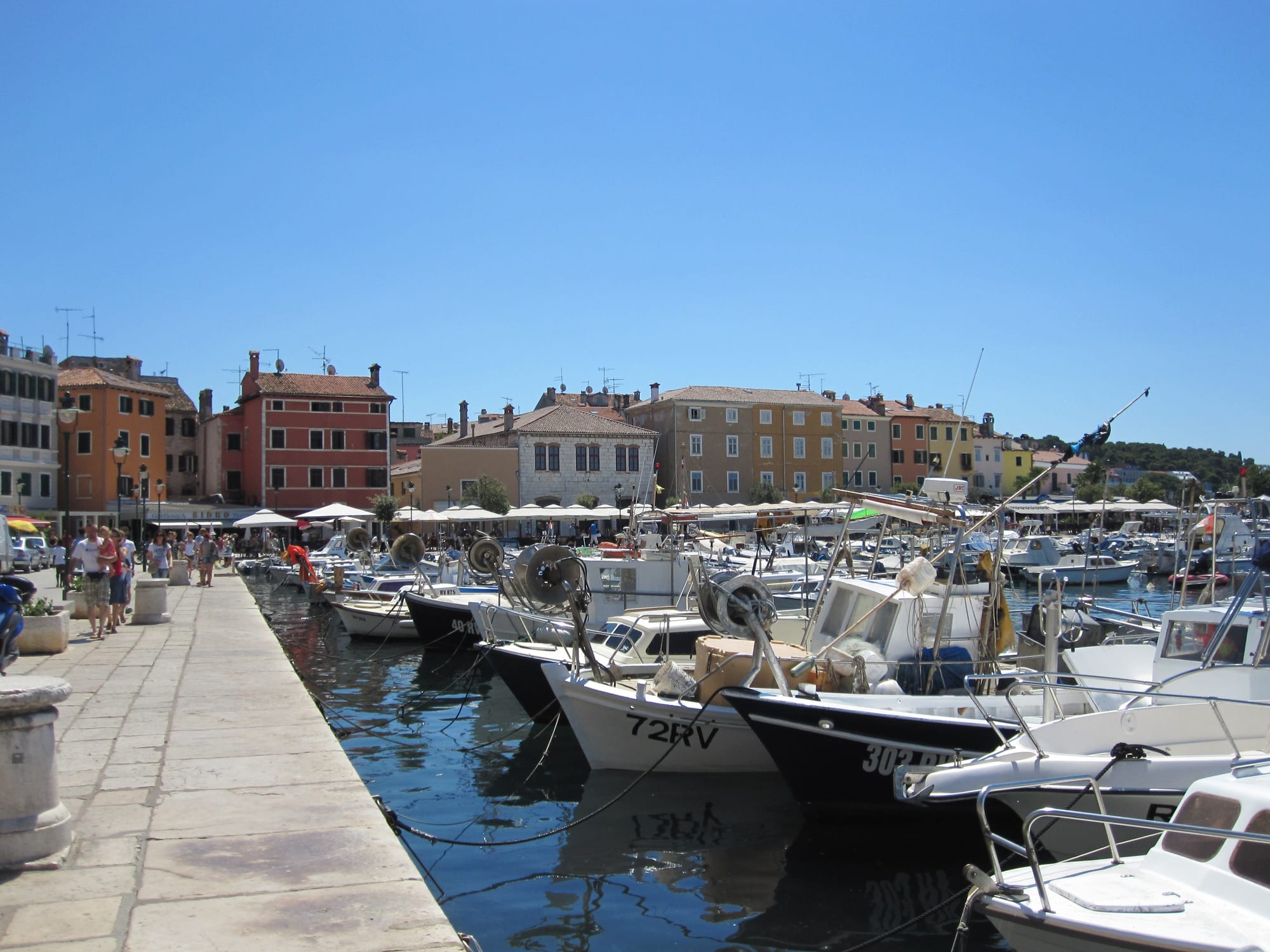
Small fishing boats moored along a stone quay in front of a row of tall pastel-coloured houses under a clear blue sky

Istria, Kvarner & Plitvice, Croatia

Rovinj

Fishing boats in the harbour of Rovinj, below the houses of the old town. (Tiefkuehlfan / Wikimedia Commons · CC BY-SA 4.0)

A fishing port and resort town on the west coast of Istria, built on a former island and joined to the mainland only in 1763. Five centuries of Venetian rule left tall houses packed up a hill to the church of St Euphemia, whose bell tower copies St Mark's in Venice; the town is officially bilingual in Croatian and Italian and lives largely on summer tourism.

Neighbourhoods

  • The old town
    • First-time visitors
    • Historic district
    • Art galleries

    The former island, a tight knot of tall Venetian houses, stepped lanes and arches climbing to the church of St Euphemia. Grisia is the street of artists' studios and galleries, and the houses on the seaward side rise straight from the rocks.

    Open in Maps
  • The harbour and Valdibora
    • Cafés and restaurants
    • Markets
    • Close to public transport

    The busy edge of the old town, where the fishing harbour, the café-lined waterfront, and the clock tower meet. Valdibora, at the edge of the old town, has the farmers' market; Carera, the pedestrian main street with shops and galleries, runs from here towards the bus station.

    Open in Maps
  • Zlatni Rt and the southern shore
    • Beaches
    • Parks
    • Walking and cycling

    South of the harbour, the coast turns into the Zlatni Rt forest park, a wooded headland of holm oak and pine with shore paths.

    Open in Maps

Things to do

The old town

  • Church of St Euphemialandmark

    The baroque church at the top of the old town, built in 1725–36, holding the relics of St Euphemia in a Roman sarcophagus; its 60-metre bell tower, modelled on St Mark's in Venice, is topped by a statue of the saint that turns in the wind.

    Open in Maps
  • Balbi's Archlandmark

    A baroque arch of 1678–79 on the site of the old town gate, carved with the head of a Turk on one side and a Venetian on the other.

    Open in Maps
  • Grisia Streetneighborhood

    The artists' street of the old town, lined with studios and galleries.

    Open in Maps
  • Casa della Batanamuseum

    A community ecomuseum in the old harbour devoted to the batana, Rovinj's traditional flat-bottomed fishing boat, and the people who built and used it, listed by UNESCO as a model of safeguarding living heritage.

    Open in Maps

Markets

  • Valdibora marketmarket

    The farmers' market at the edge of the old town, selling fish, truffles and truffle oil, olive oil, fruit and vegetables.

    Open in Maps

Coast and nature

  • Rovinj islandspark

    An archipelago of 19 islands along the coast, part of a protected landscape of indented shoreline and holm oak and pine forest that runs from the St Ivan headland to Barbariga; boats run out from the town.

    Open in Maps
  • Zlatni Rt Forest Parkpark

    A wooded headland just south of the town centre, part of the protected coastline of holm oak and pine around Rovinj.

    Open in Maps
  • Palud marshpark

    A coastal marsh near Rovinj, listed among the town's natural sights, with the Dvije Sestrice islands nearby, a nesting site for seagulls.

    Open in Maps

Short trips from the town

  • Lim bayviewpoint

    A long, narrow sea inlet between Rovinj and Vrsar, on the western coast of Istria; the film The Long Ships was shot here.

    Open in Maps
  • Monkodonjalandmark

    A Bronze Age hillfort near Rovinj, occupied from roughly the 19th to the 15th century BC.

    Open in Maps

Eat and drink

Long-standing places and food districts in Rovinj. Hours, ratings and directions come from your maps app, always current.

Food districts and markets

  • Valdibora marketmarket

    The town's open-air market for fish from the boats, truffles, olive oil and seasonal produce from inner Istria.

    Open in Maps
  • Harbour-front restaurantsneighborhood

    Seafood restaurants and konobas line the waterfront and the lanes of the old town, serving fish, shellfish, fuži pasta and dishes with Istrian truffles and olive oil.

    Open in Maps

Cafés and bars

  • Old-town cafés and barscafe

    Most of Rovinj's bars cluster in the centre between the bus station and the old town.

    Open in Maps

Experience Rovinj

History

Rovinj was a settlement of Illyrian or Venetic tribes before the Romans took it, calling it Arupinium or Mons Rubineus and later Ruginium. It passed to the Byzantine Empire, became part of the Exarchate of Ravenna in the 6th century and fell to the Franks in 788. After centuries under a succession of feudal lords, it was acquired in 1209 by the Patriarchate of Aquileia, and from 1283 to 1797 it was one of the most important towns of Venetian Istria. Under Venice it was enclosed by two rings of walls with three gates, gained its first statute in 1531, and built its baroque church and campanile. The town stood on an island until 1763, when the channel separating it from the mainland was filled in.

After the fall of Venice and a Napoleonic interlude, Rovinj became part of the Austrian Empire until the First World War; at the last Austrian census, in 1911, nearly 98 per cent of its people spoke Italian. It belonged to the Kingdom of Italy from 1918 to 1947, when it was ceded to Yugoslavia and its name changed from Rovigno to Rovinj. In the post-war years many Italian inhabitants left, transforming the town's population.

From 1876 to 1966 a branch railway linked Rovinj with Kanfanar. Since Croatian independence in 1991 Rovinj has become one of the main centres of Istria County, its third-largest town after Pula and Poreč, and one of its leading tourist destinations.

Culture & Customs

Rovinj's identity rests on its two languages and its fishing past. The town's statute makes it officially bilingual, and its official name is Rovinj-Rovigno; Italian has equal status in administration and signs, and the town has Italian-language primary and secondary schools. Istriot, a Romance language spoken by a few hundred people in south-western Istria, survives in Rovinj, whose dialect is called Ruvignìʃ, and the local poet Ligio Zanini wrote in it.

The batana, a flat-bottomed wooden fishing boat, is the town's emblem. Casa della Batana, a community ecomuseum in the old harbour, keeps alive the boat, its builders and the fishing community around it, and UNESCO has listed it on its Register of Good Safeguarding Practices as a model for protecting living cultural heritage. The harbour remains a working fishing port.

Art is the other thread. Grisia, the artists' street of the old town, is known for its studios and galleries, and galleries continue along Carera Street. The town also holds a photography festival, Mundial. St Euphemia, the town's patron saint, whose relics rest in a Roman sarcophagus in the church, stands as a wind vane on top of the bell tower, watching over a town that turns towards the sea.

Daily Life

At the 2021 census Rovinj had about 13,000 people, of whom about 11,600 lived in the town itself; the only other settlement in the municipality is Rovinjsko Selo. The population has fallen since 2011, when it was about 14,300. At that census Croats formed a majority of just under two-thirds, with Italians the largest minority at about one in nine, and about a tenth declaring a regional identity.

Tourism is the main economic activity. Rovinj is the second-biggest destination in Istria County by overnight stays, and from May to September its bars, restaurants and galleries keep long hours, then shorten them for the off-season. Accommodation runs from private rooms and campsites to large resort hotels, and a few islands off the town have hotels reached by boat. Fishing continues from the harbour.

The town is governed by a directly elected mayor and a council of 16, which can grow to ensure the Italian community is represented. Everyday life gathers along Carera Street, at Valdibora market and around the harbour; outside summer the town is much quieter, and locals get around by bicycle and scooter.

Food

Rovinj eats Istrian food, which is close to Italian cooking: some dishes that Istrian Italians took with them after the post-war exodus, such as scampi alla busara, brudet and cured ham, are now part of Italian cuisine too. Brudet is a fish stew shared by the coasts of Istria, Kvarner and Dalmatia. Fuži, the region's traditional pasta, is made by cutting thin sheets of dough into strips, then cut diagonally into diamond shapes. Istarska jota is a hearty soup of beans with sauerkraut or sour turnip, potatoes, bacon and spare ribs, seasoned with garlic and olive oil.

The Valdibora market shows what the town cooks with: fish straight from the boats, truffles and truffle oil, olive oil, fruit and vegetables.

Malvazija, the Istrian Malvasia, is one of the region's main white wines, and Teran, a red grape native to the Croatian part of the Istrian peninsula, makes its red wine. The harbour front and the old town hold many seafood restaurants and konobas, and Rovinj's bars cluster between the bus station and the old town.

Planning tools

Budget

Rovinj is at its most expensive in July and August, with rooms far above their spring level and accommodation often fully booked. Prices drop sharply outside the peak, and in the off-season many bars and restaurants keep shorter hours. Private rooms and apartments are the usual budget option; staying inland costs far less.

Daily Budget Midrange
USD 160–310 (apartment or mid-range hotel, konoba dinners, boat trips, a hire car)
Daily Budget Shoestring
USD 70–115 (private room or campsite, market food and bakeries, buses)

Visit in May, June or September to avoid peak prices, and book well ahead for summer.

Best Time to Visit

May to September is the season: from May to September the town gets more than ten hours of sunshine a day. June and September are warm but less crowded than July and August, when the old town is packed. Autumn is truffle season in inner Istria. Winter is quiet, mild and rainier, and many businesses close.

Suggested Number of Days

Two or three days suit the town, the islands and the coast. Four to six allow time for the rest of western and inner Istria, which is best reached by car.

First Visit
2–3 days
With Surroundings
4–6 days

Transportation

The old town and harbour are best on foot, and bicycles and scooters are popular for getting around the wider town and the coastal paths. Boats run from the harbour to the islands. Beyond the town, the car is the usual way to travel: the D303 road joins the Istrian motorways at Kanfanar. Buses leave from the main bus station at the end of Carera Street.

Leave the car outside the centre; the old town is pedestrian and parking near it is scarce in summer.

Airport & Station Connections

Pula Airport is the closest commercial airport, with summer flights by low-cost airlines, followed by Rijeka and Trieste; Venice and Zagreb are the nearest major international airports. Buses connect Rovinj with Pula and the rest of Istria. The nearest railway station is at Kanfanar, about 15 km away, but buses are more practical. In summer a fast ferry links Rovinj with Venice in about two and a half hours.

Walkability

Very walkable. The old town is car-free, with steep, polished stone lanes that can be slippery, and the harbour, market and main street are a few minutes apart. The shore paths south through the forest park are flat and easy on foot or by bike.

Safety

Croatia is a very safe country for visitors, with low levels of violent crime. In Rovinj the main risks are pickpocketing in the crowded old town in summer and thefts from cars and beach bags; the stone lanes and rocks along the shore are slippery when wet.

Watch belongings in the summer crowds, wear shoes with grip on the old-town lanes and the rocks, and check the bura forecast before boat trips in winter. Check current official travel advice before travelling.

Climate

A humid subtropical climate, with more than ten hours of sunshine a day from May to September: hot, dry summers and mild, wetter winters, with the cold bura wind in some winter spells. Rain averages about 940 mm a year.

Summer
warm to hot, with a July average of about 22°C and long sunny days
Winter
mild, with a January average of about 5°C, more rain and occasional bura

Local Customs

Rovinj is officially bilingual, and Croatian and Italian have equal status on signs and in public life; Istriot, an old Romance language of south-western Istria, is still spoken by a few residents. Greet shop staff on entering.

Dress modestly in St Euphemia's and keep voices down during services.

Common Payment Methods

The currency is the euro, used since 2023. Cards and contactless payment are accepted almost everywhere, and ATMs are easy to find; carry some cash for the market.