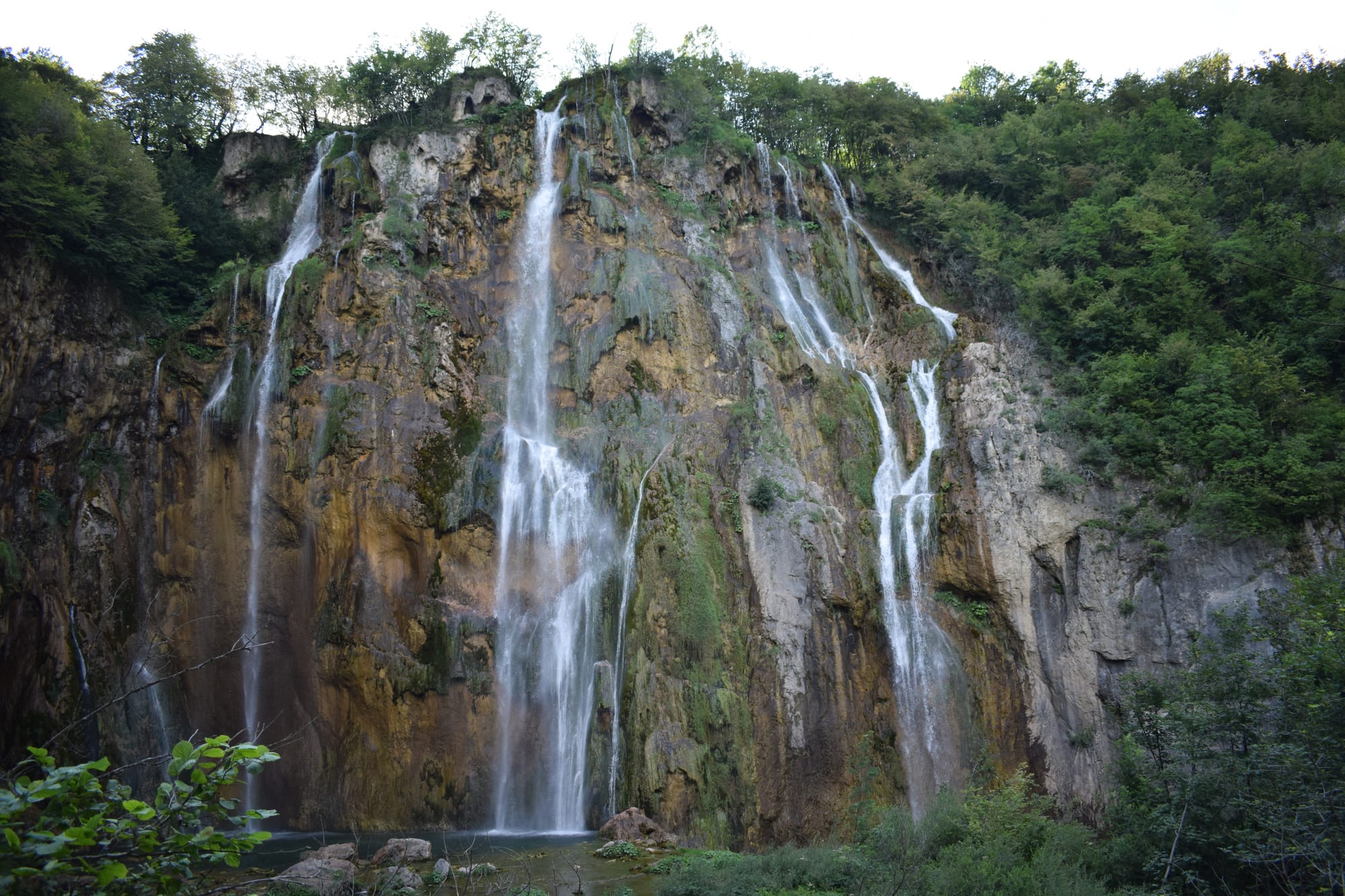
Several thin streams of water falling down a tall, moss-streaked rock face into a pool, framed by green woodland

Istria, Kvarner & Plitvice, Croatia

Plitvička Jezera

Veliki slap, the tallest waterfall in Plitvice Lakes National Park. (MarioMagdic / Wikimedia Commons · CC0)

A thinly peopled municipality of Lika hamlets on the Zagreb–Split road, gathered around the entrances to the Plitvice Lakes National Park, where sixteen travertine lakes step down a forested karst valley in waterfalls. The park, a UNESCO World Heritage Site since 1979, draws around 1.5 million visitors a year and is the area's main source of income.

Neighbourhoods

  • Entrance 1 and the Lower Lakes
    • First-time visitors
    • Waterfalls

    The northern gate on the D1 road, closest to Veliki slap and the canyon of the Lower Lakes. It is the busier entrance, used by most day-trippers from Zagreb, with car parks, ticket offices and food stalls.

    Open in Maps
  • Entrance 2, Mukinje and Jezerce
    • Quiet and residential
    • Close to the Upper Lakes

    The southern gate, about 3 km from Entrance 1, near Lake Kozjak and the boat landings for the Upper Lakes. The hamlets of Mukinje and Jezerce, within walking distance, offer private rooms and apartments, a bistro, a small ski slope and campsites nearby.

    Open in Maps
  • Korenica
    • Local life
    • Shops and services

    The municipal seat, a village further south on the D1 towards Udbina, with the schools, shops and services of the area. Some buses stop here.

    Open in Maps

Things to do

The national park

  • Plitvice Lakes National Parkpark

    Founded in 1949, one of the oldest and largest national parks in Croatia: sixteen visible lakes, coloured from azure to green and grey, linked by travertine barriers and waterfalls, crossed on wooden boardwalks and home to brown bears, wolves and lynx.

    Open in Maps
  • Veliki slapviewpoint

    The 'Big Waterfall', where the Plitvica stream drops 78 metres into the canyon of the Lower Lakes near Entrance 1 — the tallest fall in the park.

    Open in Maps
  • Lake Kozjakpark

    One of the two largest lakes and the deepest, up to 47 metres deep, crossed by small electric boats that link the Lower and Upper Lakes; formed about 400 years ago when two lakes merged behind a growing travertine barrier.

    Open in Maps
  • The Upper Lakestrail

    A chain of smaller lakes between Prošćansko jezero and Kozjak, separated by dozens of cascading falls, over dolomite rock in the south of the park.

    Open in Maps
  • Mukinje ski slopeattraction

    A small ski centre in Mukinje, with three short slopes that open when there is enough snow in winter.

    Open in Maps

Short trips

  • Rastokeattraction

    The old mill hamlet at Slunj, to the north along the Korana, where the Slunjčica falls over travertine cascades — often called 'the Small Lakes of Plitvice'.

    Open in Maps
  • Caves of Baraćattraction

    A group of caves near Nova Kršlja in Rakovica municipality, opened to visitors in 1892, where Neanderthal tools were found in 2022.

    Open in Maps

Eat and drink

Long-standing places and food districts in Plitvička Jezera. Hours, ratings and directions come from your maps app, always current.

Lika classics

  • Konobas in the surrounding villagesrestaurant

    The villages around the entrances have konobas serving Lika food — lamb, potatoes, cheese and roast meats — and pancakes with walnuts as a local favourite.

    Open in Maps
  • Mukinjeneighborhood

    The hamlet near Entrance 2 has a bistro and a small supermarket for picnic supplies before a day in the park.

    Open in Maps

Experience Plitvička Jezera

History

The lakes long stayed little known because of their isolated position, and were first arranged for visitors in 1888, for a visit by Crown Princess Stéphanie. Two paths in the park still carry the names of daughters of Emperor Franz Joseph, Stephanie and Dorothea. In 1893 a society for the preservation of the lakes was founded, which built the first hotel here. During the Second World War, after the zones of influence were redrawn in June 1942, the area was administered civilly by Croatia but militarily by Italy. In 1949 the national park was founded, and in 1979 it was inscribed on the UNESCO World Heritage List for its travertine lakes, caves and waterfalls. The park also became a film location, used between 1962 and 1968 for many of the westerns based on the novels of Karl May.

On Easter Sunday, 31 March 1991, after local Serb rebels of the self-proclaimed SAO Krajina took over the park, Croatian police clashed with them in what became known as the Plitvice Lakes incident — the first armed confrontation of the Croatian War of Independence to cause deaths. The park was then held by rebel forces as part of the self-proclaimed Republic of Serbian Krajina until Croatian forces retook the rebel-held areas in 1995; hotels and other facilities were damaged, and many local Serbs left. Between 1,500 and 2,000 have since returned.

Since the war the park has grown into one of Croatia's busiest attractions. Its management introduced daily visitor caps for summer in 2019, and yearly visitor numbers hover around 1.5 million, almost a tenth of all visitors to Croatia.

Culture & Customs

Plitvička Jezera is less a town than a scatter of 41 settlements in the uplands of Lika, with Korenica as its seat. The population is mostly Croat, with a substantial Serb minority, about 27 per cent at the 2011 census, which elects its own minority council. The legacy of the war shapes relations, and Human Rights Watch has reported that Serb returnees faced higher unemployment and exclusion from jobs in municipal services and the national park.

Life here is organised around the park, which is both the area's identity and its employer. Its rules shape local custom: the lakes are strictly protected, swimming has been banned since 2006, and visitors stay on boardwalks and marked paths. The landscape itself carries meaning — the travertine barriers that hold back the lakes are still growing, built up by mosses, algae and calcium carbonate deposited from the water, a process that has run since the end of the last ice age.

Outside the park the culture is that of rural Lika: farming, grazing and forestry, family-run guesthouses, and a landscape of beech and fir forest home to brown bears, wolves, lynx and wildcats. In winter, snow brings skiers to the small slopes at Mukinje.

Daily Life

At the 2021 census the municipality had about 3,650 residents in 41 settlements, down from about 4,400 in 2011 and 4,700 in 2001. It covers about 470 square kilometres and is classed by the government as an area of special state concern, the category for underdeveloped parts of Croatia.

The national park is the main source of income, alongside farmland, grazing and woodland. Hotels at the entrances, private rooms and apartments in Mukinje, Jezerce and other hamlets, campsites and restaurants all depend on the visitor season, which brings around 1.5 million people a year, with the peak in August. Korenica has the elementary school and the high school for the area.

The rhythm of the year is sharp. In summer the D1 is busy with cars and coaches, the car parks at the entrances fill early and every room is taken; in winter, when the lakes freeze, the hamlets return to a quiet life of snow-clearing, firewood and the few winter visitors who come for the frozen falls or the ski slope.

Food

Lika has its own regional cooking, distinct from both the coast and the continental north, and three of its products are protected by European designations of origin: Lička janjetina, Lika lamb; Lički krumpir, the Lika potato; and Lički škripavac, the region's farmers' cheese. Curd cheese from Lika and neighbouring Kordun is also part of the local table.

Food inside the park is limited to stalls and restaurants at the entrances and boat landings, run by the park authority, and many visitors bring their own food. The villages near the entrances have konobas and a bistro serving the hearty food of the uplands, and pancakes with walnuts or chocolate spread are a local favourite for dessert or a snack.

As across inland Croatia, meals often feature roast and boiled meats, stews of vegetables with a little meat or sausage, known as varivo or čušpajz, potato dumplings, and strudel filled with apple or curd cheese.

Planning tools

Budget

The park ticket is the main cost and varies sharply by season, highest in summer and lowest in winter; two-day tickets cost less per day. Rooms close to the entrances fill early in summer, while private rooms in the hamlets and in Korenica cost less. Food inside the park is limited and relatively expensive, so many visitors bring a picnic.

Daily Budget Midrange
USD 150–280 (guesthouse or hotel, konoba dinners, park tickets, a hire car)
Daily Budget Shoestring
USD 70–110 (private room or campsite, picnic food, one park ticket, buses)

Buy tickets online for a fixed entry time at least two days ahead in summer, and arrive at opening to avoid the crowds on the boardwalks.

Best Time to Visit

Spring and autumn bring the most rain, and October the autumn colours of the beech forest. July and August are the busiest months, when the park caps visitors at up to 12,000 a day and the boardwalks crowd by mid-morning; May and September now draw more people than June. In winter the lakes usually freeze in December and January, and tickets are cheapest.

Suggested Number of Days

One full day covers the main lake circuits; staying overnight allows an early start before the crowds arrive. Two or three days give time for the longer park trails and the surrounding countryside.

First Visit
1–2 days
With Surroundings
2–3 days

Transportation

The D1 road runs through the park, past both entrances about 3 km apart. Inside the park, sightseeing buses and electric boats on Lake Kozjak are included in the ticket and link the trails, so circuits can be walked one way. A car is the easiest way to reach the villages and nearby sights; parking is only allowed at the lots by the entrances.

Do not park along the main road; use the paid car parks at the entrances, and arrive early in summer, when they fill.

Airport & Station Connections

The park is about two hours by car from Zagreb, Zadar and Rijeka and about three from Split, reached from the A1 motorway via Karlovac, Ogulin or Gornja Ploča. Some buses between Zagreb and Zadar or Split pass the entrances and stop at the marked bus stops there, and some stop in Korenica, Mukinje, Rakovica or Slunj. Zagreb and Zadar have the nearest major airports.

Walkability

Inside the park, everything is on foot: boardwalks and paths run along and over the lakes and falls, with circuits of a few hours and a long-distance trail of about 30 km. The boardwalks are slippery when wet or icy. Mukinje and Jezerce are within walking distance of Entrance 2; other hamlets and Korenica need transport.

Safety

Croatia is a very safe country for visitors, with low levels of violent crime. At Plitvice the hazards are natural: wet or icy boardwalks, steep paths, sudden evening thunderstorms and, in the forests beyond the trails, brown bears and wolves. Swimming in the lakes has been banned since 2006. The minefields left by the 1990s war in this area have been cleared; Croatia was declared free of mines in February 2026.

Wear shoes with grip, keep to the marked trails and boardwalks, carry rain gear in summer, and never swim in the lakes. Check current official travel advice before travelling.

Climate

A cool mountain climate with heavy precipitation, about 1,500 mm a year. Summers are fresh, with cool nights and sudden evening storms; winters are long and snowy, and the lakes usually freeze in December and January.

Summer
at the lakes and in the surrounding highlands, mild to warm, about 20–27°C by day, with cool nights
Winter
across Lika, cold, about -5 to 3°C, with deep snow

Local Customs

The park is strictly protected: swimming, fishing, campfires and gathering firewood or berries are forbidden, and visitors are asked to take their rubbish out with them. The area's population is mixed Croat and Serb, and the 1990s war, which began in part here, is a sensitive subject best approached with care. Greet hosts and shop staff on entering.

Keep to the boardwalks, carry litter out of the park, and leave wildlife undisturbed.

Common Payment Methods

The currency is the euro, used since 2023. Cards are widely accepted, and tickets can be bought online; carry cash for private rooms, small bistros and village shops.