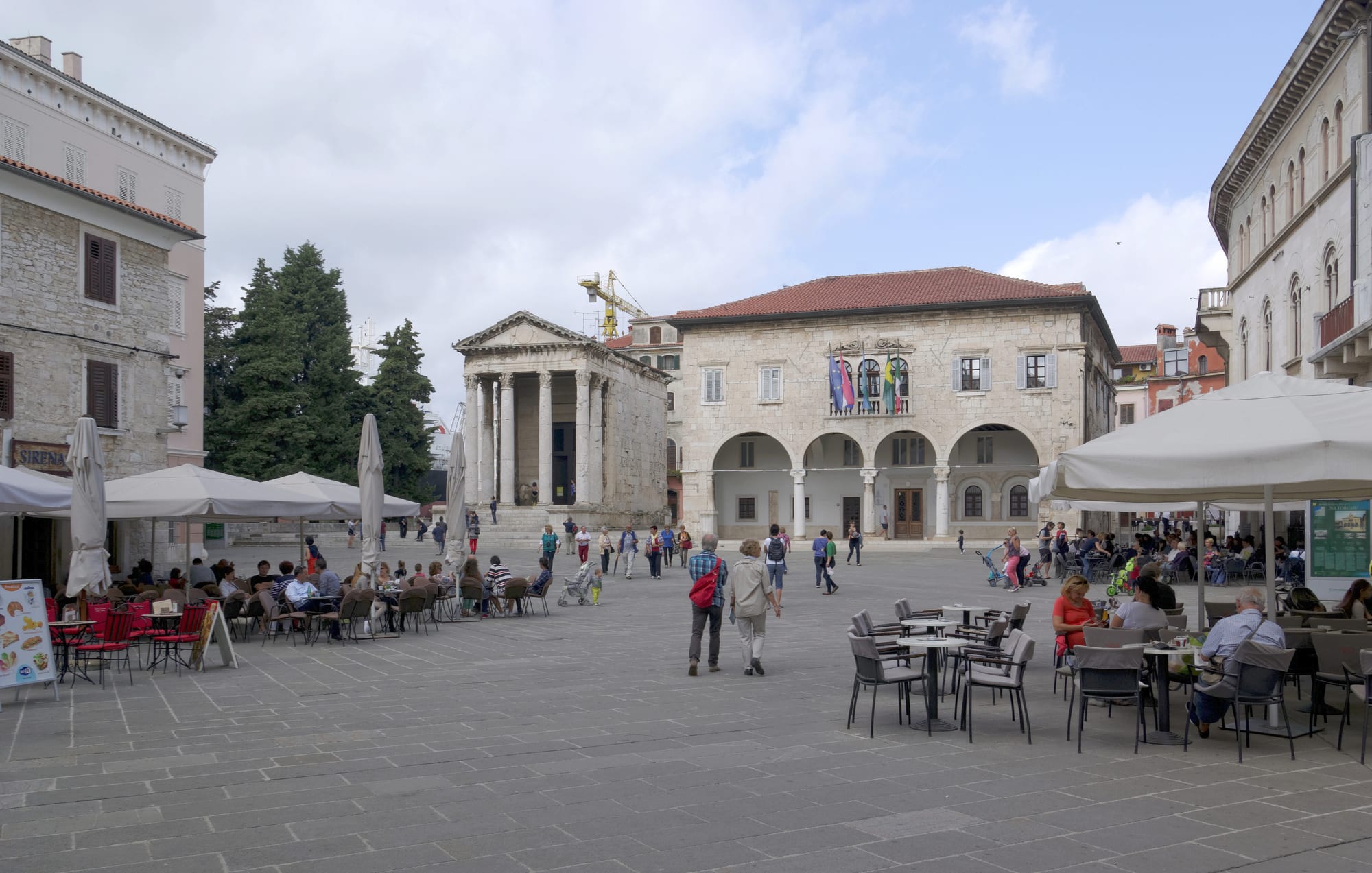
Pula's paved Forum with café tables, the columned Roman Temple of Augustus and the arcaded town hall behind

Istria, Kvarner & Plitvice, Croatia

Pula

The Forum in Pula, with the Temple of Augustus on the left and the town hall on the right. (Berthold Werner / Wikimedia Commons · CC BY-SA 3.0)

The largest city in Istria, on a deep natural harbour at the southern tip of the peninsula. A Roman colony that left one of the best-preserved amphitheatres in the world, it later became Austria-Hungary's main naval base and a shipbuilding town. Today it is a bilingual Croatian and Italian city of about 52,000 people, busy with visitors in summer.

Neighbourhoods

  • Old town
    • First-time visitors
    • Historic district

    The compact core around the hill crowned by the Venetian Kaštel, with narrow streets of old stone buildings. The Forum, the Temple of Augustus, the Arch of the Sergii and the cathedral are all here, with the Arena a few minutes north.

    Open in Maps
  • Verudela and Lungomare
    • Beaches
    • Swimming

    The wooded peninsulas south-west of the centre, where most of the city's beaches are — Gortanova uvala on the Lungomare, Ambrela and Havajsko on Verudela. An Austro-Hungarian fort here now holds the city aquarium, and many of the holiday apartments are nearby.

    Open in Maps
  • Stoja and Veruda
    • Quiet and residential
    • Local life

    Residential districts between the centre and the southern coves, with schools, local shops and the Veruda marina. Stoja has its own stretch of rocky shore, and the area gives a sense of everyday Pula outside the summer crowds.

    Open in Maps

Things to do

Roman Pula

  • Pula Arenalandmark

    A Roman amphitheatre of about 132 by 105 metres, the only surviving example that keeps its entire outer circular wall, still used for concerts and the summer film festival.

    Open in Maps
  • Temple of Augustuslandmark

    A small Corinthian temple on the Forum, built for the first emperor, probably between 27 BC and his death in AD 14, and still well preserved.

    Open in Maps
  • Arch of the Sergiilandmark

    A triumphal arch of about 29–27 BC honouring three members of a prominent local family, which stood behind the original sea gate of the Roman colony.

    Open in Maps
  • Porta Geminalandmark

    The Twin Gates, a double-arched Roman gate of the late 2nd or early 3rd century and one of the few to survive when the city walls were pulled down in the 19th century.

    Open in Maps
  • The Forumlandmark

    The city's main square since Roman times, where the Temple of Augustus stands beside the medieval town hall, which incorporates part of the wall of a temple to Juno.

    Open in Maps

Churches and museums

  • Pula Cathedrallandmark

    A co-cathedral founded in the 6th century and largely rebuilt in the 15th, with fragments of early floor mosaics and a belfry built from stones taken from the Arena.

    Open in Maps
  • Monastery and Church of St Francislandmark

    A late Romanesque church of 1314 with a rose window, a gilded 15th-century wooden polyptych on the altar and a cloister holding a collection of medieval stone monuments.

    Open in Maps
  • Santa Maria del Cannetolandmark

    The surviving 6th-century Byzantine chapel of St Mary Formosa, once part of a Benedictine abbey and compared with the churches of Ravenna.

    Open in Maps
  • Kaštel and the Historical Museum of Istriamuseum

    The star-shaped Venetian fort of the 17th century on the central hill, housing the Historical Museum of Istria since 1961, with views over the harbour from the top.

    Open in Maps
  • Zerostrasseattraction

    A network of underground tunnels and bunkers beneath the old town, with an entrance at the Porta Gemina, now used for exhibitions.

    Open in Maps

The coast

  • Aquarium Pulaattraction

    Croatia's largest aquarium, inside the Austro-Hungarian Verudela fortress of 1886, with about 60 tanks and a centre for the rehabilitation of sea turtles.

    Open in Maps
  • Verudela beachesbeach

    Rocky and pebbly coves along the Verudela peninsula and the Lungomare, the city's main swimming area.

    Open in Maps

Short trips from the city

  • Brijuni National Parkpark

    Fourteen small islands off Fažana, a Habsburg resort and later Tito's summer residence, where the founding Brioni meeting of the Non-Aligned Movement took place in 1956.

    Open in Maps
  • Cape Kamenjakpark

    A small peninsula beyond the village of Premantura at the very tip of Istria, with more than 30 kilometres of coastline broken into coves and beaches.

    Open in Maps
  • Nesactiumlandmark

    The ruins of the Histri people's capital, later a Roman town, regarded as the oldest urban settlement in Istria, north of the city near Valtura.

    Open in Maps
  • Fažananeighborhood

    A fishing village on the strait facing the Brijuni islands, from which boats cross to the national park.

    Open in Maps
  • Vodnjanneighborhood

    A small Istrian town about 10 kilometres north of Pula.

    Open in Maps
  • Rovinjneighborhood

    A Venetian fishing port and resort on the west coast of Istria where Istriot, a Romance language, is still spoken.

    Open in Maps

Seasonal events

  • Pula Film Festivalsummer, July or August

    Croatia's largest and oldest film festival, held in the Arena since 1954, where the Golden Arena national film awards are presented.

  • Summer cinema at the Kaštelsummer

    A seasonal open-air cinema inside the Venetian fort on the hill above the old town.

Eat and drink

Long-standing places and food districts in Pula. Hours, ratings and directions come from your maps app, always current.

Food districts

  • Old town restaurantsneighborhood

    Restaurants and cafés spread through the streets around the Forum and below the Kaštel, with seafood and Istrian pasta dishes on many menus.

    Open in Maps
  • Verudela and Stoja seafrontneighborhood

    Places to eat close to the beaches south of the centre, busiest in the summer season.

    Open in Maps
  • Fažana's harbourneighborhood

    Fish restaurants around the harbour of a working fishing village a short drive north-west of the city.

    Open in Maps

Experience Pula

History

Pula stands on a deep, sheltered harbour at the southern tip of Istria, among seven low hills. Bronze Age hill-forts and Greek pottery show early settlement, and Greek legend credited its founding to Colchians who had chased Jason and failed to catch him. Rome took Istria in 177 BC, and between about 47 and 44 BC Pula became a colony; after siding with Caesar's assassins it was razed by Octavian, then rebuilt as Pietas Iulia. The Arena, the Temple of Augustus, the Arch of the Sergii and a ring of walls with ten gates date from this time, when the town reached about 30,000 people.

After Rome it passed to the Ostrogoths, the Byzantine Exarchate of Ravenna, which made it a fleet base, and the Franks. Venice took it in 1150 and, after fights with Genoa, the patriarchs of Aquileia and others, held it from 1331 until 1797. Raids, plague and malaria reduced it to about 3,000 inhabitants by the 1750s. Under Austria the harbour was chosen in 1859 as the empire's main naval base, the Uljanik shipyard was founded in 1856, and Pula grew into an industrial city; James Joyce taught English to naval officers here in 1904–05.

Italy ruled from 1918 and repressed its Croatian residents. The Second World War brought Allied bombing and partisan killings, and between December 1946 and September 1947 most of the Italian-speaking population left before the city passed to Yugoslavia. Pula lost its role as Istria's administrative centre to Pazin in 1991, and the Uljanik group filed for bankruptcy in 2019.

Culture & Customs

The city is officially bilingual, and its streets show its layers — Roman stones underfoot, Venetian churches and fort, Habsburg naval buildings and Yugoslav apartment blocks. A local Italian community remains, alongside Serbs, Bosniaks, Albanians and Slovenians, and many residents move easily between Croatian, Italian and other languages. Dante mentioned Pola in the Divine Comedy as the place at the edge of Italy beside the Kvarner gulf.

Film is the city's great cultural event. The Pula Film Festival has screened films in the Arena since 1954; it was the centrepiece of Yugoslav cinema and now presents Croatia's national film awards, the Golden Arenas. The Arena also stages concerts and opera, and a summer cinema runs in the Kaštel. Club Uljanik, opened in the 1960s, was for decades the centre of the city's youth subculture and is still an important meeting place.

Sport mirrors the sea and the shipyard: football with NK Istra 1961, water polo, rowing and sailing clubs, a long tradition of regattas, and bowls clubs, one of them named after the shipyard. A run named for the shipyard's founding day has been held every year since 1983.

Daily Life

The city had about 52,000 residents in 2021, and more people live in the wider area that takes in Medulin, Fažana, Vodnjan and other nearby municipalities. Croats make up about three-quarters of the population. The University of Juraj Dobrila is based here, and the city has two museums, the Istrian National Theatre and two libraries.

For more than a century Pula's economy rested on the navy and the Uljanik shipyard, one of the oldest operational shipyards in the world, until the Uljanik group filed for bankruptcy in 2019. Tourism now carries much of the economy, built around the Roman monuments, the beaches of Verudela and the Lungomare, the Brijuni islands and the coast down to Medulin and Premantura. Most visitors come in summer, and many restaurants and attractions close between October and May.

Daily life outside the season is quiet and local: residential districts such as Veruda, Stoja and Štinjan surround the old centre, the Forum and the harbour front fill at coffee time, and the summer swells the city with visitors, concerts and traffic. Plans for a new tram line, funded for its first phase in 2021, would link the railway station with the waterfront.

Food

Pula eats in the Istrian way, one of Croatia's distinct regional cuisines, which, like the rest of the coast, shows Italian influence. Fuži are a traditional Istrian pasta: strips of thin dough cut into diamonds and folded into a bow shape, usually served with a mild red veal sauce, or with rooster or game such as boar or rabbit. Maneštra is a vegetable stew made with spring corn, eaten as a first course or, with meat, as a main dish. Istrian truffles appear on many menus.

Seafood comes from the Adriatic at the city's edge — fish and shellfish feature on restaurant menus in the old town, and the fishing village of Fažana, just north-west, is known for its harbour restaurants. Istrian pršut, cured with salt, pepper and garlic and dried by the bora wind, is a common starter.

The wines are those of Istria: Malvazija, a white, and the red Teran, while the region's brandies include biska, flavoured with mistletoe. Fritule, small pieces of deep-fried dough, are a festive sweet, particularly at Christmas.

Planning tools

Budget

Pula follows the seasonal curve of the Istrian coast: room rates climb sharply in July and August and fall away in the shoulder months, when many restaurants and attractions close. Most visitors stay in rented apartments. Entry to the Arena, the Kaštel and the Brijuni boat trip are the main sightseeing costs.

Daily Budget Midrange
USD 140–280 (apartment or mid-range hotel, konoba dinners, museum entries and a Brijuni trip)
Daily Budget Shoestring
USD 60–100 (hostel or private room, bakery and supermarket food, city buses)

Visit in June or September for warm sea and lower prices; much of the Roman town — the Forum, the arches and the gates — can be seen for free from the street.

Best Time to Visit

May to September for swimming and the full range of open restaurants, with June and September the most comfortable. July and August bring the film festival and Arena concerts but also the heaviest crowds and prices. Between October and May many attractions and restaurants close, though the Roman monuments are quiet and the climate stays mild.

Suggested Number of Days

Two days cover the city itself at an easy pace. Four or five allow time for the islands offshore, the southern cape and other towns of southern Istria. A beach holiday or a car makes the longer stay more natural.

First Visit
2 days
With Surroundings
4–5 days

Transportation

The old town is walkable, and local buses run by Pulapromet link the centre with the beach districts and suburbs. The main bus station, just west of the Arena, is the hub for all of Istria. A train line runs north to Slovenia but is not connected to the rest of the Croatian network. A hire car is the easiest way to explore inner Istria.

In summer, buses to the southern beaches fill up; arriving early or using a bicycle avoids the worst of the parking pressure near the coves.

Airport & Station Connections

Pula Airport is about 6 kilometres from the centre, with year-round flights to London and many seasonal routes from Western Europe; shuttle buses link it with the bus station. Direct buses come from Zagreb, Rijeka, Split, Trieste, Ljubljana and Venice, and passenger ferries sail to Venice and Trieste in summer. Trieste and Rijeka airports are alternatives.

Walkability

The historic centre is small and flat around the base of the castle hill, and the Arena, the Forum and the bus station are all within a short walk of each other. The beaches on Verudela are a few kilometres away, best reached by bus or bike. Old stone paving is smooth and can be slippery after rain.

Safety

Croatia is a very safe country for visitors, with low levels of violent crime. In Pula the main risks are petty theft from cars and beach bags in summer, and the usual care on rocky shores and in the sun.

Keep valuables out of sight in parked cars and on the beach, wear water shoes on rocky coves, and check the wind forecast before boat trips. Check current official travel advice before travelling.

Climate

A mild, humid subtropical climate, protected from the north by the inland highlands, with about 2,300 hours of sunshine a year. The cold bora brings clear weather in winter, the sirocco brings rain, and the maestral breeze blows in summer.

Summer
warm to hot — average air temperatures of about 26°C in July and August, with occasional heat waves
Winter
mild — February averages about 6°C, with bora spells and some rain

Local Customs

Pula is officially bilingual, Croatian and Italian, and many residents speak both, along with German or English. Tipping is voluntary: rounding up for drinks, and 5–10 per cent for a meal with good service. Swimwear belongs on the beach rather than in the old town or churches, where shoulders and knees should be covered.

A greeting of 'dobar dan' (good day) or the Italian 'buongiorno' is welcome; ask before photographing people, and dress modestly inside churches.

Common Payment Methods

The currency is the euro, adopted in 2023 in place of the kuna. Cards are accepted almost everywhere, and ATMs are common in the centre; some cash is useful for small shops, markets and beach kiosks.