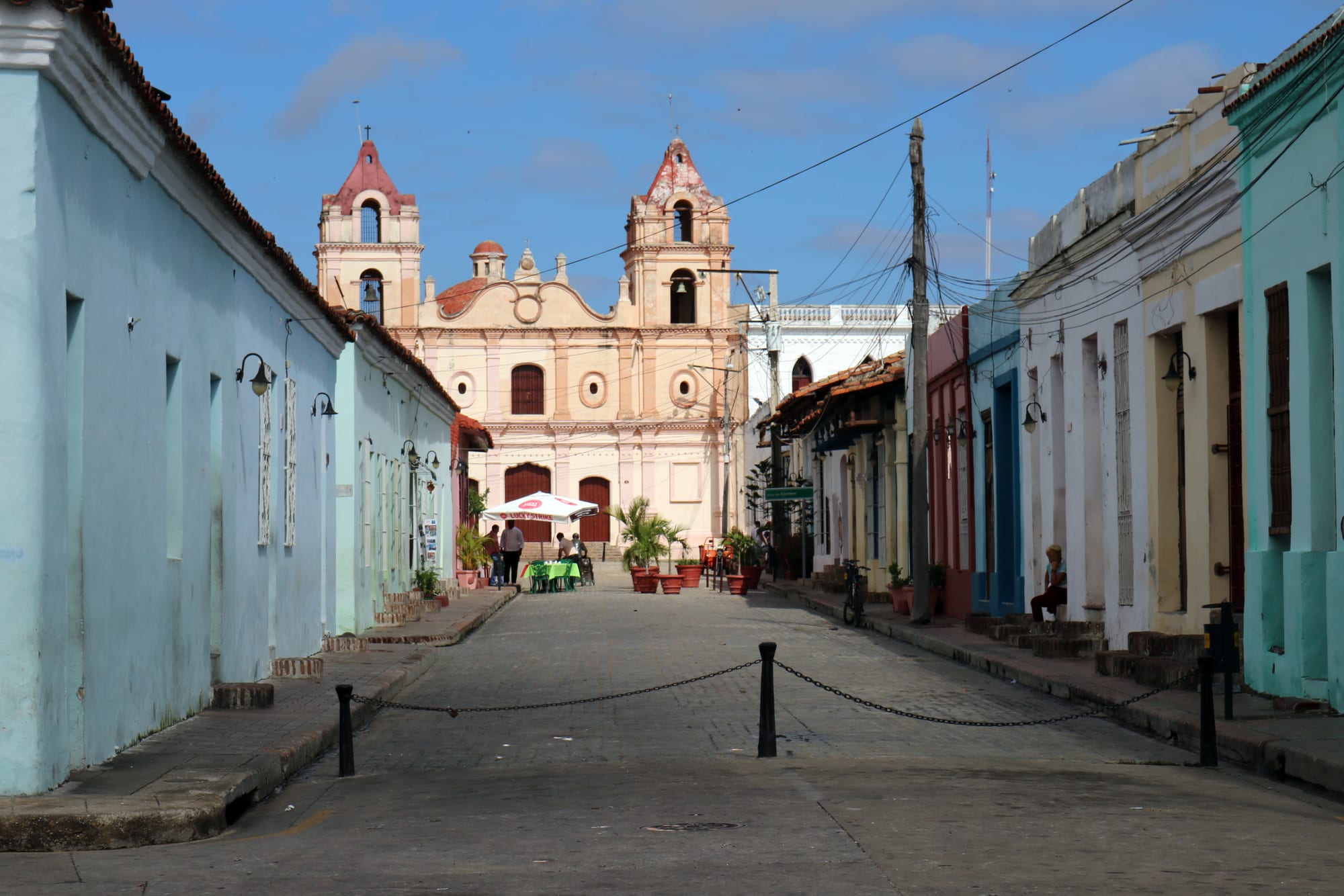
A cobbled street lined with low pastel houses leading to a cream two-towered church under a blue sky

Camagüey & the Centre-East, Cuba

Camagüey

The twin-towered church of Nuestra Señora del Carmen at the end of a street of colonial houses in Camagüey. (Maesi64 / Wikimedia Commons · CC0)

Cuba's third-largest city, on the cattle plains of the centre-east — one of the seven towns the Spanish founded on the island, moved inland in 1528. Its maze of winding streets, small squares, churches and great clay rainwater jars, the tinajones, was listed by UNESCO in 2008, and it remains a proud provincial capital of ranchers, poets and dancers.

Neighbourhoods

  • The historic centre
    • First-time visitors
    • Historic district
    • Walking

    The UNESCO-listed old town of narrow, short streets that always seem to turn, with blind alleys and forked lanes opening onto squares of different sizes — the Parque Agramonte, San Juan de Dios, El Carmen. Churches, museums, paladares and most casas particulares are here, and tinajones stand in courtyards and on street corners.

    Open in Maps
  • La Caridad
    • Historic district
    • Quiet and residential

    A district that grew up along the old royal road at the end of the 18th and the start of the 19th century, where the wealthiest families built their country houses on a regular grid, quite unlike the tangle of the old centre. Its parish church holds an early replica of the Virgin of Charity of El Cobre.

    Open in Maps
  • The Hatibonico river and Casino Campestre
    • Parks
    • Local life

    The river marks the southern edge of the old centre. The city's farmers' market sits on its banks, and just across the water lies the Casino Campestre, a large and shady urban park.

    Open in Maps

Things to do

Squares of the old town

  • Parque Agramontepark

    The former Plaza de Armas, with the equestrian monument to Ignacio Agramonte by the Italian sculptor Salvatore Buemi, unveiled by Agramonte's widow; its outline has become a symbol of the city.

    Open in Maps
  • Plaza San Juan de Dioslandmark

    A small square of low colonial houses around the church and convent-hospital of San Juan de Dios, whose altar shows the Holy Trinity as three human figures, an image unique in Cuba.

    Open in Maps
  • Plaza del Carmenlandmark

    A quiet square overlooked by the twin-towered baroque church of Nuestra Señora del Carmen, completed in 1825.

    Open in Maps

Churches

  • Camagüey Cathedrallandmark

    The cathedral and minor basilica of Our Lady of Candelaria on the Parque Agramonte, begun as a chapel in 1530 and completed in 1864; its tower can be climbed.

    Open in Maps
  • Iglesia de Nuestra Señora de la Soledadlandmark

    An 18th-century church with baroque frescoes inside and the font in which Ignacio Agramonte was baptised in 1841.

    Open in Maps
  • Iglesia de Nuestra Señora de la Mercedlandmark

    A church rebuilt by the governor Luis de Unzaga in the mid-18th century, after the city was badly damaged during the War of Jenkins' Ear; the public clock was moved to its taller tower in 1825.

    Open in Maps
  • Iglesia del Sagrado Corazón de Jesúslandmark

    A neo-Gothic church built between 1912 and 1919 on the site of the former Franciscan convent.

    Open in Maps

Museums and parks

  • Birthplace of Ignacio Agramontelandmark

    The house in the old centre where the independence leader was born in 1841.

    Open in Maps
  • Museo Provincial Ignacio Agramontemuseum

    The provincial museum of Camagüey, one of several museums in the historic centre.

    Open in Maps
  • Casino Campestrepark

    A large and shady urban park just across the Hatibonico river from the old centre, often described as the largest in Cuba.

    Open in Maps

Short trips from the city

  • Playa Santa Lucíabeach

    A long beach with an offshore reef on the north coast of Camagüey province, part of the reef barrier of northern Cuba, whose visitors mostly arrive through the city's airport.

    Open in Maps

Eat and drink

Long-standing places and food districts in Camagüey. Hours, ratings and directions come from your maps app, always current.

Food districts and markets

  • The Hatibonico farmers' marketmarket

    The local market on the banks of the Hatibonico at the south end of the historic centre, selling the fruit, vegetables, roots and meat of the surrounding farms when supplies allow.

    Open in Maps
  • Paladares of the historic centreneighborhood

    Private restaurants in colonial houses around the old squares, serving Cuban staples, beef and the local cheese.

    Open in Maps
  • Calle Maceoneighborhood

    One of the main streets of the centre, lined with shops.

    Open in Maps

Experience Camagüey

History

Spanish colonists led by Diego Velázquez founded Santa María del Puerto del Príncipe on 2 February 1514 on the north coast, near present-day Nuevitas, as one of the seven original towns of Spanish Cuba. In 1528 the settlement moved inland to the site of a Taíno village called Camagüey, a name the city and its province formally took after independence. The surrounding grasslands suited cattle, and for centuries the town lived largely by ranching.

The pirate Henry Morgan sacked and burned the town in 1668. One explanation for its maze of blind alleys and forked streets is that it was laid out to trap raiders; many locals call that a myth and say the streets simply grew without a plan, as everyone wanted to stay close to their own church. In the mid-18th century the governor Luis de Unzaga rebuilt much of the city after damage in the War of Jenkins' Ear.

Camagüey was a stronghold of the independence cause. Its son Ignacio Agramonte, born in 1841, helped draft the first Cuban constitution in 1869 and led the rebel cavalry in the Ten Years' War until he was killed in battle on 11 May 1873; the Spanish burned his body in the city for fear the rebels would try to recover it. In the 20th century sugar mills and railways spread across the plains around it. In July 2008 UNESCO listed the old town as a World Heritage Site for its maze-like plan, its role in early colonisation and its varied architecture, and that November the city saw the beatification of José Olallo, a friar who had cared for the sick at the San Juan de Dios hospital.

Culture & Customs

The tinajón is Camagüey's emblem. These huge clay jars, introduced by the Spanish, were half-buried beneath gutters to collect rainwater and keep it cool, and were soon made in the town itself; a family's wealth could be judged by the number and style of its jars. Today they decorate streets, parks and courtyards, some as small as a hand and some big enough for two people to stand in, and the city is known as the city of the tinajones. The poet Aurelia Castillo wrote a famous poem about them, and local lore says that whoever drinks from one stays in Camagüey.

The city has a strong literary and artistic tradition. Gertrudis Gómez de Avellaneda, the national poet Nicolás Guillén and the writer Severo Sarduy were born here, as was the physician Carlos Finlay, who identified the mosquito that spreads yellow fever. The Ballet de Camagüey is the country's second classical ballet company, and the city has folk, traditional and modern dance groups, choirs, theatre companies and art galleries. With more than 30 Catholic churches, it is also a city of parishes and patron saints.

The great popular festival is the San Juan camagüeyano, the carnival held around 24 June, still celebrated despite the crisis, if with less colour than in the past. Baseball is followed closely: the Toros de Camagüey, nicknamed the Potters, play at the Estadio Cándido González.

Daily Life

The municipality of Camagüey had about 333,000 people in 2022, making it the third-largest city in Cuba. It is the capital of Camagüey province and the commercial, university and transport centre of the cattle plains, and is divided into four districts. The University of Camagüey, founded in 1967 and merged with the sports and teaching universities in 2016, has more than 12,000 students, and a separate medical university trains doctors.

The economy of the province has long rested on cattle, sugar and the railway. Inside the old town, families live in colonial houses behind ornamental window grilles. Bicycle taxis are the usual way to move around, and local buses are scarce and crowded.

Daily life follows the national pattern of low state wages, rationing, queues and frequent power cuts and water shortages. Island-wide blackouts have recurred through 2026, and since the United States began blocking fuel shipments to Cuba early in the year, shortages of fuel, food and medicine have deepened. Like the rest of the region, Camagüey has lost many young adults to emigration in recent years.

Food

The dish most tied to the city is the ajiaco camagüeyano, a thick stew of yuca, boniato (sweet potato), green, half-ripe and ripe plantain, yam and pumpkin with tasajo (salt-dried beef), pork and beef ribs and fresh corn on the cob, cooked until the broth turns thick. During the San Juan festival it is made and shared out by neighbours on the very block where it was cooked.

Matajíbaro is another local speciality: pork crackling ground together with ripe and half-ripe plantains and garlic. With its long ranching tradition, Camagüey is famed for its cheeses, and queso criollo is one of its typical dishes. Rice with beef and ripe plantain and maíz pelao, a dish of hulled corn, are also part of the local repertoire, alongside casabe, a flat cassava bread.

Everyday meals are the national staples of rice and beans, pork, yuca and plantain, at home, in casas particulares and in the paladares of the old centre. Coffee is drunk strong and sweet from small cups throughout the day, rum is the drink of celebrations, and guarapo, fresh cane juice, is sold in the sugar country.

Planning tools

Budget

Camagüey sees fewer visitors than Havana or Trinidad, so its casas particulares and paladares are among the cheaper in Cuba. Prices still shift fast because of the multiple exchange rates and the shortages, and visitors pay almost everything in cash.

Daily Budget Midrange
USD 80–180 (a good casa, paladar dinners, private taxis, a day at the beach at Santa Lucía)
Daily Budget Shoestring
USD 30–55 (casa particular, state cafeterias and home-cooked meals, bicycle taxis and buses)

Bring all the cash needed in euros or US dollars; ATMs are unreliable and US-issued cards do not work.
Best Time to Visit

December to April is the driest and most comfortable time to walk the old town; rainfall is lowest in February. The San Juan festival, held around 24 June, is the city's big celebration. Rain peaks in June, and September and October carry the highest hurricane risk.

Suggested Number of Days

Two days allow an unhurried look at the old town, whose maze of streets rewards slow walking. Add a day or two for the north-coast beaches. Fuel shortages can disrupt buses and taxis, so a spare day helps.

First Visit
2 days
With Surroundings
3–4 days

Transportation

The historic centre is small enough to cover on foot. Bicycle taxis are everywhere and the easiest way to get around the city, and some taxis are available; local buses run but are infrequent and crowded. Víazul buses connect Camagüey with Havana, Santa Clara, Sancti Spíritus, Trinidad, Varadero and Santiago de Cuba.

Bus seats between the eastern cities can sell out in season, so book ahead and allow extra time for fuel-related delays.

Airport & Station Connections

Ignacio Agramonte International Airport lies in the north-eastern suburbs and serves both the city and the beach resort of Santa Lucía. The railway station, on Avenida Van Horne, is on the main Havana–Santiago line, and the city lies on the central highway; Víazul buses arrive at the bus station, about 20 minutes' walk from the historic centre. Fuel shortages have disrupted flights and buses since 2026.

Walkability

The old town is made for walking and almost impossible to drive through: short, narrow streets bend in every direction, so even neighbouring squares can be hard to find. Distances are short, but getting lost is part of the experience, and a map helps. Pavements are narrow, and the midday heat is strong for much of the year.

Safety

Cuba has low levels of violent crime and is generally very safe for visitors. Camagüey is calm and crime against visitors is uncommon, though there is some hustling around its squares, and its winding centre makes it easy to get lost. Power cuts and water shortages are frequent, and island-wide blackouts have recurred through 2026.

Carry a paper or offline map in the old town, keep valuables secure, agree taxi fares in advance and keep a torch for blackouts. Check current official travel advice before travelling.

Climate

A tropical savanna climate: afternoons are hot all year and mornings mild to warm. The interior plains have long dry spells, with rainfall lowest in February; the wet season from May to October brings heavy storms, with rain peaking in June, and the province lies in the path of Atlantic hurricanes.

Summer
hot and humid, around 32–34°C by day inland in the region, with heavy storms
Winter
warm and dry, around 26–28°C by day in the region, with cool nights inland during cold fronts

Local Customs

Camagüeyanos are proud of their colonial city and of the figures it produced, from Ignacio Agramonte to Nicolás Guillén. The tinajón is the city's emblem, and local lore says that anyone who drinks water from one will stay in Camagüey. Churches remain centres of community life. Spanish is the language of daily life; English is limited outside tourism.

Ask before photographing people, and expect friendly approaches around the squares offering rooms or meals — a polite no is enough.

Common Payment Methods

The currency is the Cuban peso (CUP), but many tourist services are priced in US dollars or euros. Bring cash in euros or US dollars and change small amounts at a time; there are several official rates and a far weaker informal one. ATMs are unreliable and US-issued cards do not work.