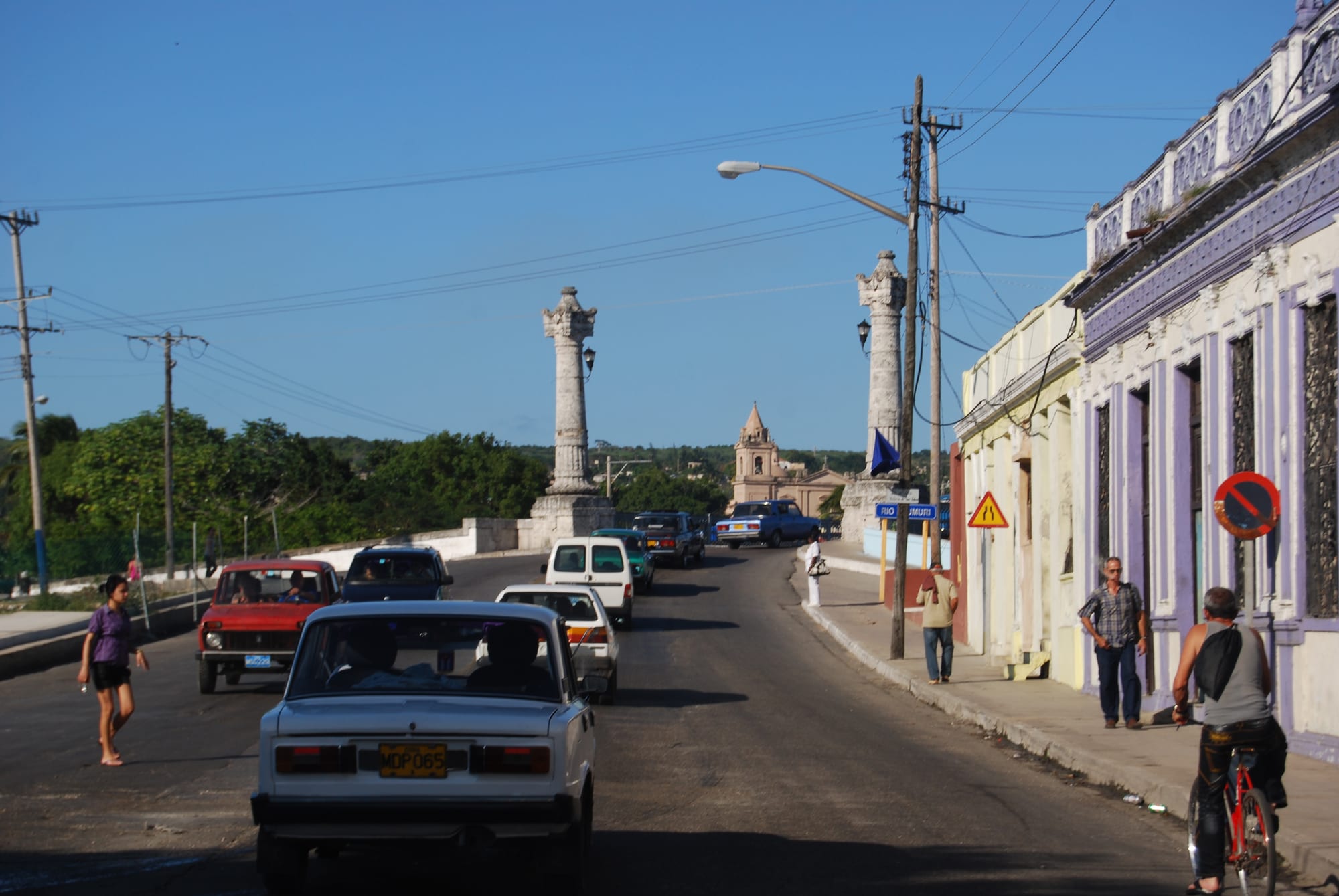
A street of pastel houses and old cars leading to a bridge flanked by tall stone columns, with a church tower beyond

Varadero & Matanzas, Cuba

Matanzas

A street in Matanzas running down to the Puente de la Concordia over the Yumurí River. (Dietrich Michael Weidmann / Wikimedia Commons · CC BY-SA 3.0)

The capital of Matanzas Province, on a deep bay on Cuba's north coast about 100 km east of Havana. Sugar and slavery made it rich in the 19th century, when its poets earned it the name Athens of Cuba; today it is a working port city of rivers and bridges, best known as the birthplace of danzón and a home of rumba.

Neighbourhoods

  • The historic centre
    • First-time visitors
    • Historic district
    • Architecture

    The old core of the city, where the Sauto theatre, the Palacio de Junco and the Plaza de la Vigía stand a short walk from the Parque de la Libertad. Most of the city's casas particulares are in the streets between the theatre and the park.

    Open in Maps
  • Versalles
    • Quiet and residential
    • Local life

    One of the city's four traditional neighbourhoods, with the separate station of the electric line built to carry sugar towards Havana.

    Open in Maps
  • Bellamar and the Canímar
    • Caves and nature
    • Day trips

    The south-eastern side of the city, towards the Bellamar caves and the mouth of the Canímar River on the far side of the bay. Boat trips up the river start from the bridge on the road to Varadero.

    Open in Maps

Things to do

Famous landmarks

  • Sauto Theaterlandmark

    The theatre opened in 1863, a national monument with a U-shaped, wood-panelled auditorium of 775 seats, three balconies, Carrara marble goddesses in the lobby and a floor that can be raised to make a ballroom.

    Open in Maps
  • Matanzas Cathedrallandmark

    The Cathedral of San Carlos Borromeo, the seat of the bishop of the Catholic Diocese of Matanzas.

    Open in Maps
  • Puente de la Concordialandmark

    The bridge over the Yumurí River marked by tall stone columns, one of the many crossings that give Matanzas its name as the City of Bridges; it is painted on the Sauto's original curtain.

    Open in Maps
  • Plaza de la Vigíalandmark

    A square in the old centre, which gave its name to Ediciones Vigía, the publishing group founded here in 1985 that makes short runs of hand-coloured books.

    Open in Maps

Museums

  • Pharmaceutical Museummuseum

    Founded in 1882 and declared a national monument, it preserves a 19th-century French pharmacy.

    Open in Maps
  • Provincial History Museummuseum

    Housed since 1980 in the Palacio de Junco, built for the del Junco family between 1835 and 1838, with collections on the province's history.

    Open in Maps
  • Castillo de San Severinomuseum

    A 17th-century fortress close to the shore of the port, one of the oldest buildings in the city, which since 2009 has held the National Museum of the Slave Route.

    Open in Maps
  • Galería Pedro Esquerrémuseum

    The provincial visual arts council's gallery, with changing exhibitions of contemporary Cuban art.

    Open in Maps

Rivers, caves and countryside

  • Cuevas de Bellamarattraction

    A cave system on the south-eastern edge of the city, protected as a national monument and visited on guided tours.

    Open in Maps
  • Canímar Riverpark

    The river that enters the bay on its south-east side; open boats carry visitors some 13 km upstream past the river's meanders to a riverside restaurant, with horse rides at the end.

    Open in Maps
  • Yumurí Valleypark

    The green valley behind the city, between the Pan de Matanzas hill and the coastal ridge, with good birdwatching among the trees below the heights.

    Open in Maps

Short trips from the city

  • Varaderobeach

    The resort town about 32 km east on the Hicacos Peninsula, one of the largest resort areas in the Caribbean, with a long beach of pale sand; many of its hotel staff live in Matanzas.

    Open in Maps

Eat and drink

Long-standing places and food districts in Matanzas. Hours, ratings and directions come from your maps app, always current.

Matanzas classics

  • Café Atenascafe

    A café in a historic building facing the Sauto theatre, with a terrace for watching the square and a menu of Cuban pizzas and rice-and-meat dishes.

    Open in Maps
  • The Canímar riverside restaurantrestaurant

    A rustic restaurant at the end of the Canímar boat trip, reached along an avenue of royal palms.

    Open in Maps

Food districts

  • The old centre around Parque de la Libertadneighborhood

    The streets between the theatre and the central park, where casas particulares cook for their guests and small private and state eateries serve the standard Cuban plates.

    Open in Maps

Experience Matanzas

History

Matanzas was founded on 12 October 1693 as San Carlos y San Severino de Matanzas, after a royal decree of 1690 ordered that the bay be settled by 30 families from the Canary Islands. The name means "massacres", and local tradition ties it to an episode in 1510 when Spanish soldiers crossing one of the rivers were overturned by Indigenous fishermen and most of them drowned — described by the city's historian as the first act of Indigenous rebellion in Cuba. The town grew up where three rivers, the Yumurí, the San Juan and the Canímar, run into the bay.

In the 19th century the plains around the city were turned over to sugar, and enslaved Africans were brought in to work the plantations. In 1792 they were about 30 per cent of the population of Matanzas; by 1841 they were 62.7 per cent. The area saw several slave risings and plots, among them the Escalera conspiracy discovered in late 1843, which was followed by a year of savage repression. During the sugar boom the city's poets earned it the name Athens of Cuba, and the Sauto theatre opened in 1863.

On 25 April 1898 American warships bombarded Matanzas, the first action of the Spanish–American War. In the 20th century the Hershey company built an electric railway to carry sugar to the port of Havana. In August 2022 an explosion and fire at the city's oil storage base forced the evacuation of about 4,900 people and shut the local power station.

Culture & Customs

Matanzas is known as the birthplace of danzón and rumba. Danzón, the stately couple dance long treated as Cuba's national dance, became a distinct genre by 1879, when Miguel Faílde's Las alturas de Simpson — named after a neighbourhood of the city — was first performed here. Rumba grew in the second half of the 19th century among Afro-Cuban workers in the poor neighbourhoods of Havana and Matanzas, and the city's Los Muñequitos de Matanzas, formed in 1952 as the Conjunto Guaguancó Matancero, are among the most acclaimed rumba groups of all time. The group Afrocuba is another local name, and the mambo bandleader Dámaso Pérez Prado was born here.

Because so many enslaved and free Afro-Cubans lived in Matanzas, African traditions survived especially strongly. Santería is widely practised, and the city even has a Lucumí name, Ayá Áta. Drumming, song and ritual are part of neighbourhood life.

The city also keeps its literary reputation. The Sauto theatre still stages plays, opera, ballet and concerts, and Ediciones Vigía, founded in 1985 on the Plaza de la Vigía, has become known abroad for its handmade, hand-coloured books, a collection of which is held by the British Library.

Daily Life

About 164,000 people lived in the municipality of Matanzas at the 2022 count, spread over the city's four traditional neighbourhoods — Versalles, Matanzas, Playa and Pueblo Nuevo — and the outlying barrios. As the provincial capital it has the province's government offices, the University of Matanzas, a working port and oil installations around the bay.

Many people in the city work in tourism without working in Matanzas at all: a large share of the hotel staff of Varadero live here and travel along the coast each day, and a job with access to tips in foreign currency is one of the most valued in Cuba. Sugar, once the base of the economy, has shrunk as mills have closed.

Daily life follows the national pattern of low state wages, rationing, queues and long power cuts, and the province has lost many young people to emigration. The 2022 fire at the oil base, which knocked out the local power station, deepened the city's energy troubles. Even so, life is lived outdoors — on doorsteps, in the squares and on the bridges — and the music that made the city's name is still played in homes and neighbourhood halls.

Food

Matanzas eats the Cuban staples: rice and black beans, often cooked together as congrí, roast and fried pork, chicken, yuca with mojo, a garlic and citrus dressing, and fried plantain, both as savoury tostones and sweet maduros. Along the coast there is fish, and casabe, a flat cassava bread with Taíno roots, is still made in parts of the countryside. Ingredients are often limited by the shortages, so menus change with what can be found.

Much of the cooking visitors eat is done in casas particulares, whose hosts serve breakfast and dinner, or in small private paladares and state cafés around the old centre. Guarapo, freshly pressed sugar-cane juice, is sold at stands in the cane country, and strong sweet coffee punctuates the day.

The province has a place in the history of rum: in nearby Cárdenas the Arechabala company launched Havana Club in 1934, and rum from the region's cane underpins the mojitos and Cuba libres served along the coast. In the city itself the cafés around the Sauto theatre are the classic places to sit over a coffee or a beer and watch the square.

Planning tools

Budget

Matanzas is much cheaper than Varadero and sees few tourists for a city so close to the resorts. Casas particulares in the centre are the usual places to stay, and boat trips, cave tours and taxis are the main extra costs. Cuba is essentially a cash economy for visitors, and shortages of fuel, food and medicine make prices hard to predict.

Daily Budget Midrange
USD 90–180 (a good casa, private restaurant meals, a cave or river trip, private taxis)
Daily Budget Shoestring
USD 35–60 (casa particular, home-cooked meals and state cafés, buses and shared taxis)

Bring all the cash needed in euros or US dollars; US-issued cards do not work and ATMs are unreliable.

Best Time to Visit

December to April is the dry season and the most comfortable time, and the best months for birdwatching and for the beaches at nearby Varadero. May to October is hotter and wetter, with afternoon storms, and September and October carry the highest hurricane risk.

Suggested Number of Days

The historic centre can be seen in a day or two. Allow three or four to add the caves, the river, the valley and the beaches to the east, and leave extra time because fuel shortages can disrupt transport.

First Visit
1–2 days
With Surroundings
3–4 days

Transportation

The centre is best covered on foot. Víazul buses stop at the bus terminal east of the San Juan River, where shared taxis also wait, and local buses run to the caves and to Varadero for resort workers. The main railway station is on the line from Havana to Santiago de Cuba, and the Vía Blanca highway links the city with both Havana and Varadero.

Fuel shortages regularly disrupt buses and taxis, so confirm services are running and keep plans flexible.

Airport & Station Connections

Matanzas lies about 100 km east of Havana and about 30 km west of Varadero along the Vía Blanca. Juan Gualberto Gómez Airport, the international airport for Varadero and the province, is closer to Matanzas than to Varadero. Most visitors arrive by Víazul bus or shared taxi from Havana or Varadero. Cuba stopped refuelling airliners in February 2026 and several foreign airlines suspended their routes.

Walkability

The historic centre is compact and easy on foot, with the theatre, squares and museums close together and the bridges linking the neighbourhoods on either side of the rivers. The bus terminal is about a ten-minute walk from the centre. The caves and the Canímar River need a bus, taxi or tour.

Safety

Cuba has low levels of violent crime and is generally very safe for visitors. Matanzas city is calm, and few tourists stay overnight. The practical problems are the national ones — power cuts, shortages and overcharging — and the province is exposed to hurricanes.

Keep valuables secure, agree taxi fares in advance, carry a torch for power cuts, and bring basic medicines. Check current official travel advice before travelling.

Climate

Tropical and hot, with the north coast cooled by trade winds. The dry season runs from November to April; May to October is hotter, more humid and wetter, and overlaps the Atlantic hurricane season.

Summer
Matanzas summers are hot and humid, with afternoon storms; nearby Varadero's summer mean is about 27°C
Winter
Matanzas winters are warm, with windy spells when cold fronts pass; nearby Varadero's winter mean is about 21°C

Local Customs

Spanish is spoken everywhere, and English far less than in Varadero. Afro-Cuban religion is part of daily life, and drumming ceremonies are held in homes and in the cabildos; visitors should ask before photographing them or people dressed in white for initiation. Tips in foreign currency are an important part of many incomes.

Ask before taking photographs of religious ceremonies or people, dress modestly in churches, and tip guides, drivers and casa hosts in cash.

Common Payment Methods

The currency is the Cuban peso (CUP), but many services for visitors are priced in US dollars or euros, and the official and informal exchange rates differ widely. Bring cash in euros or US dollars and change small amounts at a time; US-issued cards do not work, and ATMs are unreliable.