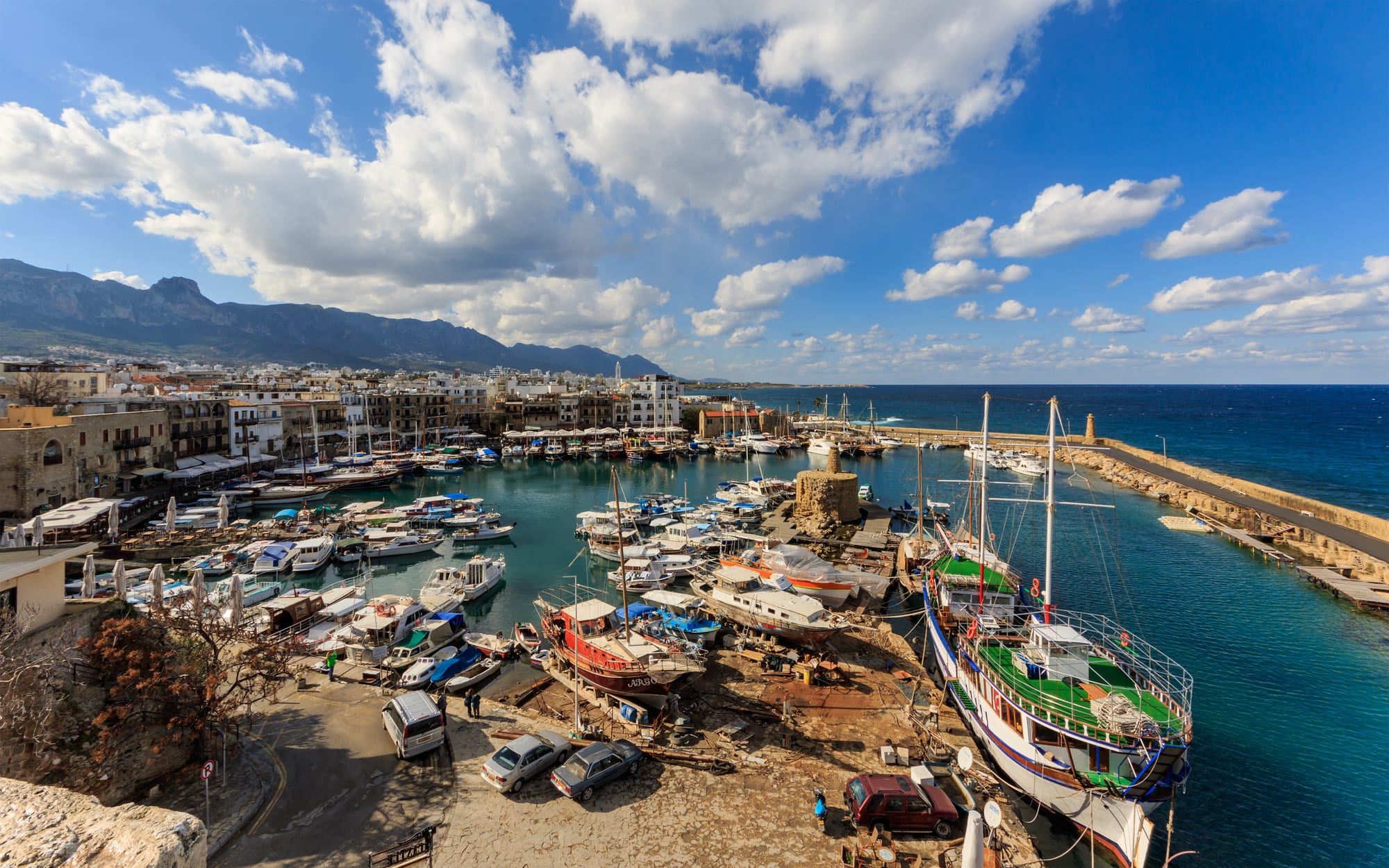
Boats and wooden gulets crowding Kyrenia's old harbour, ringed by waterfront buildings, with the Kyrenia Mountains rising behind under white clouds

Cyprus

Kyrenia

Kyrenia's old harbour seen from a bastion of the castle. (A.Savin / Wikimedia Commons · FAL)

A harbour town on the north coast of Cyprus, below the Kyrenia Mountains, known for its old harbour and the Venetian castle that holds a 4th-century BC shipwreck. Since 1974, when its Greek Cypriot inhabitants were displaced, it has lain in the north of the divided island, and it is now the north's main tourist town.

Neighbourhoods

  • The old harbour and Kato Kyrenia
    • First-time visitors
    • Historic district
    • Best for food

    Lower Kyrenia around the old harbour, where two-storey merchants' houses, once warehouses below and homes above, are now lined with cafés, bars and restaurants, with the castle guarding the eastern end.

    Open in Maps
  • Pano Kyrenia
    • Local life
    • Quiet and residential

    The upper town, known historically as the Riatiko, where the Christian population moved after the Ottomans cleared the fortified town. The church of Archangel Michael, rebuilt after 1856 on a rocky mount above the sea, now houses an icon museum.

    Open in Maps
  • Bellapais
    • Views
    • Quiet and residential
    • History

    A village about 5 km from the town, built around its ruined 13th-century abbey, which looks down over Kyrenia to the sea.

    Open in Maps
  • Alsancak and Lapta
    • Beaches
    • Quiet stays

    The villages of the coastal strip west of the town, with Lapta about 13 km out, where many of the area's smaller hotels are found.

    Open in Maps

Things to do

The town and harbour

  • Kyrenia Castlelandmark

    The castle at the east end of the old harbour, founded on Roman and Byzantine works and rebuilt by the Venetians with massive round corner towers, with a 12th-century chapel reusing late Roman capitals.

    Open in Maps
  • Shipwreck Museummuseum

    Inside the castle, the Kyrenia Ship — a Greek merchant ship that sank some time after 294 BC, found by a diver in 1965 and raised with its cargo of amphorae, with more than half of its hull timbers preserved.

    Open in Maps
  • Harbour chain towerviewpoint

    The small tower in the harbour from which a defensive chain could once be slung to close it to enemies, with views back to the castle.

    Open in Maps
  • Archangel Michael icon museummuseum

    An icon museum in the former church of the Archangel Michael, set on a rocky rise above the harbour.

    Open in Maps
  • Agha Cafer Pasha Mosquelandmark

    An Ottoman mosque in the town centre, built in 1589–1590.

    Open in Maps

Abbey and mountain castles

  • Bellapais Abbeylandmark

    The ruin of a 13th-century abbey of canons regular at 220 metres above sea level, with long views down to Kyrenia; its refectory hosts concerts and music festivals in spring and early summer.

    Open in Maps
  • Saint Hilarion Castlelandmark

    The best-preserved of the three Kyrenia Mountains strongholds, possibly built around an earlier monastery, commanding the pass road from Kyrenia to Nicosia.

    Open in Maps
  • Buffavento Castlelandmark

    A mountain castle mixing Byzantine and Frankish building, used as a prison under the Lusignans, known in legend as the Lion's Castle, and disused from the 14th century.

    Open in Maps

On the water

  • Boat trips from the harbourattraction

    Gulets and other boats leave the old harbour for trips along the coast, often with a meze lunch on board.

    Open in Maps

Seasonal events

  • Kyrenia Festival of Culture and Artssummer, centred on June

    A festival of concerts, from Turkish bands and singers to Latin and reggae music, with plays and talk shows in the city amphitheatre and Ramadan Cemil Square, later extended with events from May to September.

  • Bellapais music festivalsspring and autumn

    Classical music, opera and concerts by Turkish Cypriot and international musicians in the refectory of Bellapais Abbey.

Eat and drink

Long-standing places and food districts in Kyrenia. Hours, ratings and directions come from your maps app, always current.

Kyrenia classics

  • The old harbourneighborhood

    The harbour front is lined with cafés, bars and restaurants used by locals and visitors alike, with fish and meze the staples.

    Open in Maps
  • Bellapais Abbey cafécafe

    The abbey site includes a restaurant and a café, looking out over the coast below.

    Open in Maps

Experience Kyrenia

History

Greek myth credits Kyrenia's founding to the Achaeans Cepheus and Praxandrus, who came here after the Trojan War and named the town after their home of Kyrenia in Achaea; the coast to the east is still called the Coast of the Achaeans. An ancient merchant ship that sank off the harbour some time after 294 BC is evidence of the busy sea trade of the time. The Romans laid the foundations of the castle, and early Christians used the old quarries of Chrysokava, just east of it, as catacombs and rock-cut cemeteries.

The town grew in importance after Arab raids destroyed Lambousa in 806, because its castle offered protection. In 1191 Isaac Komnenos sent his family and treasure there for safety when Richard I of England seized the island, which passed in 1192 to Guy of Lusignan. The Lusignans walled the town and enlarged the castle, which never capitulated in the island's medieval wars; the Venetians rebuilt it for the age of artillery, adding massive round towers, but surrendered it and the town to the Ottomans in 1571. Christians were then expelled from the fortified town and moved to Pano Kyrenia or to the mountain villages.

In 1831 the town was almost evenly divided between Muslims and Christians, but under British rule many Turkish Cypriots left for Anatolia, and Greek Cypriots became the majority. The British built a road over the mountain pass to Nicosia, and tourism revived the economy. The town saw little fighting in 1963–64, though the Kyrenia–Nicosia road was blockaded. On 20 July 1974 the Turkish army, responding to the coup by EOKA B and the Greek junta, landed west of the town and reached Kyrenia on 22 July. Its Greek Cypriot inhabitants, around 2,650 people, fled or were displaced.

Culture & Customs

Kyrenia today is the cultural and tourist centre of Northern Cyprus. Its Festival of Culture and Arts, held through June and later extended across the summer, brings concerts by Turkish bands and singers, Latin and reggae music, talks and theatre to the city amphitheatre and Ramadan Cemil Square; in 2012 some 500 to 600 artists and performers took part. In 2014 the town hosted the Golden Island International Film Festival, the first such festival in the north.

Bellapais Abbey, above the town, is its most atmospheric stage. Its refectory hosts concerts and lectures, and two music festivals are held there — a spring festival of opera and classical music, and the International Bellapais Music Festival, with Turkish Cypriot musicians such as the pianist Rüya Taner alongside international performers.

The layers of the town's past sit close together: the Venetian castle, the Ottoman Agha Cafer Pasha Mosque of 1589–1590 and four 19th-century fountains, and the church of the Archangel Michael, rebuilt after the Ottoman reform edict of 1856 and now an icon museum. Before 1974 Greek, Turkish, Maronite, Armenian, Latin and British residents lived side by side here; today the population is Turkish Cypriot, mainland Turkish and British.

Daily Life

The municipality has about 33,000 people — Turkish Cypriots, settlers from mainland Turkey and British expatriates. Several universities, among them Girne American University and the University of Kyrenia, have around 14,000 students between them.

Tourism is the core of the economy. Kyrenia is described as the tourism capital of Northern Cyprus, with many hotels and a busy nightlife, and the old harbour is lined with cafés, bars and restaurants used by locals and visitors alike. Casinos draw a share of the visitors, though they do not necessarily benefit local businesses. The Kyrenia Touristic Port, opened in 1987, is a major transport hub thanks to its closeness to Turkey and the entry point for those who arrive by ferry.

The old harbour itself has a hard history: harbour works begun by the British in 1885 left it open to the northern gales, and many caiques were wrecked in it over the following decades. Today it serves boats taking visitors along the coast.

Food

Kyrenia's food is Cypriot, with a Turkish Cypriot accent. Grilled meat is the centre of it: chunks of pork, lamb, beef or chicken cooked on skewers over charcoal, known as şiş in Turkish and souvla or souvlaki in Greek, alongside gyros, called döner in Turkish, with slices of grilled meat. Halloumi, the semi-hard brined cheese of goat's and sheep's milk, may be eaten fresh, grilled or fried, and aged halloumi is grated over pasta.

A meze is the fullest meal: olives, tahini, potato and garlic dip, taramosalata and cacık — the yoghurt dip known in Greek Cypriot as ttalattouri — with bread and salad, followed by grilled halloumi, meatballs, sausages and more. On the harbour front fish leads the menu, and a fish meze brings calamari, octopus, cuttlefish, red mullet and sea bass. Boat trips along the coast often serve a meze lunch on board.

Sweets include loukoum (Cyprus delight), tulumba, baklava, loukoumades and ravani, a semolina cake with citrus. To drink there is, as across the island, brandy and zivania, the grape spirit.

Planning tools

Budget

Kyrenia is the tourism capital of Northern Cyprus, with plenty of choice at every level. A hire car adds to the bill but is the practical way to reach the mountain castles.

Daily Budget Midrange
USD 120–220 (mid-range hotel, hire car, harbour dinners, castle and abbey tickets)
Daily Budget Shoestring
USD 55–95 (guesthouse or simple hotel, grill-house meals, minibuses)

The castle, the abbey and the mountain castles are the main paid sights; the harbour, the breakwater and the old streets cost nothing.

Best Time to Visit

Spring and autumn are the best seasons, warm enough for the sea and cool enough for climbing to Saint Hilarion; Bellapais holds its music festivals in spring and again in autumn. Summers are long, hot and dry, and the festival of culture and arts fills the early summer. Winters are cool, with sunny spells and rain.

Suggested Number of Days

Two or three days cover the town and the hills directly above it. Four or five allow time for the rest of the north coast and for crossing to Nicosia; without a car, the outlying sights take longer to reach.

First Visit
2–3 days
With Surroundings
4–5 days

Transportation

The town centre is walkable, but a car is needed to explore the mountains, and there are many rental companies in town. Buses work like Turkish dolmuş minibuses, leaving when full rather than to a fixed timetable; they run along the coastal resort strip but do not reach outlying sights such as Saint Hilarion. Cyprus drives on the left.

A hire car taken across from the south needs extra insurance to be driven in the north.

Airport & Station Connections

Most visitors arrive through Ercan airport in the north, whose flights all route via Turkey; public transport from it is limited, usually by bus into Nicosia and out again. The Republic of Cyprus treats entering the island through Ercan as illegal. Visitors can also fly into Larnaca in the south and cross at an official checkpoint. Minibuses from North Nicosia take about half an hour, and ferries from Turkey use the Kyrenia Touristic Port, 1 km east of the old harbour.

Walkability

The old harbour, the castle, the mosque and the icon museum are all within a few minutes' walk of one another, and the bus drop-off point is 200 metres south of the castle. Beyond the centre the town spreads along the coast road, and Bellapais and the castles are a steep drive up into the mountains.

Safety

Cyprus is a very safe country with low levels of crime. Kyrenia lies in the north, which has been divided from the south by a UN buffer zone since 1974 and is recognised only by Turkey; the crossings between north and south are official checkpoints on the UN buffer zone.

Cross between north and south only at official crossing points, and do not photograph military or police installations. Check current official travel advice before travelling.

Climate

Hot-summer Mediterranean, with long, dry, hot summers and cool winters of sunny spells and rain.

Summer
long, hot and dry — in July and August the average maximum on the Cyprus coast is around 37°C by day and around 28°C at night
Winter
cool, with sunny spells and rain — in January and February coastal places other than Limassol are generally 16–18°C by day and 9–11°C at night

Local Customs

Kyrenia is Turkish-speaking, and its people are Turkish Cypriots, settlers from mainland Turkey and British residents; English is spoken, though less widely than in the south. The town's Greek Cypriot past remains visible in its churches and the icon museum, and its Ottoman past in the mosque and fountains.

Alagadi beach, about 30 km east of the town, is closed to the public on summer nights to protect nesting turtles, but volunteer rangers run guided walks.

Common Payment Methods

The official currency in the north is the Turkish lira, but most businesses accept euros, British pounds, US dollars and bank cards, though better rates come from changing money into lira at the exchange offices.