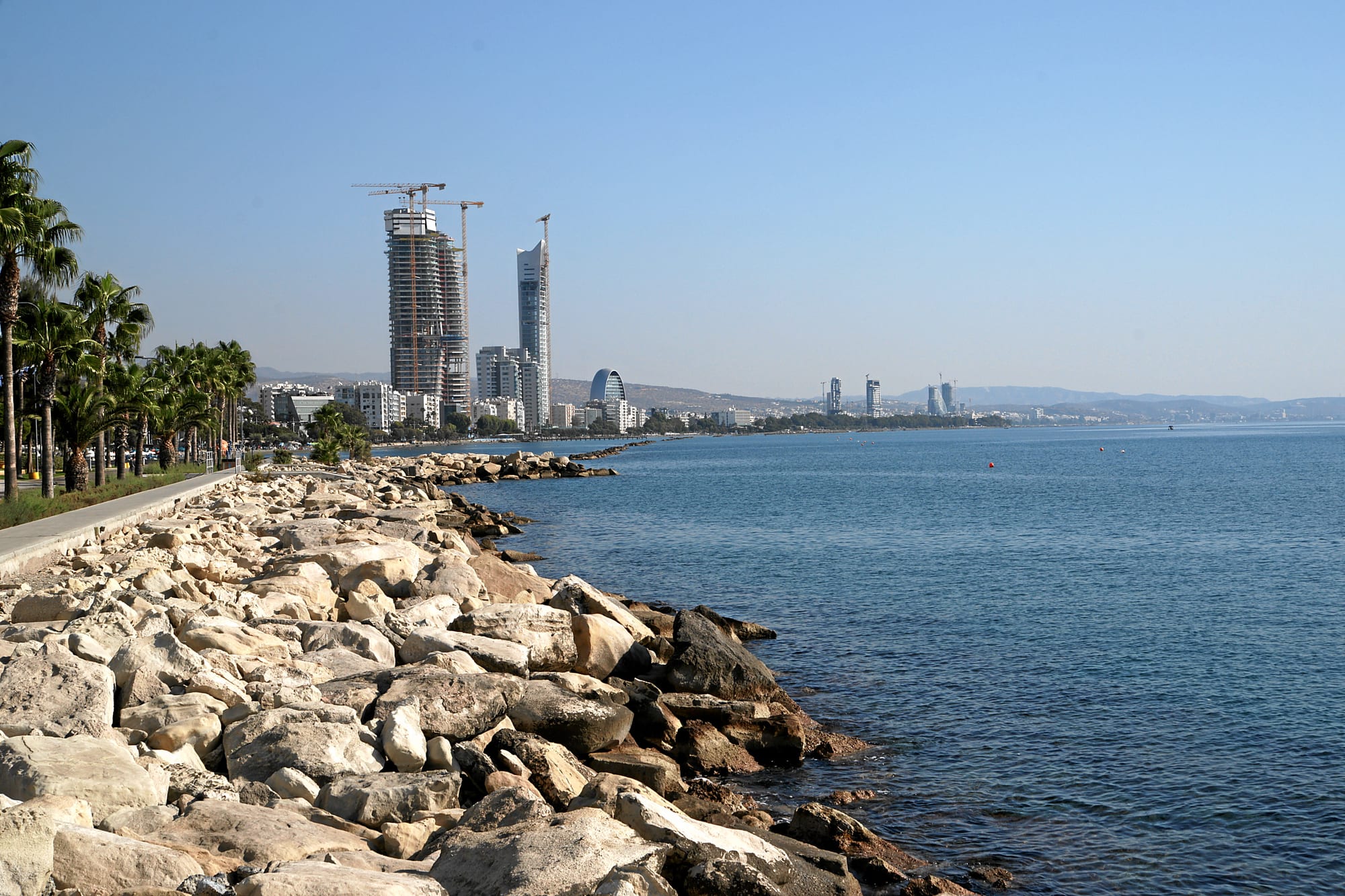
A palm-lined promenade and rocky breakwater beside calm blue sea, with Limassol's high-rise towers and cranes along the coast beyond

Cyprus

Limassol

The Molos seafront promenade in Limassol. (Mboesch / Wikimedia Commons · CC BY-SA 4.0)

The second city of Cyprus and its main port, on the south coast between the ancient sites of Amathus and Kourion. A medieval castle and old port mark the historic centre; since 1974 the city has spread for kilometres along the shore, with a seafront park, a marina, high-rise towers and a large international business community.

Neighbourhoods

  • Old Town and the Old Port
    • First-time visitors
    • Historic district
    • Best for food

    The historic centre around the medieval castle and the Old Port. Anexartisias Street is one of the main shopping streets, and the marina, built in 2014, lies just west of the castle.

    Open in Maps
  • Molos and the seafront
    • Walks
    • Families
    • Waterfront

    A kilometre of seaside park on reclaimed land east of the Old Port, with sculptures, playgrounds and piers, part of a long seafront walk that leads east past the Municipal Garden. A cycle lane follows the beach road.

    Open in Maps
  • Germasogeia and the tourist area
    • Beaches
    • Nightlife
    • Hotels

    The eastern suburb of about 17,000 people and the hotel strip along the coast below it, where beach bars, tavernas and the pubs of the Potamos Yermasoyia area fill the seafront. Its dam dates from 1968.

    Open in Maps
  • Amathus and Agios Tychonas
    • Beaches
    • Quiet and residential

    The far eastern end of the city's coastal sprawl, where the suburbs reach the ruins of ancient Amathus, about 10 km from the centre, with the village of Agios Tychonas close by.

    Open in Maps

Things to do

The historic centre

  • Limassol Castlemuseum

    The castle by the Old Port, rebuilt around 1590 under Ottoman rule on older foundations. Tradition says Richard the Lionheart married Berengaria of Navarre here in 1191; it was a prison from 1790 to 1940 and is now a medieval museum.

    Open in Maps
  • Limassol Marinaattraction

    A marina for about 1,000 boats on the Old Port, 500 metres west of the castle, opened in 2014, with restaurants and shops along its quays.

    Open in Maps

Parks and the seafront

  • Limassol Molospark

    The seaside park and promenade on reclaimed land, one of the largest parks on the island, with a sculpture park, piers for fishing and kayaking, and playgrounds.

    Open in Maps
  • Akti Olympiontrail

    A 7 km beachside walking park running from the Municipal Gardens to the Old Port.

    Open in Maps
  • Municipal Gardenpark

    The public gardens along the beach road, where the annual wine festival is held, with a small zoo.

    Open in Maps

Ancient sites and castles

  • Amathuslandmark

    The ruins of an ancient city-kingdom on the coast east of the city, whose sanctuary of Aphrodite was second only to Paphos; tombs, public baths and an agora have been excavated.

    Open in Maps
  • Kourionlandmark

    An ancient Greek city on a limestone promontory nearly 100 metres above Episkopi Bay, with a Greco-Roman theatre and the House of Achilles; it lies within the British Sovereign Base Area.

    Open in Maps
  • Kolossi Castlelandmark

    A three-storey Crusader keep of 1454 built by the Knights Hospitaller, once with large facilities for producing sugar, and linked by name with Commandaria wine.

    Open in Maps

Beaches and nature

  • Lady's Milebeach

    A beach on the coast south-west of the city, inside the British Sovereign Base Area.

    Open in Maps
  • Limassol Salt Lakepark

    The largest inland body of water on Cyprus, on the Akrotiri peninsula south-west of the city, which dries out in summer.

    Open in Maps
  • Governor's Beachbeach

    A 2 km stretch of small sandy coves with a Blue Flag, on the coast east of the city.

    Open in Maps
  • Fasouri Watermaniaattraction

    The largest water park on the island, in the village of Fasouri west of the city.

    Open in Maps

Short trips from the city

  • Troodos Mountainspark

    The island's largest mountain range, rising to Mount Olympus at 1,952 m, with Byzantine monasteries and churches, mountain resorts and terraced villages.

    Open in Maps
  • Omodosneighborhood

    A village in the Troodos Mountains in the Limassol district, with several eateries and wineries.

    Open in Maps

Seasonal events

  • Limassol CarnivalFebruary or March, ending on the Sunday before Ash Monday

    A ten-day carnival of costumes, satire and parties that ends with a grand parade of floats along Makariou Avenue.

  • Wine Festival of Cypruslate summer or early autumn

    A celebration of the island's winemaking held since 1961, organised by the municipality since 1978 and usually staged in the Public Gardens.

  • Limassol Marathonannually, over two days

    A two-day running event first held in 2006, including a full marathon; more than 17,000 runners from over 70 countries took part in 2024.

Eat and drink

Long-standing places and food districts in Limassol. Hours, ratings and directions come from your maps app, always current.

Limassol classics

  • Meat and fish mezeneighborhood

    A traditional Cyprus meze, of meat or of fish, brings a long run of small hot and cold dishes to the table and is the city's favourite way to eat out.

    Open in Maps
  • Commandarianeighborhood

    The sweet dessert wine of the Limassol hills, named after the Grand Commandery at Kolossi and thought to be the oldest continually produced named wine in the world.

    Open in Maps

Food districts

  • Old Town and Saripolou Squareneighborhood

    Restaurants and bars in the streets of the old town near the castle, around Saripolou Square and the old agora.

    Open in Maps
  • The Carob Millneighborhood

    A restaurant and bar complex in the old carob mill beside Limassol Castle.

    Open in Maps
  • Germasogeia seafrontneighborhood

    Beachside tavernas, fish meze restaurants and the many bars of the Potamos Yermasoyia tourist area.

    Open in Maps

Experience Limassol

History

Limassol grew up between two ancient city-kingdoms, Amathus to the east and Kourion to the west, both founded around 1100 BC. A settlement probably took shape here as Amathus declined, by around the 7th century AD, and it was known for a time as Theodosiana and Neapolis. Its decisive moment came in 1191, when Richard the Lionheart, sailing to the Third Crusade, landed at Limassol, took the Byzantine ruler Isaac Komnenos captive and seized the whole island. Richard married Berengaria of Navarre, who was crowned queen of England in Cyprus, and destroyed Amathus, moving its people to Limassol. The island passed to Guy of Lusignan, and under the medieval Kingdom of Cyprus Limassol's harbour became a centre of trade.

The Ottomans captured the city and its castle in 1538; the Venetians retook and demolished the castle, and after the Ottoman conquest of the island a new fort was completed in 1590 on its remains. Greek neighbourhoods lay mainly to the east, Turkish to the west, with a mixed area around the castle. British rule from 1878 brought a post office, a telegraph and a hospital, and then schools, theatres, clubs and sports teams.

The events of 1974 transformed the city. Its Turkish Cypriot inhabitants moved north, while Greek Cypriots displaced from the north arrived in large numbers. With Famagusta lost, Limassol's port became the Republic's main seaport, and with Famagusta and Kyrenia gone as resorts, tourism took off along its coast. The city has kept growing upwards and outwards since, with the marina opening in 2014 and seafront towers such as One Limassol, the tallest in Cyprus.

Culture & Customs

Carnival is the high point of the city's year. The ten-day Limassol Carnival, with roots traced to pagan rituals, has a satirical Carnival King at its centre and ends with a grand parade of floats and masqueraders on Makariou Avenue that draws crowds from across Cyprus. The Wine Festival of Cyprus, held since 1961 and organised by the municipality since 1978, brings the island's winemaking to the Public Gardens.

Sport has deep roots here, reaching back to the clubs founded under British rule. AEL and Apollon are the city's two largest sports clubs, with football, basketball and volleyball teams, and AEL became the first Cypriot team to win a European trophy. Limassol co-hosted EuroBasket in 2025, and its marathon set a record in 2024 with more than 17,000 runners. The PSI Foundation, opened in 2024 in an old carob warehouse, shows modern and contemporary art.

The city is also unusually international. It has drawn many Russian and other post-Soviet residents — enough to earn the nickname "Limassolgrad" — and at the 2021 census 77.7 per cent of the district's residents were Cypriot citizens. Schools teach in English, French, Greek, Russian, Ukrainian and other languages.

Daily Life

The municipality, the most populous in Cyprus, has about 108,000 people, and the urban area about 199,000 at the 2021 census, second only to Nicosia's. The urban area takes in the suburbs of Kato Polemidia, Mesa Geitonia, Agios Athanasios, Germasogeia and Ypsonas, and in 2024 a reform of local government reshaped the municipalities.

The city is a major centre for tourism, trade and services, and shipping is at its heart: the New Port is the largest in the Republic and one of the busiest in Mediterranean transit trade, exporting grapes, wine, carobs and citrus fruit, while the Old Port serves mainly fishing boats. Tourism runs along the coast from the Old Port to Amathus, and the presence of the British base at Akrotiri adds to local trade. Anexartisias Street and Makariou Avenue are the main shopping streets.

Weekday shopping hours still break for the middle of the day, and outside the tourist area many smaller shops close on Wednesday afternoons. Life moves outdoors in the long summer — along the Molos promenade, at the beaches, and in the old town's bars late into the evening.

Food

The meze is the meal to have in Limassol, of meat or of fish. A meat meze starts with olives, tahini, skordalia (potato and garlic dip), taramosalata and ttalattouri, the Cypriot version of tzatziki, with bread and salad, before grilled halloumi, lountza (smoked pork tenderloin), keftedes (meatballs), sheftalia and loukaniko sausages arrive. A fish meze brings calamari, octopus, cuttlefish, red mullet and sea bass. Souvlaki — meat grilled over charcoal on skewers — is the everyday quick meal, and kleftiko is marinated meat, traditionally lamb or goat, slow-roasted; aubergines also go into moussaka.

The district's own drink is Commandaria, a sweet dessert wine and a speciality of Limassol, produced in the region for millennia and named after the Grand Commandery at Kolossi; legend has Richard the Lionheart calling it "the wine of kings and the king of wines". Cypriot brandy is drunk with meze and forms the base of the brandy sour, created on the island in the late 1930s, and zivania is the local grape spirit.

The old town around the castle and Saripolou Square has restaurants and bars in its narrow streets, including those in the old Carob Mill, while the Germasogeia tourist area offers seafront tavernas and fish meze.

Planning tools

Budget

Hotel prices in Limassol are highest on the seafront and in July and August. Eating meze in the old town or the tourist area is good value for the amount of food, and the seafront parks are free. A hire car or taxis add to the bill for Kourion, Kolossi and the mountains.

Daily Budget Midrange
USD 125–230 (mid-range hotel, hire car, meze dinners, archaeological sites)
Daily Budget Shoestring
USD 60–100 (guesthouse or budget room, souvlaki and taverna meals, buses)

Outside the tourist area, many smaller shops close on Wednesday afternoons and for a midday break on weekdays.

Best Time to Visit

April to June and September to October are warm and sunny without the peak heat. July and August are hot and busy, with the beaches at their fullest. The carnival enlivens late winter, and winters are mild enough for walking along the seafront and visiting the ancient sites.

Suggested Number of Days

Two or three days are enough for a first visit to the city itself. Four to six allow for the villages and the mountains inland as well. The city is long and thin, so time spent between places adds up without a car.

First Visit
2–3 days
With Surroundings
4–6 days

Transportation

EMEL runs the city buses, with around 53 lines across the district as of 2024, some of them electric; waiting times can still be long. Taxis are widely used, a cycle lane follows the beach road from the Old Port to the Dasoudi area, and hire cars are available in town and at both airports. Cyprus drives on the left, and speed and red-light cameras operate in the city.

InterCity buses to Nicosia, Larnaca, Paphos and the Troodos leave from the Limassol Port passenger building.

Airport & Station Connections

Limassol has no airport of its own. Larnaca International Airport is about 60 km north-east, and both it and Paphos airport are roughly 40 minutes away by car; the Limassol Airport Express shuttle runs from both to Chavouzas station in the outer suburbs, from where a taxi is usually needed. Shared minibuses and intercity buses link the main towns, and the port handles almost all of the island's passenger boat traffic.

Walkability

The old town around the castle is compact and good on foot, and the seafront promenade runs for kilometres east from the Old Port through Molos and past the Municipal Garden. The city as a whole stretches a long way along the coast, so the eastern hotel area is a bus or taxi ride from the centre. Midday summer heat makes long walks hard work.

Safety

Cyprus is a very safe country with low levels of crime. In Limassol the practical concerns are busy roads and the summer heat. The British base at RAF Akrotiri, on the peninsula west of the city, was targeted by a drone attack during the 2026 strikes on Iran, and further drones were intercepted on 2 March.

Take care when crossing roads and when driving, keep away from the military areas of the Sovereign Base Area, and do not photograph them. Check current official travel advice before travelling.

Climate

Hot-summer Mediterranean, close to semi-arid, with hot, dry summers and mild, wet winters separated by short, generally warm and sunny springs and autumns.

Summer
hot and dry — in July and August temperatures range from about 22°C at night to as high as 40°C by day
Winter
mild and wet — days are usually 16–20°C and nights 7–12°C, with occasional colder spells

Local Customs

Limassol is Greek-speaking and Greek Orthodox, with a large Russian-speaking and international community, and English is widely understood. Weekday shop hours include a midday break, and outside the tourist area many smaller shops close on Wednesday afternoons. Greek Cypriot Easter usually falls on a different date from Western Easter, and on Easter Sunday many museums close.

The carnival's dates follow the Orthodox calendar, ending 50 days before Orthodox Easter.

Common Payment Methods

The currency is the euro. Turkish lira are not generally accepted in the south. Carry some cash for small purchases; on some buses cash is the preferred way to pay.