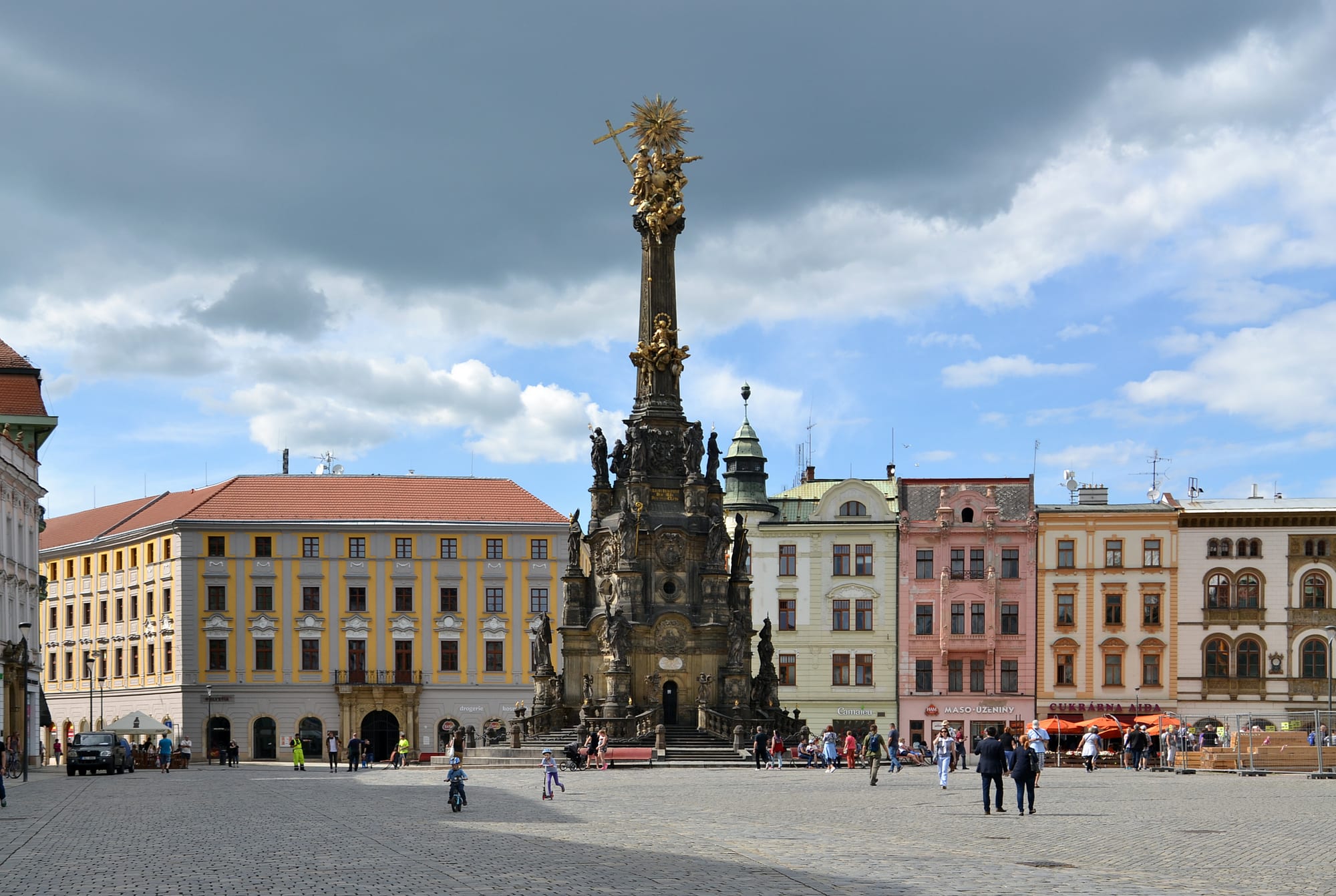
The tall Baroque Holy Trinity Column with gilded statues rising over Olomouc's cobbled main square, lined with pastel facades

Moravia & Silesia, Czechia

Olomouc

The Holy Trinity Column on Horní náměstí, the main square of Olomouc. (Pudelek / Wikimedia Commons · CC BY-SA 4.0)

A university and cathedral city on the Morava in central Moravia, seat of a bishopric since 1063 and once Moravia's largest town and co-capital. Its well-preserved centre holds the UNESCO-listed Holy Trinity Column, six Baroque fountains and a Socialist Realist astronomical clock, and with about 25,000 students it has the highest density of university students in Central Europe.

Neighbourhoods

  • Horní and Dolní náměstí
    • First-time visitors
    • Historic district
    • Best for food

    The two linked market squares at the heart of the old town. Horní náměstí, the larger, holds the town hall with its astronomical clock, the Holy Trinity Column, the theatre and a bronze model of the old town; Dolní náměstí has the Marian column and the Neptune and Jupiter fountains. Cafés and pubs line both.

    Open in Maps
  • Předhradí and Wenceslas Hill
    • History
    • Churches
    • Students

    The eastern, smaller part of the medieval centre, where the Great Moravian governor and later the Přemyslid princes resided. St Wenceslas Cathedral, the Romanesque bishop's palace and many university buildings stand among quiet lanes and cobbled squares.

    Open in Maps
  • The parks along the walls
    • Parks
    • Quiet
    • Families

    A green belt of gardens between the old fortress walls and the Mill channel, including Bezruč gardens, the Smetana gardens, the rose garden and the Flora exhibition grounds, with views up to the university and St Michael's Church.

    Open in Maps
  • Svatý Kopeček
    • Viewpoints
    • Pilgrimage
    • Families

    A village on a hill in the city's eastern spur, crowned by the Baroque basilica of the Visitation of the Virgin Mary that overlooks Olomouc, with the city zoo beside it. Frequent buses climb from the station.

    Open in Maps

Things to do

Famous landmarks

  • Holy Trinity Columnlandmark

    A 35-metre Baroque column built in 1716–1754, the largest Baroque sculptural group in the country and a UNESCO World Heritage Site, with a small chapel in its base.

    Open in Maps
  • Olomouc astronomical clocklandmark

    The clock on the town hall's north wall, first built in the 15th century, shot to pieces by retreating German troops in 1945 and remade in 1947–1955 in Socialist Realist style, with workers in place of saints.

    Open in Maps
  • The Baroque fountainslandmark

    Six Baroque fountains on Roman themes — Jupiter, Mercury, Triton, Neptune, Hercules and Julius Caesar, the city's legendary founder — kept by a cautious council as fire-water reservoirs; a modern Arion fountain joined them on the main square.

    Open in Maps
  • Saint Wenceslas Cathedrallandmark

    The seat of the Archbishop of Olomouc, founded before 1107 and rebuilt in neo-Gothic style in the late 19th century, keeping a Romanesque crypt and Gothic cloister; its 100-metre spire is the second-highest in the country.

    Open in Maps
  • Bishop Zdík's Palacelandmark

    A Romanesque bishop's palace built after 1141 beside the cathedral, an early survival described as unique in Central Europe.

    Open in Maps

Churches and monasteries

  • Church of Saint Mauricelandmark

    A 15th-century Gothic church near the main square, home to one of the largest organs in Central Europe and the International Organ Festival; its tower is a lookout.

    Open in Maps
  • Church of Saint Michaellandmark

    A church above the parks whose richly decorated interior surprises first-time visitors, with a rare painting of an apparently pregnant Virgin Mary.

    Open in Maps
  • Chapel of Saint John Sarkanderlandmark

    A neo-Baroque chapel on the site of the town prison where the priest John Sarkander was tortured and died for refusing to break the seal of confession; the rack is preserved there.

    Open in Maps
  • Hradisko Monasterylandmark

    A large former monastery north-east of the centre, nicknamed the Moravian Escorial, now used as a hospital and open on guided tours.

    Open in Maps

Museums, parks and the zoo

  • Villa Primavesilandmark

    An Art Nouveau villa built for the merchant-banker Otto Primavesi and his wife, the actress Eugenia Butschek, now holding a small gallery beside St Michael's Church.

    Open in Maps
  • Bezruč gardenspark

    A park running between the massive fortress walls and the Mill channel, with views of the university and St Michael's Church.

    Open in Maps
  • Flora Olomouc and the botanical gardenpark

    The exhibition grounds and glasshouses beside the city parks, home since the 1960s to a large horticultural show held each spring.

    Open in Maps
  • Olomouc Zoopark

    The zoo on Svatý Kopeček, one of Europe's largest breeders of the South African gemsbok.

    Open in Maps
  • Andrův stadionattraction

    The 12,474-seat stadium of 1940, home of SK Sigma Olomouc and an occasional venue for the national team, a short walk north of the centre.

    Open in Maps

Short trips from the city

  • Litovelské Pomoravípark

    A protected floodplain of the Morava north of the city, where the freely meandering river splits into a maze of channels through riverside forests.

    Open in Maps
  • Bouzov Castlelandmark

    A castle on a hill above the village of Bouzov, about 28 km north-west of Olomouc, first recorded in 1317.

    Open in Maps
  • Litovelneighborhood

    A small town in the Upper Morava valley, founded in the 1250s, with a protected centre, its town hall and a stone bridge that is the oldest preserved bridge in Moravia.

    Open in Maps
  • Kroměřížneighborhood

    The town long owned by the bishops and archbishops of Olomouc, whose Baroque castle and gardens are a UNESCO World Heritage Site.

    Open in Maps

Seasonal events

  • Academia Film OlomoucApril

    An international festival of science documentary films held under the patronage of Palacký University, with screenings around the faculties and in the main square.

  • Flora Olomoucspring

    A horticultural exhibition with collections of flowers in the exhibition grounds and city parks, drawing tens of thousands of visitors.

  • Festival of SongsJune

    An international choir festival whose singers perform and compete in the city's venues and often break into song in the streets.

  • International Organ FestivalSeptember–October

    A festival organised by the Moravian Philharmonic in venues around the city, centred on the great organ of St Maurice's Church.

  • Christmas marketDecember

    A market on the main square from the start of December, with free concerts, roasted chestnuts, mulled wine and traditional crafts.

Eat and drink

Long-standing places and food districts in Olomouc. Hours, ratings and directions come from your maps app, always current.

Olomouc classics

  • Olomoucké tvarůžky in the pubsneighborhood

    The city's pungent ripened curd cheese, a long-standing beer snack, served in pubs around the squares — eaten plain, fried or marinated.

    Open in Maps
  • Lošticeneighborhood

    The small town where Olomoucké tvarůžky are made, the home of the cheese since the 19th century.

    Open in Maps

Cafés and bars

  • Café Caesarcafe

    A café in the town hall building on the main square, beside the Caesar gallery.

    Open in Maps
  • Cafés and bars of the old townneighborhood

    Student cafés, galleries with coffee and pubs spread through the lanes between the squares and the university, including the pubs in the former water barracks of the fortress.

    Open in Maps

Experience Olomouc

History

As early as the 7th century the early Slavs built a fortified settlement at Povel, one of the three most important Moravian sites of the early Middle Ages. In the 9th century the centre moved to Předhradí, where the Great Moravian governor resided, and the settlement survived the fall of Great Moravia to become the capital of the province. The bishopric was founded in 1063, and around 1141 Bishop Jindřich Zdík moved it to St Wenceslas and built his Romanesque palace. In 1306 King Wenceslas III was assassinated here on his way to Poland, ending the Přemyslid dynasty. Chartered in the mid-13th century, Olomouc was the largest town in Moravia, and in its 15th-century golden age Matthias Corvinus was elected anti-king of Bohemia here in 1469.

The Jesuits founded the university in 1573 to win the Protestant lands back for Catholicism. In the Thirty Years' War the Swedes held the city for eight years and left it in ruins, and Brno took over as the capital. Maria Theresa made Olomouc a fortress, which withstood a seven-week siege by Frederick the Great in 1758. In 1848 Emperor Ferdinand abdicated here. The German-speaking council kept the walls standing until nearly 1900 to keep the city small and German; only in 1919 did it annex its neighbours.

On Kristallnacht in 1938 the synagogue was destroyed, and of the city's Jews fewer than 300 survived the Holocaust. Retreating German troops shot the astronomical clock to pieces in 1945, and the communists rebuilt it with workers in place of saints. After the expulsion of the Germans the city became Czech. Pope John Paul II canonised John Sarkander here in 1995, and the Holy Trinity Column joined the UNESCO list in 2000.

Culture & Customs

Olomouc's culture is shaped by its church and its university. As a bishopric since 1063 and an archbishopric since 1777 it has many churches, from the cathedral and St Maurice, with one of the largest organs in Central Europe, to St Michael and the pilgrimage basilica on Svatý Kopeček, which John Paul II raised to a minor basilica. Palacký University, the oldest in Moravia and second-oldest in the country, occupies about a third of the heritage centre, and its students set the pace of the city's cafés, theatres and festivals.

The city is the centre of Haná, one of the Moravian folk regions, and claims a playful founding legend: humanists of the Renaissance traced its name to a fort of Julius Caesar, who stands on one of the fountains, though nothing confirms it. The six Baroque fountains survived because the council kept them as fire reservoirs while other cities removed theirs.

The calendar is crowded for a city of its size: Academia Film Olomouc, a science documentary festival, in April; the Flora horticultural show in spring; Divadelní Flora, one of the largest Czech theatre festivals; a choir festival and summer concerts; the organ festival in autumn; an animation festival; and the Christmas market. The Moravian Theatre and the Moravian Philharmonic, which the city decided in 2023 to merge into one institution, are based on the main square. Sigma Olomouc play top-flight football and HC Olomouc top-flight ice hockey.

Daily Life

About 105,000 people live in Olomouc, the sixth-largest city in Czechia and the administrative centre of the Olomouc Region; the wider agglomeration, which takes in Přerov and Prostějov, has about 401,000. With over 25,000 students, the city has the highest density of university students in Central Europe, and its rhythm follows the academic year: during term the trams run in coupled pairs and the squares are full, while in the holidays and exam periods many student-oriented cafés and services close.

The city lies on the flat farmland of the Upper Morava valley and is an important railway junction, the first train having arrived from Vienna in 1841. It is the seat of the regional government, the archdiocese and Palacký University, and the city grew beyond its walls only after it annexed two towns and eleven villages in 1919.

North of the city, the gravel-pit lake of Chomoutovské jezero is a protected nature monument with one of the country's largest colonies of black-headed and Mediterranean gulls, and the floodplain forests of the Litovelské Pomoraví protected landscape area begin at the city's northern edge.

Food

Olomouc's name is carried around the country by Olomoucké tvarůžky, a ripened cheese recognisable by its strong scent, pungent taste and yellowish colour. It is made not directly from milk but from low-fat quark, which gives it its name, "little quarks", and a fat content of only about half a per cent. First mentioned in 1452 and sold at the markets that made it famous, it was a peasant food made in the villages around the city until the 19th century; today it is made in Loštice, and since 2010 the name has been protected by the European Union. Tvarůžky are a classic beer snack and are eaten fried, marinated or added to bramboráky, fried potato pancakes.

Otherwise the city eats the Czech staples: svíčková, marinated beef in a thick root-vegetable sauce with dumplings and cranberries; roast pork with dumplings and sauerkraut; guláš; and koláče, yeast pastries filled with fruit, poppy seed or sweet curd cheese. Moravia grows most of the country's wine, and Litovel, just up the Morava valley, has its own brewery.

Student life fills the cafés around the squares and the university, including galleries that double as cafés, and the pubs in the old water barracks of the fortress. In December the Christmas market adds mulled wine and roasted chestnuts.

Planning tools

Budget

Olomouc is one of the least expensive cities in the country to stay in, and its large student population keeps bars and lunches cheap. Most sights are churches and squares that cost nothing to see, and theatre and concert tickets are good value.

Daily Budget Midrange
USD 100–170 (mid-range hotel, restaurant dinners, museum and tower tickets, a concert)
Daily Budget Shoestring
USD 45–75 (hostel or pension, pub lunches, trams and buses)

Many student-oriented cafés and services close or shorten their hours during university holidays and exam periods.

Best Time to Visit

April to June and September, when the university is in session, the flower show fills the parks in spring and festivals of film, song and organ music take place. July and August are warm and quieter, with the students gone. December brings the Christmas market to the main square.

Suggested Number of Days

One or two days are enough for the old town and its churches. Three or four allow time for the castles, floodplain forests and archbishops' towns around the city; festivals and university term dates affect how lively the city feels.

First Visit
1–2 days
With Surroundings
3–4 days

Transportation

The old town is small enough to walk, and trams and buses run by the city transport company cover the rest; trams run as coupled pairs during term and singly in the summer holidays. Buses climb to Svatý Kopeček from in front of the main station every 10–15 minutes. The city is relatively bike-friendly, with paths through the parks, but cycling on pavements is not allowed.

Journey planners such as Mapy.com or IDOS show tram and bus connections across the city.

Airport & Station Connections

The main station is an important rail junction, with trains from Prague in about two to two and a half hours and frequent links to Brno, Ostrava, Zlín and Břeclav. Olomouc lies about 61 km north-east of Brno, whose airport and those of Ostrava, Prague and Vienna serve air travellers. The D35 and D46 motorways skirt the city.

Walkability

The historic centre — one of the largest urban monument reservations in the country — is compact, largely flat and easy on foot, with the two main squares, the cathedral quarter and the parks along the walls all within a short walk.

Safety

Czechia is a safe country with low levels of violent crime. Olomouc is a calm university city where ordinary care with belongings is enough.

Keep an eye on bags in busy bars and at the Christmas market. Check current official travel advice before travelling.

Climate

A humid continental climate on the flat, fertile plain of the Upper Morava valley, fairly dry, with about 530 mm of precipitation a year; July is the wettest month and February the driest.

Summer
warm — July has a mean daily temperature of about 20°C, with hotter spells
Winter
cold — January averages about -1.4°C, with frost and some snow

Local Customs

Olomouc is the centre of Haná, one of Moravia's folk regions, and the seat of an archbishop, so churches are working places of worship as well as monuments; visitors dress modestly and keep quiet during services. In restaurants, a tip of around 10 per cent is normal where tourists eat, and it is handed to the waiter when paying rather than left on the table.

Tvarůžky have a famously strong smell — order them in a pub rather than carrying them around unwrapped.

Common Payment Methods

The currency is the Czech koruna (CZK, written Kč). Cards are accepted almost everywhere; a little cash is useful in small pubs and at the Christmas market. When paying by card or using an ATM, choose to be charged in koruna to avoid a high conversion fee.