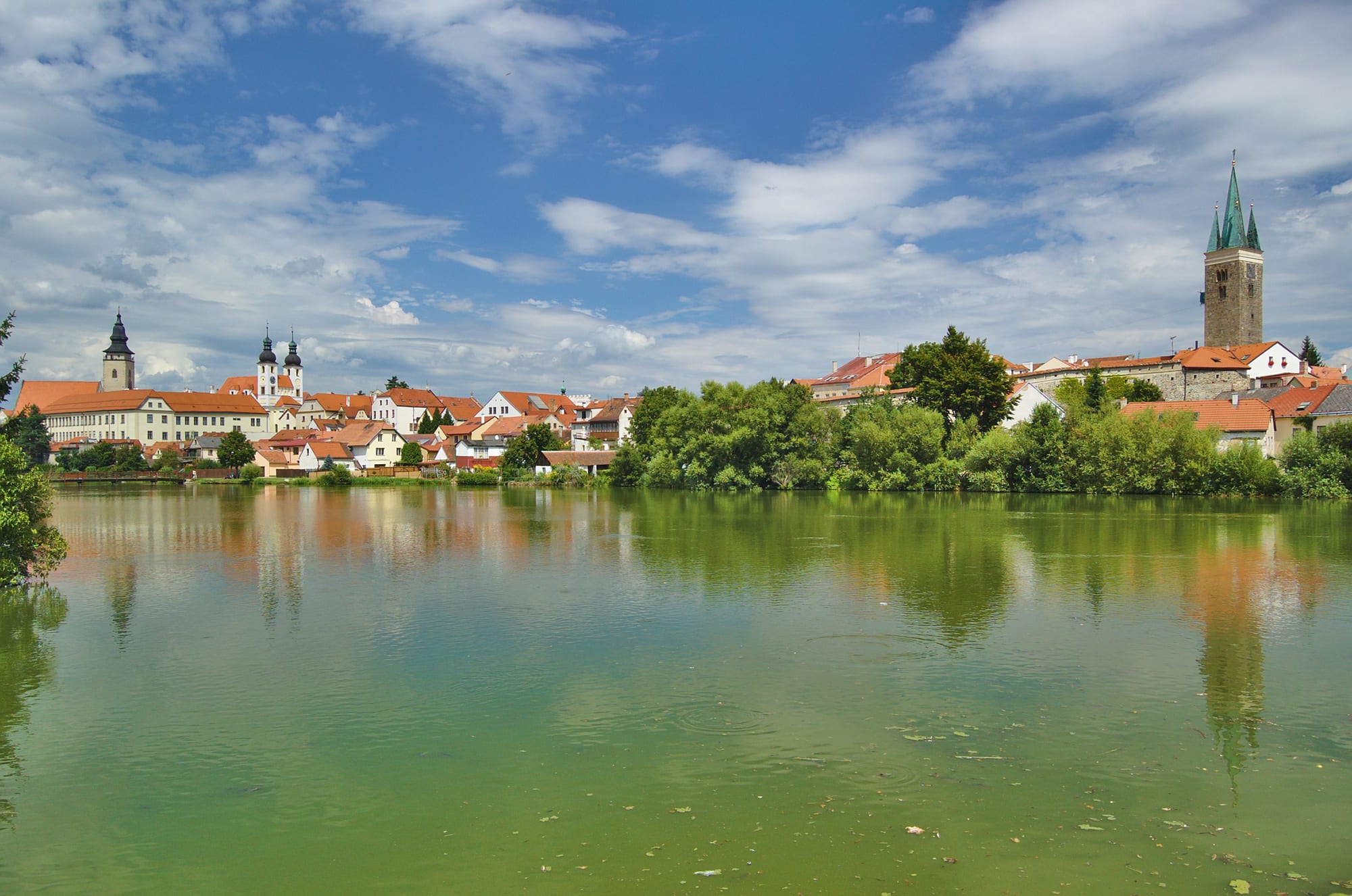
The red roofs, church towers and castle of Telč seen across a calm green pond under a blue sky with white clouds

Moravia & Silesia, Czechia

Telč

The inner town of Telč seen across Ulický rybník, one of the ponds that ring it. (xkomczax / Wikimedia Commons · CC BY-SA 4.0)

A small town in the Křižanov Highlands of south-west Moravia, hemmed in by fishponds, whose long square of arcaded Renaissance and Baroque houses was rebuilt for the nobleman Zachariáš of Hradec in the 16th century. Its historic centre has been a UNESCO World Heritage Site since 1992, and today the town of about 5,100 people lives largely on tourism.

Neighbourhoods

  • The historic centre
    • First-time visitors
    • Historic district
    • Cafés and restaurants

    The walled inner town between the Štěpnický and Ulický ponds, protected as an urban monument reservation. It is built around the long, irregular square of Náměstí Zachariáše z Hradce, with its arcades, high gables and the castle; many of the ground floors hold shops, galleries and cafés, and rooms are rented in houses on the square.

    Open in Maps
  • Staré Město
    • Quiet and residential
    • Churches

    The southern part of town, protected as an urban monument zone, with the town's oldest church, the Church of the Holy Mother of God, inside its walled churchyard. It is a quieter, more residential side of Telč with its own small railway station.

    Open in Maps

Things to do

The square and its churches

  • Náměstí Zachariáše z Hradcelandmark

    The long main square, lined with Renaissance houses that have arcades and high gables, many later given Baroque façades — the heart of the UNESCO-listed historic centre.

    Open in Maps
  • Telč Castlelandmark

    The 14th-century Gothic castle that Zachariáš of Hradec had rebuilt in the Renaissance style, a national cultural monument with the stuccoed Chapel of All Saints, several tour routes, an arcaded garden court and a branch of the Vysočina Museum.

    Open in Maps
  • Church of the Name of Jesuslandmark

    The Baroque Jesuit church of 1663–1667, designed by Giovanni Domenico Orsi and set right into the row of houses on the square as part of the former Jesuit college.

    Open in Maps
  • Church of Saint James the Greatlandmark

    A large Gothic church joined to the castle, with a massive tower almost 60 metres high that opens in summer for views over the town.

    Open in Maps
  • Tower of the Holy Spiritviewpoint

    The late Romanesque tower from the early 13th century, the oldest structure in Telč and a fixture of its skyline, later extended by a Gothic church and opened in summer as a lookout.

    Open in Maps

Ponds, parks and viewpoints

  • The fishpondspark

    Štěpnický, Ulický and Staroměstský ponds, which ring the old town and kept it from spreading; boats can be hired to row on the old moats, and the banks give the classic views of the town.

    Open in Maps
  • Castle parkpark

    The English-style park beside the castle, protected together with it as a national cultural monument.

    Open in Maps
  • Oslednice lookout towerviewpoint

    A 34-metre steel tower on a hill at the edge of town that carries antennae and a viewing platform.

    Open in Maps
  • Muzeum techniky Telčmuseum

    A privately founded museum of technology, opened in 2012 in a former steam sawmill of 1873 on Na Sádkách street.

    Open in Maps

Short trips from the town

  • Třebíčattraction

    A town on the Jihlava River whose Jewish Quarter and St Procopius Basilica are listed together as a UNESCO World Heritage Site.

    Open in Maps
  • Slavoniceattraction

    A small town on the Austrian border that reached its greatest prosperity in the 16th century, when it took on the Renaissance look its protected centre still has.

    Open in Maps
  • Dačiceattraction

    A town on the Moravian Thaya known as the home of the sugar cube, invented there in 1841, with a historic centre protected as an urban monument zone.

    Open in Maps

Seasonal events

  • Prázdniny v Telčilate July to early August

    A music festival held every summer since 1982, one of the oldest in Czechia, with concerts in the town's historic setting.

Eat and drink

Long-standing places and food districts in Telč. Hours, ratings and directions come from your maps app, always current.

Telč's cafés and pubs

  • Restaurants on the squareneighborhood

    Restaurants and summer gardens under the arcades of the main square, serving Czech staples within sight of the castle.

    Open in Maps
  • Pubs on Palackého streetneighborhood

    A street in the centre with traditional pubs serving Czech food and beer.

    Open in Maps
  • Cafés in the historic centrecafe

    Cafés and a tea room in the Renaissance houses around the square, including one run as part of the university centre.

    Open in Maps

Experience Telč

History

Local legend dates Telč to 1099, but the first written mention is from 1335. Its name comes from Teleč, formed from the personal name Telec, meaning "young calf". In the mid-14th century the town gained a Gothic castle, Gothic houses and a water fortification. The Hussite Wars ended this first period of growth: the Hussites took the town, though the castle held out.

Prosperity returned under Zachariáš of Hradec, who acquired the estate in the middle of the 16th century. He had the medieval castle rebuilt in the Renaissance style and the Gothic houses on the square remodelled as Renaissance houses with arcades and decorated façades — the uniform ensemble that defines Telč today, many of whose gables were later reworked in the Baroque style. The Swedish army briefly occupied the town during the Thirty Years' War. The Counter-Reformation brought the Jesuits, who built the Church of the Name of Jesus in 1663–1667 and founded a Latin grammar school; their order's rights were cancelled in 1773.

In the 18th century wealthy townspeople paid for statues, fountains, chapels and a Marian column, and from 1785 the town was Germanised. Industry arrived in the 19th century and the railway in 1898. A Jewish community built a synagogue east of the square in 1904; the building survives, along with the Jewish cemetery. Because the ponds kept the town from spreading, the historic core came through largely intact, and in 1992 it was inscribed as a UNESCO World Heritage Site.

Culture & Customs

Telč is above all a monument town. Its square, protected houses such as the Telč House and the house U Šeniglů, the castle and its Jesuit churches make it one of the most visited places in Czechia by foreign tourists. The setting has long attracted film-makers: Vojtěch Jasný shot The Cassandra Cat here in 1963, Werner Herzog filmed Woyzeck in the town in 1979, and many Czech fairy-tale films were made at the castle, the best known being The Proud Princess (1952) and Z pekla štěstí (1999).

Music is the town's main festival. Prázdniny v Telči ("Holidays in Telč") has been held every year since 1982, at the turn of July and August, and is one of the oldest music festivals in the country. The town also has an arts school, a gymnasium named after the poet Otokar Březina, waymarked nature trails dedicated to him, and links with twin towns that include Rothenburg ob der Tauber in Germany and Figeac in France.

Everyday manners are the Czech ones: a greeting of "Dobrý den" on entering a shop and "Na shledanou" on leaving, beer ordered by the half-litre, and quiet respect inside churches that still serve their parishes. The Jesuit legacy and the many Baroque statues and chapels reflect the strong Catholic history of this part of Moravia.

Daily Life

About 5,100 people live in Telč, a figure that has changed little over the past century — the 1930 census counted around 4,300. The municipality is made up of five parts, one of which, the village of Studnice, is an exclave separated from the rest of the town's territory. The town's economy depends on tourism.

Because the ponds kept the medieval town within its walls, the newer streets where many residents live lie beyond them, in areas such as Štěpnice, the streets by the railway station and Staré Město. Within the centre, the ground floors of the Renaissance houses on the square are largely given over to shops, galleries, cafés and guest rooms.

Telč is also a small centre of learning. Masaryk University runs a university centre here and the Czech Technical University a teaching centre, and the town has a gymnasium, a secondary vocational school, two primary schools and an arts school. The rhythm is that of a Czech country town: an early start, a hot lunch in a pub or canteen, and quiet evenings outside the summer season, when coach parties have left and the square empties.

Food

The town's kitchens serve the Czech staples. Roast pork with dumplings and cabbage (vepřo-knedlo-zelo), often called the most typical Czech dish, and roast duck (pečená kachna) with bread or potato dumplings and braised red cabbage fill pub menus. Knedlíky, bread dumplings steamed and sliced like bread, are one of the mainstays of the cuisine. Bramboračka is a potato soup with onion, carrot, root parsley and celeriac, spiced with caraway, garlic and marjoram, and kulajda, a creamy soup of mushrooms, dill, egg and potatoes, comes from neighbouring South Bohemia.

The fishponds that frame the town are part of a long Czech tradition of fish farming. Fish, mostly trout and carp, is commonly eaten at Christmas, when fish soup made with carp is a traditional dish, and braided vánočka buns and many kinds of Christmas biscuits (vánoční cukroví) are made for the season.

Beer culture was added to the national list of intangible cultural heritage in 2025. Most Czech wine comes from Moravia, and Moravian drinks include burčák, a low-alcohol, partly fermented grape must, and slivovice, plum brandy. Koláče, sweet yeast pastries usually round in shape, are a traditional treat at village feasts and weddings.

Planning tools

Budget

Telč is inexpensive by Czech standards and far cheaper than Prague. Many of the houses on the square rent out rooms at prices that compare well with hotels, and pub lunches are good value. Summer is the busiest season.

Daily Budget Midrange
USD 90–170 (comfortable room on or near the square, restaurant dinners, castle tours and tower climbs)
Daily Budget Shoestring
USD 45–75 (private room or pension, pub lunches, local buses)

Walking the square, the pond banks and the castle park costs nothing.

Best Time to Visit

Late spring to early autumn, when the castle tours and the church towers are open, boats are out on the ponds and the square's cafés set tables outside. Late July and early August bring the music festival. Winters in the highlands are cold and quiet, with many sights closed.

Suggested Number of Days

The town is small and one day covers it comfortably, and many people come on a day trip. An overnight stay adds the square in the quiet of early morning and evening, and two or three days allow time for the other historic towns of the area.

First Visit
1 day
With Surroundings
2–3 days

Transportation

Everything of interest in Telč can be reached on foot. The I/23 road from Třebíč to Jindřichův Hradec runs through the town, and signs on the approach roads direct drivers to a large car park about five minutes' walk from the centre, where tour buses also stop. The town has two railway stations, Telč and Telč-Staré Město, on the line from Havlíčkův Brod to Slavonice, though trains on it are slow.

Use the signposted car park rather than driving into the historic centre, and plan connections in advance, as rural services are limited.

Airport & Station Connections

Prague's Václav Havel Airport is the main gateway to Czechia. From Prague there is at least one direct bus a day; other routes by train involve several changes. A common route is by intercity bus from Prague to Jihlava, the regional capital about 26 km to the north-east, and then by one of the frequent local buses to Telč. A car makes it easy to combine Telč with Třebíč or Slavonice.

Walkability

Very easy. The historic centre is compact, flat and largely built around one square, and the walks along the pond banks and old moats outside the walls give the best views. The square is paved with cobbles, which can be uneven underfoot.

Safety

Czechia is a safe country with low levels of violent crime. Telč is a small, quiet town, and serious crime affecting visitors is rare. The busiest times are summer days when tour groups crowd the square.

Take ordinary care of bags in the summer crowds and keep to the paths along the pond banks. Check current official travel advice before travelling.

Climate

Telč lies in the Bohemian-Moravian Highlands, with a humid continental climate like that of nearby Jihlava, where January averages −2 to −3°C and July 16 to 17°C. Summers are warm, and winters, as across Czechia, are cold, cloudy and snowy.

Summer
warm; in nearby Jihlava July averages 16–17°C
Winter
cold, cloudy and snowy; in nearby Jihlava January averages −2 to −3°C

Local Customs

Tipping is customary but modest: Czechs usually round the bill up, and about 10 per cent is standard in restaurants used to foreign visitors; the tip is given to the waiter when paying rather than left on the table. It is polite to say 'Dobrý den' (good day) on entering a small shop and 'Na shledanou' (goodbye) on leaving. Beer is ordered by the half-litre.

Dress modestly and keep quiet inside the churches, and remove shoes when invited into a Czech home.

Common Payment Methods

The currency is the Czech koruna (CZK), often written 'Kč'; the euro is not the local currency. Cards are accepted almost everywhere, but a little cash is useful for small pubs, markets and rural buses. A cash machine is called a bankomat.