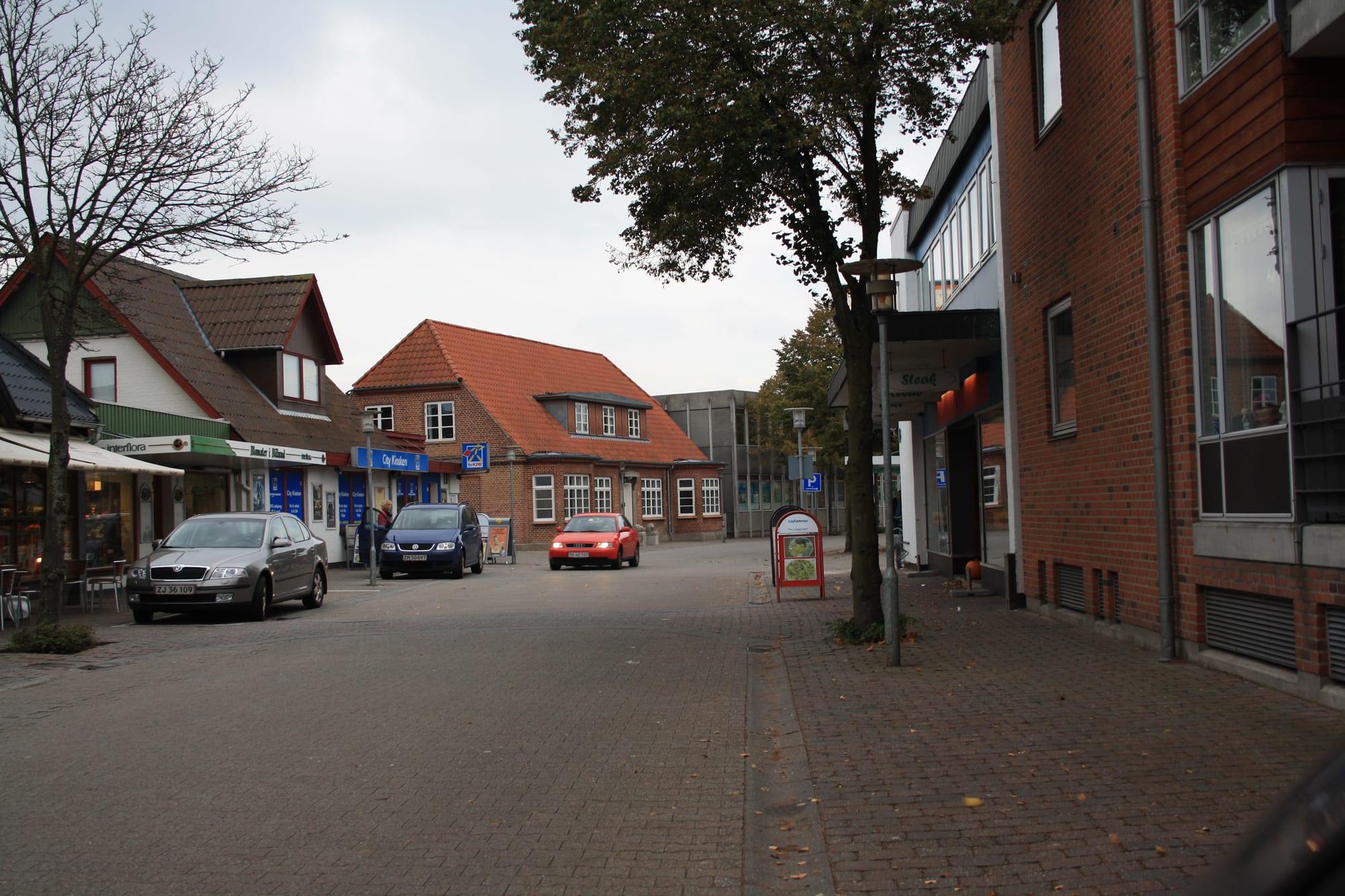
A brick-paved main street in Billund with red-roofed brick shops, parked cars and a tree under a grey sky

Southern Denmark: Funen & South Jutland, Denmark

Billund

Hovedgaden, the main street of Billund. (Størtebeker / Wikimedia Commons · CC BY 3.0)

A small town on the sandy heathland of southern Jutland, west of Vejle, that grew from a handful of farms into the home of the Lego Group. A carpenter's toy workshop of the 1930s gave it the Lego factory, the original Legoland of 1968, an international airport and the Lego House, and it is now one of Denmark's busiest family destinations.

Neighbourhoods

  • The town centre and Hovedgaden
    • Local life
    • Shops and cafés

    The small centre around Hovedgaden, where Ole Kirk Christiansen built his house in 1924 and where the Lego House now stands on its own square. The Billund Centre, a gift of the Kirk Christiansen family, holds the library, the church and a theatre, and a sculpture trail follows the brook through town.

    Open in Maps
  • Legoland, Lalandia and the airport
    • Families
    • Theme parks
    • Close to the airport

    The northern edge of town, where the Legoland park, the original Lego factory and the airport sit side by side, with the Lalandia water park close to Legoland. This is where most visitors spend their time, and where most of the holiday accommodation is.

    Open in Maps

Things to do

Lego and family parks

  • Legoland Billund Resortattraction

    The original Legoland, opened beside the Lego factory in 1968 and the largest tourist attraction in Denmark outside Copenhagen, built around Miniland, made from more than 20 million bricks.

    Open in Maps
  • Lego Housemuseum

    A building by the Bjarke Ingels Group in the form of stacked bricks, opened in 2017, with play zones, the Lego Museum, a 15-metre Tree of Creativity and roof terraces, around a free public square.

    Open in Maps
  • Lalandia Billundattraction

    The largest water park in Scandinavia, near Legoland, with a tropical indoor water park as well as bowling and mini golf.

    Open in Maps
  • Wow Parkpark

    An outdoor activity park near the town with Denmark's longest freefall slide.

    Open in Maps

Around the town

  • Teddy Bear Art Museummuseum

    A museum of teddy bears in the centre of town, in the former home of Godtfred Kirk Christiansen, who led the Lego Group from 1957.

    Open in Maps
  • Ole Kirk's Houselandmark

    The house on Hovedgaden that the founder of Lego built in 1924 after a fire, with two stone lions at its entrance.

    Open in Maps
  • Skulpturpark Billundtrail

    A free 1.3-kilometre sculpture trail laid out in 1991 along Billund Brook through the heart of the town.

    Open in Maps

Short trips from the town

  • Jelling stoneslandmark

    Two 10th-century runestones raised by Gorm the Old and Harald Bluetooth, which with the burial mounds and church beside them form a UNESCO World Heritage Site.

    Open in Maps
  • Givskud Zooattraction

    A zoo and safari park north-west of Vejle, opened in 1969 as a lion park and known for large enclosures that visitors drive through in their own cars.

    Open in Maps
  • Vejleneighborhood

    The nearest city, at the head of Vejle Fjord, known for its wooded hills, harbour, pedestrian street and new architecture, with far more places to eat than Billund.

    Open in Maps

Eat and drink

Long-standing places and food districts in Billund. Hours, ratings and directions come from your maps app, always current.

Billund classics

  • Lego House restaurantrestaurant

    The restaurant inside the Lego House, on the free public ground floor alongside the shop, which can be visited without a ticket to the experience zones.

    Open in Maps
  • Cafés and pubs in the town centreneighborhood

    A handful of cafés, a gastropub and bakery counters around Hovedgaden and the shopping streets of the small centre.

    Open in Maps

Further afield

  • Restaurants in Vejleneighborhood

    The nearest city, about half an hour away, with a far wider choice of restaurants than Billund itself.

    Open in Maps

Experience Billund

History

Billund was long part of the parish of Grene, whose church was first mentioned in 1291, and its name, first recorded as "Byllundt" in 1454, means a grove with bees: beehives were recorded in its fields in the 17th century. In the middle of the 19th century it was just eight farms on sandy heath, where farmers grew rye, grazed sheep and cut peat, and the last wolf was shot in 1813. A cooperative dairy came in 1888, a windmill on the Vejle road in 1880, and a railway from Vejle early in the 20th century.

In 1916 the carpenter Ole Kirk Christiansen bought the village joinery, building houses in summer and furniture in winter. When the Depression stopped house-building he turned in 1932 to ironing boards, stepladders and wooden toys, and in 1934 named the toy business Lego. The factory burned down in 1942, during the German occupation, and was rebuilt at once; in 1947 the company bought a plastic injection moulding machine, and plastic bricks left the factory from 1949.

Under his son Godtfred, who took over in 1957, Lego grew into an international company and pulled the village with it, from 418 people in 1950 to about 6,000 by 2006. The company built a private airfield that opened to the public in 1964, and on 7 June 1968 Legoland opened beside the factory, receiving 625,000 visitors in its first year. When the company nearly collapsed in 2003 the town feared for its jobs; the Lego House opened in 2017.

Culture & Customs

Billund's identity is Lego's, and the company's founding family shaped the town directly. In 1973 the Kirk Christiansens and their foundation gave the town the Billund Centre, with its church, library, theatre and leisure facilities, and they paid for an organ for the parish church at Grene. The library inside, redesigned by Rosan Bosch as a creative space for children, was nominated for a Danish Design Award in 2016.

The town has built a civic identity around childhood. Since 2010 a partnership begun by the Lego Foundation and the municipality has run the Capital of Children, which gives children a say in community projects through an annual Children's General Assembly, and in 2020 Billund became the first town in Denmark designated a UNICEF Child Friendly City. A Playline trail guides children safely between the attractions, and a sculpture trail laid out in 1991 along Billund Brook brings outdoor art into the centre.

Each spring the municipality holds a gala to honour local achievements in sport and culture, and the town park north of the centre, a gift from Lego in 1959, has an open-air stage. Beyond that the rhythm is that of a small Jutland town, busy with international visitors in the holiday weeks and quiet in winter.

Daily Life

About 7,400 people lived in Billund at the start of 2026, making it the second-largest town in its municipality after Grindsted, the municipal seat. Jobs outnumber residents: in 2007 about 5,000 people commuted in, and more than a quarter of the Lego Group's 20,000 employees worked in the town in 2022, at its headquarters, offices and factory.

Tourism is the other pillar. One in four people in the municipality worked in the tourist trade in 2010, at Legoland, Lalandia, Lego and the zoo at Givskud, and Billund Airport, which handled about 3.7 million passengers in 2022, is one of the country's busiest air cargo centres as well as the biggest airport in Jutland. Several aviation companies have settled near it.

The town keeps growing. The International School of Billund, opened in 2013 with 60 pupils, had 450 a decade later, serving the families that Lego and the airport bring from abroad, and a large new district, Billund Travbyen, is planned on the site of the old trotting track, bought in 2021 by KIRKBI, Lego's majority owner. The Billund Bad pool, open since 1969, and the sports clubs fill evenings.

Food

Billund eats as the rest of Denmark does. Lunch is often smørrebrød, buttered rye bread, rugbrød, topped with cold meat, sliced sausage or egg; hot dishes include frikadeller, pan-fried meatballs of pork or of veal and pork, with spices; and rødgrød med fløde, a thickened compote of red berries with cream, is a classic dessert.

The commonest quick meal is from a grill bar or a pølsevogn, the hot-dog van that was Denmark's original street food, selling red-skinned Vienna-style sausages with ketchup, remoulade and mustard. In a town full of families on day trips, the restaurants and cafés inside Legoland, the Lego House and Lalandia feed many of the visitors.

The land itself was poor: heath farmers grew rye for bread, and honey from the local bees was recorded in the 17th century before cultivation pushed the hives out. For a wider choice of restaurants, many visitors drive to Vejle, about half an hour east.

Planning tools

Budget

Denmark is expensive, and Billund's prices are set by its theme parks. Legoland is the largest single cost for families, followed by the Lego House experience zones and Lalandia; the Lego House square, shop and restaurant, the sculpture trail and the town's parks are free.

Daily Budget Midrange
USD 220–390 (mid-range hotel, park tickets, meals out, a hire car)
Daily Budget Shoestring
USD 90–150 (hostel or campsite cabin, supermarket and bakery food, buses, free sights)

Tap water is safe to drink, and tipping is not expected.

Best Time to Visit

From spring to autumn. Legoland is a seasonal park, with special events through its season, including a Halloween celebration and firework shows.

Suggested Number of Days

Families usually allow one to two days for the town and its parks. Three or four days leave room for trips out into the surrounding area. The number grows with the children's ages and with whether there is a car.

First Visit
1–2 days
With Surroundings
3–4 days

Transportation

The town itself is small and walkable, and a Playline trail links many of its attractions with a safe, child-friendly path. There is no railway: Billund's station closed in 1957 and a planned new line had been cancelled by 2021. Local buses run to Vejle, Grindsted, Kolding and Horsens, all stopping at the airport, but a car is the easiest way to reach sights outside town.

Drivers from Germany come up the E45 motorway and turn off at Kolding, or at Vejle from the north and east.

Airport & Station Connections

Billund Airport, built by Lego as a private airfield and opened to the public in 1964, is about 2 km north-east of the town and is the biggest airport in Jutland and one of Denmark's busiest. Without a railway, travellers by train change at Vejle, 27 km east, for the bus, about 30 minutes; express buses also run to Aarhus in about an hour and a half.

Walkability

Billund is compact and flat. The centre, the Lego House, Legoland and the airport are all within walking or short bus distance of one another, and the Playline and the sculpture trail along the brook give traffic-free routes between them.

Safety

Denmark is a very safe country with low levels of violent crime. Billund is a quiet family town, and the practical concerns are those of any busy theme park: crowds, queues and keeping track of children.

Agree a meeting point with children inside the parks, and check for ticks after walks on the heath and in plantations. Check current official travel advice before travelling.

Climate

Maritime, mild and changeable, with wind and rain possible in any month. Daylight is long in June and short in December.

Summer
mild — across Denmark the July mean temperature is about 16.5°C
Winter
cool to cold — across Denmark the January mean temperature is about 1°C

Local Customs

Danish manners are informal and egalitarian, and English is spoken fluently by most Danes. Tipping is not expected. The town takes pride in children: in 2020 it became the first Danish town named a UNICEF Child Friendly City, and it holds an annual Children's General Assembly.

Queue patiently at rides and counters; dress is casual everywhere.

Common Payment Methods

The currency is the Danish krone (DKK). Cards are accepted almost everywhere and little cash is needed, though some retailers, above all supermarkets, may add a surcharge for foreign credit cards.