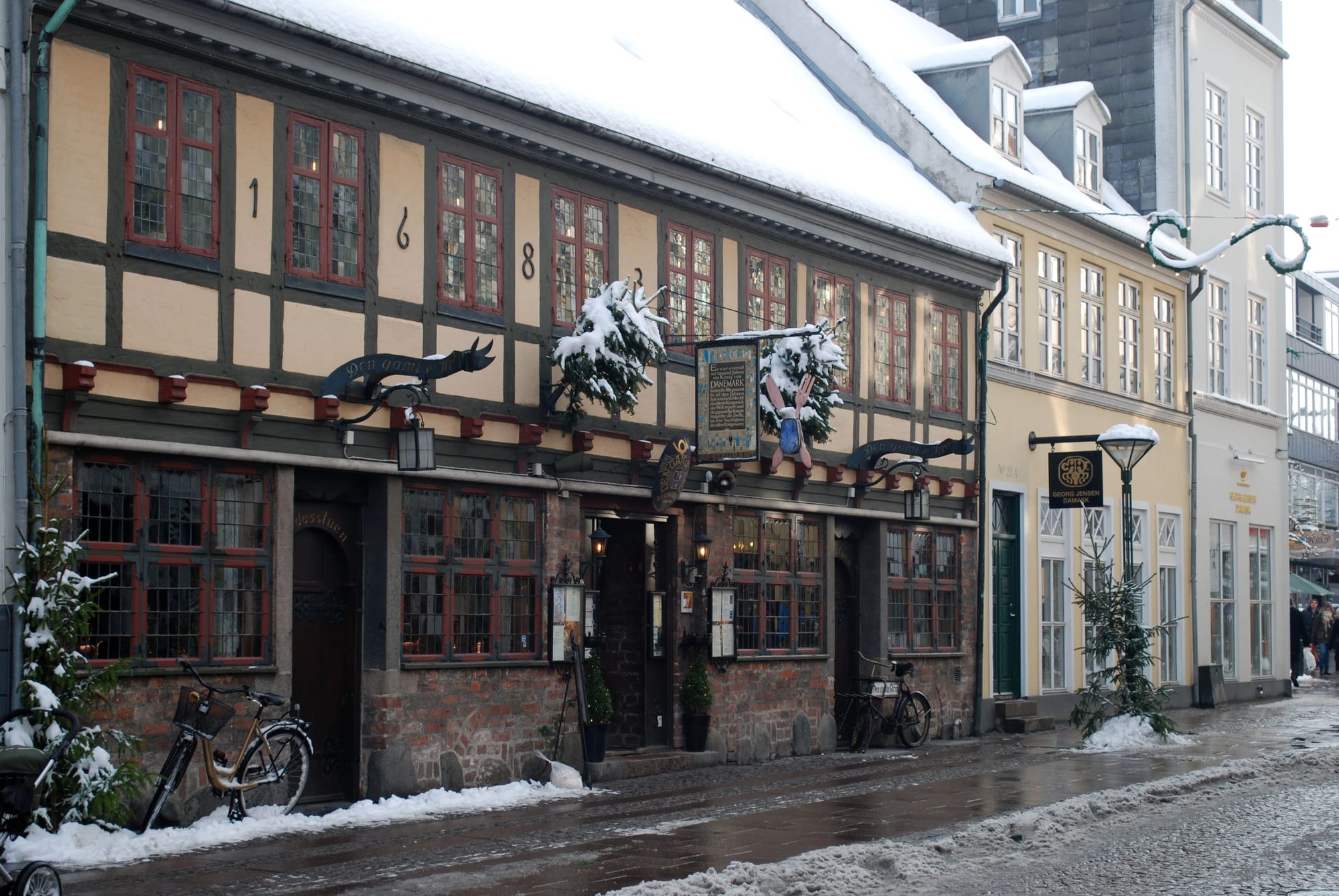
A half-timbered house with red window frames and hanging signs on a snowy old street in Odense

Southern Denmark: Funen & South Jutland, Denmark

Odense

Half-timbered houses on Overgade in the old centre of Odense, in winter. (Knirk Saxo / Wikimedia Commons · CC BY-SA 3.0)

Denmark's third city and the largest on the island of Funen, first named in writing in 988 and home to the cathedral where Canute IV lies. Hans Christian Andersen was born here in 1805. A canal port and rail junction in the 19th century, it now lives from its university, its hospital and a cluster of robotics firms, around a compact old centre.

Neighbourhoods

  • The old town and Overgade
    • First-time visitors
    • Historic district

    The medieval core around St Canute's Cathedral and the city hall. Cobbled lanes such as Hans Jensens Stræde hold the yellow corner house where Andersen is thought to have been born, now part of his museum, and Overgade has a run of half-timbered houses, including the Møntergården museum courtyard.

    Open in Maps
  • Vestergade and Brandts
    • Shopping
    • Nightlife
    • Arts and culture

    West of the cathedral, the pedestrian shopping streets of Vestergade and Kongensgade lead to the Brandts art complex in the old industrial quarter. Brandts Passage, beside it, is the focus of the city's nightlife, with restaurants, bars and cafés.

    Open in Maps
  • Munke Mose and Fruens Bøge
    • Parks and the river
    • Families

    Green land along the Odense River south of the centre. Munke Mose park is where the river boats and rowing boats start; the zoo straddles the river further upstream, and the Funen Village open-air museum stands beside the Fruens Bøge woods.

    Open in Maps
  • The station quarter
    • Close to public transport
    • Museums

    The northern edge of the centre, around the station building of 1995, which also holds the bus station, a light-rail stop and the central library. The Danish Railway Museum fills an old engine shed beside the tracks, and the King's Garden and Odense Palace are a short walk south.

    Open in Maps
  • The university and Hjallese
    • Students
    • Quiet and residential

    The south-eastern suburbs around the main campus of the University of Southern Denmark and the new university hospital beside it, linked to the centre by the light rail that ends at Hjallese. Mostly housing and campus, with little to draw a visitor beyond its everyday life.

    Open in Maps

Things to do

Famous landmarks

  • St. Canute's Cathedrallandmark

    A Brick Gothic cathedral built in phases from about 1300, whose crypt displays the remains of King Canute IV and his brother Benedict, and whose late Gothic altarpiece is by Claus Berg.

    Open in Maps
  • Odense Palace and the King's Gardenlandmark

    A white Baroque palace completed in 1723 for Frederick IV, who died there, on the site of a medieval monastery, with a formal park laid out in front of it.

    Open in Maps
  • Odense City Halllandmark

    A red-brick 19th-century city hall with stepped gables, modelled on Italian buildings such as the Palazzo Pubblico in Siena, beside the cathedral.

    Open in Maps
  • Nonnebakkenlandmark

    The hill by the river where a Viking ring fortress of about 980–1000 stood; with four other ring fortresses it was inscribed on the UNESCO World Heritage List in 2023.

    Open in Maps

Museums

  • Hans Christian Andersen Museummuseum

    H.C. Andersens Hus, a museum building by Kengo Kuma inaugurated in 2021 that takes in the house of the writer's birth, with a children's play space and a garden; his childhood home is a separate small museum nearby.

    Open in Maps
  • The Funen Villagemuseum

    An open-air museum of 25 buildings from Funen villages, most from the 18th and 19th centuries, founded during the German occupation and opened in 1946.

    Open in Maps
  • Møntergårdenmuseum

    The city's cultural history museum, in a courtyard of Renaissance half-timbered houses on Overgade, with finds from Viking Odense and the Middle Ages.

    Open in Maps
  • Danish Railway Museummuseum

    The largest railway museum in Scandinavia, with some 50 locomotives and carriages on 20 tracks in a former engine shed beside the station.

    Open in Maps
  • Carl Nielsen Museummuseum

    A museum of the composer Carl Nielsen and his wife, the sculptor Anne Marie Carl-Nielsen, attached to the Odense Concert Hall.

    Open in Maps
  • Brandts Museum of Photographic Artmuseum

    Denmark's national museum of photographic art, part of the Brandts centre for art and culture in the old industrial quarter.

    Open in Maps

Parks and the river

  • Odense Zooattraction

    A zoo founded in 1930 on both banks of the Odense River, whose Oceanium of 2001 takes visitors from the Amazon rainforest to Antarctica.

    Open in Maps
  • Tusindårsskovenpark

    The Thousand Year Forest, planted in 1988 for the city's millennium in the south-west of Odense, and the site of the Tinderbox music festival.

    Open in Maps

Theatre and sport

  • Odense Teaterattraction

    Founded in 1796 and Denmark's second-oldest theatre, where Ibsen's The Pillars of Society had its première in 1877.

    Open in Maps
  • Odense Stadiumattraction

    Odense Boldklub's football ground in Bolbro since the 1940s, known under sponsorship as Nature Energy Park.

    Open in Maps

Short trips from the city

  • Egeskov Castlelandmark

    Near Kværndrup in the south of Funen, Denmark's best-preserved Renaissance water castle.

    Open in Maps
  • Ladby shipmuseum

    Near Kerteminde, the only Viking Age ship burial found in Denmark, preserved where it was discovered inside a museum.

    Open in Maps
  • Nyborg Slotlandmark

    A restored medieval castle in Nyborg, where Eric V signed Denmark's first constitution in 1282 and the Danehof, the first Danish parliament, met.

    Open in Maps
  • Kertemindeneighborhood

    A small harbour town on Kerteminde Bay with the Johannes Larsen Museum and Fjord & Bælt, a research and exhibition centre for fish and porpoises.

    Open in Maps

Seasonal events

  • EventyrløbetAscension Sunday, late spring

    The Fairy Tale Run, a popular run through the city on circuits of 2.5 to 10 km.

  • Odense International Film Festivallast week of August

    A week-long short film festival, first held in 1975 and the oldest film festival in Denmark.

Eat and drink

Long-standing places and food districts in Odense. Hours, ratings and directions come from your maps app, always current.

Odense classics

  • Brunsviger at a bakerycafe

    Funen's own cake, a sheet of yeast dough covered in a topping of brown sugar, syrup and butter, eaten on Sunday mornings and shaped into a cake man for children's birthdays.

    Open in Maps
  • Odense Pilsner and Odense Classiccafe

    The pilsners of the Albani brewery, founded in Odense in 1859, poured in bars across the city and drunk mainly on Funen.

    Open in Maps

Food districts

  • Brandts Passageneighborhood

    The passage by the Brandts art complex where many of the city's restaurants, bars and cafés are gathered, and where nights out begin.

    Open in Maps
  • Vestergade and Kongensgadeneighborhood

    The pedestrian shopping streets of the centre, lined with cafés and places to eat between the shops.

    Open in Maps

Experience Odense

History

Odense takes its name from Óðins vé, "Odin's sanctuary", and people have lived on the higher ground beside the Odense River for more than 4,000 years. The town is first named in a letter of 988 from the German emperor Otto III, the year it also became a diocese, and late in the 10th century a Viking ring fortress stood at Nonnebakken, commanding the river. In 1086 King Canute IV, often called the last Viking king, was murdered by rebels angry at his taxes in St Alban's Priory; canonised in 1101, he became the focus of a pilgrimage cult, and Benedictine monks from England founded St Canute's Abbey early in the 12th century.

After the Reformation the cattle trade made northern Funen's market town rich, and merchants built the half-timbered houses still seen on Overgade, until heavy taxes after the Swedish wars of the 1650s brought a long stagnation; by 1700 only about 4,000 people lived here. Recovery came with a canal to Odense Fjord, dug between 1796 and 1806, which made the town a port. The city gates came down in 1851 and the railway across Funen arrived in 1865, turning Odense into one of the country's largest rail junctions and an industrial city.

In August 1943 a general strike in Odense helped bring the government's collaboration with the German occupiers to an end, and in 1944 a Danish Nazi group blew up the Odin Tower, built in 1935 as the second-tallest tower in Europe. The great Lindø shipyard, opened by A.P. Møller in 1919, closed in 2012, and a light-rail line opened in 2022.

Culture & Customs

Everything in Odense comes back to Hans Christian Andersen, born here in 1805, the son of a struggling shoemaker. The yellow corner house thought to be his birthplace has been a museum since 1908 and is now part of a new museum by Kengo Kuma, opened in 2021; the half-timbered childhood home on Munkemøllestræde has its own small museum; and the Steadfast Tin Soldier, the Little Mermaid, the Emperor's New Clothes and many other characters stand as sculptures across the centre. The city marked 200 years since his birth in 2005 and 150 since his death in 2025.

Music is the other strand. The composer Carl Nielsen, who was born near Nørre Lyndelse south of the city, has a museum beside the concert hall, home to the Odense Symphony Orchestra. Odense Teater, founded in 1796, is the second-oldest theatre in Denmark and runs the first drama school outside Copenhagen, and the Funen Opera stages contemporary opera in Danish. Every year the Tinderbox festival fills the Thousand Year Forest, and the city also hosts the country's oldest film festival.

Sport is close to the heart of the place: Odense Boldklub, founded in 1887 as a cricket club, has won three national football titles, and the Odense Bulldogs play professional ice hockey. Funen has its own dialect, and the city hosts the annual H.C. Andersen Marathon.

Daily Life

About 188,000 people lived in the city of Odense at the start of 2026, and about 213,000 in the wider municipality, making it the third-largest city in Denmark. The Odense University Hospital is the city's largest employer, and the University of Southern Denmark, with its main campus here, gives the place a large student population.

The economy has moved from factories to services. The shipyard site at Lindø is now an industrial park for offshore components, while Odense has become known internationally for robotics, above all collaborative robots: firms such as Universal Robots and Mobile Industrial Robots grew here, and the national robotics cluster counts hundreds of companies. TV 2, the Albani brewery and the horticultural wholesaler GASA are other local names, and Rosengårdcentret on the south-eastern edge is the largest shopping centre in Denmark.

Daily life runs by bicycle. Cycle lanes line most main roads, and the city has experimented with rain sensors at traffic lights that lengthen the green phase for cyclists in bad weather. The light rail now links the north-western suburbs with the station, the campus and the new hospital buildings. Suburbs spread out around the old core, from Stige in the north to Hjallese in the south, and Vollsmose, a 1970s housing estate in the north-east, is officially classed as a vulnerable residential area.

Food

Odense eats as the rest of Denmark does, from rye-bread open sandwiches, smørrebrød, at lunch to flæskesteg, roast pork with crackling, often with red cabbage. Funen adds its own specialities. Brunsviger is the island's cake: a sheet of yeast dough covered with a topping of brown sugar, syrup and butter or margarine, poured on before baking. On Funen it belongs to Sunday mornings with fresh rolls — sandwiched inside a roll it becomes a "runder med brunner" — and, shaped as a cake man, to children's birthday parties.

Rygeost is the other Funen classic, a soured-milk cheese, salted, flavoured with caraway and smoked over straw or nettles, known above all from Funen. Odense Marcipan, founded in the city in 1909, is one of the world's largest marzipan makers.

The local beer comes from the Albani brewery, founded in Odense in 1859 and now part of the Royal Unibrew group; its Odense Pilsner and Odense Classic are drunk mainly on Funen. The city's restaurants and bars gather around Brandts Passage and the pedestrian streets of the centre.

Planning tools

Budget

Odense is expensive by European standards, like all of Denmark, but cheaper than Copenhagen, above all for hotel rooms. Restaurants and alcohol are the big costs; bakeries, supermarkets and the free walks along the river and through the old town keep a day affordable.

Daily Budget Midrange
USD 190–340 (mid-range hotel, restaurant dinners, museum and zoo tickets, the odd train trip)
Daily Budget Shoestring
USD 90–150 (hostel bed, bakery and supermarket food, buses, light rail and a bike)

Tap water is safe to drink, and tipping is not expected because service is included.

Best Time to Visit

May to September, when the days are long and the parks and outdoor cafés are at their best; July and August are the warmest months. Winter is cold and dark but the museums stay open and the old town is quiet.

Suggested Number of Days

One to two days covers the centre and its museums, which lie close together. Three or four allow trips out across Funen to its castles and harbour towns. Without a car, the extra time goes on buses between smaller places.

First Visit
1–2 days
With Surroundings
3–4 days

Transportation

The centre is small enough to walk, and the city has good cycle lanes and separate commuter paths, with app-based bike hire. A single light-rail line, opened in 2022, runs 14.5 km from Tarup in the north-west through the station and the university to Hjallese in the south. FynBus city buses fill in, nearly all passing the station, and river boats run from Munke Mose to the zoo and Fruens Bøge.

Taxis cannot be hailed in the street: order one by phone or app, or find one at the station rank. Drivers should note that Odense has a low-emission zone.

Airport & Station Connections

Odense Station is on the main line between Copenhagen and Jutland, with trains to Copenhagen in as little as an hour and a quarter and to Aarhus in about an hour and a half, and international trains to Hamburg. From Copenhagen Airport there are direct trains; from Billund Airport a bus runs to Kolding or Vejle for a train onwards. Hans Christian Andersen Airport, 9 km north-north-west, has mostly summer charter flights. Drivers arrive on the E20 and pay a toll on the Great Belt Bridge from Zealand.

Walkability

The main sights of the centre are five to ten minutes' walk from one another, on largely pedestrianised streets. The zoo is about half an hour's walk along the river and the Funen Village about 45 minutes, both on a pleasant riverside path.

Safety

Denmark is a very safe country with low levels of violent crime. Odense is generally safe for visitors, though some caution is sensible in the centre late at night when the bars empty, and cyclists move fast on the city's many bike lanes.

Keep out of the cycle lanes when walking, and use the taxi rank or an app late at night. Check current official travel advice before travelling.

Climate

Temperate oceanic, mild and changeable, with rain in every season and no great extremes. July and August are both the warmest and the wettest months, and Odense Fjord often holds ice between January and March.

Summer
mild — July and August highs average about 21°C, with daily means of 16–17°C
Winter
cold and grey — January and February average about 0°C, with nights a little below freezing

Local Customs

Manners are informal and egalitarian, and showing off is frowned on. Odense is proud of Andersen, whose characters appear as statues and sculptures all over the centre, and of its Funen identity. Tipping is not expected, as service is included in prices.

Cycle lanes are for cycling, not walking; and dress is casual almost everywhere.

Common Payment Methods

The currency is the Danish krone (DKK). Cards are accepted almost everywhere and little cash is needed, though some retailers, above all supermarkets, may add a surcharge for foreign credit cards, and shops may refuse cash between 20:00 and 06:00.