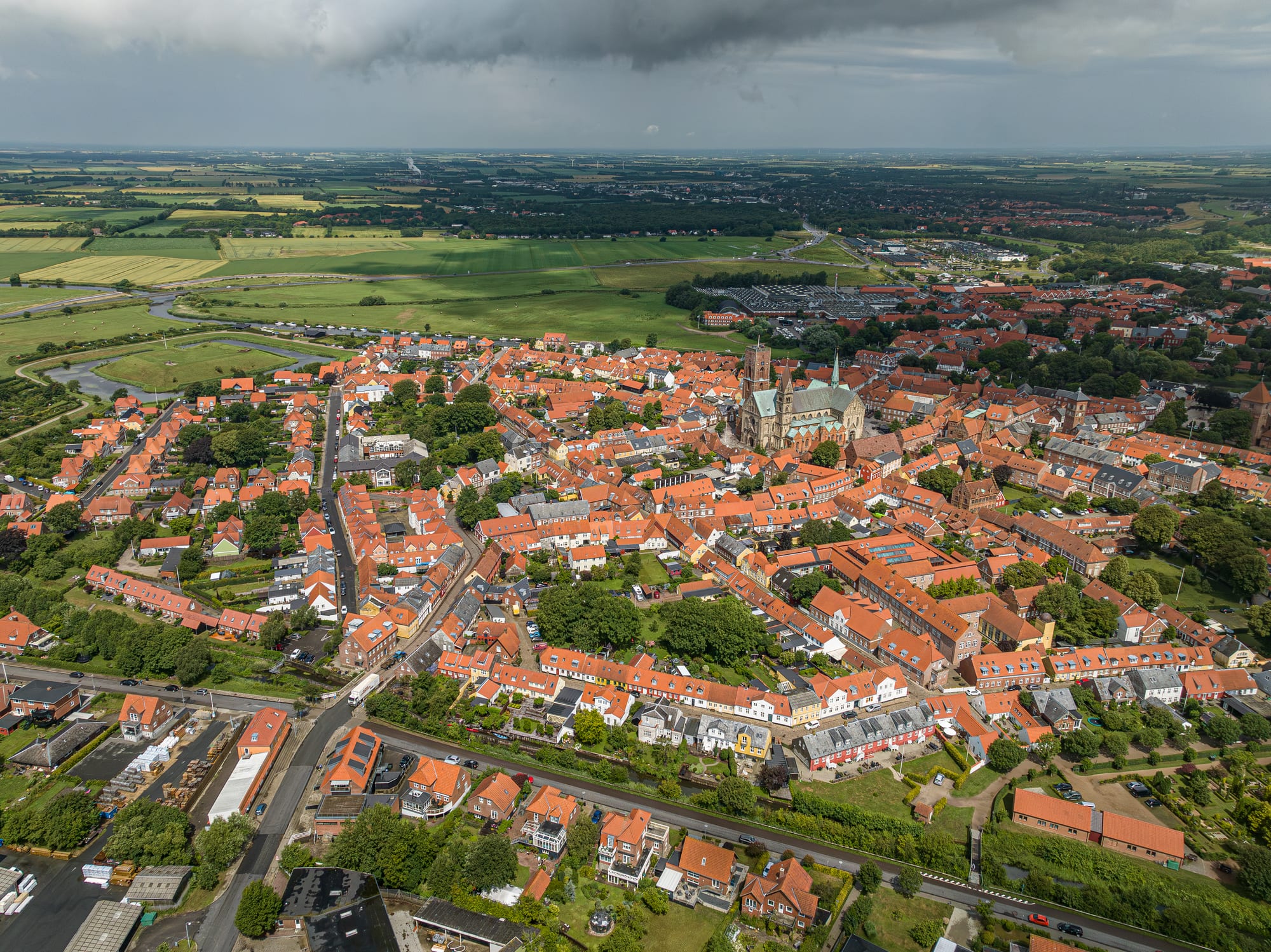
Aerial view of Ribe's red-tiled old town around its cathedral, with flat green marshland beyond under heavy cloud

Denmark

Southern Denmark: Funen & South Jutland

Ribe, Denmark's oldest town, seen from the air with its cathedral at the centre and the flat marshland of south-west Jutland behind. (Arne Müseler / Wikimedia Commons · CC BY-SA 4.0)

Denmark's south-western third — the garden island of Funen with Odense and the small islands of its southern archipelago, the fjord towns of Vejle, Kolding and Fredericia, the North Sea port of Esbjerg and the Wadden Sea marshes around Ribe, and South Jutland, the borderland with Germany that was ruled from Berlin between 1864 and 1920.

Explore Southern Denmark: Funen & South Jutland

History

Ribe, on the marsh edge of south-west Jutland, began as a seasonal market in the first years of the 8th century and is Denmark's oldest town; its stone cathedral, begun in the 12th century, was built of tufa imported from Germany. At Jelling, near Vejle, Harald Bluetooth raised his great runestone in memory of his parents. In Odense — Odins Vi, Odin's shrine, first recorded in 988 — King Canute IV was killed before the altar of St Alban's church in 1086 and canonised in 1101. Nyborg Castle hosted the Danehof, the medieval parliament, until 1413, and at Ribe in 1460 Christian I was elected ruler of both Schleswig and Holstein on the promise that they remain "forever undivided".

That promise shaped the south. The First Schleswig War of 1848–51 is remembered for the Danish sortie from the fortress of Fredericia on 6 July 1849; the second was decided at Dybbøl, outside Sønderborg, where Prussian troops stormed the Danish redoubts on 18 April 1864 after weeks of shelling. Denmark lost everything south of the little Kongeå river, and Esbjerg was founded in 1868 as a new North Sea harbour to replace Altona, lost in 1864.

North Schleswig spent 56 years under German rule; some 30,000 of its men were conscripted in the First World War and more than 5,000 died. In the plebiscite of 10 February 1920 three-quarters voted for Denmark, and on 15 June 1920 North Schleswig rejoined Denmark. The Little Belt Bridge of 1935 and the Great Belt link of 1997–98 ended Funen's isolation, while a carpenter's workshop in Billund, which began making wooden toys in 1932, became Lego.

Culture & Customs

The region holds two of Denmark's most distinct identities. Funen calls itself the garden of Denmark, a rolling island of hedgerows, half-timbered farms and more manor houses than anywhere else in Denmark, and its own dialects, known together as fynsk. Hans Christian Andersen was born in Odense in 1805; the composer Carl Nielsen in 1865 at Sortelung near Nørre Lyndelse, recalled in his memoir My Childhood on Funen; and around 1900 the Funen Painters — Johannes Larsen, Fritz Syberg, Peter Hansen — turned from Copenhagen's salons to the island's fields and coasts. Larsen came from Kerteminde, Syberg and Hansen from Faaborg.

South Jutland, Sønderjylland, was formed by the border. Its dialect, sønderjysk, defeats many other Danes. Under Prussian rule the inns where the Danish-minded met were often refused licences to sell alcohol, so they built assembly halls, and out of those evenings grew the sønderjysk kaffebord, a coffee table of seven soft cakes, then layer cakes, then at least seven kinds of biscuit. A German minority of about 15,000 has its own political party, the Schleswig Party, an arrangement mirrored for the Danes south of the frontier.

The summer calendar is local. Ringridning, tilting at a small ring from horseback, fills Sønderborg and Aabenraa in July; Fredericia remembers its battle of 6 July 1849; Fanø's islanders bring out their old wedding costumes for Sønderhodag; Tønder, once rich on lace-making, holds its folk festival on the last full weekend of August.

Daily Life

About 1.2 million people live in the region, some 500,000 of them on Funen and its islands. Odense, with around 185,000 in the city and 210,000 in the municipality, is Denmark's third city; Esbjerg has about 72,000, Kolding and Vejle just over 60,000 each, Fredericia 41,000, and Svendborg and Sønderborg under 30,000. Vejle is the administrative seat, and Ribe and Tønder, for all their history, have about 8,000 people apiece.

Family-owned manufacturers anchor small towns here: Lego at Billund, which built the airport that now serves all of western Denmark; Danfoss, founded in 1933 and still headquartered at Nordborg on Als; the shoemaker Ecco at Bredebro. Odense lost the Lindø shipyard in 2012 and has rebuilt itself around robotics — Universal Robots was founded there in 2005 — its university and a light-rail line opened in 2022. Esbjerg, once the country's largest fishing port, is the main town for Denmark's oil and offshore activities, and its harbour is expanding for the wind-turbine industry. Pig and dairy farms cover the land between.

Along the border the lorries queue at Padborg, Danes drive south to fill their cars with cheap beer and sweets from German border shops, and commuters cross in both directions. In July German visitors fill many of the rented summer houses of Blåvand, Henne Strand and Rømø. The small islands and the Tønder marsh are losing people, while Tønder, the first town over the border, has been a popular place to elope to since the 1960s.

Food

Funen's signature is brunsviger, a soft yeast cake drowned in melted butter and brown sugar, eaten warm from Odense's bakeries and shaped into a "cake man" for children's birthdays. Rygeost, a sour-milk cheese smoked over straw or nettles and sprinkled with caraway, is known above all from Funen and is Denmark's only wholly native cheese. Odense's Albani brewery, founded in 1859, makes the strong Giraf lager, first brewed in 1962 to pay for a new giraffe at the city zoo.

South Jutland cooks with a German accent. Kålpølser, spiced beef-and-pork sausages, come with grønlangkål, stewed kale, at New Year; spegepølse, a smoked salami, is sliced onto rye; and solæg, "sun eggs" boiled with onion skins and kept for a few days in brine, are eaten with mustard, vinegar, oil and a glass of snaps. The kaffebord's showpiece is brødtorte, a layer cake made with rye bread, and Christiansfeld has been known for its honey cakes since 1783.

The Wadden Sea adds lamb from the dyke pastures, brown shrimps and Pacific oysters gathered from the flats on guided winter walks. Fanø and Esbjerg share bakskuld — dab that is salted, dried and smoked, then fried in butter.

Attractions & Natural Wonders

Odense is built around Hans Christian Andersen: the museum of 2021 by Kengo Kuma, much of it underground beneath a garden, stands beside the yellow corner house of his birth, with his childhood home, St Canute's Cathedral and the Funen Village open-air museum close by. South of the city, Egeskov, finished in 1554 on oak piles in a small lake, is Denmark's best-preserved Renaissance water castle. Around it lie Nyborg's royal castle, the Viking ship grave at Ladby near Kerteminde, the Svanninge hills above Faaborg, and Svendborg, the port for the South Funen archipelago — Ærøskøbing's 18th-century lanes, Marstal's maritime museum and the Archipelago Trail.

Across the Little Belt, where the 1935 bridge can be climbed on a guided walk, are Kolding's fire-scarred castle Koldinghus, Fredericia's ramparts, the UNESCO-listed Moravian town of Christiansfeld, and Jelling's runestones, mounds and church. Billund has Legoland, opened in 1968 around a Miniland that now holds more than 20 million bricks, and the Lego House. Sønderborg's castle faces Als Sound, with the Dybbøl redoubts and mill on the hill opposite, the royal summer palace at Gråsten nearby and the 84-kilometre Gendarme Path along Flensburg Fjord.

The west belongs to the Wadden Sea National Park. Ribe has its cathedral tower, half-timbered streets and Viking centre; tractor buses cross the seabed to Mandø; Rømø's Lakolk beach is wide enough to drive on; and Møgeltønder's cobbled Slotsgade leads towards the Tønder marsh, where starlings gather in huge flocks for the "black sun". Fanø, twelve minutes by ferry from Esbjerg and its four white seaside giants, Man Meets the Sea, has the thatched skippers' village of Sønderho. North of Esbjerg the North Sea dunes run to Blåvandshuk, Denmark's westernmost point, and the Tirpitz bunker museum.

Cities in Southern Denmark: Funen & South Jutland

Planning basics

Budget

Prices run below Copenhagen's across the board, most clearly for hotel rooms in Odense, Kolding and Esbjerg. The classic stay on the North Sea coast, Rømø and Fanø is a summer house rented by the week, good value for a family outside the July peak and expensive in it. Legoland is the largest single outlay for families, while the Jelling monuments, the Dybbøl battlefield paths and the Wadden Sea beaches cost nothing.

Daily Budget Midrange
USD 200–370 (mid-range hotel or country inn, restaurant dinners, museum and park tickets, a hire car)
Daily Budget Shoestring
USD 90–150 (hostel, campsite cabin or shared summer house, supermarket and bakery food, regional buses and a bike)

Buy Legoland tickets online ahead of the visit, which is cheaper than at the gate, and look at the old country inns (kroer) of South Jutland for dinner-and-room packages.

Safety

Crime is low everywhere in the region, and the real risks are natural ones. On the Wadden Sea the tide comes in across the flats faster than a person can walk, and the gravel road to Mandø can be cut off at high tide. The North Sea beaches have strong rip currents and offshore winds that carry inflatables out to sea, and cars driven onto the sand at Rømø and Fanø get stuck or caught by the water. Ticks carrying Lyme disease are common in woods and heath in summer.

Go out on the tidal flats only with a guide or a tide table, swim where others are swimming, keep cars on the firm, marked part of the beach, and check for ticks after woodland walks. Check current official travel advice before travelling.

Climate

Maritime throughout, with a clear west-to-east gradient. The North Sea coast and South Jutland are the wettest and windiest part of Denmark, with autumn gales that push storm surges against the Wadden Sea dykes; Funen and its archipelago lie in the shelter of Jutland and are drier, calmer and a little sunnier. The Wadden Sea tide rises and falls twice a day.

Summer
17–22°C, a degree or two cooler on the North Sea beaches in a steady onshore wind; the sea reaches 16–18°C in August
Winter
0–5°C, damp, grey and windy; snow is light and brief, and westerly storms can flood the Wadden Sea forelands

Transportation

Billund Airport is western Denmark's international gateway but has no railway; buses link it with Vejle, Kolding and Aarhus. Trains from Copenhagen cross the Great Belt to Odense and continue to Fredericia, Kolding and Esbjerg or to Sønderborg; a local line runs south from Esbjerg through Ribe and Tønder, and Flensburg trains cross at Padborg. Odense has a light-rail line, and a local line runs to Svendborg. Ferries do the rest: Esbjerg to Fanø in 12 minutes, Svendborg to Ærøskøbing, Bøjden on Funen to Fynshav on Als, and Rømø to the German island of Sylt. Rømø is reached by a nine-kilometre causeway, Mandø by a gravel causeway passable at low tide or by tractor bus. A car is the practical way to see the west coast and South Jutland.

Carry a passport or national ID card when crossing the German border, where Denmark has made spot checks since 2016; drivers pay a toll on the Great Belt Bridge between Funen and Zealand.

Best Time to Visit

May to September. Legoland is a seasonal park and is closed for most of the winter. July is the peak on the west-coast beaches and brings the tilting festivals of Sønderborg and Aabenraa; late June has Fanø's kite festival, and the last full weekend of August the Tønder Festival. The "black sun" starling flights over the Tønder marsh belong to spring and autumn, and guided oyster walks on the Wadden Sea run in the cold months.