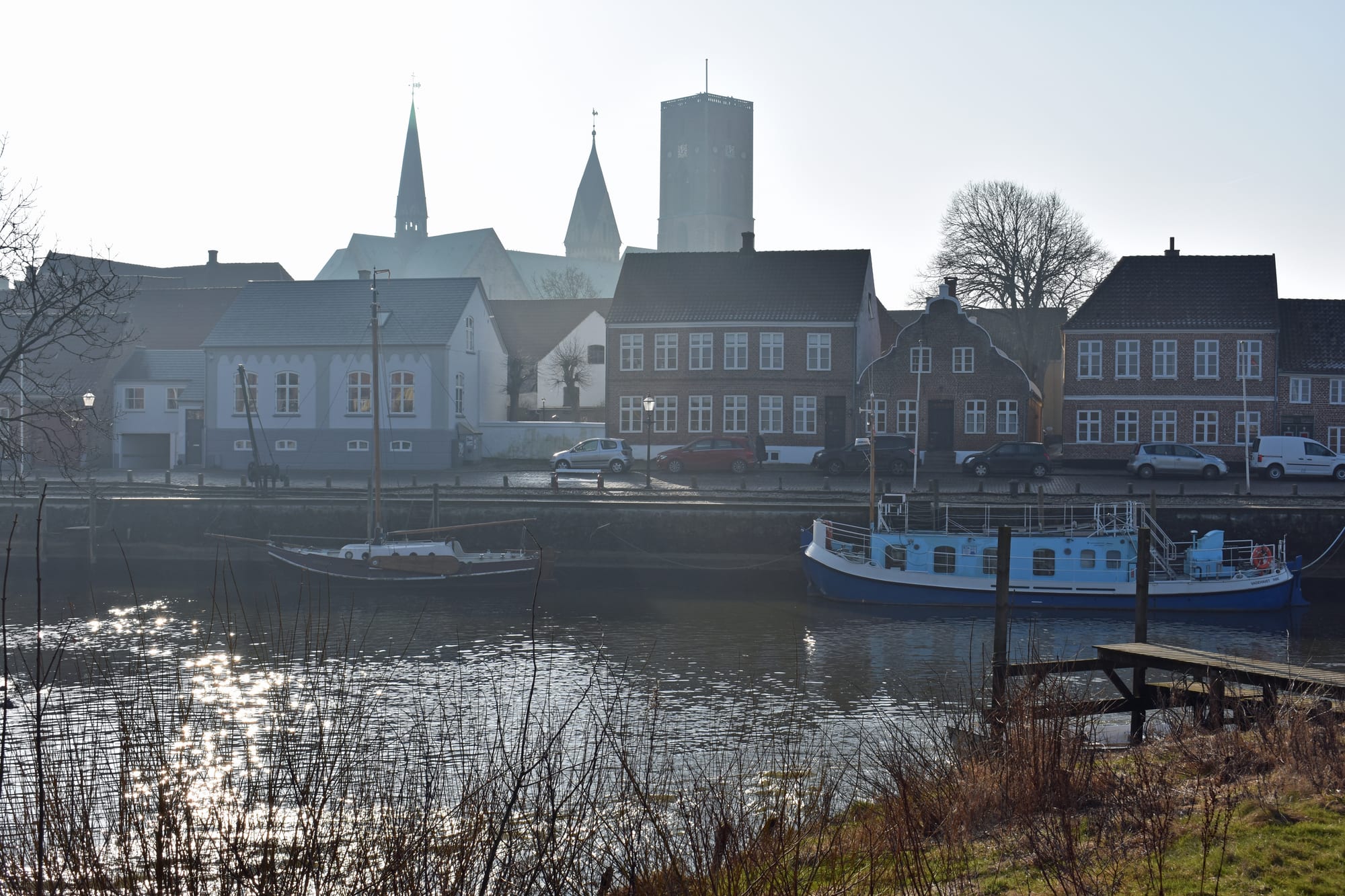
Boats moored on the Ribe River below a row of brick houses, with the towers of Ribe Cathedral rising behind

Southern Denmark: Funen & South Jutland, Denmark

Ribe

The old harbour quay of Skibbroen on the Ribe River, with the cathedral towers behind. (Thomas Dahlstrøm Nielsen / Wikimedia Commons · CC BY 4.0)

Denmark's oldest town, on the Ribe River in the marshes of south-west Jutland near the Wadden Sea, where a trading place stood in the early 8th century. A bishop's seat from 948 and one of the largest medieval towns in the kingdom, it declined when its river silted up, leaving a cathedral, a Dominican priory and around 100 listed old houses.

Neighbourhoods

  • The old town
    • First-time visitors
    • Historic district
    • Walking

    The medieval town stands on three islands in the Ribe River, its streets almost all pedestrianised and cobbled. Around the cathedral square are half-timbered houses, the old town hall, a stone house of 1496, and St Catherine's Priory, and the quay of Skibbroen runs along the river to the old harbour.

    Open in Maps
  • The station side and Riberhus
    • Close to public transport
    • Museums

    The eastern edge of town, where the railway station faces the Ribes Vikinger museum across a roundabout, and the western outskirts, where the grassy mound and moats of the royal castle of Riberhus look out over the marsh.

    Open in Maps
  • The marsh and the Wadden Sea coast
    • Nature
    • Birdwatching

    Flat meadows and dykes run west from the town to the sea lock at Kammerslusen and the Wadden Sea, with the Wadden Sea Centre at Vester Vedsted and the causeway to the island of Mandø. In spring and autumn starlings gather here in huge flocks.

    Open in Maps

Things to do

The old town

  • Ribe Cathedrallandmark

    Denmark's best-preserved Romanesque building, begun around 1150 in tufa stone imported from Germany, whose 14th-century Commoners' Tower can be climbed for a view over the town and the marshes.

    Open in Maps
  • St. Catherine's Priorylandmark

    A Dominican friary founded in 1228, the most complete surviving monastic complex in Denmark, with its brick church and cloister.

    Open in Maps
  • Ribe Kunstmuseummuseum

    An art museum opened in 1891 in a factory owner's villa of the 1860s, with collections that follow the main line of Danish painting.

    Open in Maps
  • Ribes Vikingermuseum

    The town museum facing the station, devoted to the Viking Age and the Middle Ages in Ribe.

    Open in Maps
  • Jacob Riis Museummuseum

    A museum near the cathedral on the life and work of the social documentary photographer Jacob Riis, who was born in Ribe.

    Open in Maps
  • The night watchman's roundattraction

    On summer evenings visitors can follow the night watchman through the old streets as he sings the bedtime verses and tells of witches, floods and fires.

    Open in Maps

Walks and viewpoints

  • Riberhusviewpoint

    The 8-metre embankment and moats of a medieval royal castle on the western edge of town, with a bronze statue of Queen Dagmar by Anne Marie Carl-Nielsen.

    Open in Maps
  • Skibbroen and the flood pillarlandmark

    The old harbour quay on the river, with a reconstructed Wadden Sea sailing ship and a storm-surge post marking historic flood levels, the highest that of 1634.

    Open in Maps

Short trips from the town

  • Ribe VikingeCentermuseum

    An open-air museum of reconstructed Viking Age buildings about 2 km south of the town, reached by a signed cycle path, where volunteers live out Viking everyday life.

    Open in Maps
  • Wadden Sea Centremuseum

    A visitor centre and museum at Vester Vedsted, opened in 2017, explaining the Wadden Sea World Heritage Site and running tours on the tidal flats, including oyster tours, and to Mandø.

    Open in Maps
  • Mandøattraction

    A small Wadden Sea island with a few dozen inhabitants, reached by a gravel causeway passable at low tide, and surrounded by mudflats and salt marshes full of birds.

    Open in Maps

Seasonal events

  • Viking marketApril or May

    An international Viking market, in Denmark's oldest town.

  • Ribe Jazz FestivalJuly

    A summer jazz festival in the old town.

  • Black Sunspring and autumn

    Huge flocks of starlings settle in the Wadden Sea marshes to feed and swirl at dusk in the display known as the black sun.

Eat and drink

Long-standing places and food districts in Ribe. Hours, ratings and directions come from your maps app, always current.

Ribe classics

  • Restaurants in old houses around Torvetneighborhood

    Several restaurants and cafés occupy old houses on the cathedral square and the streets beside it, one of them a listed building of 1668.

    Open in Maps
  • Skibbroenneighborhood

    The riverside quay of the old harbour, with a restaurant beside the moored sailing ship.

    Open in Maps

Cafés

  • Courtyard cafés on Overdammen and Mellemdammencafe

    Cafés in old timber-framed buildings with courtyards along the streets that cross the river channels in the old town.

    Open in Maps

Experience Ribe

History

Ribe began as a trading place on the bank of the Ribe River between about 704 and 710, a date fixed by tree rings in the timber of a well, which makes it Denmark's oldest town; it celebrated 1,300 years in 2010. Booths lined the river for about 400 metres, and craftsmen made combs, glass beads, amber jewellery and textiles, trading mostly with Frisia and England; coins may have been struck here as early as 720. Around 860 the missionary Ansgar was allowed by King Horik to build a church here, and excavations in 2008–2012 found thousands of Christian graves. Ribe had a bishop by 948.

Construction of the stone cathedral began around 1150. The kings probably often stayed at the castle of Riberhus, Christopher I died in the town in 1259 and was buried in the cathedral, and Ribe received its town law in 1269. Exporting oxen, it became one of the largest towns in the kingdom. A Dominican priory was founded in 1228, and in 1460 the Treaty of Ribe was proclaimed here. Christmas morning 1283 brought the collapse of the cathedral's north-west tower, and on 3 September 1580 the "great fire" destroyed 213 houses in 11 streets.

The marsh was both protection and threat. Storm floods struck again and again, worst of all in October 1634, when the water rose 6.1 metres above normal. During the 17th century the river silted up so that ships could no longer reach the town, and Ribe declined; the founding of Esbjerg in 1868 drew away trade and industry. In 2007 Ribe lost its own municipality and became part of Esbjerg.

Culture & Customs

Ribe's culture is its preserved past. The cathedral, with its Commoners' Tower completed in 1333, dominates the skyline, and around 100 listed old houses stand in the old town. Learning has deep roots: the cathedral school traces itself to the chapter school handed over by the bishop in 1145. The Reformation leader Hans Tausen was bishop here from 1542, and a statue of him stands by the cathedral.

The town also knows how to tell its own story. From May to October a night watchman walks the old streets every evening, singing the old verses that sent citizens to bed and telling of witches, floods and fires. Two museums deal with the Vikings — Ribes Vikinger in the town and the reconstructed estate of the Ribe VikingeCenter to the south — and an international Viking market is held in April or May. May brings a tulip festival, July the Ribe Jazz Festival and September a wine festival.

Ribe calls itself the "town of storks". The birds have only visited in recent years without breeding here, but the storks' nests on the rooftops are still made ready every year. The photographer Jacob Riis, whose How the Other Half Lives exposed the slums of New York, was born here in 1849 and has a museum near the cathedral, and the composer Rued Langgaard was organist at the cathedral.

Daily Life

About 8,400 people lived in Ribe at the start of 2026. It is the seat of the Diocese of Ribe and, since 2007, part of Esbjerg Municipality, having been the seat of its own municipality and county until then.

Industry came to the town in the 19th and 20th centuries — in the middle of the 20th century the Ribe iron foundry employed 520 people — but tourism now shapes much of the economy, with thousands of visitors from around the world each year. The cathedral school remains the town's best-known school, while the teacher training college moved to Esbjerg in 2009. Ribe Fritidscenter, with a swimming pool and sports halls, is sometimes the home ground of the handball club Ribe-Esbjerg HH, which has played in the top Danish division.

Living on the marsh means living with water: flood marks on the cathedral and a storm-surge pillar at the harbour record the great floods, and the sea lock at Kammerslusen guards the mouth of the Ribe River.

Food

Ribe eats as the rest of Denmark does. Lunch is often smørrebrød, buttered dark rye bread, rugbrød, topped with cold meat, sliced sausage or egg; frikadeller, pan-fried meatballs of pork or of veal and pork, are a hot staple; and roast pork with crackling, flæskesteg, is often served with red cabbage.

The Wadden Sea gives the area its own produce. The Wadden Sea Centre at Vester Vedsted runs oyster tours on the flats. The medieval town grew rich on exporting oxen. For dessert, rødgrød med fløde, a thickened compote of red berries such as strawberries, rhubarb and raspberries served with cream, is a Danish classic, and the pølsevogn, the hot-dog van, sells red-skinned sausages with ketchup, remoulade and mustard.

Eating out in Ribe means eating in old houses. Restaurants and cafés occupy old timber-framed buildings around the cathedral square, along the river and in courtyards in the old town, including a restaurant on the harbour quay of Skibbroen.

Planning tools

Budget

Ribe is a small country town and cheaper than Copenhagen or Aarhus, though prices are Danish: restaurant meals and drinks are the main cost. Walking the old town, the riverside and Riberhus, following the night watchman and entering the cathedral cost nothing; the museums, the cathedral tower and guided Wadden Sea tours charge.

Daily Budget Midrange
USD 190–340 (mid-range room, restaurant dinners, museum tickets and a Wadden Sea tour)
Daily Budget Shoestring
USD 90–150 (hostel or campsite cabin, bakery and supermarket food, trains and a bike)

Tap water is safe to drink, and tipping is not expected.

Best Time to Visit

May to September for long days, the night watchman's rounds and the jazz festival in July. Spring and autumn bring the starling flights over the marsh, and the Viking market comes in April or May. Winter is quiet, windy and grey.

Suggested Number of Days

One day covers the compact old town and a museum or two, and a night allows the evening walk with the watchman. Two or three days leave time for the marshes and the Wadden Sea coast, which depend on the tides and on transport.

First Visit
1–2 days
With Surroundings
2–3 days

Transportation

The old town is almost entirely pedestrianised, so walking is the only practical way around it. Ribe has two stations on the Bramming–Tønder line, with roughly hourly trains to Esbjerg and to Tønder and through connections to Niebüll in Germany. A bike or a car is useful for the Viking centre, the coast and Mandø.

The gravel causeway to Mandø can be cut off at high tide: check the tide table before driving it, or take the tractor bus.

Airport & Station Connections

Most visitors arrive by train from Esbjerg via Bramming, or by car on the roads of south-west Jutland. Billund Airport is the biggest airport in Jutland, with Copenhagen Airport reached by train across the country.

Walkability

Excellent. The whole old town is small, cobbled and car-free, and the cathedral is visible from almost everywhere, so it is hard to get lost. Cobbles can be uneven and slippery when wet. The Viking centre is a short ride or a longer walk south on a signed cycle path.

Safety

Denmark is a very safe country with low levels of violent crime. In Ribe the real risks are natural ones: on the Wadden Sea the tide comes in across the flats faster than a person can walk, and the low marsh has been flooded by storm surges many times.

Go out on the tidal flats only with a guide or a tide table, and check for ticks after walks in heath and woodland. Check current official travel advice before travelling.

Climate

Maritime and changeable, and storm floods from the Wadden Sea have struck the low marsh around the town again and again.

Summer
mild — across Denmark the July mean temperature is about 16.5°C
Winter
cool to cold — across Denmark the January mean temperature is about 1°C

Local Customs

Manners are informal and egalitarian. The people of Ribe are called ripensere, and the town is proud of its age, celebrating 1,300 years in 2010. Tipping is not expected. The cathedral is a working church and the seat of the Diocese of Ribe.

Keep voices down in the cathedral during services, and keep cycles to the roads outside the pedestrian streets.

Common Payment Methods

The currency is the Danish krone (DKK). Cards are accepted almost everywhere and little cash is needed, though some retailers, above all supermarkets, may add a surcharge for foreign credit cards.