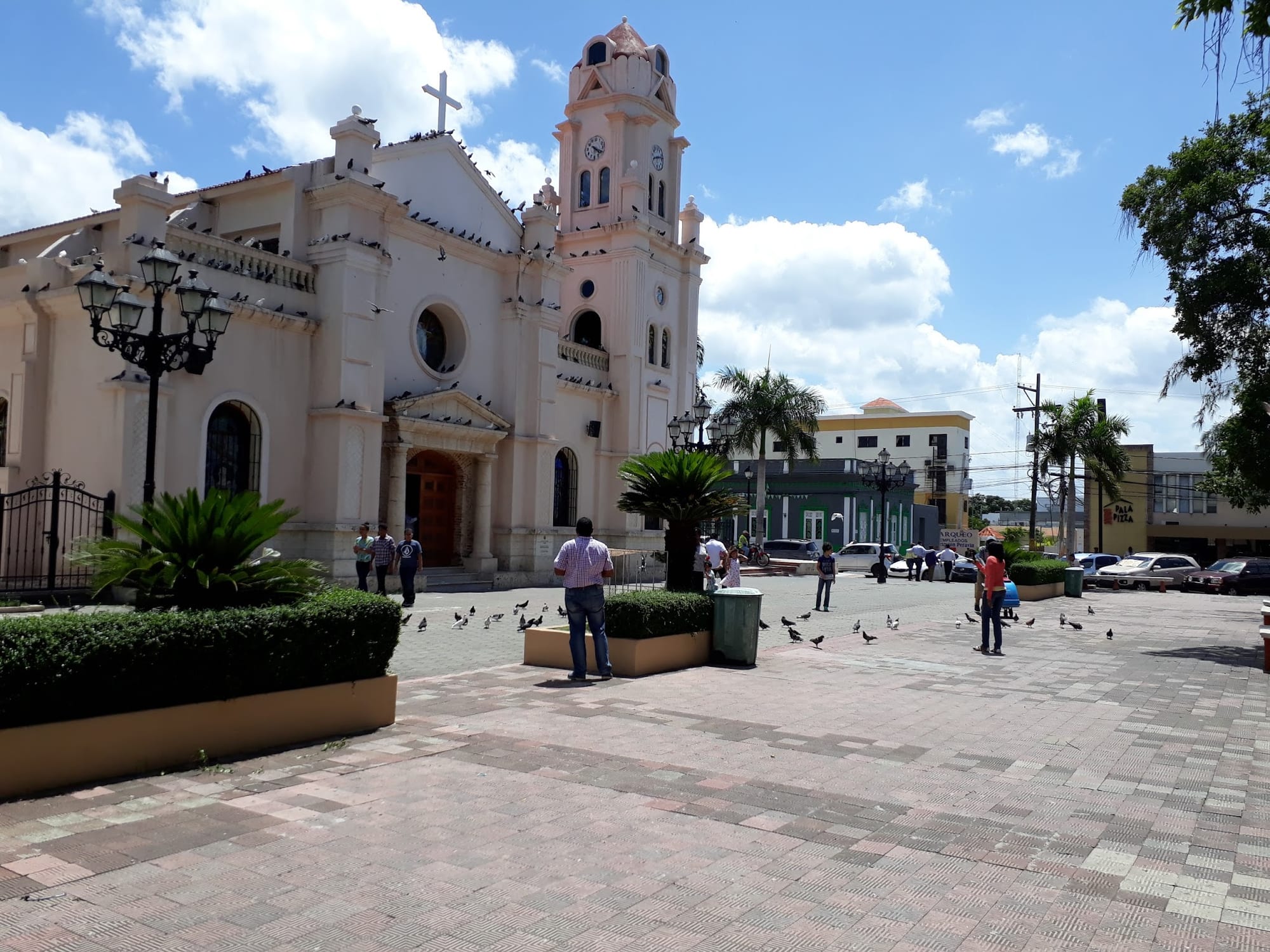
A cream-coloured church with a clock tower beside a paved square with lamp posts, palms, pigeons and people walking

Santo Domingo & the South, Dominican Republic

Baní

The Cathedral of Nuestra Señora de Regla on the main square of Baní. (Peravio / Wikimedia Commons · CC BY-SA 4.0)

The capital of Peravia province, about 65 kilometres from Santo Domingo on the dry southern plain below the Cordillera Central. Founded in 1764 by families of Canary Islander descent and the birthplace of the general Máximo Gómez, it is a busy farming and market town, named the country's mango capital, with the Baní dunes and salt pans on the coast nearby.

Neighbourhoods

  • El Centro
    • First-time visitors
    • Historic district
    • Shopping

    The heart of town around the main square, with the Cathedral of Nuestra Señora de Regla, the town hall, and the shops and market streets of a provincial capital.

    Open in Maps
  • Pueblo Arriba and Pueblo Abajo
    • Quiet and residential
    • Local life

    The names banilejos use for the upper and lower parts of town on either side of the centre — residential streets of low houses, colmados and small businesses where daily life goes on with few visitors.

    Open in Maps
  • The coast: Los Almendros and Las Salinas
    • Beaches
    • Nature

    South and south-west of town the land runs down to the Caribbean: the local beach of Los Almendros, and further on the bay of Las Calderas with its salt pans, small villages and the dune field on the peninsula.

    Open in Maps

Things to do

In town

  • Cathedral of Nuestra Señora de Reglalandmark

    The town's main church on the central square, inaugurated in 1889 and given its present façade, bell tower and dome in 1929–31; it became the seat of the Diocese of Baní, created in 1986.

    Open in Maps
  • Museo Archivo Histórico de Banímuseum

    A museum and archive holding documents on the history of Baní and the country, together with Taíno objects.

    Open in Maps

Beaches and the coast

  • Playa Los Almendrosbeach

    Baní's local beach, about 6 kilometres south of the main square, where families from town go at weekends.

    Open in Maps

Short trips from the town

  • Dunas de Banípark

    The Las Calderas dunes, a protected natural monument covering the Las Calderas peninsula for about 15 kilometres, with dunes up to 35 metres high — the largest in the Caribbean.

    Open in Maps
  • Payaattraction

    A village near Baní known across the country for its milk-based sweets, above all dulce de leche.

    Open in Maps

Seasonal events

  • Expo Mangoat the mango harvest

    A fair held since 2005 to celebrate the mango harvest in the country's mango capital.

  • Fiestas patronales of Nuestra Señora de ReglaNovember, peaking on 21 November

    The patron saint festival of the town, with religious services at the cathedral and celebrations organised by the town council.

Eat and drink

Long-standing places and food districts in Baní. Hours, ratings and directions come from your maps app, always current.

Baní classics

  • Mango sellersmarket

    In season, mangoes from the farms around town — the banilejo mango is the best-known and most exported variety in the country — are sold from stalls and roadside stands.

    Open in Maps
  • Paya sweet shopsmarket

    The dulce de leche and other milk sweets of the village of Paya are known across the country.

    Open in Maps
  • Restaurants in the town centreneighborhood

    Comedores and family restaurants around the central square serve Dominican home cooking to a mostly local crowd.

    Open in Maps

Experience Baní

History

Before the town existed, the valley of Baní was cattle and sugar country on the royal road west from Santo Domingo. Between 1680 and 1684 families from the Canary Islands settled in the fields around the capital, especially in the land that is now Baní, and after a church synod in 1683 a parish dedicated to Our Lady of Regla was set up to serve the scattered ranches.

Baní was formally founded on 2 March 1764, when its parishioners signed a contract to buy land for a village from the del Castillo and Báez families, under the Spanish governor Manuel de Azlor. In 1789 it was a town of about 2,000 people of Canary Islander origin, living mainly from pig farming and logging. It did not gain its own town council and independence from Santo Domingo until 1810, and after Dominican independence in 1844 it became a commune of the Department of Santo Domingo. The journey to the capital along the royal road took about twelve hours.

The town's most famous son is Máximo Gómez, born here in 1836, who fought for the Dominican Republic and later led Cuban rebels in the Ten Years' War and the Cuban War of Independence. Baní became the capital of Peravia province, and in 1986 the seat of a new Catholic diocese. In 2014 the town marked its 250th anniversary with a Te Deum mass at the cathedral and a week of events in honour of Máximo Gómez.

Culture & Customs

Banilejos are proud of their town's history and of its heroes, above all Máximo Gómez. The patron saint, Our Lady of Regla, is honoured each year with the fiestas patronales that peak on 21 November, organised by the town council, and the cathedral, on the site where a chapel of wood and palm leaves stood by 1740, remains the centre of religious life.

Mangoes are part of the town's identity. Baní was named the country's mango capital in 2005, and the Expo Mango fair, first held that year, celebrates the harvest each year. Sweets are the other local pride: the village of Paya is known nationwide for its dulce de leche and other milk candies.

The town has a regional book fair, a cultural centre with exhibition rooms and an auditorium, and local digital newspapers that follow town affairs closely. Daily manners are those of a conservative provincial town, where people greet each other on the street and family networks are strong.

Daily Life

The 2010 census counted about 157,000 people in the municipality of Baní, about 109,000 of them in its urban area. It is the commercial and manufacturing centre of the southern Valdesia region and holds regional offices of the police, the agriculture ministry and the traffic authority.

The economy rests on agribusiness. Coffee, tomatoes, maize, pigeon peas, onions, coconuts, mangoes, plantains, cashews, papaya, milk and salt are produced or processed in and around the town, and retail trade and the informal economy provide many livelihoods. Tourism is still small, with projects developing in the province.

Banilejos divide their town simply into Pueblo Arriba, Pueblo Abajo and the centre. Minibus associations run the routes to Santo Domingo and to the villages of the province, and many people travel to the capital for work, study and shopping. Days start early to avoid the heat, and evenings bring people out to the square and the colmados.

Food

Mangoes are the town's signature, and in 2005 Baní was named the country's mango capital. The banilejo mango is the best-known and most widely exported Dominican variety, and in season the fruit is sold on stalls and roadside stands around town. The Expo Mango fair turns the harvest into a celebration.

Baní is equally known for sweets. The traditional desserts are dulce de leche, dulce de leche with coconut, figs stuffed with milk sweet, stuffed oranges, arroz con leche — rice pudding — and majarete, a creamy maize pudding. Paya's milk sweets are sold far beyond the province.

Everyday meals are the Dominican staples: rice and beans with stewed meat at lunch, and dishes of pigeon peas, which are processed in the town, such as moro de guandules, rice cooked with the peas. Salt from the pans of Las Salinas on the bay is part of the local economy, and the town also processes coconuts, cashews and milk.

Planning tools

Budget

Baní runs on local prices. There are few tourist-priced services, and a handful of town and beach hotels, comedores and minibuses keep costs low. A taxi or hire car to the dunes and the coast is the main extra.

Daily Budget Midrange
USD 90–180 (town or beach hotel, restaurants, a hire car or taxis to the dunes)
Daily Budget Shoestring
USD 35–65 (simple hotel, comedor meals, minibuses)

Many visitors come on a day trip from Santo Domingo; staying a night makes an early visit to the dunes easier, before the midday heat.

Best Time to Visit

Baní is dry and hot almost all year, so there is no bad season, though winter is a little milder. The mango harvest brings its own fair, and the patron saint festival comes in November. The rainiest months are May and October, and hurricane season runs from June to November.

Suggested Number of Days

A single day covers the town centre and a stop for sweets or mangoes. Two or three days allow time for the dunes, the salt pans and the beaches of the bay without hurrying.

First Visit
1 day
With Surroundings
2–3 days

Transportation

The town centre is small enough to walk. Minibuses run between Baní and Santo Domingo and out to the villages of the province, and motoconchos and taxis cover short trips. A hire car is the easiest way to explore the coast, the dunes and the bay of Las Calderas.

Carry water and sun protection to the dunes, where there is little shade.

Airport & Station Connections

Baní is about 65 kilometres from Santo Domingo, and frequent minibuses link the two. The capital's main international airport is Las Américas, east of Santo Domingo, so the journey from it crosses the whole capital.

Walkability

The centre is flat and compact, and the square, the cathedral and the main shopping streets are all close together. The heat makes midday walks tiring, and the beaches, dunes and Paya need transport.

Safety

The main tourist areas are heavily policed and generally safe, but the Dominican Republic has significant crime, and petty theft, scams, and occasional armed robbery affect visitors, particularly in Santo Domingo and Santiago. Baní sees few foreign visitors and the usual precautions apply. Traffic is chaotic, and hurricanes and flooding can affect the coast in the wet season.

Avoid driving between towns at night, keep valuables out of sight, and take care on the busy highway. Check current official travel advice before travelling.

Climate

Dry and tropical. Baní lies in the rain shadow of the Cordillera Central, which blocks the moist trade winds, so the land is covered in dry forest and rainfall is low, with most of it in May and October.

Summer
hot almost all year, with temperatures ranging up to about 30°C
Winter
a little milder, with temperatures falling to about 18°C

Local Customs

Banilejos are known for their pride in the town and in its founders and heroes. Greetings matter — a 'buenos días' on entering a shop or office — and dress is modest in town, with swimwear kept for the beach. The cathedral is a working church: cover shoulders and keep quiet inside.

Ask before photographing people, and expect some curiosity in a town that sees few foreign visitors.

Common Payment Methods

The currency is the Dominican peso (RD$). Banks and ATMs are found in the centre, but cash in pesos is needed for minibuses, market stalls and small shops, and US dollars are rarely used.