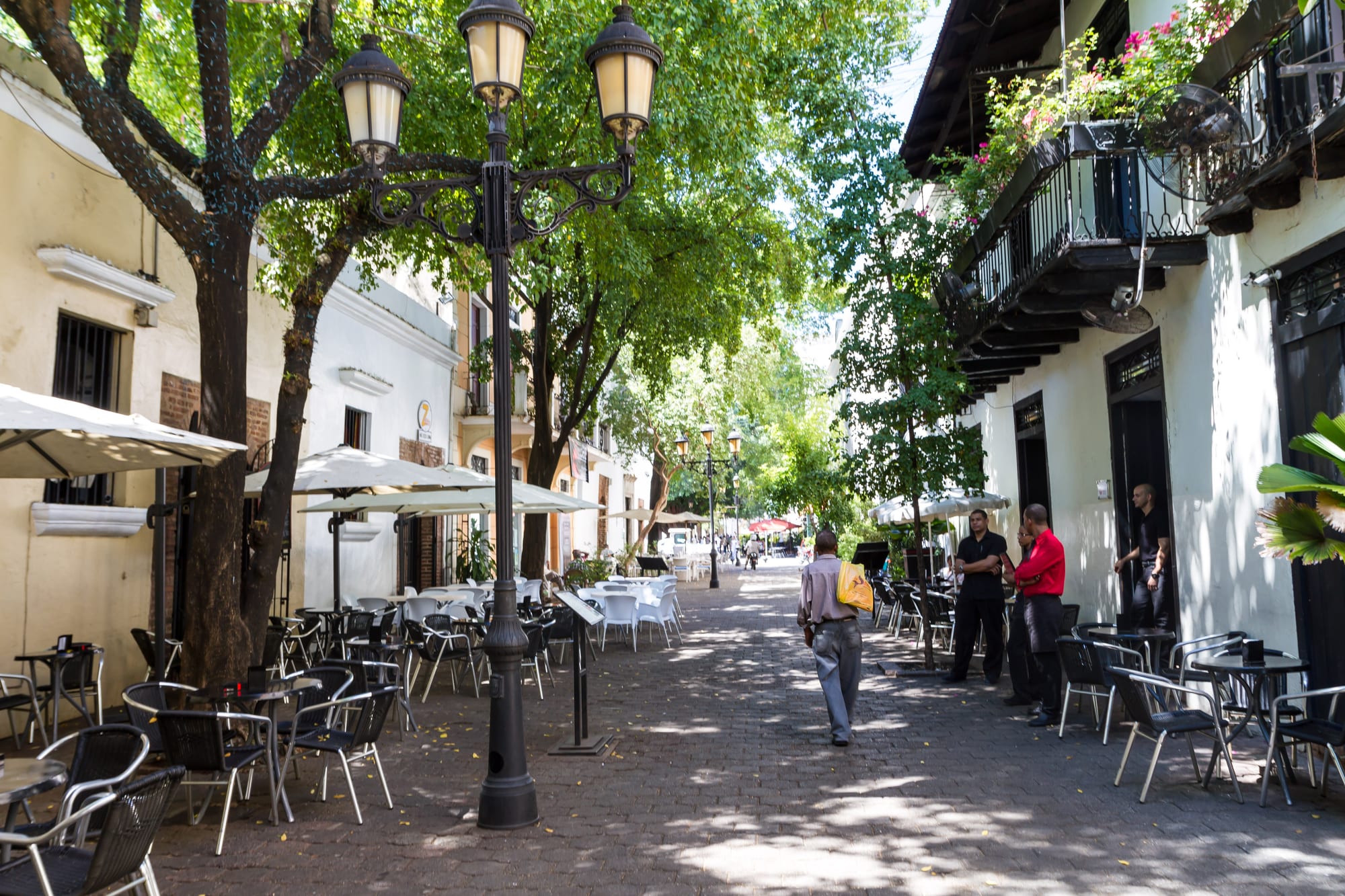
A shaded pedestrian street of pale colonial houses with café tables, iron lamp posts and balconies with flowers

Dominican Republic

Santo Domingo & the South

A café-lined street in the Zona Colonial, the historic heart of Santo Domingo. (Максим Улитин / Wikimedia Commons · CC BY 3.0)

The capital and the provinces around it on the south-central Caribbean coast, from Monte Plata's cane fields to the dry plains of Baní and Azua — the oldest European city in the Americas, home to well over a third of all Dominicans, with city beaches to the east and dunes, salt pans and mountain coffee to the west.

Explore Santo Domingo & the South

History

Before 1492 the plains around the Ozama and Haina rivers were Taíno farmland, and caves such as El Pomier near San Cristóbal hold thousands of their rock drawings. Bartholomew Columbus founded Santo Domingo on the east bank of the Ozama in 1496; after a hurricane Governor Nicolás de Ovando rebuilt it on the west bank from 1502, on the grid that still shapes the Zona Colonial. For a few decades it was Spain's capital in the New World, with the first cathedral, university and royal court of the Americas, and Azua, founded in 1504, had the young Hernán Cortés among its residents before he left for Cuba and Mexico.

As the conquest moved to the mainland the city declined. Francis Drake held and ransomed it in 1586, and the south became a thinly peopled land of cattle ranches. After the Haitian occupation of 1822–1844, independence was declared at the Puerta del Conde on 27 February 1844; Dominican forces then fought off a Haitian army at Azua in March, and the first constitution was signed in San Cristóbal that November. Baní produced Máximo Gómez, later a commander in Cuba's wars of independence.

Rafael Trujillo was born in San Cristóbal in 1891 and ruled from 1930. He renamed the capital Ciudad Trujillo in 1936, filled it with monuments and state buildings, and ran the country through the army, secret police and his family's monopolies, and in 1937 the army, on his orders, killed an estimated 20,000 Haitians in the north-western border region, in what became known as the Parsley massacre. He was assassinated by conspirators on the road to San Cristóbal in May 1961. In 1965 fighting between Constitutionalist rebels and the military in the capital brought a US intervention. Since then the city has sprawled into the surrounding province, which was split off as Santo Domingo province in 2001.

Culture & Customs

The capital is the centre of Dominican national culture: the Colonial Zone's churches and plazas, the Palacio de Bellas Artes, the national theatre and museums of the Plaza de la Cultura, and a music scene that runs from merengue bands on the Malecón to bachata in the colmados and dembow on car speakers in the barrios. Carnival parades fill the capital in February, and the diablo cojuelo, a masked devil, is its best-known character.

Afro-Dominican tradition is strong on the city's northern edge. The Cofradía del Espíritu Santo de los Congos de Villa Mella, a brotherhood whose drumming and funeral rites go back to the colonial era, is recognised by UNESCO as intangible cultural heritage. Bayaguana's image of the Santo Cristo draws pilgrims each year, and Catholic processions still mark Holy Week in the towns.

West of the capital, Baní celebrates its mangoes with an annual fair, Expo Mango. Ocoa is a mountain coffee district of small farms, and Azua has old cattle and fishing traditions.

Daily Life

Greater Santo Domingo holds more than four million people between the National District and the municipalities of Santo Domingo Este, Norte and Oeste. The city runs from the high-rise business districts of Piantini and Naco to dense barrios along the Ozama and Isabela rivers, where housing, flooding and water supply are persistent problems. San Cristóbal and Baní are the largest towns to the west, and Azua anchors the dry south-west of the region.

The economy mixes government, finance, commerce and universities with free-trade-zone factories, the port and oil refinery at Haina, and farming in the provinces: sugar cane, cacao and cattle in Monte Plata, mangoes and other crops around Baní and Azua, sea salt at Las Salinas, and coffee around San José de Ocoa.

The day starts early to beat the traffic. Motorbikes, guaguas and carros públicos (shared taxis) fill the avenues, the metro carries commuters in from the north and east, and evenings end on the Malecón, in the plazas of the Zona Colonial or at a colmado with dominoes and cold Presidente. Power cuts, the cost of living and the traffic are the constant talk.

Food

The capital eats the national staples — la bandera at lunch, mangú for breakfast, sancocho at weekends — and adds a busy restaurant scene in the Zona Colonial and Piantini. Chicharrón, crisp fried pork, is a favourite snack, and pica pollo, fried chicken, is a popular fast food in the barrios.

On the coast fried fish comes with tostones, fried green plantain, and yaniqueques, Johnnycakes brought by cane workers from the Lesser Antilles. Baní was named the country's mango capital in 2005, and sea salt comes from Las Salinas. Ocoa grows coffee and highland vegetables, and moro de guandules, rice cooked with pigeon peas, is widely eaten.

Street carts sell chimichurris, the local burger, and pastelitos, fried pastries filled with meat or cheese. Morir soñando, orange juice mixed with milk and sugar, and fresh fruit batidos cool the afternoon, and the capital's bars pour rum, mamajuana and Presidente beer.

Attractions & Natural Wonders

Santo Domingo's Zona Colonial, a UNESCO World Heritage Site, holds the Catedral Primada de América, begun in 1512, the Fortaleza Ozama, the Alcázar de Colón built for Diego Columbus, and the Museo de las Casas Reales along cobbled Calle Las Damas. Nearby are the ruins of the Monasterio de San Francisco, the Panteón Nacional, Parque Colón and the pedestrian Calle El Conde leading to the Puerta del Conde. Across the river in Santo Domingo Este stand the Faro a Colón, a vast cross-shaped monument completed in 1992, and the cave pools of Los Tres Ojos.

East along the coast, past Las Américas airport, Boca Chica's white-sand beach is the city's weekend escape. Inland to the north-east, Monte Plata's cane and cattle country rises towards the edge of the Los Haitises karst, and Bayaguana's sanctuary of the Santo Cristo draws pilgrims.

West of the capital, San Cristóbal has the Castillo del Cerro, built for Trujillo but never lived in, and the Taíno rock art of the El Pomier caves, with the beaches of Najayo and Palenque on its coast. Beyond Baní, the Médanos de Baní, sand dunes on the Las Calderas peninsula, rise above the bay, with the salt pans of Las Salinas nearby. Further west lie Azua's bay and the cool coffee mountains around San José de Ocoa.

Cities in Santo Domingo & the South

Planning basics

Budget

Santo Domingo is the country's most expensive city for rent but good value for visitors: guesthouses and boutique hotels in the Zona Colonial, comedor lunches and the metro keep costs well below the resort zones. Boca Chica has cheap guesthouses alongside larger hotels, and the provinces west and north of the capital are inexpensive, with few tourist-priced services.

Daily Budget Midrange
USD 110–220 (colonial-zone hotel, restaurants, taxis or a hire car, museum and cave tickets)
Daily Budget Shoestring
USD 40–75 (guesthouse, comedor meals, metro and guaguas)

Stay in the Zona Colonial for the sights and use the metro or app-based taxis for longer journeys across the city.

Safety

Santo Domingo has more street crime than the resort zones: bag snatching, often from passing motorbikes, phone theft, scams and occasional armed robbery, especially after dark and in poorer outer districts. The Zona Colonial has a tourist police presence and is busy until late, but side streets empty at night. Traffic is chaotic, and hurricanes and flooding can hit the coast in the wet season.

Keep phones out of sight near the kerb, use app-based or hotel taxis at night, and avoid walking alone through empty streets after dark. Check current official travel advice before travelling.

Climate

Hot and humid on the coast all year, with the capital slightly less rainy than the north coast. West of San Cristóbal the land dries out quickly: Baní and Azua sit in the rain shadow of the Cordillera Central and are semi-arid, while the mountains around San José de Ocoa are markedly cooler. Monte Plata, inland to the north-east, is greener and wetter.

Summer
hot and humid, 30–33°C by day on the coast, with afternoon storms and hurricane risk from June to November
Winter
warm and drier, 28–30°C by day and around 20°C at night; cool nights in the Ocoa mountains

Transportation

Las Américas International Airport lies east of the capital, near Boca Chica. Santo Domingo has the country's only metro, plus a cable car in the north of the city, and is the hub for intercity coaches to the rest of the country. Guaguas run west along the highway to San Cristóbal, Baní and Azua and east to Boca Chica. Traffic in the capital is heavy at rush hours.

Boca Chica is about 30–45 minutes from the Zona Colonial by road; allow roughly an hour and a half to Baní.

Best Time to Visit

December to April is the driest and most comfortable time for walking the Zona Colonial. February brings carnival parades to the capital, and the Merengue Festival fills it in summer. Summer is hot and sticky but good for city beaches, and Baní holds its Expo Mango fair to celebrate the mango harvest.