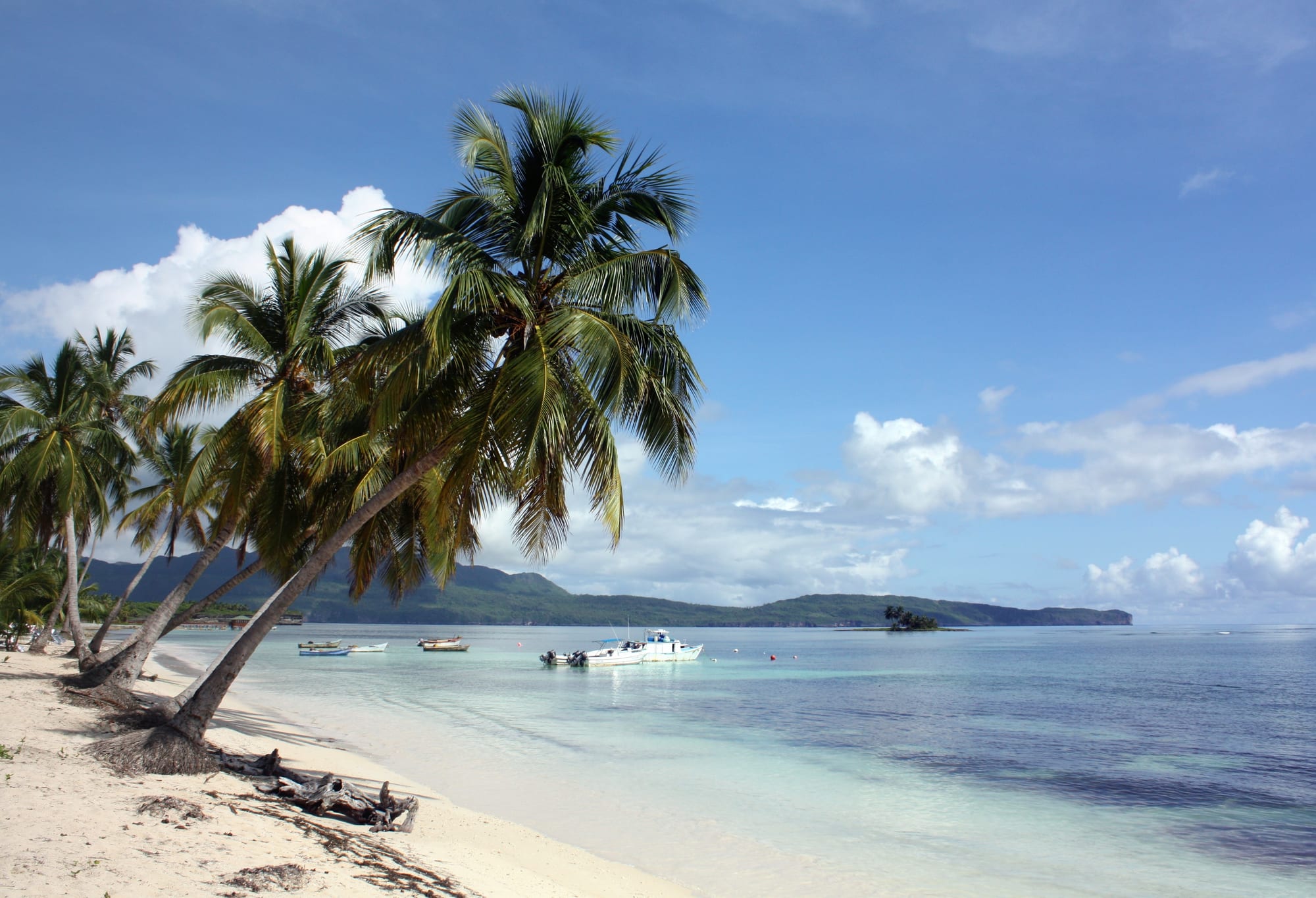
Leaning coconut palms over a white-sand beach and calm turquoise water, with small boats and green hills beyond

Dominican Republic

Samaná & the Northeast

The beach at Las Galeras, near the eastern tip of the Samaná peninsula. (Einfach-Eve / Wikimedia Commons · CC0)

The north-eastern corner of the country, from the cacao and rice lands around San Francisco de Macorís to the Atlantic coast at Nagua and the mountainous Samaná peninsula — a region of palm-lined beaches, waterfalls and the winter gathering of humpback whales in Samaná Bay.

Explore Samaná & the Northeast

History

The Samaná peninsula was home to the Ciguayo, a Taíno-related people known for their bows, and in January 1493 Columbus's men fought a skirmish with them on the shore of Samaná Bay, the first armed clash between Europeans and native people in the Americas; he named the place the Golfo de las Flechas, the Bay of Arrows. For centuries afterwards the peninsula was thinly settled, a refuge for pirates and runaways, until Spain founded Santa Bárbara de Samaná with families from the Canary Islands in 1756.

In 1824 and 1825, during Haiti's rule of the whole island, several thousand free African Americans emigrated from the United States at the invitation of President Jean-Pierre Boyer, and some of them settled on the peninsula. Their descendants kept English, Protestant churches and their own traditions. The deep, sheltered bay also drew foreign interest: in 1869 the US government negotiated a treaty to annex the country, with Samaná Bay as a naval prize, but in 1870 the US Senate rejected it.

Inland, San Francisco de Macorís grew as a market town for cacao, rice and cattle from the 18th century, and the region formed the eastern edge of the Cibao. Until late in the 20th century the Samaná peninsula stayed isolated, reached mainly by boat and rough tracks. Tourism grew slowly at first, then quickly after 2006, when the El Catey airport opened, followed by a motorway to the capital.

Culture & Customs

The region mixes Cibao farming culture inland with a distinctive coastal identity. In Samaná, descendants of the 1820s African American settlers still carry English surnames, and older people speak Samaná English, an English-based variety handed down from their ancestors. Their Protestant congregations centre on La Churcha, the church that is the town's symbol and the setting of an annual harvest festival procession, and they keep hymn-singing traditions.

Samaná's local rhythm, the bambulá, a drum-led dance, is still performed in communities such as La Aguada, Tesón and Anadel. The patron saint's festival of Santa Bárbara in December and the whale season shape the town's calendar. Las Terrenas has a different flavour altogether: French, Italian and other European residents run many of its bakeries, restaurants and guesthouses, and French is commonly heard in the streets.

San Francisco de Macorís, by contrast, is a proud Cibao city with a large emigrant community in the United States, whose remittances show in its houses and businesses, and it has a keen basketball scene as well as baseball.

Daily Life

San Francisco de Macorís, capital of Duarte province, is the largest city, with around 200,000 people, and the commercial centre of the lower Cibao. Nagua is the capital of María Trinidad Sánchez, and Santa Bárbara de Samaná, usually just called Samaná, is the peninsula's main town; Las Terrenas and Las Galeras are small but growing quickly.

The economy is farming and tourism. The plains around San Francisco and Nagua are among the country's main rice-growing areas, and cacao, much of it exported, is grown on small farms in Duarte and across the north-east. Coconuts are the main crop of the peninsula's coast, and fishing supports the coastal villages. Tourism brings foreign investment, holiday rentals and building work to the peninsula, along with arguments over land prices, coastal development and the strain on water and waste services.

On the peninsula life moves slowly: fishermen landing their catch in the morning, motoconchos ferrying schoolchildren, and colmados with loud music at night. In the whale season the pace in Samaná's harbour picks up sharply.

Food

The peninsula's signature is cooking with coconut. Pescado con coco, fish simmered in a sauce of coconut milk, tomato, peppers and garlic, is served everywhere from beach shacks to restaurants, and lobster, shrimp and crab are also cooked in coconut sauce. Rice cooked with coconut milk accompanies it, and Johnny cakes, fried or baked breads brought by the African American settlers, are a local speciality.

Coconut sweets, including dulce de coco and coconut bread, are sold in Samaná's streets, and fresh coconuts are cracked open at roadside stands. In Las Terrenas the European community has added French bakeries, pizza and fresh seafood restaurants on the beachfront.

Inland, the Duarte plains supply the rice that goes into la bandera across the country, and cacao from the region is made into chocolate and hot drinking chocolate at small local producers. As elsewhere, Presidente beer, rum and mamajuana are the drinks of the beach bars.

Attractions & Natural Wonders

The Samaná peninsula is the region's heart. From about mid-January to mid-March, humpback whales fill Samaná Bay, part of a marine mammal sanctuary, and boats leave Samaná town's harbour to watch them, often stopping at the palm-covered island of Cayo Levantado. Across the bay, boats reach the mangroves, karst islets and Taíno cave drawings of Los Haitises National Park.

On the north shore, Las Terrenas has a string of palm-lined beaches, among them Playa Bonita and Playa Cosón, and a lively village of small restaurants. Inland, the El Limón waterfall, near the village of El Limón, is a popular excursion into the forested hills. At the peninsula's eastern tip, Las Galeras has a calm village beach, with Playa Rincón, one of the province's most visited beaches, and the remote cove of Playa Frontón nearby.

West of the peninsula, the Nagua coast runs north through fishing villages and surf beaches to Cabrera, and on to Río San Juan with its Laguna Gri-Gri, a mangrove lagoon explored by boat, and the sweep of Playa Grande. Inland, San Francisco de Macorís is a working city with cacao farms in the surrounding hills.

Cities in Samaná & the Northeast

Planning basics

Budget

Mid-priced by Dominican standards. Las Terrenas and Las Galeras have a wide range of guesthouses, apartments and small hotels run by foreign residents, often priced in US dollars, plus a few large resorts. Samaná town, Nagua and San Francisco de Macorís are cheap and local. Whale watching, boat trips and horse rides to El Limón are the main extras.

Daily Budget Midrange
USD 110–220 (beach hotel, restaurants, a whale-watching or boat trip)
Daily Budget Shoestring
USD 40–75 (guesthouse, comedor meals, guaguas and motoconchos)

Book whale watching with operators that follow the sanctuary rules on distance and boat numbers, and pay in pesos where possible.

Safety

The peninsula is generally calm, with petty theft and burglary of holiday rentals as the main crime concerns. Natural risks matter more: strong currents on Atlantic beaches, slippery paths at El Limón, hurricanes and flooding in the wet season, and poorly maintained boats on some excursions.

Swim only where locals do and away from rip currents, ride motoconchos with a helmet, and choose licensed boat operators with life jackets. Check current official travel advice before travelling.

Climate

A wet stretch of the country's coast. The trade winds bring rain to the Samaná peninsula and the Atlantic shore year-round, with the heaviest falls from autumn into winter as northerly fronts arrive, so the hills stay very green. Temperatures are steady, and the Duarte plains inland are hot and humid.

Summer
hot and humid, 30–32°C, with showers and a hurricane risk from June to November
Winter
warm, 27–29°C, with frequent showers, especially from November to January

Transportation

El Catey International Airport, west of Samaná town, takes international and domestic flights. A toll motorway connects the peninsula with Santo Domingo, and a scenic road runs on to Las Terrenas. Coaches link Samaná, Nagua and San Francisco de Macorís with the capital and Santiago; guaguas and motoconchos serve the peninsula, and boats cross the bay to Los Haitises.

Las Terrenas is about 30 minutes and Las Galeras about an hour by road from El Catey airport.

Best Time to Visit

Mid-January to mid-March for the humpback whales, the region's big event, which is also the busiest time in Las Terrenas and Las Galeras. March and April are drier and good for beaches. Summer is hot but quieter, and late autumn is the rainiest stretch.