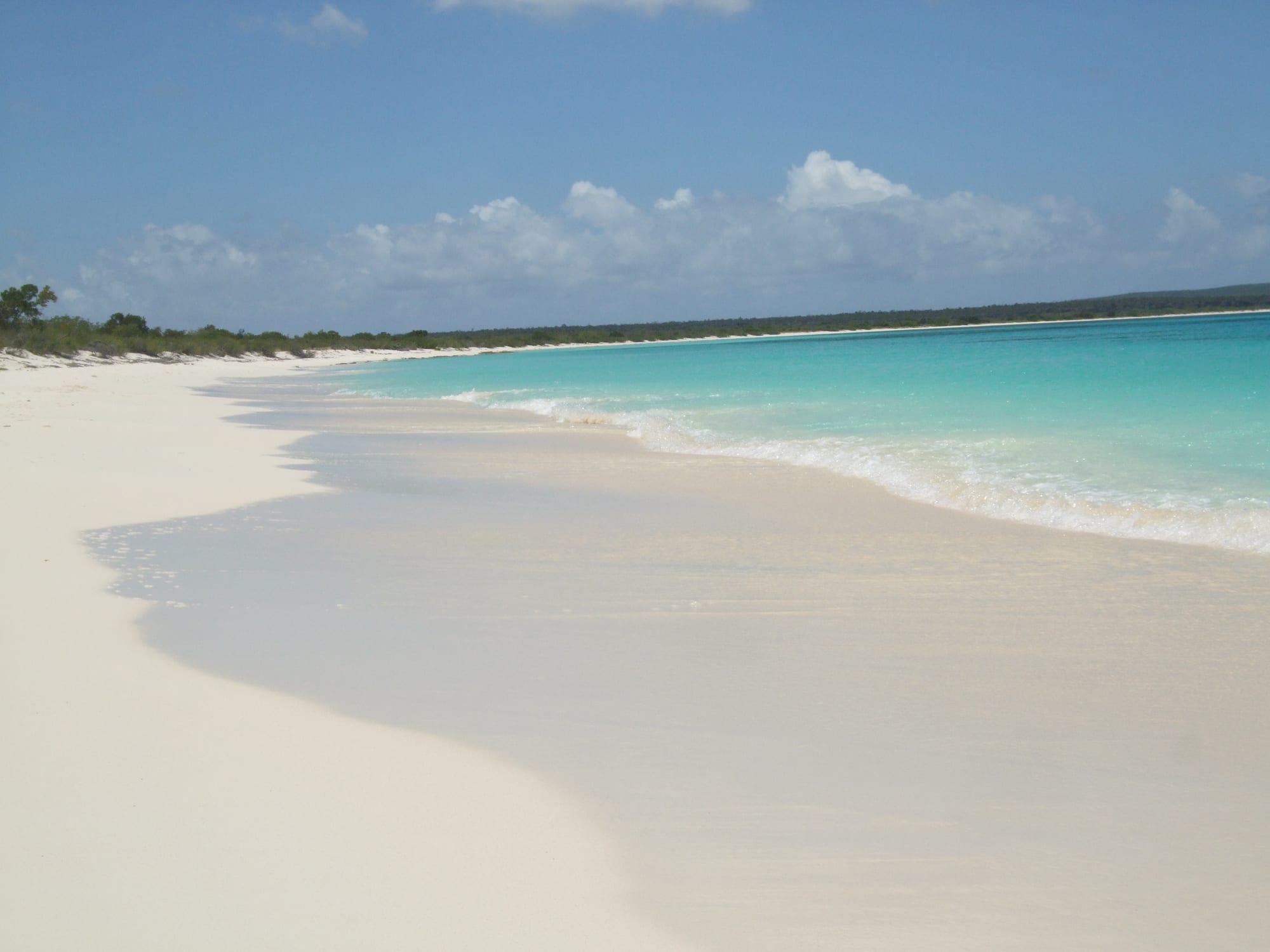
A long curve of empty white-sand beach meeting bright turquoise water under a blue sky with scattered clouds

Dominican Republic

Bahía de las Águilas, an undeveloped eight-kilometre beach in Jaragua National Park in the arid southwest. (jordina collellcortacans (Flickr) / Wikimedia Commons · CC BY-SA 2.0)

The larger, more populous share of the island of Hispaniola — site of the first European city in the Americas, now the Caribbean's biggest tourism economy, with baseball, merengue, mountains, and long beaches.

Explore Dominican Republic

History

Santo Domingo, founded in 1496, was the first permanent European city in the Americas and the base from which Spain launched the conquest of the mainland. The Indigenous Taíno were destroyed within decades by disease and forced labour, and enslaved Africans were brought to work sugar and cattle estates. As Spain's attention moved to Mexico and Peru, the colony became a poor backwater.

The western third of Hispaniola became the rich French colony of Saint-Domingue, which after its slave revolution became Haiti in 1804. Haiti occupied the whole island from 1822 to 1844, when Dominican rebels declared independence — celebrated as the founding of the nation. The nineteenth century brought a brief return to Spanish rule, chronic instability, and, from 1916, an eight-year US military occupation.

Rafael Trujillo seized power in 1930 and ran one of the most brutal and bizarre dictatorships in Latin American history for 31 years, until his assassination in 1961 — a period that included the 1937 Parsley massacre, in which tens of thousands of Haitians were killed or driven across the border. After further US intervention and civil conflict in the 1960s, the country settled into democratic politics and became the most visited destination in the Caribbean.

Culture & Customs

Dominican culture is a blend of Spanish, African, and Taíno elements, with music at its heart: merengue, the fast national dance, and bachata, the guitar-driven style born among the rural poor and long played in the country's bars, now heard worldwide. Both fill radios, colmados (corner shops), and street parties, and Carnival in February is a riot of diablo cojuelo devil costumes, especially in La Vega.

Baseball — pelota — is close to a religion. The Dominican Republic supplies more Major League players than any country outside the United States, winter-league games are a major social event, and small-town academies feed the pipeline.

Religion is mostly Catholic, with growing evangelical and some Afro-syncretic practice. Family and the extended household are central, and relations with Haiti — sharing an island, a long history of conflict, and a large migrant labour force often in a precarious legal position — remain a charged national issue. Construction of a wall along part of the 392-kilometre border began in 2023, and the government announced tighter border controls and migration enforcement in April 2025.

The country was shaken in April 2025 when the roof of the Jet Set nightclub in Santo Domingo collapsed during a merengue concert, killing 236 people in what is believed to be the deadliest non-natural disaster in its history.

Daily Life

Greater Santo Domingo holds around a third of the country's roughly 11 million people; Santiago, in the fertile Cibao valley, is the second city and the centre of the tobacco and cigar industry. The coasts are increasingly shaped by tourism and foreign residents, while the mountainous interior stays agricultural.

The economy is the largest and one of the fastest-growing in the Caribbean, built on tourism, free-trade-zone manufacturing, mining (gold), remittances from the large diaspora in the US, and agriculture. Growth has not erased sharp inequality, and power cuts, water supply, and the cost of living are constant concerns; a fault on a transmission line blacked out the whole country in February 2026.

Daily life runs on the colmado as social hub, the guagua, dominoes, baseball on the radio, and merengue from every direction, with a strong Sunday of church and family meals.

Food

Dominican cooking is filling and unfussy. The everyday lunch, la bandera ("the flag"), is white rice, red beans, stewed meat, and salad, often with fried plantain (tostones). Sancocho, a thick stew of several meats and root vegetables, is the celebratory dish, and mangú — mashed green plantain, classically served for breakfast "los tres golpes" with fried cheese, salami, and eggs — is a national favourite.

Street and beach food includes chicharrón, yaniqueques (fried dough), empanadas, and chimichurris (the local burger). Habichuelas con dulce, a sweet cream of beans, is an Easter tradition, and dulce de leche and coconut sweets are common.

Rum is the national spirit, drunk in a Cuba libre or straight, and mamajuana — rum, red wine, and honey steeped with bark and herbs — is the folk tonic. Presidente is the ubiquitous beer, and strong sweet coffee punctuates the day.

Attractions & Natural Wonders

Santo Domingo's Colonial Zone, a UNESCO World Heritage Site, is the essential history stop: the first cathedral, first university, and the ruins of the first monastery of the Americas, the fortress of the Ozama, and the Alcázar de Colón, all within a few walkable blocks of restored streets.

The east has the country's famous beaches — the long white strands and coconut groves of Punta Cana and Bávaro, backed by huge all-inclusive resorts — and the protected mangroves and rock-art caves of Los Haitises National Park, reached by boat. The Samaná Peninsula in the northeast adds El Limón waterfall, the bay of Las Galeras, and, in winter, the humpback whales of Samaná Bay.

Inland rises the Cordillera Central, with Pico Duarte, the highest peak in the Caribbean, the cool mountain towns of Jarabacoa and Constanza, and fast mountain rivers. In the southwest, far from the resorts, lie the salt lake of Lago Enriquillo with its crocodiles and iguanas, the pale-sand crescent of Bahía de las Águilas in Jaragua National Park, and the sand dunes of Baní.

Planning basics

Budget

The Dominican Republic spans budgets. The all-inclusive resort zones of Punta Cana and Puerto Plata can be done cheaply as a package or expensively à la carte; independent travel using guaguas (minibuses), local comedores, and guesthouses is inexpensive. Cards work in resorts and cities; carry pesos elsewhere. Since the war that began in the Middle East in February 2026, global oil and gas prices have surged and aviation has been disrupted, so air fares and fuel-linked costs can run above these ranges.

Daily Budget Midrange
USD 100–200 (hotel, rental car, restaurants, excursions)
Daily Budget Shoestring
USD 40–70 (guesthouse, comedor meals, guaguas)

Resort areas quote in US dollars; you'll get better value paying in Dominican pesos away from them.

Visa Requirements

Citizens of the US, Canada, the UK, the EU, and most of Latin America enter visa-free for up to 90 days, extendable to 180. A tourist tax is usually bundled into the airfare, and there is a departure tax. An e-ticket migration form must be completed online before arrival and departure.

Typical Stay
Up to 90 days on entry, visa-free, extendable to 180

Fill in the free E-Ticket form online shortly before both entry and exit.

Safety

The main tourist areas are heavily policed and generally safe, but the Dominican Republic has significant crime, and petty theft, scams, and occasional armed robbery affect visitors, particularly in Santo Domingo and Santiago. Road accidents, especially on motorbikes (motoconchos), are a leading hazard.

Source
US Department of State and UK FCDO travel advisories — check for the latest wording.

Use hotel or app-based transport at night, don't display valuables, be cautious with unlicensed money changers and "helpful" strangers, and think twice about riding pillion on a motoconcho.

Source: US Department of State and UK FCDO travel advisories — check for the latest wording.

Climate

Tropical, warm year-round, and moderated by trade winds and altitude. Across most of the country the drier season runs roughly December to April, and May to November is hotter and wetter and overlaps the Atlantic hurricane season; on the north coast, though, the wet season runs from November to January.

Mountains
the Cordillera Central is cool; Pico Duarte can freeze
Dry Season
Dec–Apr, around 26–29°C, less rain
Wet Season
May–Nov in most of the country (Nov–Jan on the north coast), humid, hurricane risk

Transportation

Several international airports serve different regions — Punta Cana, Santo Domingo, Puerto Plata, Santiago, Samaná. There is no passenger rail beyond Santo Domingo's metro. Comfortable intercity coaches (Caribe Tours, Metro) link the main cities; guaguas cover shorter routes; a rental car gives flexibility on generally decent roads.

Driving
On the right; driving is assertive and rural roads can be rough, so avoid night trips between towns

Best Time to Visit

December to April for the driest, sunniest weather in most of the country, and the peak season for prices and crowds. Humpback whales gather to breed in Samaná Bay in the winter months, roughly January to March. May and November are quieter shoulder months.

Events
Carnival runs through February, with the best-known celebrations in La Vega and the national parade in Santo Domingo, and peaks around Independence Day on 27 February

Currency

The currency is the Dominican peso (DOP). US dollars are widely accepted in tourist areas, often at a poor rate; change money at banks or ATMs for pesos to use elsewhere.

Cards
Accepted in cities and resorts; cash needed for transport and small vendors
Symbol
RD$
Currency Code
DOP — Dominican peso

Language

Spanish is the official language, spoken in a fast Caribbean accent. English is widely spoken in the resort areas and by many in tourism, less so in the interior. Haitian Creole is the largest minority language, spoken by Haitian immigrants and their descendants, and a community of a few thousand on the Samaná peninsula descends from African American settlers who arrived in the 1820s and spoke Samaná English.

English
Common in resorts; limited in the interior
Official Language
Spanish (Dominican)