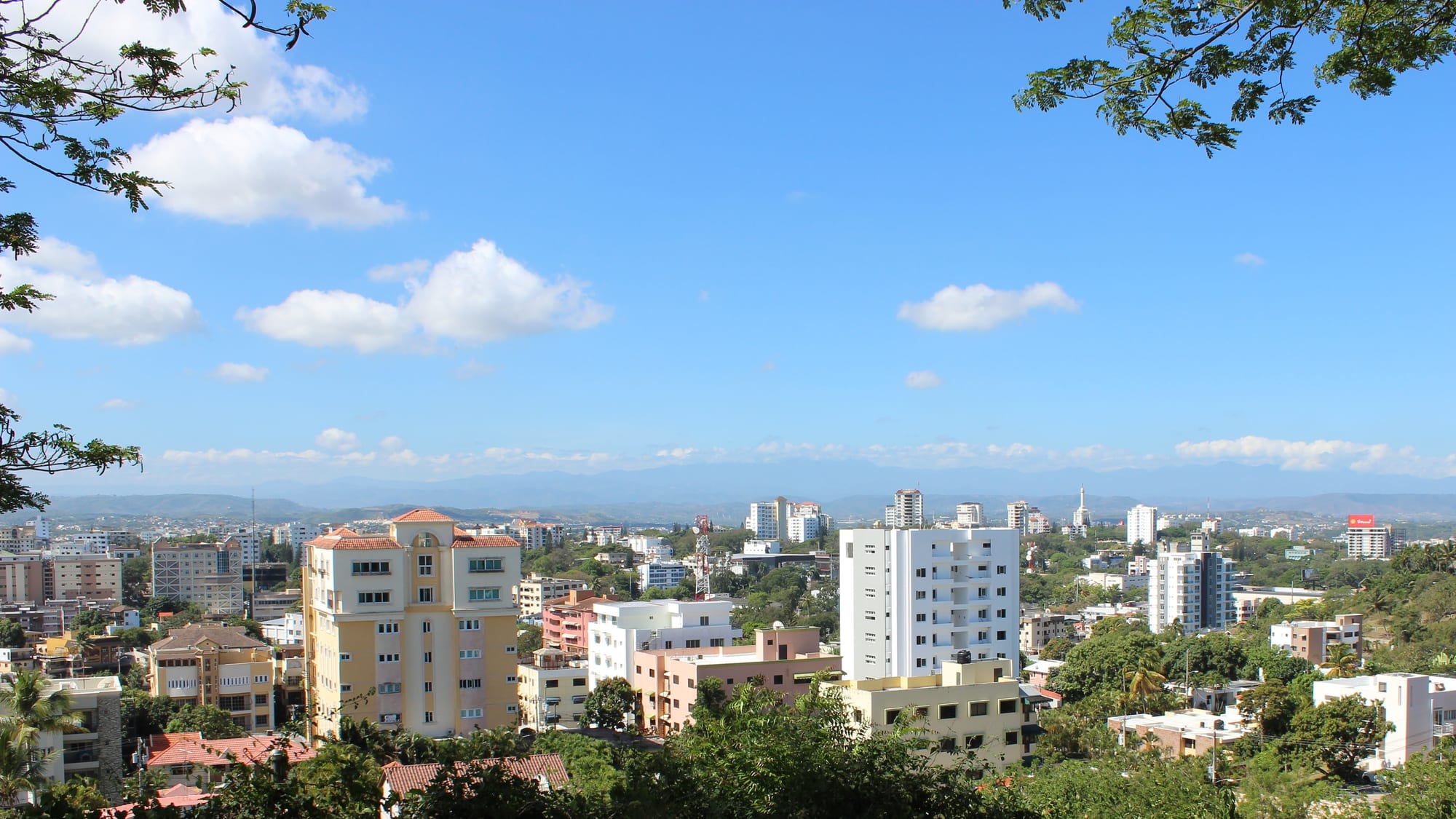
Pale apartment blocks and low houses among trees in Santiago, with distant hills under a blue sky with small clouds

Santiago, Puerto Plata & the Cibao, Dominican Republic

Santiago de los Caballeros

Santiago de los Caballeros spreading across the Cibao valley. (Janel J. Díaz / Wikimedia Commons · CC BY-SA 3.0)

The Dominican Republic's second city, in the fertile Cibao valley between two mountain ranges, founded in 1495 and rebuilt beside the Yaque del Norte river. Tobacco, trade and free-zone factories made it the commercial heart of the north; today a hilltop marble monument, a carnival of masked lechones, winter baseball and a busy old centre around Calle del Sol define it.

Neighbourhoods

  • Historic centre and Calle del Sol
    • First-time visitors
    • Historic district
    • Shopping

    The old core near the river, where Calle del Sol, the city's main shopping street, runs past the cathedral, the Fortaleza San Luis, the first banks and the Mercado Modelo craft market. Busy, noisy and commercial by day, with small hotels and cheap eateries in the surrounding streets.

    Open in Maps
  • The Monument and around
    • Views
    • Close to the centre

    The hill crowned by the Monument to the Heroes of the Restoration and its surrounding park, about ten minutes' walk from Calle del Sol. Horse-drawn carriages wait at its foot, and hotels and restaurants cluster on the avenues nearby.

    Open in Maps
  • La Joya
    • Local life
    • Carnival

    An old barrio on the south-western edge of the city beside the Yaque del Norte, long known for its parties, games and folk traditions. It sends many of the masked lechones into the February carnival, and Plaza Valerio is a market where visitors from the hill country arrive.

    Open in Maps
  • Los Cerros de Gurabo and La Esmeralda
    • Quiet and residential
    • Upmarket

    The city's upper-class districts, among them Los Cerros de Gurabo, La Esmeralda and the Quintas de Pontezuela, mainly residential and quieter than the centre.

    Open in Maps

Things to do

Famous landmarks

  • Monument to the Heroes of the Restorationlandmark

    A 67-metre marble monument on a hill in the middle of the city, begun in 1944 under Trujillo as a monument to himself and renamed after 1961 for the heroes of the Restoration War; there is a museum inside and a view over the valley.

    Open in Maps
  • Cathedral of Santiago Apóstollandmark

    The city's neo-classical and Gothic-style cathedral, the work of the Santiago-born architect Onofre de Lora, built between 1868 and 1894, consecrated in 1895 and dedicated to St James the Greater.

    Open in Maps
  • Fortaleza San Luismuseum

    A fort near the Yaque del Norte river that saw fighting in the Restoration War, later served as the municipal prison and is now a history museum.

    Open in Maps

Museums and culture

  • Centro Leónmuseum

    A museum and cultural centre opened in 2003, with collections of Dominican art, archaeology, ethnography and folk culture.

    Open in Maps
  • Museo Folklórico Yoryi Morelmuseum

    A folk museum named after the Santiago painter Yoryi Morel, showing the culture of Santiago's carnival and costumes worn by the lechones.

    Open in Maps
  • Museo del Tabacomuseum

    A museum in the centre on how tobacco is grown and made into cigars, and on the plantations' part in the city's history.

    Open in Maps
  • Gran Teatro del Cibaoattraction

    Regarded as the second most important theatre in the country, the regional stage for concerts, opera, plays and award ceremonies.

    Open in Maps

Markets and sport

  • Mercado Modelomarket

    A market on Calle del Sol with stalls of handicrafts and locally made goods.

    Open in Maps
  • Estadio Cibaoattraction

    The country's largest baseball stadium, opened in 1958 with about 18,000 seats, home of the Águilas Cibaeñas in the winter league.

    Open in Maps

Short trips from the city

  • Puerto Plataattraction

    The old port on the Atlantic coast, with the Fortaleza San Felipe, Victorian architecture and a cable car up Pico Isabel de Torres.

    Open in Maps
  • Jarabacoaattraction

    A cool mountain town of rivers and waterfalls in the Cordillera Central.

    Open in Maps
  • La Vegaattraction

    The town south-east of Santiago known as the country's carnival capital, where masked diablos cojuelos fill the streets every February.

    Open in Maps

Seasonal events

  • Santiago carnivalFebruary

    The national carnival season opens with an indoor gala in Santiago, and through February the city's lechones parade in multicoloured costumes and horned masks.

  • Winter baseball seasonwinter

    The Águilas Cibaeñas, winners of 22 national titles and six Caribbean Series, play at Estadio Cibao, with their rivalry against Licey the high point.

Eat and drink

Long-standing places and food districts in Santiago de los Caballeros. Hours, ratings and directions come from your maps app, always current.

Food districts and markets

  • Calle del Solneighborhood

    The old shopping street and the blocks around it, with cheap places to eat and drink among the shops.

    Open in Maps
  • Plaza Valeriomarket

    A market area in La Joya where travellers from the Cibao's hill country arrive on visits to the city.

    Open in Maps
  • Restaurants near the Monumentneighborhood

    The avenues around the monument hill, with grills, steakhouses and empanada stands.

    Open in Maps

Experience Santiago de los Caballeros

History

Santiago was founded in 1495, and its name recalls a group of knights — the caballeros — who came from La Isabela to settle there. Its early settlement stood for a time at Jacagua, now a suburb, and was struck by earthquakes; after one devastated the town in December 1562, the survivors settled on land beside the Yaque del Norte river, where the city stands today.

A Haitian army was defeated at the city on 30 March 1844, and in the Restoration War of 1863–1865 against renewed Spanish rule the rebels set up their government in Santiago; the city burned during the fighting, and the Fortaleza San Luis saw several battles. The cathedral was consecrated in 1895, and in 1944 Trujillo began a marble tower on the hill above the centre, inaugurated in 1953 as a monument to his own peace and renamed for the Restoration heroes after his assassination in 1961.

From the 1980s industrial free zones drew migrants from the countryside, and the city spread north-west, north and east. Today its free-zone parks hold a large share of the country's export firms. A cable car joined the public transport system in 2024, a monorail was under construction in 2026, and hotel building has grown alongside rising numbers of visitors.

Culture & Customs

Santiago calls itself La Ciudad Corazón, the Heartland City, and sees itself as the capital of the Cibao — the country's farming and trading heart, with its own accent and pride. Merengue típico, played on accordion and güira, grew up in the Cibao around Santiago, and the region produced Ñico Lora, considered one of the fathers of merengue.

Carnival is the great event. Santiago's devil figures are the lechones, men in loose multicoloured silk suits covered with mirrors and imitation jewels, wearing grotesque masks; the Pepines wear masks with a broad flattened beak crowned with two bull's horns. The barrio of La Joya sends many of them into the streets every February, and the Yoryi Morel folk museum displays costumes worn by them. The national carnival season opens in Santiago with an indoor gala.

Baseball is followed with devotion. The Águilas Cibaeñas, who play at Estadio Cibao, have won 22 national titles and six Caribbean Series, and their rivalry with Licey of Santo Domingo is one of the sport's most intense. The city is also a university town, home of the Pontificia Universidad Católica Madre y Maestra, whose campus holds the stadium of Cibao FC, the city's football club.

Daily Life

The municipality of Santiago had about 772,000 people at the 2022 census, and the wider metropolitan area, which takes in Tamboril, Licey al Medio, Puñal and Villa González, about 948,000. The city also receives more than 250,000 visitors a day.

Commerce and hotels are the biggest employers, followed by industry. Santiago makes cigars, coffee, rum and other drinks, concrete and plywood, and its free-zone parks hold well over a hundred companies; the surrounding municipalities grow tobacco and raise poultry. The city is also a centre of health tourism, and Cibao International Airport's busiest route links it to New York, the home of a large Dominican community.

Wealthier families live in upper-class districts such as Los Cerros de Gurabo and La Esmeralda, while fast-growing barrios such as Cienfuegos sprawl to the west and older neighbourhoods like La Joya complain of poor drainage and neglected streets. Weekday traffic is heavy, colmados play music into the evening, and dominoes and baseball fill spare hours.

Food

Santiago eats like the rest of the Cibao, heartily. Mangú, mashed green plantain, is the breakfast favourite, served with fried cheese, salami and eggs; at lunch la bandera — white rice, red beans, stewed meat and salad — is the standard plate, and chicharrón, crisp fried pork, and longaniza, a spicy sausage, are popular throughout the region.

Street food is part of daily life: empanadas, fried pastries filled with meat or cheese, are sold from stands across the city, and the avenues around the Monument have grills and steakhouses. Comedores, simple lunch places, serve set plates to office workers in the centre, and the market area of Plaza Valerio draws travellers from the Cibao's hill country.

Coffee is drunk through the day, and rum and Presidente beer are the drinks of an evening out. Cigars, rolled in the city's factories from tobacco grown in the valley, are a long-standing local product.

Planning tools

Budget

Santiago runs on local prices and is cheaper than the capital or the beach resorts. Guesthouses and comedores in the centre are inexpensive, business hotels near the Monument cost more, and taxis are the main daily extra for anyone without a car.

Daily Budget Midrange
USD 100–200 (city hotel, restaurants, museum visits, taxis or a hire car)
Daily Budget Shoestring
USD 40–70 (guesthouse, comedor meals, guaguas and the cable car)

Many of the best things — the Monument's park and view, Calle del Sol and the cathedral — cost little or nothing; pay in pesos away from hotels.

Best Time to Visit

February brings carnival, the city's biggest event, and the winter months add the baseball season at Estadio Cibao. The city is hot all year and often cloudy, so mornings and evenings are the best times for walking.

Suggested Number of Days

One or two days cover the centre and the main museums. Allow three or four to add trips into the mountains or to the coast, which are all within reach by road; a carnival weekend or a ball game adds time.

First Visit
1–2 days
With Surroundings
3–4 days

Transportation

Taxis, guaguas and motoconchos are the main ways around this spread-out city. The Teleférico de Santiago, a cable car that opened in March 2024, is part of the city's public transport system, and a 12.8-kilometre elevated monorail line was under construction in 2026. Coach companies run from their own terminals to Santo Domingo, Puerto Plata, Sosúa, Dajabón and Monte Cristi.

Use taxis or app-based transport rather than motoconchos, especially at night.

Airport & Station Connections

Cibao International Airport, 15 kilometres south-east of the centre, is the country's third-busiest airport, with many flights from the United States, especially New York. Coaches from Santo Domingo take about three hours along the Autopista Duarte.

Walkability

The historic centre around Calle del Sol is walkable, and the Monument is about ten minutes on foot from it. Beyond that the city spreads across the valley along busy avenues, heavy with weekday traffic, and a taxi is the practical way between districts.

Safety

The main tourist areas are heavily policed and generally safe, but the Dominican Republic has significant crime, and petty theft, scams, and occasional armed robbery affect visitors, particularly in Santo Domingo and Santiago. Santiago has the same street-crime problems as the capital — phone and bag theft, often from motorbikes, and occasional robbery at night.

Keep phones out of reach of passing motorbikes, carry little at night and use taxis rather than walking after dark. Check current official travel advice before travelling.

Climate

A tropical monsoon climate, made a little milder by the city's height of about 180 metres, with cloudy skies for much of the year. Rain falls mostly in the wetter half of the year.

Summer
hot, around 30–34°C in the Cibao valley
Winter
warm — around 26–29°C across most of the country in the drier months, with cooler nights

Local Customs

Santiagueros are proud of their city, its accent and the Cibao's farming and trading traditions, and conversation readily turns to baseball and the Águilas. Dress is neater than in the beach towns, and churches expect covered shoulders.

Greet people before asking for anything, ask before photographing carnival performers or residents, and be ready for loud music from colmados in the evening.

Common Payment Methods

The currency is the Dominican peso (RD$). Cards are accepted in hotels, malls and larger restaurants, and ATMs are common; cash is needed for guaguas, motoconchos, market stalls and colmados.