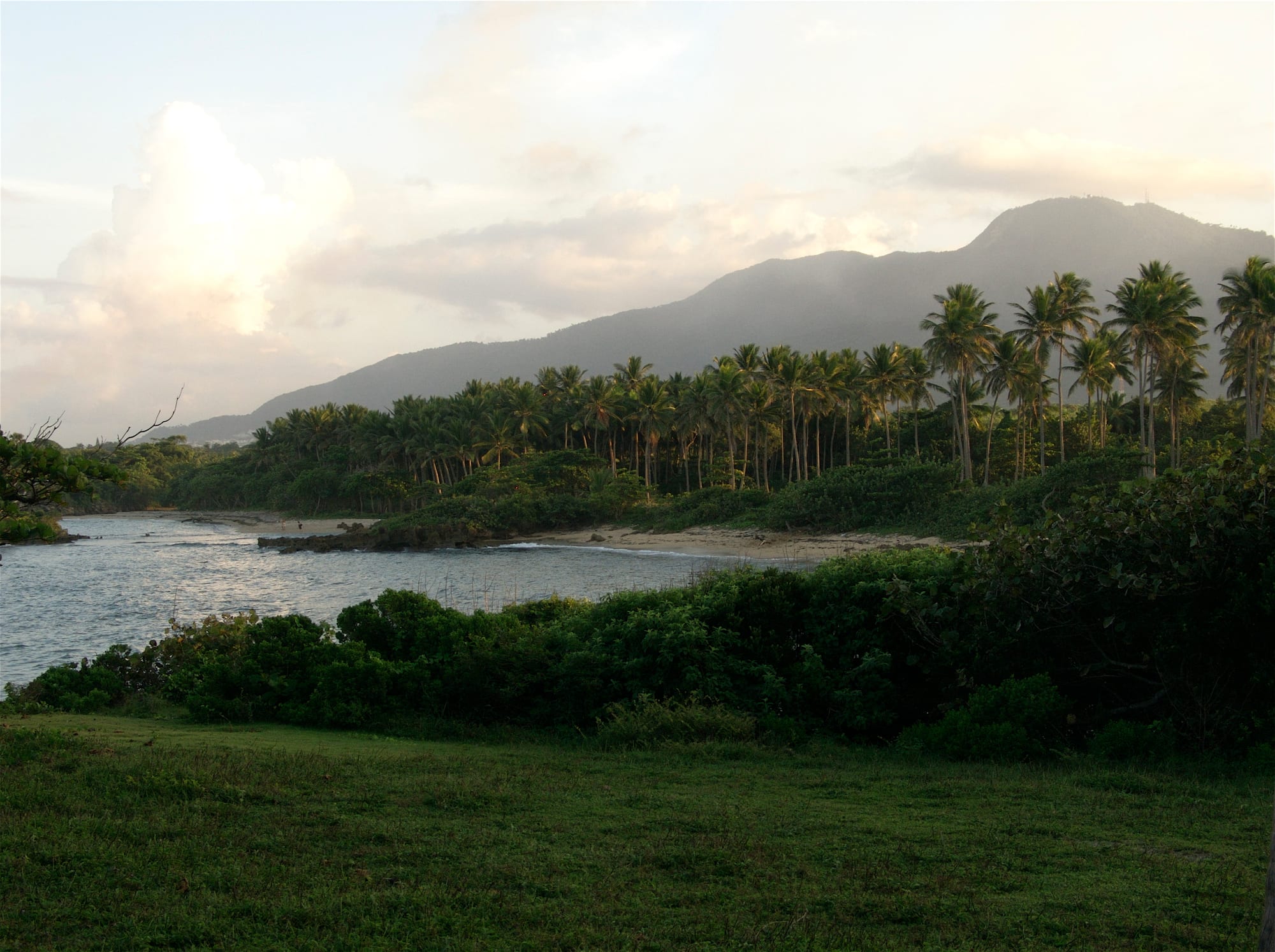
A calm river mouth and sandy cove backed by a coconut palm grove, with a large green mountain behind under soft evening light

Dominican Republic

Santiago, Puerto Plata & the Cibao

Palm-fringed coast near Puerto Plata, below Pico Isabel de Torres. (Sandra Cohen-Rose and Colin Rose / Wikimedia Commons · CC BY 2.0)

The north and north-west of the country, from the Haitian border at Dajabón and Monte Cristi across the fertile Cibao valley to the Amber Coast of Puerto Plata and the pine-covered Cordillera Central — the heartland of tobacco, merengue típico and the second city, Santiago.

Explore Santiago, Puerto Plata & the Cibao

History

The Cibao, from a Taíno word for "stone mountain", was the name of the gold-bearing mountains that first drew the Spanish. Columbus founded La Isabela on the north coast in 1493, the first stable Spanish town in the Americas, and soon abandoned it; forts and towns followed inland at Concepción de La Vega and Santiago, near the gold fields, and Puerto Plata was founded as a port in the early 16th century. An earthquake destroyed La Vega and Santiago in 1562, and in 1605–1606 the Spanish crown emptied Puerto Plata and other northern settlements to stop smuggling with Dutch and English traders, the "devastations" that left the north coast largely deserted.

In the 19th century tobacco was the Cibao's great trade crop, and its planters and merchants became a political force. Dominican forces defeated a Haitian army at Santiago on 30 March 1844, and in 1863 the Restoration War against renewed Spanish rule began with the Grito de Capotillo near Dajabón; Santiago burned during the fighting, and Spain left in 1865. In 1895 José Martí and Máximo Gómez signed the Manifesto of Montecristi, launching Cuba's final war of independence, and in 1899 the dictator Ulises Heureaux was shot in Moca.

In October 1937 Trujillo, after a speech in Dajabón, ordered the army to kill Haitians and Dominicans of Haitian descent living in the north-western borderlands. An estimated 14,000 to 40,000 people were killed within days, most scholars putting the figure at around 20,000, in what is known as the Parsley massacre. In November 1960 the Mirabal sisters, opposition activists from Ojo de Agua near Salcedo, were murdered on Trujillo's orders; the province now bears their name, and 25 November is the International Day for the Elimination of Violence against Women in their memory.

Culture & Customs

Cibaeños see themselves as the country's farmers and traders, and their accent is the easiest to spot: final r and l often turn into an i, so "por favor" comes out close to "poi favoi". The valley is the home of merengue típico, or perico ripiao, played on accordion, güira and tambora, and of the country's strongest carnival tradition.

La Vega, known as the carnival capital of the country, fills with masked diablos cojuelos every February, and its carnival has been recognised by Congress as folk heritage of the nation. Santiago's carnival has its own devil figures, the lechones. The Santo Cerro, above La Vega, is a major pilgrimage site linked to a legend of the conquest.

Cigar rolling is a craft of the region, centred on Santiago's factories, and amber from the Cordillera Septentrional fills the collection of Puerto Plata's amber museum. Baseball is followed passionately, with Santiago's Águilas Cibaeñas one of the most successful teams in the winter league. On the north coast, Sosúa keeps a trace of the Jewish refugees from Europe who settled there from 1940 and founded its food company, Productos Sosúa.

Daily Life

Santiago de los Caballeros, with more than 1.2 million people in its metropolitan area, is the second city, a business and university centre for the north. Other large towns are La Vega, Moca, Bonao, Cotuí, Mao and Puerto Plata, while Dajabón and Monte Cristi are smaller border and fishing towns.

The economy is agricultural and industrial at once. The fertile Cibao valley is a major farming region, Constanza's valley grows strawberries, garlic, potatoes and flowers, and Santiago has cigar factories and free-trade-zone plants. Mining is big business: the Falcondo ferronickel works near Bonao and the Pueblo Viejo gold mine near Cotuí. Tourism dominates the coast from Puerto Plata to Cabarete.

Dajabón's binational market, held twice a week on the Dominican side of the bridge, brings thousands of Haitian traders across the river; migration and border controls are a constant political issue, and Haitian labour is common on farms and building sites. In Santiago, weekday traffic, colmados with loudspeakers and evening games of dominoes set the rhythm.

Food

The Cibao eats well and heavily. Mangú, mashed green plantain, is the breakfast favourite, served with fried cheese, salami and eggs, and chicharrón and longaniza, a spicy sausage, are popular throughout the region.

In the north-west, goat farming is important in Monte Cristi province, and goat is a regular part of the local diet. On the Amber Coast, fried fish is the beach meal, and restaurants in Cabarete and Sosúa cater to foreign residents. Constanza's cool valley grows strawberries, garlic, potatoes and other temperate crops.

Brugal rum, whose founder Andrés Brugal settled in Puerto Plata in 1897, still bottles its rum there, and Santiago's cigars are the usual accompaniment.

Attractions & Natural Wonders

Santiago de los Caballeros centres on the Monument to the Heroes of the Restoration, begun under Trujillo and visible across the city, with the Centro León cultural museum and cigar factories nearby. South-east of Santiago, La Vega's carnival fills its streets every February, and the ruins of the colonial town of La Vega Vieja and the Santo Cerro lie just outside. In Salcedo, the sisters' home town, the Mirabal Sisters Museum honours them.

On the north coast, Puerto Plata has the Fortaleza San Felipe, Victorian houses around its central park, an amber museum and a cable car up Pico Isabel de Torres. Inland, the 27 Charcos de Damajagua is a chain of pools and waterfalls near Imbert. East along the coast are Sosúa's bay and Cabarete's kitesurfing beaches, and to the west the ruins of La Isabela near Luperón.

The Cordillera Central rises south of the valley. Jarabacoa is the base for the Yaque del Norte river and the Baiguate and Jimenoa waterfalls, and the trail to Pico Duarte, at a little over 3,000 metres the highest peak in the Caribbean, starts at La Ciénaga, near Jarabacoa. Constanza's high valley lies beyond.

In the far north-west, Monte Cristi has the flat-topped El Morro, salt flats, mangroves and the Cayos Siete Hermanos offshore, and Dajabón's market sits on the Haitian border.

Cities in Santiago, Puerto Plata & the Cibao

Planning basics

Budget

Cheaper than the east and the capital. Puerto Plata's Playa Dorada resorts and the Cabarete and Sosúa strip have all-inclusive and holiday-rental prices, but Santiago, La Vega and the mountain towns run on local prices, with inexpensive guesthouses, comedores and cheap guaguas. Mountain guides and mules for Pico Duarte are the main extra cost.

Daily Budget Midrange
USD 100–200 (hotel or mountain lodge, restaurants, excursions or a hire car)
Daily Budget Shoestring
USD 40–70 (guesthouse, comedor meals, guaguas)

Pico Duarte treks are usually arranged through local operators, who supply guides, mules and food.

Safety

Santiago has the same street-crime problems as the capital — phone and bag theft, often from motorbikes, and occasional robbery at night. The north coast resort towns see petty theft and scams, and Sosúa has a reputation for sex tourism. On the water, Cabarete's winds and currents demand experience, and river trips and mountain treks need proper guides; heavy rain brings flash floods. The border area around Dajabón is busy with trade and has a strong military presence.

Take kitesurfing lessons only from certified schools, trek Pico Duarte with a licensed guide and warm clothing, and use taxis rather than walking in Santiago at night. Check current official travel advice before travelling.

Climate

Very varied. The Atlantic coast from Puerto Plata to Cabarete is wetter than the south, with rain spread through the winter months when northerly fronts arrive. The Cibao valley is hot and fertile, the north-west around Monte Cristi and Dajabón is dry and dusty, and the Cordillera Central is cool: Jarabacoa is spring-like, Constanza colder, and frost is possible near Pico Duarte's summit.

Summer
hot, 30–34°C in the valley and on the coast; 25–28°C in Jarabacoa
Winter
warm on the coast with showers from northern fronts; nights can drop close to freezing on Pico Duarte

Transportation

Two international airports serve the region: Cibao International in Santiago and Gregorio Luperón near Puerto Plata. The Autopista Duarte links Santiago and La Vega with Santo Domingo, and intercity coaches run to Santiago, Puerto Plata, Jarabacoa and Monte Cristi. Guaguas and motoconchos cover the coast road from Puerto Plata to Sosúa and Cabarete. Mountain roads beyond Jarabacoa and Constanza are steep and winding.

Santiago is around two to three hours from Santo Domingo by coach; Cabarete is about 30 minutes from Puerto Plata's airport by road.

Best Time to Visit

February for carnival in La Vega and Santiago. December to March brings the best trekking weather in the mountains, though nights are cold high up. Kitesurfers favour roughly June to August and the winter months, when the trade winds blow steadily at Cabarete. The coast can be rainy from November to January.