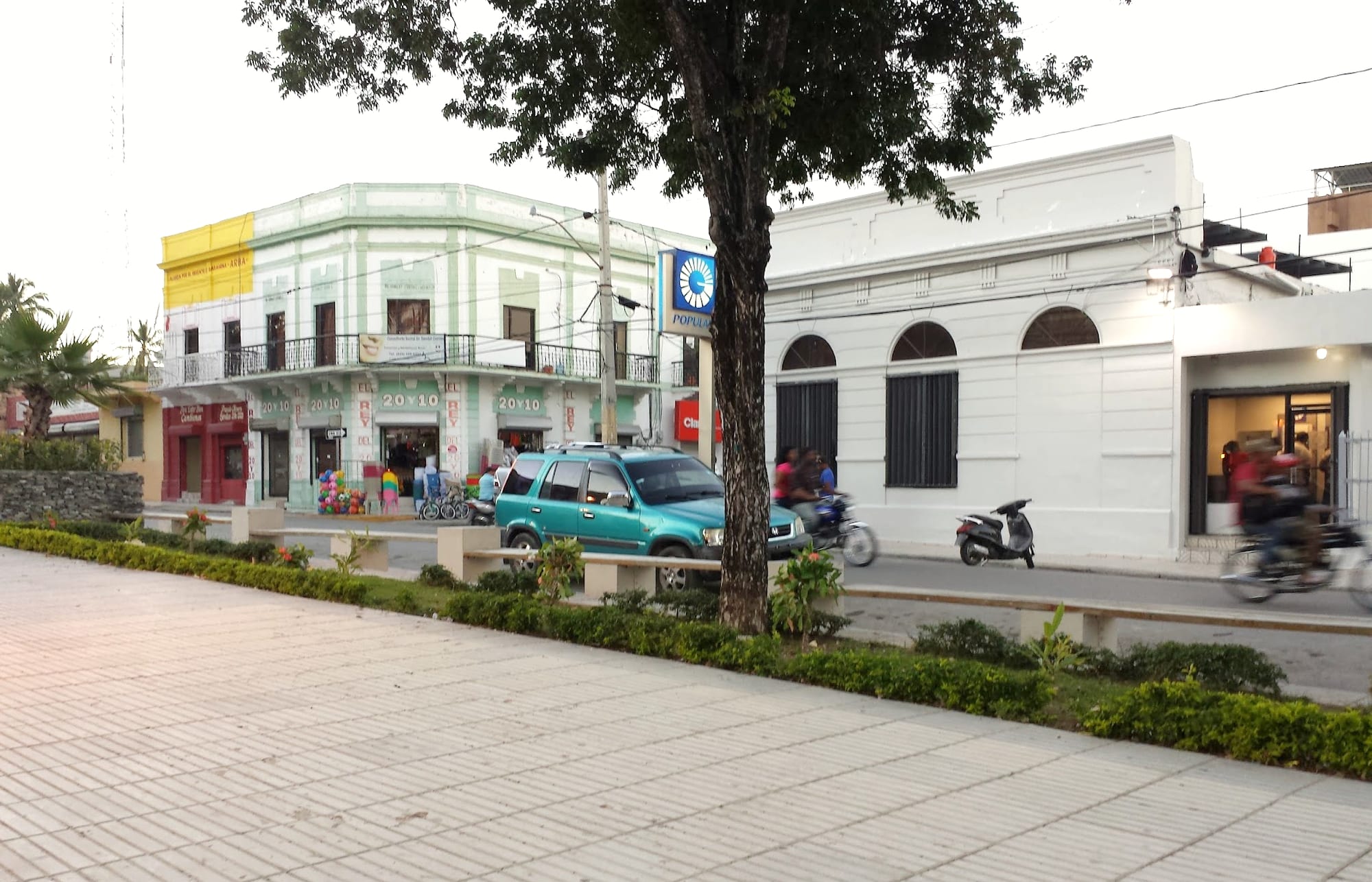
Pale green and white two-storey buildings on a street corner in central Barahona, seen past a tree and a paved square

Barahona & the Southwest, Dominican Republic

Barahona

Street corners in the centre of Barahona. (FronterizoRD / Wikimedia Commons · CC BY-SA 4.0)

Santa Cruz de Barahona is the port and main city of the south-west, on the Caribbean below the Bahoruco mountains. Sugar built the modern town in the 20th century; today it combines a working port, coffee from the hills, gypsum and larimar mining, and a slow-growing ecotourism trade along a coast of river mouths and pebble beaches.

Neighbourhoods

  • The centre and Parque Central
    • First-time visitors
    • Historic district
    • Bars

    The older heart of the city, around the central park, holds the 1935 town hall with its clock tower, the cathedral and streets of vernacular buildings. Shops, banks, small restaurants and the town's bars are here.

    Open in Maps
  • Villa Central
    • Historic district
    • Quiet and residential

    The old sugar-mill quarter, built from 1918 as El Batey alongside the mill. Some of the wooden houses of its managers survive, with pitched roofs raised on piles.

    Open in Maps
  • The Malecón and the town beach
    • Sea views
    • Nights out

    The seafront road runs along the bay beside the town beach, with views over the Caribbean and a few bars along it; the port lies a short drive from the centre.

    Open in Maps

Things to do

In the city

  • Cathedral of Nuestra Señora del Rosariolandmark

    The city's cathedral, built in 1948 beside the parish house, with a bell tower that rises above the whole building.

    Open in Maps
  • Palacio Municipallandmark

    The town hall facing the central park, built in 1935, whose clock tower has become one of the symbols of the city.

    Open in Maps
  • Villa Centralneighborhood

    The former batey of the sugar mill, where some of the wooden houses of the mill's managers still stand on their piles.

    Open in Maps
  • The Malecónviewpoint

    The seafront road along the bay, with views over the Caribbean and the town beach.

    Open in Maps

Short trips: the coast road

  • Paraísobeach

    A small coastal town between green mountains and the sea, with San Rafael and Los Patos on either side, all with beaches and fresh river water flowing down from the mountains.

    Open in Maps
  • Playa San Rafaelbeach

    One of the beaches on the coast south of the city where river water from the mountains meets the sea.

    Open in Maps
  • Playa Los Patosbeach

    A beach at a river mouth on the coast road, where fresh mountain water runs into the Caribbean.

    Open in Maps

Short trips: mountains and lakes

  • Sierra de Bahoruco National Parkpark

    The protected mountain range behind the coast, created as a national park in 1983, with large areas of pine forest, broad-leaved trees and mixed forest.

    Open in Maps
  • Poloattraction

    A mountain municipality known for its coffee and for the Polo Magnético, a gravity hill where a stopped car seems to roll uphill.

    Open in Maps
  • Lake Enriquillopark

    The largest lake in the Caribbean, a hypersaline lake 46 metres below sea level with the Caribbean's largest population of American crocodiles and the island of Isla Cabritos.

    Open in Maps
  • Lago de Oviedopark

    A hypersaline lake inside Jaragua National Park to the south-west, with mangroves, American flamingos and several cays.

    Open in Maps

Eat and drink

Long-standing places and food districts in Barahona. Hours, ratings and directions come from your maps app, always current.

Food districts

  • Around Parque Centralneighborhood

    Small restaurants and cafés around the central park serve Dominican home cooking.

    Open in Maps
  • Bars on the Malecónneighborhood

    Some of the town's bars lie along the seafront road.

    Open in Maps

Experience Barahona

History

Before the Spanish arrived, the coast here was part of the Taíno chiefdom of Jaragua, ruled by Bohechío. The city and province take their name from the Barahona surname: several Spaniards called Barahona arrived on Columbus's first and second voyages in the 1490s, and some settlers came from the town of Baraona in Spain.

After independence in 1844 Barahona was a military post of Azua province. It became a municipality in 1858 and the head of its own province in 1881. Cuban radicals founded a revolutionary group, El Salvador, here to raise money for Cuba's independence from Spain, and with help from President Ulises Heureaux weapons were shipped to Cuba from Barahona's shores.

Sugar made the modern city. During the US occupation of 1916–1924 cane planting spread, and construction of the sugar mill began in 1918, together with the workers' quarter of El Batey, now Villa Central. In 1916 a Barahona priest asked permission to mine a blue stone he had found; in 1927 the first aviation company in the Caribbean began flights from the city to Santo Domingo, San Juan and Port-au-Prince. The town hall dates from 1935 and the cathedral from 1948. In 1974 the blue stone was rediscovered on a beach and named larimar, and mining in the mountains followed. The city's airport has had no regular scheduled flights in recent years, and the port, the mill and the mines remain its mainstays.

Culture & Customs

Barahona has given the country two great stars of entertainment. María Montez, born in the province, became a Hollywood film star and died in Paris in 1951; the city's airport bears her name. Casandra Damirón, born in 1919, started performing at six in the town's La Unión theatre and became a celebrated singer, dancer and folklorist; the Casandra awards for Dominican artists, created in the 1980s, carried her name until 2012. Baseball players from the city, among them Julio Lugo and Edinson Vólquez, have reached the major leagues.

Craft is a living tradition. Larimar, a rare blue variety of the mineral pectolite found only around Barahona, is cut and polished into jewellery, and artisans in the town and in the coastal barrios also work in metal, shells and natural fibres. Its name joins Larissa, the daughter of one of the men who rediscovered it, and mar, the Spanish word for sea.

The coast and mountains shape local pastimes. Barahona is the main destination for the country's amateur surfers, and the national surf federation has held competitions on its beaches, while the trails through forest, caves and coffee farms draw mountain bikers. In the evenings people gather in the central park, the colmados and the bars of the town centre.

Daily Life

About 90,000 people lived in Barahona at the 2022 census, making it the port and commercial centre of the south coast. It has a mixed economy of agriculture, cattle, mining and tourism, with one of the busiest ports in the region, a power station, a sugar mill and a free zone of textile factories.

The countryside grows cane, plantains, fruit, sorghum, yams and yautía, and the mountains of the eastern Bahoruco produce the city's best-known product, Barahona coffee. Cattle and goats are fattened for meat and leather, and milk production is growing. Mining is a major employer: gypsum is quarried, and the hills yield marble, alabaster, kaolin for bottle-making, salt and larimar, mined at Los Chupaderos, about 10 km south-west of the city, from a mountainside riddled with some 2,000 shafts.

Life starts early and slows in the midday heat, and motoconchos carry most people around town. Ecotourism along the coast road and in the mountains is growing slowly.

Food

Barahona sits on the Caribbean, yet much of the fish and shrimp eaten in town comes from the rivers and freshwater lagoons inland. Lagoon fish such as tilapia and biejaca are served boiled or stewed, and freshwater shrimp are popular too. From the sea, crab, conch and lobster are preferred, prepared with lime or garlic or stewed.

Goat and beef are cooked in a cacerola, a casserole stew, and sancocho with beans is made with beef, chicken, goat and pork. Everyday lunch follows the Dominican pattern of la bandera — rice, beans and stewed meat — and plantains, yams and yautía from the surrounding farms appear at almost every meal.

The city's pride is its coffee, grown on the slopes of the Bahoruco mountains and sold as Barahona coffee. It is drunk strong and sweet throughout the day, and in the evenings Presidente beer and rum are drunk in the bars and colmados around the central park and along the seafront.

Planning tools

Budget

Barahona is one of the cheapest places in the country to travel. Simple hotels, comedores and motoconchos are priced for Dominicans, and a few eco-lodges on the coast and in the hills charge more. The main costs are a hire car or driver for the coast road and the mountains, and guides and boat trips at the lakes and parks.

Daily Budget Midrange
USD 80–160 (better hotel or eco-lodge, restaurants, a hire car or driver, park fees)
Daily Budget Shoestring
USD 35–60 (simple hotel, comedor meals, motoconchos and guaguas)

Carry enough pesos for trips out of town: cash machines are found in the city but are few further along the coast.

Best Time to Visit

December to April is the dry season, with plenty of sun and the most comfortable heat for the lakes and parks. Rain peaks in May and June and again later in the year, with a drier spell in July and August, and the hurricane season can bring storms and wash out roads.

Suggested Number of Days

Two or three days cover the city and the nearest beaches of the coast road. Five to seven allow time for the mountains, the salt lake and the parks of the far south-west, which are long drives away. Road conditions and the heat can change the number.

First Visit
2–3 days
With Surroundings
5–7 days

Transportation

The city is small, and a motoconcho will take a passenger almost anywhere in town. Guaguas run along the coast road and inland, but services are thin and distances long, so most visitors hire a car or a driver; a four-wheel drive helps on park tracks and mountain roads.

Fill up with fuel in Barahona before heading west, and avoid driving between towns at night.

Airport & Station Connections

Most visitors come by road from Santo Domingo, about three hours by express coach. María Montez International Airport lies 3 km north of the city, but as of 2024 it had no regular scheduled flights, so the nearest airports with regular services are in Santo Domingo. The port lies a few minutes from the centre.

Walkability

The centre is small, and everything in town can be reached on foot, though the heat is intense in the middle of the day. The beaches of the coast road, the mountains and the lakes all need transport.

Safety

The main tourist areas are heavily policed and generally safe, but the Dominican Republic has significant crime, and petty theft, scams, and occasional armed robbery affect visitors, particularly in Santo Domingo and Santiago. In the south-west, crime is lower than in the big cities, but the region is remote, with long stretches without phone signal, fuel or medical care. Towards the Haitian border there are military checkpoints. Heat, flash floods and hurricanes are the main natural risks.

Carry identification for checkpoints, travel between towns by day with water and fuel, and take care on isolated beaches and roads. Check current official travel advice before travelling.

Climate

A tropical wet and dry climate, hot and very sunny all year, with more than 3,200 hours of sunshine. Rain comes in two wet seasons, with a peak in May and June and another later in the year, separated by a drier spell in July and August; the main dry season runs from December to April.

Summer
hot, with mean temperatures around 28°C in July, and showers and storms in the wet seasons
Winter
warm and dry, with mean temperatures around 25°C in January

Local Customs

Barahona is a provincial city where Spanish is the only language heard in most places, and some Spanish helps a great deal. Greetings matter in shops and offices, and beachwear stays on the beach. The evening walk through the central park and along the seafront is a local habit.

Ask before photographing people, especially in the mining and fishing communities; dress modestly in churches.

Common Payment Methods

The currency is the Dominican peso. Banks and ATMs are in the centre, and cards work in larger hotels and shops, but cash in pesos is needed for motoconchos, guaguas, comedores and anything along the coast road.