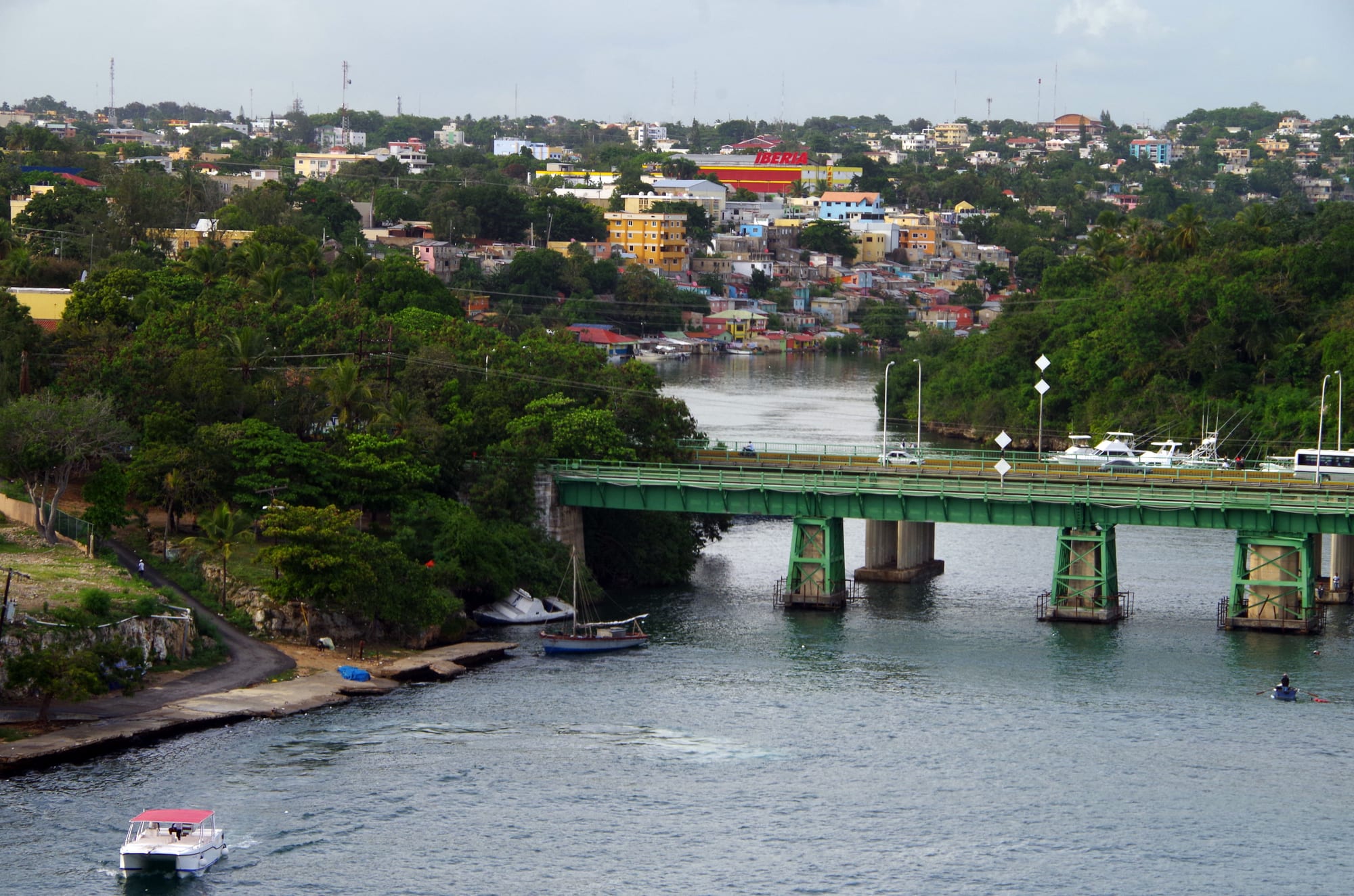
A green bridge crossing a calm river, with boats below and the colourful houses of a hillside town among trees beyond

Punta Cana & the East, Dominican Republic

La Romana

La Romana and the Río Dulce, seen from the cruise terminal at the river's mouth. (Balou46 / Wikimedia Commons · CC BY-SA 4.0)

The capital of La Romana Province, on the south-east coast facing Catalina Island, at the mouth of the Río Dulce. Founded in 1897, it became a company town around the great Central Romana sugar mill from 1917, and now combines sugar, cigars and a free-trade zone with a cruise port, an international airport and the stone village of Altos de Chavón.

Neighbourhoods

  • The town centre
    • First-time visitors
    • Local life
    • Close to public transport

    The busy streets around the central park, Parque Duarte, with shops, street markets, banks and the guagua stops. This is the working city, where most residents shop, eat and meet.

    Open in Maps
  • The Río Dulce and the port
    • Waterfront
    • Cruise passengers

    The mouth of the Río Dulce, where the cruise terminal and the commercial port that exports sugar sit side by side, with the town climbing the hillside above the river.

    Open in Maps
  • East of town: the resort estate and Altos de Chavón
    • Resorts
    • Golf
    • Arts and culture

    East of the city lies a large gated resort estate with golf courses and a marina, and on its edge, above the Chavón River, the stone village of Altos de Chavón, with its church, galleries, design school and amphitheatre.

    Open in Maps

Things to do

Landmarks and culture

  • Altos de Chavónlandmark

    A re-creation of a 16th-century Mediterranean village, built from 1976 with stone blasted for a nearby road, with cobbled lanes, St Stanislaus Church, a regional archaeology museum of pre-Columbian finds and a 5,000-seat amphitheatre.

    Open in Maps
  • Chavón Riverviewpoint

    The river that flows into the Caribbean Sea on the outskirts of the city, its mouth overlooked by the stone village of Altos de Chavón.

    Open in Maps
  • Parque Central Duartepark

    The city's central park, named after Juan Pablo Duarte, the heart of the old town and its everyday meeting place.

    Open in Maps
  • Iglesia de Santa Rosa de Limalandmark

    One of the city's churches, dedicated to Santa Rosa de Lima.

    Open in Maps

Sport

  • Estadio Francisco Micheliattraction

    The 10,000-seat baseball stadium opened in 1979, home of the Toros del Este, the city's winter-league team and winners of three national championships.

    Open in Maps

Short trips from the city

  • Catalina Islandbeach

    An island 2.4 km off the coast, a stop for cruise ships and boat trips, with shallow sandbars offshore and reefs rich in fish.

    Open in Maps
  • Cueva de las Maravillas National Parkpark

    A cave west of the city on the road to San Pedro de Macorís, a national park since 1997, with hundreds of Taíno paintings and engravings in black and red.

    Open in Maps
  • Bayahibeattraction

    The fishing village turned diving centre east of the city, the harbour for boat trips to Saona Island.

    Open in Maps
  • Cotubanamá National Parkpark

    The large national park on the south-east coast, with dry forest, caves full of Taíno pictographs, beaches and coral reefs.

    Open in Maps
  • Saona Islandbeach

    The large protected island in Cotubanamá National Park, with palm-backed beaches, sandbars and reefs, and the country's most important sea-turtle nesting beaches.

    Open in Maps

Eat and drink

Long-standing places and food districts in La Romana. Hours, ratings and directions come from your maps app, always current.

La Romana classics

  • Street markets and food vendorsmarket

    The city's street markets and the vendors who walk the streets sell homemade Dominican food, fruit and groceries, the everyday way La Romana eats.

    Open in Maps
  • Comedores in the town centreneighborhood

    Simple lunch places around the centre serving la bandera, the Dominican plate of rice, beans, stewed meat and salad, and sancocho.

    Open in Maps

Food districts

  • Restaurants at Altos de Chavónneighborhood

    Several Mediterranean-style restaurants line the cobbled alleys of the stone village, with views over the Chavón River.

    Open in Maps

Experience La Romana

History

The city takes its name from Bomana, the Indigenous name for the river now called the Río Dulce, at whose mouth it stands. La Romana was officially founded in 1897, when the national congress granted a Cuban firm a concession to build an oil refinery, and for its first two decades it was a struggling place with little future.

Everything changed in 1917, when an American sugar company built the huge Central Romana mill. Its opening coincided with a rise in world sugar prices, and workers came from across the country and from other Caribbean islands to cut and process cane from the plantations that still surround the city. La Romana became a company town, and its mill was the only sugar operation not taken over by Rafael Trujillo during his rule.

In the 1960s an American conglomerate took over the mill, invested in livestock, and spent heavily rebuilding the town with schools, clinics and workers' housing. In the mid-1970s, as it began selling its Dominican assets, it built a large luxury resort east of the city, and from 1976 the stone village of Altos de Chavón rose above the Chavón River. In 1984 the sugar company passed to a group of local and foreign investors. A cruise terminal opened at the river mouth in 2002, and the modern international airport in 2000.

Culture & Customs

Baseball is the city's passion. The Toros del Este, founded in 1983 as the Azucareros del Este, play in the Dominican winter league at the 10,000-seat Estadio Francisco Micheli and have won three national championships and a Caribbean Series. La Romana has produced a long list of Major League players, and boxing and basketball also have strong followings; the city's sports centre is named after Eleoncio Mercedes, a local flyweight who became world champion.

Music and the arts have two faces. In town, merengue and bachata fill the colmados and the streets, and the bachata and merengue singer Monchy, of the duo Monchy y Alexandra, is from La Romana. At Altos de Chavón, a design school affiliated with Parsons School of Design in New York has trained Dominican designers and artists since 1983, and the amphitheatre has hosted Frank Sinatra, Santana and Julio Iglesias, and the Concert for the Americas was held there in August 1982.

The village's church of St Stanislaus, named after the patron saint of Poland in tribute to Pope John Paul II, is a popular place for weddings. As in the rest of the country, Catholic feasts, family Sundays and the baseball calendar shape the year.

Daily Life

An estimated 153,000 people lived within La Romana's city limits in 2022, and around 270,000 in the wider metropolitan area, making it one of the ten largest cities in the country. The town remains closely tied to the sugar company, which owns property across the city, and many landowners rent their land to grow cane for the mill.

Employment is high, in tourism, at the sugar mill, in the free-trade zone and in service businesses. La Romana is also a cigar city: one of the largest cigar factories in the world has worked here since an American conglomerate moved its cigar-making to the city after 1968, producing some of the world's best-known cigar brands. The port exports sugar and handles containers, fuel and cruise ships.

Life in the centre revolves around the central park, the markets and the church, with guaguas and motoconchos filling the streets. Beyond the city, the cane fields and their workers' villages are among the poorest communities in the region, a sharp contrast with the gated resort estate just east of town.

Food

La Romana eats like the rest of the Dominican east. Lunch is la bandera — white rice, red beans, stewed meat and salad — and sancocho, a thick stew of several meats and root vegetables, is the dish many Dominicans see out the old year with. Fried fish with tostones, twice-fried slices of green plantain, is common on the coast.

Street food is a big part of the city's eating. Vendors walk the streets and markets selling homemade food, and fried snacks such as empanadas, chicharrón and yaniqueques, crisp rounds of fried dough, are sold everywhere. Vendors also set up stands selling juices made from papaya and other fruits.

The province has long raised livestock, and coconut water and tropical fruit are sold from carts. Altos de Chavón has Mediterranean-style restaurants with views over the river, while the town's own tables stay Dominican. Presidente beer, rum and mamajuana are the everyday drinks, and the city's cigars often follow a meal.

Planning tools

Budget

The city itself is inexpensive and local, with small hotels, comedores and street food. The large resort estate east of town and the beach resorts towards Bayahibe are priced in US dollars, and the estate is one of the largest exclusive resorts in the country. Boat trips to Catalina and Saona and rounds of golf are the main extras.

Daily Budget Midrange
USD 150–340 (resort or beach hotel, restaurants, a boat excursion)
Daily Budget Shoestring
USD 50–90 (simple hotel in town, comedor meals, guaguas)

Pay in pesos in town for better value, and compare boat-trip prices with licensed operators in Bayahibe.

Best Time to Visit

December to April is the driest and most comfortable time, and the peak season for prices and boat trips. The sheltered south coast is dry for much of the year, but May to November is hotter, with a hurricane risk.

Suggested Number of Days

The city itself needs a day or two. Allow four or five to add boat trips to the islands, the caves and the beaches and national park along the coast to the east; poor weather can cancel boat trips.

First Visit
1–2 days
With Surroundings
4–5 days

Transportation

Guaguas, the local buses, are the cheapest way to get around the city and along the coast road, and taxis and motoconchos fill the gaps. A motorway links La Romana with San Pedro de Macorís and Santo Domingo, with coaches along it; the resort estate and Altos de Chavón are reached by taxi.

Agree taxi fares before setting off, and avoid driving between towns at night.

Airport & Station Connections

La Romana International Airport, a private airport opened in 2000 beside the town, is the country's fifth busiest, with international and private flights. Santo Domingo is about 109 km away, a drive of roughly an hour and a half. Cruise ships dock at the terminal on the Río Dulce.

Walkability

The town centre around the central park is compact and walkable, though busy with traffic and short of shade at midday. The port is a short walk from the centre; Altos de Chavón, the resort estate and the beaches need a taxi.

Safety

The main tourist areas are heavily policed and generally safe, but the Dominican Republic has significant crime, and petty theft, scams, and occasional armed robbery affect visitors, particularly in Santo Domingo and Santiago. The resort areas of the east are heavily guarded, though theft, scams and overcharging on excursions happen, and traffic accidents are a real risk. Visitors to La Romana are advised to avoid dark, secluded places alone and beaches at night, and to choose taxis carefully.

Use licensed taxis or hotel transport after dark, keep valuables out of sight, and wear a helmet on motorbikes. Check current official travel advice before travelling.

Climate

A tropical savanna climate, close to semi-arid, because the city is sheltered from the north-easterly trade winds. It is hot all year and drier than the Atlantic coast.

Summer
in La Romana, hot and humid, 30–32°C, with short showers and a hurricane risk from June to November
Winter
in La Romana, warm, 27–29°C by day, the driest and most comfortable time

Local Customs

La Romana is a working city rather than a resort, and people dress neatly in town; beachwear belongs on the beach. Greetings matter — a 'buenos días' on entering a shop — and baseball is a constant topic of conversation. Churches expect covered shoulders and knees.

Ask before photographing people, especially in the cane fields and workers' villages around the city.

Common Payment Methods

The currency is the Dominican peso. Cards are accepted in hotels, resorts, supermarkets and larger restaurants, and the town has banks and ATMs. Cash in pesos is needed for guaguas, motoconchos, markets and street food.