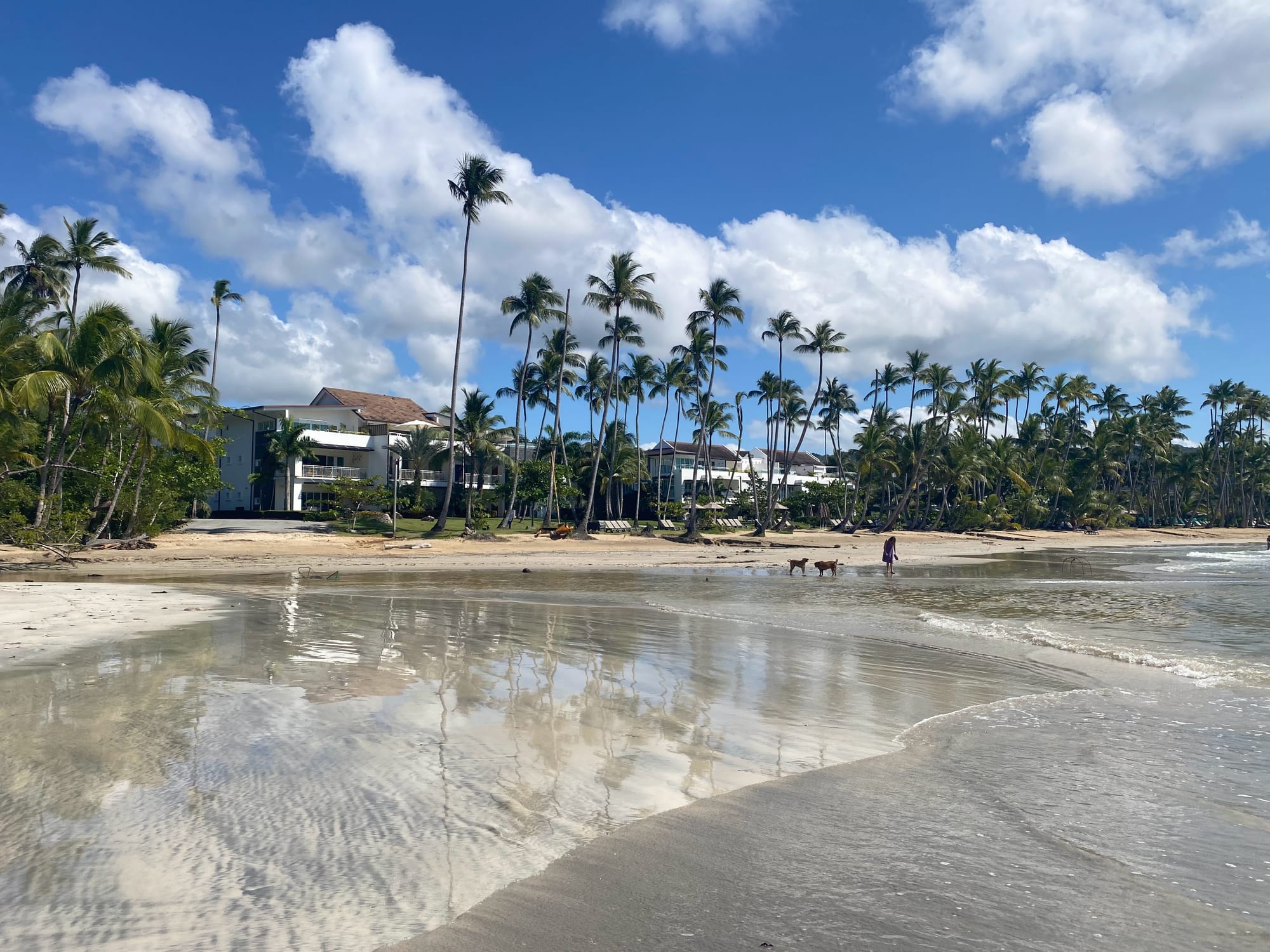
Wet sand reflecting tall coconut palms and white low-rise buildings along Playa Bonita under a blue sky with white clouds

Samaná & the Northeast, Dominican Republic

Las Terrenas

Playa Bonita, a short ride from the centre of Las Terrenas. (-wuppertaler / Wikimedia Commons · CC BY 4.0)

A beach town on the north shore of the Samaná peninsula, founded in 1946 as an isolated village of farmers and fishermen. A paved road, a new airport and a motorway opened it up, and French settlers and other foreigners have made it a relaxed resort of beaches, reefs, mid-range hotels and beach restaurants.

Neighbourhoods

  • Town centre and the fishermen's village
    • First-time visitors
    • Best for food
    • Nightlife

    The tourist triangle where the two main roads from inland meet the beach, with shops, restaurants, bars and the Pueblo de los Pescadores, the old fishermen's cabins turned into restaurants and bars. The fish market and beach fish restaurants sit on the little point by the walled cemetery.

    Open in Maps
  • Playa Las Ballenas
    • Beaches
    • Quieter stays

    West of the centre around the point, a wide beach with plenty of coconut palms and a more relaxed, suburban feel, with beach-hut bars just before it and sheltered reefs offshore.

    Open in Maps
  • Punta Popy and the east
    • Beaches
    • Budget stays

    The pointed beach where the town's businesses thin out on the coast road heading east, with guesthouses across the road from the sand and quieter rural beaches beyond.

    Open in Maps
  • Playa Bonita and Cosón
    • Beaches
    • Surfing
    • Quiet and residential

    The beaches a short ride outside town, among the best known in the area; Playa Bonita's waves draw surfers.

    Open in Maps

Things to do

Beaches

  • Playa Las Terrenasbeach

    The town's central beach in a wide cove, lined with beach restaurants and fishing boats, running for kilometres towards Las Ballenas in the west and Punta Popy in the east.

    Open in Maps
  • Playa Bonitabeach

    Perhaps the area's most talked-about beach, a ten-minute motoconcho ride from town, with a long straight stretch popular for swimming and one of the country's top surf spots.

    Open in Maps
  • Playa Cosónbeach

    One of the area's best-known beaches, with the Cosón reef dive sites offshore.

    Open in Maps
  • Playa Las Ballenasbeach

    A wide, palm-shaded beach west of the centre, a bit more sheltered by the outer reefs and often better for snorkelling.

    Open in Maps

Reefs and the hills

  • Reefs off Las Terrenasattraction

    Coral reefs of brain coral, sea fans and sea rods, with dive sites offshore and shallow patches near the beaches for snorkellers.

    Open in Maps
  • El Limón waterfallattraction

    A group of falls in the forest near the hill village of El Limón, about 20 kilometres east, reached only on foot or horseback along dirt trails, with a tall misty fall and a swimming hole at its foot.

    Open in Maps

Short trips from the town

  • Samanáattraction

    The provincial capital on Samaná Bay and the main centre for whale-watching tours in the Caribbean.

    Open in Maps

Eat and drink

Long-standing places and food districts in Las Terrenas. Hours, ratings and directions come from your maps app, always current.

Las Terrenas classics

  • Pueblo de los Pescadoresneighborhood

    The old fishermen's village on the beach, its old cabins turned into bars, restaurants and shops.

    Open in Maps
  • Fish market and beach fish restaurantsmarket

    The local fish market and the restaurants on the sand beside it, on the point by the town cemetery.

    Open in Maps
  • Beach-hut bars before Las Ballenasneighborhood

    Bars of a hut and seating set right on the sand around the western point, just before Playa Las Ballenas.

    Open in Maps

Experience Las Terrenas

History

Las Terrenas was founded in 1946, when Trujillo ordered poor residents of Santo Domingo to resettle on the north shore of the Samaná peninsula as farmers and fishermen. For decades it remained a small fishing village cut off from the rest of the country: the track to Sánchez was often impassable and was paved only in 1989, and reaching the village was an adventure.

French settlers were part of the community from its early years, and the town's name is said to come from the French la terrienne, the landowner. As the beaches became known, Europeans — mostly Spanish, Italian, French and German — became its most frequent visitors, in 1977 an American became the first foreigner to build a private home there, and the old fishermen's cabins on the beach were gradually turned into bars, restaurants and shops.

Two projects transformed access. Samaná El Catey International Airport opened in 2006 near Sánchez, and in 2012 the motorway from Santo Domingo to the peninsula was completed, cutting the drive from the capital to Las Terrenas to about two hours. Since then hotels, clubs, restaurants and shopping centres have kept being built, and the population has grown quickly.

Culture & Customs

Las Terrenas has a strong foreign presence. Its French community, sometimes called les Terrestres, has been there since the town's beginnings and is among the most influential in it, and French is the town's second language. Spanish, Italian and German visitors add to the mix, and foreigners settling in the area account for much of the town's recent growth.

The Dominican fishing village survives alongside them. Fishing boats still line the main beach, the fish market and beach fish restaurants sit by the cemetery on the point, and the Pueblo de los Pescadores is named after the fishermen who once made up most of its people. Inland, the downtown thoroughfares are busy and very noisy.

The sea shapes local life. Playa Bonita is among the country's best surfing spots, divers and snorkellers explore the reefs offshore, and the forested hills inland lead to El Limón waterfall, where a local ecotourism cooperative charges entry.

Daily Life

The municipality of Las Terrenas had about 25,700 people at the 2022 census, split almost evenly between the town and the countryside, and its population has grown by more than 85 per cent since 2002, much of it from foreigners settling in the area. Tourism, commerce and fishing are the main economic activities.

The town runs along two main roads that stretch inland from the beach, one-way near the sea, with the tourist businesses in the triangle where they meet the coast road and the more Dominican downtown further inland. Motoconchos fill the streets, and the downtown thoroughfares are noisy for much of the day.

Infrastructure has followed the growth: electricity reached the town only in 1994, a fibre-optic internet, television and telephone network arrived in 2012 and a new aqueduct in 2013, though parts of town still have frequent power and water cuts, and tap water is not considered drinkable. The high season runs roughly from December to March, and May to October is the low season.

Food

Seafood is the centre of the table. Fishing boats line the main beach, the fish market sits on the point, and the beach restaurants serve pescado con coco — a whole fish in a coconut-milk sauce, one of the local specialities. Tostones, fried green plantain, are a common Dominican side.

The European community has added its own layer, with pizzerias and restaurants along the beach, while barbecue stands and small cafés in the inland downtown serve cheaper food and freshly made fruit juice, and empanadas and chimichurris, Dominican burgers, are sold for less there than near the beach. Samaná province is the country's main coconut producer, and dulce de coco, coconut fudge, is a common Dominican sweet.

In the Dominican downtown, comedores serve la bandera — white rice, red beans and stewed meat — and mangú, mashed green plantain, for breakfast. Presidente beer and rum, the country's most popular drinks, are served in the beach-hut bars around the western point.

Planning tools

Budget

Mid-priced by Dominican standards. Guesthouses, apartments and small hotels sit across the road from the beach, and the cheapest rooms are mostly further inland. Dives, boat trips and horse rides to El Limón are the main extras.

Daily Budget Midrange
USD 110–220 (beach hotel, restaurants, a dive or a whale-watching or boat trip)
Daily Budget Shoestring
USD 40–75 (guesthouse, comedor meals, guaguas and motoconchos)

Agree the price of a horse at El Limón before setting out, and pay in pesos where possible.

Best Time to Visit

December to March is the high season in Las Terrenas, and humpback whales gather in Samaná Bay from January to March. May to October is the low season, when rooms are often cheaper.

Suggested Number of Days

Three or four days suit the beaches, the reefs and an outing into the hills. Allow a week to add the rest of the peninsula and the whale season on the bay; many visitors simply stay longer for the beach.

First Visit
3–4 days
With Surroundings
5–7 days

Transportation

Motoconchos are everywhere and are the usual way around town and out to the nearer beaches; guaguas run further, including to El Limón, and scooters and four-wheel-drives can be hired downtown. The main roads are noisy with traffic, and potholes are common after rain.

Ride motoconchos with a helmet, and take special care on scooters at night or after rain.

Airport & Station Connections

Samaná El Catey International Airport, which opened in 2006 near Sánchez, is about 30 minutes' drive away, with flights mainly from Europe and Canada. The motorway from Santo Domingo to the peninsula, completed in 2012, made the drive far quicker, and guaguas run from the capital, Sánchez and Samaná to the bus station on the inland edge of town.

Walkability

Many places to stay are across the road from the beach and within an easy walk of the centre, and the beach itself makes a long walking route. Playa Bonita, Cosón and the waterfall are outside town, reached by motoconcho, guagua or car.

Safety

The main tourist areas are heavily policed and generally safe, but the Dominican Republic has significant crime, and petty theft, scams, and occasional armed robbery affect visitors, particularly in Santo Domingo and Santiago. Las Terrenas is reputed to be one of the safest places in the country, with very little petty crime; the main natural hazards are the sharp reefs and sea urchins off the beaches and the surge on the outer reef.

Swim where the water is clear over sand, leave the outer reef to experienced snorkellers, lock rentals carefully and ride motoconchos with a helmet. Check current official travel advice before travelling.

Climate

Warm and wet: a tropical rainforest climate with an average temperature of about 26°C and rain through the year.

Summer
hot and humid (the yearly mean at nearby Samaná is 26.2°C), within the Atlantic hurricane season of June to November
Winter
warm (the yearly mean at nearby Samaná is 26.2°C), with showers, as rain falls through the year

Local Customs

French is the town's second language, just about everyone speaks Spanish, and Haitian Creole is also heard. Life is relaxed and informal, but swimwear belongs on the beach, not in shops and town streets.

Greet people in Spanish, ask before photographing fishermen or residents, and keep the beaches free of litter.

Common Payment Methods

The currency is the Dominican peso (RD$); some guesthouses and taxis quote in US dollars. Cards are accepted in hotels and larger restaurants, and there are ATMs in the centre; cash is needed for motoconchos, guaguas, beach bars and the waterfall.