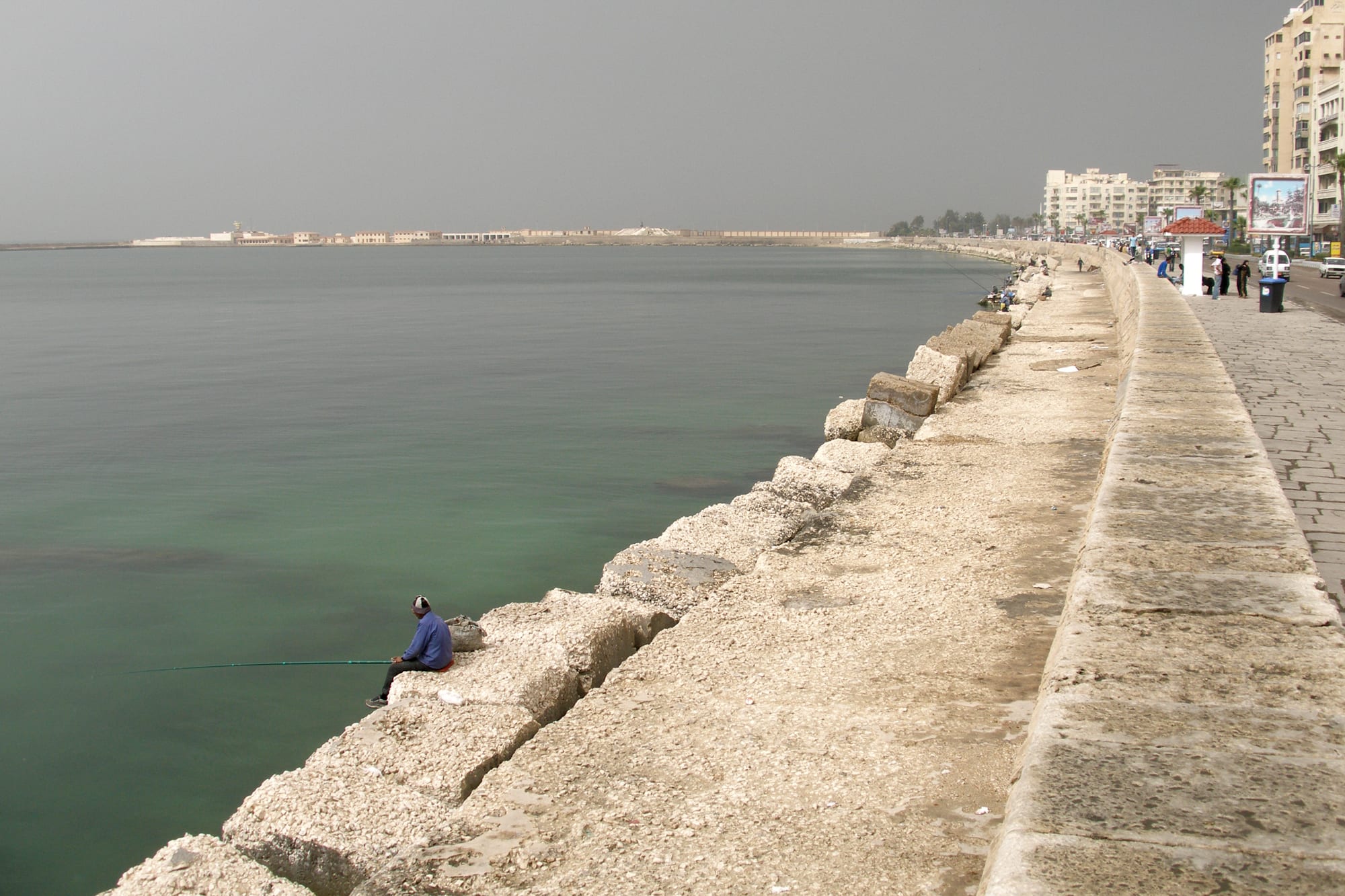
A stone seawall curving along a green-blue bay with a man fishing from the rocks and apartment blocks lining the road

Alexandria & the Nile Delta, Egypt

Alexandria

The corniche seawall along Alexandria's harbour front, with the city stretching away to the east. (Vyacheslav Argenberg / Wikimedia Commons · CC BY 4.0)

Egypt's second city and main seaport, stretched for tens of kilometres along the Mediterranean between the sea and Lake Mariout. Founded by Alexander the Great in 331 BC and capital of Greek and Roman Egypt, it keeps little of that city above ground, and lives instead as a working port with a long corniche, faded early 20th-century streets, old trams and a seafood culture of its own.

Neighbourhoods

  • Downtown and Raml Station
    • First-time visitors
    • Close to public transport
    • Cafés

    The commercial centre behind the Eastern Harbour, around the tram terminus at Raml Station and the streets of Saad Zaghloul and Nabi Daniel. Old patisseries, bookshops, cinemas, cheap hotels and the Cavafy Museum are here, within a few minutes of the sea.

    Open in Maps
  • Anfushi
    • Historic district
    • Best for food
    • Markets

    The oldest inhabited quarter, on the spit of land that was once the causeway to the Pharos island, with the fish market, the Abu al-Abbas al-Mursi mosque, boatyards and narrow streets of tall houses leading out to the Qaitbay citadel.

    Open in Maps
  • Sidi Gaber and Rushdy
    • Quiet and residential
    • Close to public transport
    • Shopping

    Middle-class districts a few kilometres east of the centre, built up in the 20th century around the main railway station and the tram line. Shops, cafés and restaurants line the inland avenues, with small city beaches at the foot of the streets.

    Open in Maps
  • Stanley and Glym
    • Beaches
    • Sea views

    A stretch of the eastern seafront where the coast breaks into small bays backed by cliffs and apartment blocks. The Stanley bridge, which carries the corniche 400 metres out over the water on six spans, is the landmark, and the beaches below fill through the summer.

    Open in Maps
  • Montaza
    • Parks
    • Beaches
    • Families

    The far eastern end of the corniche, built around the walled gardens of the former royal palace, with pines, beaches, hotels and summer crowds from across Egypt.

    Open in Maps
  • Smouha
    • Quiet and residential
    • Restaurants

    An inland district laid out from the 1920s on land developed by the businessman Joseph Smouha, now one of the city's more prosperous areas, with wide streets, a sporting club, malls and a concentration of newer restaurants and cafés.

    Open in Maps

Things to do

Famous landmarks

  • Citadel of Qaitbaylandmark

    A Mamluk fortress built between 1477 and 1479 on the foundations of the Pharos lighthouse, at the northern tip of the old Pharos island where it guards the mouth of the Eastern Harbour.

    Open in Maps
  • Bibliotheca Alexandrinalandmark

    The library opened in 2002 near the site of the ancient one, a tilted granite disc inscribed with scripts from around the world, holding reading halls, museums and a planetarium.

    Open in Maps
  • Pompey's Pillarlandmark

    A red granite column about 27 metres high raised between 298 and 302 in honour of the emperor Diocletian, standing on the mound of the ruined Serapeum.

    Open in Maps
  • Abu al-Abbas al-Mursi Mosquelandmark

    The city's principal mosque, rebuilt in the mid-20th century to a neo-Mamluk design by the Italian architect Mario Rossi, over the tomb of a 13th-century Sufi saint from Murcia.

    Open in Maps
  • Cornicheviewpoint

    The seafront road and seawall running for many kilometres from the harbour to Montaza, the city's promenade, fishing spot and evening meeting place.

    Open in Maps

Ancient sites

  • Catacombs of Kom El Shoqafalandmark

    A Roman-era burial complex cut three levels into the rock, reached by a spiral stair, where Egyptian gods appear in Greek and Roman dress.

    Open in Maps
  • Kom El Dikkalandmark

    An excavated city block in the centre with a small Roman theatre, along with baths, lecture halls and mosaic floors.

    Open in Maps
  • Serapeumlandmark

    The site of the great temple of Serapis, destroyed in the fourth century, whose underground galleries and sphinxes survive around Pompey's Pillar.

    Open in Maps

Museums and palaces

  • Alexandria National Museummuseum

    An Italian-style palace on Horriya Street, the former Rue Fouad, open since 2003 and presenting the city's pharaonic, Greco-Roman, Coptic and Islamic layers on three floors.

    Open in Maps
  • Graeco-Roman Museummuseum

    Founded in 1892 to hold the finds of the ancient city and reopened in 2023 after eighteen years of renovation, with sculpture, coins, mosaics and objects from the Ptolemaic and Roman centuries.

    Open in Maps
  • Royal Jewelry Museummuseum

    The jewels, watches and decorations of Egypt's royal family in a Zizinia villa with painted ceilings and stained glass.

    Open in Maps
  • Montaza Palacepark

    Two royal palaces, the Salamlek of 1892 and the Haramlik of 1925, set in a large walled park of pines and gardens above private beaches.

    Open in Maps
  • Cavafy Museummuseum

    The flat where the Greek poet Constantine Cavafy lived and wrote, kept as a museum of his books, letters and furniture.

    Open in Maps
  • Antoniadis Gardenspark

    The 19th-century villa of the Greek merchant Sir John Antoniadis, south of the centre, set in formal gardens of statues, terraces and avenues laid out in imitation of Versailles.

    Open in Maps
  • Ras El Tin Palacelandmark

    A 19th-century royal palace above the Western Harbour, from which King Farouk sailed into exile in 1952; it is now one of the president's official residences and is seen only from outside.

    Open in Maps

Beaches

  • Stanley Beachbeach

    A small bay of terraced cabins and sand beneath the bridge, one of the best known of the city beaches.

    Open in Maps

Short trips from the city

  • Abu Qirneighborhood

    A fishing town at the eastern end of the bay where Nelson destroyed the French fleet in 1798, known for its seafood restaurants.

    Open in Maps
  • Rosettalandmark

    The Ottoman merchant town at the Nile's western mouth, about 65 kilometres east, with restored brick houses, mosques and, north of the town, the fort where the Rosetta Stone was found in 1799.

    Open in Maps
  • El Alameinlandmark

    A coastal town about 100 kilometres west, the battlefield where the Allied advance of 1942 began, with Commonwealth, German and Italian war cemeteries and a war museum.

    Open in Maps

Seasonal events

  • The summer seasonJune to September

    Egyptian families take rooms and chalets along the coast for weeks at a time, the beaches fill, and the corniche stays busy until the early hours.

  • Sham el-Nessimspring, the Monday after Coptic Easter

    The ancient spring holiday, marked here more than anywhere with feseekh, salted fermented mullet, eaten with spring onions and flat bread on the beaches and in the parks.

  • Alexandria Mediterranean Film Festivalautumn

    A long-running film festival focused on countries around the Mediterranean, with screenings in the city's cinemas and cultural centres.

  • Moulid of Abu al-Abbas al-Mursivaries with the Islamic calendar

    The saint's festival fills the square around the Anfushi mosque with Sufi chanting, processions, stalls and crowds for several nights.

  • Ramadanthe month of Ramadan

    Lanterns go up in the old quarters, the corniche fills after sunset, and pastry shops turn out kunafa and qatayef until very late.

Eat and drink

Long-standing places and food districts in Alexandria. Hours, ratings and directions come from your maps app, always current.

Alexandria classics

  • Fish restaurants in Anfushineighborhood

    Around the fish market the catch is chosen by weight at the counter and grilled or fried, with sayadeya rice, tahini, salads and bread; shrimp, calamari and mullet are the staples.

    Open in Maps
  • Liver sandwich stallsrestaurant

    Kebda eskandarani, beef liver fried hard with garlic, chilli and green pepper and stuffed into bread, is the city's own street food, sold from small shopfronts and carts across the centre.

    Open in Maps
  • Abu Qir seafoodneighborhood

    The fishing town at the eastern end of the bay is where Alexandrians go for a long seafood lunch straight off the boats.

    Open in Maps

Cafés and old patisseries

  • Downtown patisseries and coffee housescafe

    Greek and Italian-founded tearooms and pastry shops survive around Saad Zaghloul Square and Fouad Street, serving coffee, cakes and ice cream in interiors little changed since the mid-20th century.

    Open in Maps
  • Corniche juice and shisha caféscafe

    Mango and sugar cane juice bars and shisha terraces line the seafront, busiest on summer evenings when the whole city is out walking.

    Open in Maps

Markets

  • Anfushi fish marketmarket

    The morning market beside the Western Harbour where the night's catch is auctioned and sold, and where several nearby restaurants will cook whatever is bought.

    Open in Maps

Experience Alexandria

History

Alexander the Great founded the city in 331 BC on the site of a fishing village called Rhakotis, choosing a strip of limestone between the sea and Lake Mariout with a sheltered double harbour behind the island of Pharos. Under the Ptolemies who succeeded him it became the greatest city of the Greek world: a grid of avenues, a royal quarter, the Museum and its Library, and the lighthouse on Pharos, one of the ancient wonders. Euclid, Eratosthenes and Hero worked here, the Hebrew scriptures were translated into Greek here, and the city held perhaps half a million people.

Rome annexed Egypt in 30 BC after the deaths of Cleopatra and Mark Antony, and Alexandria became the empire's second city and its grain port. It was also a turbulent one, with riots, religious violence and the loss of the Library's contents by stages. Christianity took hold early — the Coptic Church dates its foundation to St Mark here — and the city's patriarchs shaped early Christian doctrine. After the Arab conquest of 641 the capital moved inland to Fustat, the canal that fed the city silted up, earthquakes brought down the lighthouse, and Alexandria shrank to a small port on a spit of land.

Its second life began under Muhammad Ali, who dug the Mahmoudiya canal in the 1820s and rebuilt the harbours. Cotton made it rich, and a cosmopolitan population of Greeks, Italians, Jews, Syrians and Maltese filled new European-style quarters. The British bombarded the city in 1882 at the start of their occupation. After the 1952 revolution and the Suez Crisis of 1956, nationalisation and expulsions ended that era and most foreign communities left. The city has since grown into a sprawling Egyptian metropolis, its ancient remains mostly beneath it and, in the harbour, beneath the sea.

Culture & Customs

Alexandria's identity rests on a double inheritance. One is the cosmopolitan city of the early 20th century, remembered through the poetry of Constantine Cavafy, who lived and worked here, the novels of Lawrence Durrell and Naguib Mahfouz's Miramar, and preserved in the Italianate apartment blocks, the old patisseries, the trams and a handful of Greek institutions that survive. The other is the present: a large, largely conservative Egyptian city with strong religious currents, where the Sufi moulid at the Abu al-Abbas al-Mursi mosque draws crowds and the Coptic cathedral of St Mark is the seat of a patriarchate that traces its foundation to the evangelist.

Alexandrians insist they are different from Cairenes — slower, more sardonic, more attached to the sea. Their accent is recognisable, and the evening walk along the corniche is a civic habit rather than a tourist activity. Fishing from the seawall, swimming in the small bays from June onwards, and long family lunches over fish are the shared pleasures.

The city has a serious cultural life beyond the monuments: the library's exhibitions and concerts, an art scene around the city's villa museums and private galleries, and the ballet and opera seasons at the Sayed Darwish Theatre, named after the Alexandrian composer credited with founding modern Egyptian music. Football is followed through the local clubs Al Ittihad and Smouha as well as the Cairo giants.

Daily Life

About 6.1 million people lived in Alexandria and its urban area in 2023, making it Egypt's second city, strung along about 40 kilometres of coast and pressing inland towards Lake Mariout. The eastern districts are the more prosperous, the western quarters around the harbour the oldest and most crowded, and new suburbs continue to spread south and west towards Borg El Arab.

The port is the foundation of the economy: the Western Harbour handles a large share of Egypt's trade. Oil refining, petrochemicals, cement, textiles and food processing employ tens of thousands, alongside the university, the hospitals and a summer tourist season that sustains hotels, beach cabins and restaurants for three months of the year.

Daily life runs along the coast road. Commuters take trams, minibuses and the suburban trains; the fish market works before dawn; the afternoon empties in summer and refills after sunset, when families walk the corniche and the cafés open. The pressures are familiar: crowded housing and the collapse of older blocks, traffic, pollution in Lake Mariout, and a coastline that is eroding, with rising sea levels a long-term threat to a low-lying city and to the Delta behind it.

Food

Alexandria eats fish. The standard meal is the catch chosen by weight at a counter and then grilled over charcoal or fried — sea bass, mullet, bream, red mullet, shrimp, calamari and crab — served with tahini, salads, pickles and bread. Sayadeya, fish baked or stewed with rice browned in caramelised onions, is the city's signature cooked dish, and the fish soup and grilled shrimp of Abu Qir draw people out along the bay.

Its street food is just as well known. Kebda eskandarani, Alexandrian liver, is beef liver fried hard with garlic, chilli and sweet pepper and packed into bread; sogo', spiced sausage, is served the same way. Foul and ta'meya start the day, and the flat, chewy bread of the coast comes from ovens on every street. Feseekh, mullet salted and fermented for weeks, is eaten at Sham el-Nessim in spring with spring onions and lime, a custom traced back to pharaonic times and treated with great seriousness here.

The city's European past survives on the sweet side: Greek and Italian-founded patisseries downtown still sell baklava beside éclairs, ice cream and petits fours, and old tearooms keep their marble and mirrors. Otherwise it is Egyptian — rice pudding and mahallabiya from dairy shops, kunafa and qatayef in Ramadan, mango and sugar cane juice from corner bars, and very sweet tea drunk all day along the corniche.

Planning tools

Budget

Alexandria is cheaper than Cairo and much cheaper than the Red Sea resorts. Seafront hotels charge their highest rates in July and August, when Egyptian holidaymakers fill the coast, and their lowest in winter. Fish is the main food expense and is sold by weight, so the bill depends on what is chosen at the counter. Trams, buses and site tickets are inexpensive.

Daily Budget Midrange
USD 65–130 (seafront hotel, fish dinners, museum tickets, a hired car to Rosetta or Tanis)
Daily Budget Shoestring
USD 25–40 (budget hotel downtown, street food and bakeries, trams and microbuses)

Confirm the price per kilo before fish is cooked, and ask hotels for a sea-facing room only if the noise of the corniche is not a problem.

Best Time to Visit

April to June and September to November are the most comfortable, with warm days, a usable sea and fewer crowds. July and August are the peak season, hot, humid and packed, with hotel prices at their highest. Winter is cheap and quiet but genuinely wet and windy, with storms that break over the corniche.

Suggested Number of Days

Two days cover the city at a reasonable pace, given how spread out it is. Three or four allow the towns along the coast and the Delta as well. Beach time in summer easily adds more.

First Visit
2 days
With Surroundings
3–4 days

Transportation

The city is long and narrow, so almost everything runs parallel to the sea. Old trams work the eastern and western routes from the Raml Station terminus, minibuses and microbuses cover the corniche, and ride-hailing apps are widely used. Trains from Cairo arrive at Sidi Gaber as well as at the main Misr station, and Sidi Gaber is the more convenient for the eastern districts.

Trams are slow but cheap and go where visitors want; for the far eastern beaches or Abu Qir, a taxi or ride-hailing car saves an hour.

Airport & Station Connections

Trains from Cairo are the usual way to arrive, running frequently to Sidi Gaber and Misr stations. Alexandria International Airport at Borg El Arab, about 40 kilometres south-west and known until 2025 as Borg El Arab International Airport, has domestic and regional flights, with an airport bus into the city. Buses serve the Delta towns, the north coast and Marsa Matruh, and cruise ships dock at the Western Harbour.

Walkability

The historic core between the Eastern Harbour and the catacombs is compact and best walked, and the corniche is a continuous promenade for as long as anyone wants to follow it. The city as a whole, however, runs for about 40 kilometres along the coast, so moving between the centre, the eastern beaches and Montaza means a tram, a bus or a car. Traffic on the corniche is fast and crossings are few.

Safety

Alexandria is generally safe and sees less tourist hassle than Cairo or Giza. The everyday risks are the traffic on the corniche, pickpocketing in crowded markets and on trams, and the sea itself: currents and undertows on the city beaches cause drownings each summer, and winter storms send waves over the seawall. Security is visible around churches and public buildings. The war that began in February 2026 between the United States and Israel and Iran and its allies has not been fought in Egypt, but it has disrupted flights, shipping and prices across the region.

Buy tickets only at official counters, agree prices before any taxi ride, dress modestly away from hotels, and cross roads with local pedestrians. Check current official travel advice before travelling.

Climate

Mediterranean rather than desert, and one of the wettest places in Egypt. Winter brings rain, wind and heavy seas; summer is warm and humid rather than scorching, which is why the city has been Egypt's summer escape for a century. Sea breezes make the coast noticeably cooler than Cairo.

Summer
warm and humid — days around 30°C, with sea breezes and very busy beaches
Winter
mild and wet — days around 13–18°C, with rain, gales and storm waves over the corniche

Local Customs

Alexandrians think of themselves as more Mediterranean and more easy-going than Cairenes, and the corniche in the evening is a family space. The city is also religiously conservative, and modest dress covering shoulders and knees is normal away from hotel beaches; women swim in a range of dress, from swimsuits at private beaches to full clothing on public ones. Small tips are expected for most services.

Ask before photographing people or the fish market traders, and do not photograph the harbours, naval buildings or checkpoints.

Common Payment Methods

The currency is the Egyptian pound. Cards are taken in hotels, malls and larger restaurants, but the trams, markets, fish restaurants, taxis and street food all run on cash. ATMs are common downtown and along the eastern corniche, and small notes are the most useful for fares and tips.