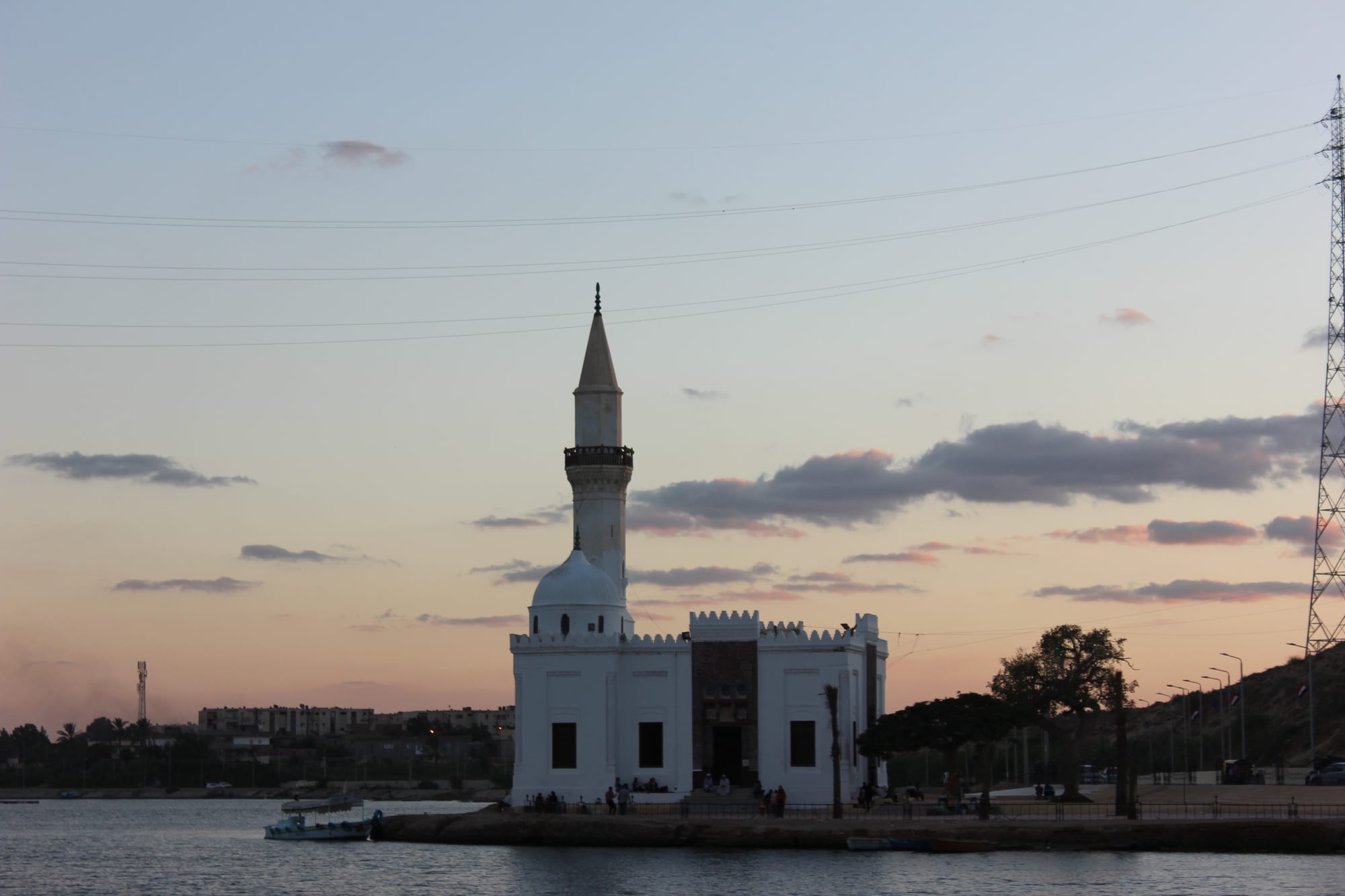
A small white mosque with a slender minaret standing on the bank of the Nile at Rosetta under a pink evening sky

Alexandria & the Nile Delta, Egypt

Rosetta

The Abu Mandur mosque on the bank of the Nile at Rosetta. (لا روسا / Wikimedia Commons · CC BY-SA 4.0)

A Delta town, known in Arabic as Rashid, standing where the western branch of the Nile reaches the Mediterranean east of Alexandria. Its wealth as an Ottoman port left streets of tall houses built in red and black brick, and in 1799 French soldiers working on a fort nearby uncovered the inscribed stone that unlocked hieroglyphs.

Neighbourhoods

  • The old town
    • First-time visitors
    • Historic district
    • Architecture

    A few compact streets near the river hold the surviving Ottoman merchants' houses, built of small red and black bricks with projecting wooden lattice windows, along with old mosques, a mill and the town museum. Most of what there is to see in Rosetta is within a short walk here.

    Open in Maps
  • The corniche and the river front
    • Views
    • Evening walks
    • Fishing boats

    The bank of the Nile's western branch, lined with cafés, landing stages and fishing boats, where the town looks across to palm groves and fields. It is the place local families come out to in the evening, and boats set off from here downstream towards the river mouth.

    Open in Maps
  • The modern town and the road to the sea
    • Local life
    • Markets
    • Transport

    Away from the historic quarter, Rosetta is an ordinary working Delta town of concrete blocks, a market, bus and microbus stands and rice mills. The road north runs a few kilometres to the fort and the sandbar where the river meets the Mediterranean.

    Open in Maps

Things to do

The Ottoman town

  • The Ottoman merchants' houseslandmark

    Restored Ottoman merchants' houses of small red and black brick, with carved wooden window screens, survive in the old streets; several can be entered.

    Open in Maps
  • Rashid National Museummuseum

    The town museum, in the three-storey Arab Killy house, covering Rosetta's Ottoman years, the battles fought against the French and the British, and the finding of the Rosetta Stone, of which it holds a copy.

    Open in Maps
  • Zaghloul Mosquelandmark

    The oldest and largest mosque in Rosetta, built in 1587 by a Mamluk named Zaghloul, carried on ninety-nine marble columns beneath a field of small Ottoman domes.

    Open in Maps

The river and the coast

  • Abu Mandurlandmark

    A domed mosque and shrine on the riverbank just upstream of the town, a local pilgrimage and picnic spot with a view along the Nile.

    Open in Maps
  • The mouth of the Nileviewpoint

    A few kilometres north of town the western branch of the Nile meets the Mediterranean across a shifting sandbar, reached by road or by boat.

    Open in Maps

Short trips from the town

  • Fort Julienlandmark

    A Mamluk fort on the river about five kilometres north-west of the town, occupied and strengthened by Napoleon's army, where soldiers found the Rosetta Stone in July 1799; the stone itself has been in the British Museum since 1802.

    Open in Maps
  • Lake Idkuattraction

    A shallow coastal lagoon west of the town, fished from small boats and a wintering ground for water birds.

    Open in Maps
  • Alexandriaattraction

    Egypt's Mediterranean second city, about sixty-five kilometres west, with the Citadel of Qaitbay, the catacombs and the modern library.

    Open in Maps

Seasonal events

  • Sham el-Nessimspring, the Monday after Coptic Easter

    The national spring holiday, spent outdoors along the river and the coast with salted fish, spring onions and coloured eggs.

  • Ramadan eveningsthe lunar month of Ramadan

    Quiet fasting days and late, sociable nights, with the old town's cafés busy after sunset.

  • Summer on the coastJuly and August

    Egyptian families fill the beaches on the Mediterranean either side of the river mouth, and the town is at its busiest.

Eat and drink

Long-standing places and food districts in Rosetta. Hours, ratings and directions come from your maps app, always current.

Rosetta classics

  • Fish grills by the riverneighborhood

    Nile and sea fish, chosen by weight and then grilled or fried, served with tahini, salad and bread at simple places along the corniche.

    Open in Maps
  • Rice and dairy from the Deltamarket

    The town sits among rice fields and buffalo herds, so the market sells rice, soft Damietta-style white cheese, aged mish and dates alongside the day's catch.

    Open in Maps

Street food and cafés

  • Ful and taameya stalls in the market streetsneighborhood

    Broad-bean stews and Egyptian falafel are the morning food, ladled into flat bread from carts and hole-in-the-wall shops.

    Open in Maps
  • Tea houses on the cornicheneighborhood

    Glasses of sweet tea, coffee and shisha at tables facing the water, the town's main evening entertainment.

    Open in Maps

Experience Rosetta

History

Rosetta was founded in the 9th century on the western mouth of the Nile, on a site that had been settled far earlier, and grew as the port where river traffic met the sea. Its great period came under the Ottomans. As the harbours of Alexandria silted and declined, Rosetta became the main outlet for Egyptian grain, rice and cotton, and merchants from across the eastern Mediterranean built the tall houses of red and black brick that still stand — warehouses at ground level, living rooms above, wooden screens across the windows.

The town's name entered every language by accident. In July 1799, during the French occupation, soldiers strengthening a fort a few kilometres downstream uncovered a slab of dark stone carved with the same decree in hieroglyphic, demotic and Greek script. Surrendered to the British in 1801 and in the British Museum from 1802, it gave Jean-François Champollion and others the key to reading ancient Egyptian. In 1807 a British expeditionary force that entered the town was defeated in its streets by Egyptian troops.

Decline followed swiftly. Muhammad Ali's Mahmoudiya Canal, completed in 1820, linked the Nile directly to Alexandria and returned the shipping trade there, leaving Rosetta a fishing and farming town. That stagnation preserved its architecture: dozens of Ottoman houses, mosques, mills and a hammam survived where a prosperous town would have rebuilt. Restoration campaigns from the later 20th century onwards have repaired many of them, and the town is valued today for the Ottoman townscape that stagnation preserved.

Culture & Customs

Rosetta's identity rests on two things: its brickwork and its river. The houses are the local pride, and their style — patterned red and black brick, projecting mashrabiya screens, painted ceilings and ranks of marble columns holding up the mosques — is particular to the town. Caretakers open them to visitors and explain them with a mixture of official history and family memory.

Life is that of a Delta town, ordered by prayer times, the market and the fishing day. Religious observance is visible and social; moulids, the festivals held at saints' shrines, draw crowds to the mosques and riverside tombs, and the shrine at Abu Mandur upstream is a place for outings as much as devotion. Hospitality is pressed firmly on the few foreigners who come, and refusing tea takes more effort than accepting it.

Rosetta has also acquired a role it did not choose. The stone named after the town has made the name a byword for decipherment and given it a share in the long Egyptian argument about antiquities held abroad; local people are well aware that the famous object is in London, and say so. Meanwhile the ordinary culture of the Delta continues around it — sung poetry at weddings, boats decorated for festivals, and the long evening sitting outside on the corniche.

Daily Life

Rosetta counted about 58,000 people at the 1996 census and has grown since, a town small enough to cross in a walk and dense enough to be busy all day. Work is divided between fishing in the river mouth and the nearby Mediterranean, farming the surrounding fields, rice milling and the small trades of a market town. Fishing boats moor along the corniche and put out into the sea across a shifting bar, which is dangerous in rough weather.

The countryside around is rice and citrus land, worked in the classic Delta way with small plots, canals and buffalo, and Rosetta's mills and cold stores handle the crop. Some residents commute to Alexandria, sixty-five kilometres west, or to the industrial and gas installations along the coast at Idku and Abu Qir. Others have taken jobs in the Gulf and send money back, a pattern visible in the newer concrete houses at the edges of the town.

The shoreline itself is a daily concern. The Rosetta promontory has been eroding for decades, since the Aswan High Dam held back the silt the river once carried, and defences have been built at the mouth; rising sea levels and the salting of farmland are discussed here as practical matters rather than distant forecasts. The rhythm of the day is early and slow, with the corniche filling after sunset.

Food

Fish is the town's food, from the river, the lagoons and the sea: mullet, tilapia, sea bass, sole, shrimp and crab, bought at the landing stages and grilled over charcoal or fried, with tahini, rocket, lemon and bread. Sayadeya, fish baked over rice coloured and sweetened by long-cooked onions, is the set-piece dish of the whole coast. Fesikh, mullet salted and left to cure, is eaten at the spring holiday of Sham el-Nessim and is prepared by specialist shops.

The everyday meals are Delta meals. Ful medames, broad beans stewed slowly and dressed with oil and cumin, and taameya, the Egyptian falafel made from split broad beans, are the breakfast; koshary, rice, lentils and macaroni under fried onion and tomato sauce, is the cheap lunch; and molokhia, a green soup of jute leaves poured over rice, is cooked for Friday. Rice is the local crop and appears at nearly every meal, including roz me'ammar, baked with milk and cream.

Dairy comes from the buffalo herds: soft white gebna domiati, sharp aged mish and thick yoghurt. Feteer meshaltet, a flaky layered pastry, is baked in village ovens and eaten with honey, cheese or molasses. Dates, guava and citrus are sold from carts in season, and the drinks are strong sweet tea, hibiscus and sugarcane juice.

Planning tools

Budget

Rosetta is very cheap, and it has almost no tourist infrastructure: a handful of simple hotels, local restaurants and small entry fees for the houses and the museum. Most visitors come for the day from Alexandria, so the main cost is a car and driver or the bus fare, and there is little to spend money on once in the town.

Daily Budget Midrange
USD 65–130 (hotel in Alexandria, fish dinners, museum and house tickets, a hired car for the day)
Daily Budget Shoestring
USD 20–35 (simple room or a day trip by bus, street food, small entry tickets)

Buy a combined ticket for the historic houses at the first one entered, and agree the fare and waiting time with any driver before setting out.

Best Time to Visit

Spring and autumn are the most comfortable, with warm days and a sea breeze off the Mediterranean. Summer is humid and busy with Egyptian holidaymakers on the nearby beaches. Winter is mild but wet and windy, and the river mouth can be rough; mornings are often misty.

Suggested Number of Days

The old houses, the museum and the corniche are easily covered in half a day, which is how most people see the town. A full day allows the fort and the river mouth as well, and staying overnight suits anyone exploring the coastal lagoons.

First Visit
half a day
With Surroundings
1–2 days

Transportation

The historic quarter is small and covered on foot. Microbuses, taxis and tuk-tuks handle the rest of the town and the road north to the fort and the river mouth, and small boats run along the river. Buses and shared microbuses link the town with Alexandria and the Delta.

There is no organised tourist transport, so a hired car with a driver from Alexandria is the simplest way to reach the outlying sites.

Airport & Station Connections

Rosetta lies about sixty-five kilometres east of Alexandria, roughly an hour by road along the coast, and buses and microbuses make the trip regularly from Alexandria's terminals. Roads also run inland to Damanhur and the Delta towns. The nearest airport is Alexandria International at Borg El Arab, west of Alexandria.

Walkability

The old town is flat, compact and best seen on foot, with the historic houses within a few hundred metres of one another and the river close by. Pavements are broken and streets are shared with tuk-tuks and carts, and the fort and river mouth are too far to walk comfortably.

Safety

Rosetta is a quiet provincial town where foreign visitors are rare enough to attract friendly curiosity rather than hassle. The practical risks are traffic, uneven pavements and the river and sea at the mouth, where currents are strong and there are no lifeguards. Police may ask to see identification. The war that began on 27 February 2026 between the United States and Israel and Iran and its allies has not been fought in Egypt, but it has disrupted flights, shipping and prices across the region.

Avoid night driving on Delta roads, swim only at beaches with lifeguards when the sea is rough, and carry a passport for checkpoints near the canal. Check current official travel advice before travelling.

Climate

A Mediterranean coastal climate, humid and mild, with almost all the rain falling between November and March. Sea breezes keep summer bearable, and spring can bring hot, dusty khamsin winds for a few days at a time.

Summer
warm and humid, about 29–31°C by day with little cooling at night
Winter
mild and damp, around 18°C by day, with rain and onshore winds

Local Customs

This is a conservative small town, and dress is modest: covered shoulders and knees for everyone, a headscarf for women entering a mosque, and shoes removed at the door. Small tips, baksheesh, are expected from the caretakers who open the historic houses. Alcohol is not sold openly. During Ramadan almost nothing is eaten or drunk in public before sunset.

Ask before photographing people or inside private houses, and expect to be invited for tea — accepting is the polite answer.

Common Payment Methods

The currency is the Egyptian pound, and the town runs on cash. Cards are of little use outside a bank, so bring notes, including small ones for tickets, tips and microbuses. There are ATMs in the centre, but changing money is easier in Alexandria.