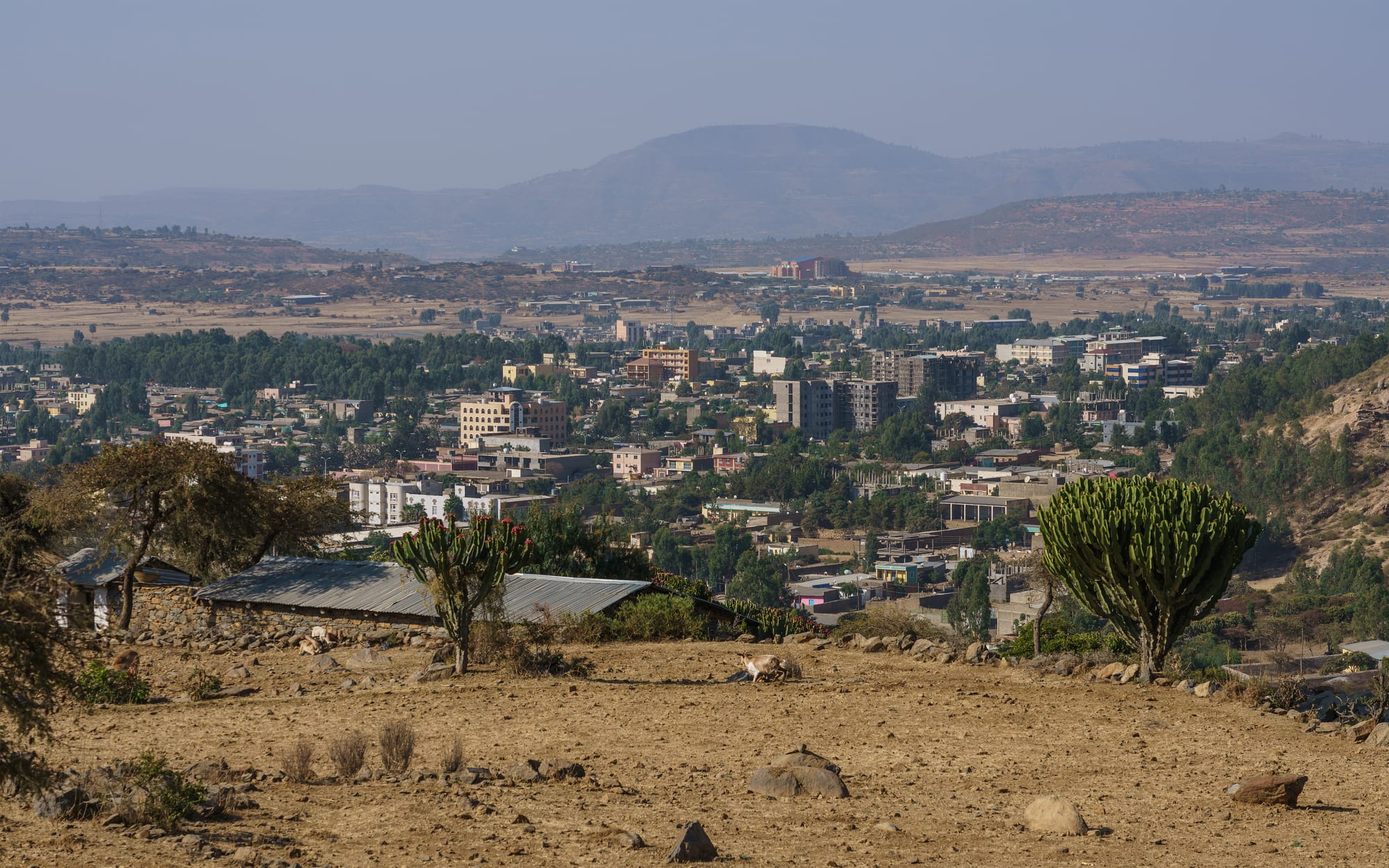
The low town of Axum spread across a dry plain of fields and trees, seen from a stony hillside with euphorbia trees and ridges behind

Lalibela, Gondar & the North, Ethiopia

Axum

Axum seen from the hills above the town, in the Tigray region of northern Ethiopia. (A.Savin / Wikimedia Commons · FAL)

A town in the Tigray region of northern Ethiopia that was the capital of the Aksumite kingdom, a trading power of the first to eighth centuries that minted its own coins and adopted Christianity in the fourth. Its fields of carved granite stelae, royal tombs and palace ruins are a UNESCO World Heritage Site, and its main church is said to hold the Ark of the Covenant.

Neighbourhoods

  • The stelae quarter
    • First-time visitors
    • Historic district

    The northern part of town, where the main field of carved granite stelae stands in open ground beside the tombs of the Aksumite kings. The church compound, the museum and most of the archaeological sites lie within a short walk of each other here.

    Open in Maps
  • The main street and market
    • Local life
    • Best for food
    • Close to public transport

    The commercial spine running south-west from the church, lined with hotels, cafés, shops and bus offices, with the open market and its grain, spice and livestock trade behind it. This is where the town's daily business happens.

    Open in Maps
  • The western outskirts
    • Quiet and residential
    • Views

    The edge of town towards the airport road and the Dungur palace ruins, thinning into fields, threshing grounds and scattered compounds, with low hills and the tombs of Kaleb and Gebre Meskel on the rising ground to the north-east.

    Open in Maps

Things to do

The ancient city

  • Obelisk of Axumlandmark

    A carved granite stele about 24 metres high, taken to Rome in 1937, returned to Ethiopia in 2005 and re-erected on its original site in 2008.

    Open in Maps
  • The main stelae fieldlandmark

    The northern park of carved granite monoliths marking royal graves, including the enormous Great Stele, which lies broken where it fell, probably during or soon after its raising.

    Open in Maps
  • Ezana Stonelandmark

    A stone inscribed in Ge'ez, Sabaean and Greek recording the campaigns of King Ezana, the fourth-century ruler under whom the kingdom adopted Christianity.

    Open in Maps
  • Dungurlandmark

    The ruins of a large stone building of the Aksumite period in the west of the town, near a stelae field traditionally associated with Queen Gudit, and long linked in local legend with the Queen of Sheba.

    Open in Maps
  • Mai Shumattraction

    A large reservoir cut into the rock below the hill of May Oho, known as the Queen of Sheba's Bath and thought to date from Aksumite times.

    Open in Maps

Churches and tombs

  • Church of Our Lady Mary of Zionlandmark

    The church at the centre of Ethiopian Orthodox tradition, rebuilt by Fasilides in the 17th century beside a 20th-century domed cathedral; the neighbouring Chapel of the Tablet is said to hold the Ark of the Covenant, and no one but its guardian may enter.

    Open in Maps
  • Tombs of Kaleb and Gebre Meskellandmark

    Two stone-built royal tombs with deep vaulted chambers on a low hill north-east of the town, attributed to a sixth-century king and his son.

    Open in Maps

Short trips from the town

  • Yehalandmark

    The tall stone temple of Yeha, dated to around 700 BC and the oldest standing structure in Ethiopia, east of Axum on the road towards Adwa.

    Open in Maps
  • Adwaattraction

    The town among sharp peaks where Menelik II's army defeated an invading Italian force in 1896, a victory still central to Ethiopian identity.

    Open in Maps
  • Debre Damolandmark

    A monastery on a flat-topped mountain east of Axum, reached only by climbing a leather rope up the cliff and open to men alone.

    Open in Maps

Seasonal events

  • Hidar TsionNovember

    The feast of Our Lady Mary of Zion on 30 November, the town's largest gathering, when pilgrims camp around the church compound for days of services.

  • TimkatJanuary

    Epiphany, on 19 January, when the tabots are carried in procession and the liturgy is celebrated at water in the early hours.

  • GennaJanuary

    Orthodox Christmas on 7 January, kept with night-long services and a family meal.

  • MeskelSeptember

    The feast of the Finding of the True Cross at the end of the rains, marked with a bonfire and processions.

Eat and drink

Long-standing places and food districts in Axum. Hours, ratings and directions come from your maps app, always current.

Axum classics

  • Restaurants on the main streetneighborhood

    Small kitchens serving injera with tsebhi, the Tigrinya word for stew, alongside tibs, shiro and fasting platters, with a few places offering pasta and grilled meat.

    Open in Maps
  • Axum marketmarket

    The open market where farmers from the Tigray plateau sell teff, barley, chillies, spices, honey and livestock, busiest on the main market day.

    Open in Maps
  • Suwa housesrestaurant

    Neighbourhood houses selling suwa, the Tigrayan home-brewed barley beer, recognised by an upturned cup or a can hung outside the door.

    Open in Maps

Cafés

  • Cafés around the churchcafe

    Macchiato, fruit juice and the full coffee ceremony, with popcorn or roasted barley, served on terraces near the stelae field and the main street.

    Open in Maps

Experience Axum

History

Axum was the capital of a kingdom that traded between the Nile valley, the Red Sea and the Indian Ocean from about the first century AD. Ivory, gold, incense and slaves moved through its port of Adulis on the coast; the kingdom minted gold, silver and copper coins from the late third century, and was named by the prophet Mani among the four great powers of the world alongside Rome, Persia and China. Its rulers raised carved granite stelae over royal graves, cut as single blocks and dressed to look like multi-storey buildings with false doors and windows. The largest of them, about 33 metres long, lies broken where it fell.

In the fourth century King Ezana adopted Christianity, recorded in his trilingual inscriptions and on his coins, making Aksum one of the earliest Christian states. Tradition holds that the Ark of the Covenant was brought here from Jerusalem by Menelik, the son of Solomon and the Queen of Sheba, and that it rests in a chapel beside the church of Our Lady Mary of Zion, where emperors were crowned. The kingdom declined from the seventh and eighth centuries as trade routes shifted, and power moved south.

The town remained a religious centre through the centuries that followed. Fasilides built the church that stands today in 1665, and a domed cathedral was added beside it in the 20th century. The ruins were inscribed as a UNESCO World Heritage Site in 1980. The great obelisk, taken to Rome in 1937 during the Italian occupation, was returned in 2005 and re-erected in 2008. The war of November 2020 to November 2022 reached the town, and it has been recovering since.

Culture & Customs

Axum is the spiritual centre of the Ethiopian Orthodox Tewahedo Church, and that gives the town a weight out of proportion to its size. The church of Our Lady Mary of Zion is held to be the resting place of the Ark of the Covenant, guarded by a single monk who never leaves the compound and is replaced only on his death; every Ethiopian Orthodox church keeps a tabot, a replica of the Tablets of the Law, in imitation of it. Ge'ez, the language of the Aksumite inscriptions, is still the language of the liturgy.

The great gathering of the year is Hidar Tsion at the end of November, when pilgrims come from across the country, camp around the church and hold services through the night; Timkat in January brings the tabots out in procession to the Mai Shum reservoir. Priests carry embroidered umbrellas, silver processional crosses and drums, and deacons chant with the sistrum and prayer staff.

The culture is Tigrayan: Tigrinya is the language, the shoulder-shaking dances and the krar and kebero music of Tigray are heard at weddings, and in August girls celebrate Ashenda in bright dresses and grass skirts. Hand crosses, basketwork and white cotton weaving are the local crafts. Memory of the 2020 to 2022 war, and before it of the 1984 famine and the long guerrilla struggle against the Derg, runs through everything.

Daily Life

Axum is a town of about 66,900 people, by a 2015 count, on the dry western edge of the Tigray plateau, low-built and spread out, with the stelae standing in open ground in the middle of it. Most families live in stone and mortar houses with corrugated roofs, and the town is ringed by fields of teff, barley, sorghum and wheat worked with oxen, with threshing grounds on the outskirts after the harvest.

Farming, trade, the church, the town's university and government offices carry the economy. Tourism was the other pillar, employing guides, drivers, hotel staff and craft sellers, and it collapsed with the war and has recovered only partly. The fighting of 2020 to 2022 brought displacement, damage to services and a long interruption of banking, electricity, telephone and internet connections across Tigray, and aid has been a part of daily life since.

Days start early, before the heat, with church bells and the sound of grain being ground. Farmers walk in for market day with donkeys and livestock, the main street fills with bajaj taxis, and by mid afternoon people gather over coffee roasted at the roadside. Water and power supplies are irregular, and the nights, at more than two thousand metres, are cold enough for a blanket most of the year.

Food

Tigrayan cooking has its own vocabulary. Stews are tsebhi rather than wat, and the regional dish is tihlo: balls of roasted barley dough, dipped by hand or on a small wooden fork into a spicy sauce of meat or pulses, a speciality tied to the Tigray highlands. Ga'at, a stiff porridge with a well of spiced butter and berbere in the middle, is a breakfast of the region, and hilbet, a paste of ground broad beans and lentils, is eaten on fasting days.

Injera here is often made with a proportion of barley or sorghum as well as teff, and comes with tsebhi dorho, the chicken stew, tsebhi birsen of lentils, shiro of ground chickpeas, and cooked greens. Zigni, a red-hot beef stew, is the festival dish, and tere siga, raw beef eaten with mustard and awaze, is a Tigrayan treat at celebrations. Kicha fit-fit, torn flatbread mixed with spiced butter and berbere, is the standard breakfast.

To drink there is suwa, the Tigrayan home-brewed barley beer sold in neighbourhood houses marked by an upturned cup, mes or tej, the honey wine, and coffee. The ceremony follows the national form — green beans roasted over charcoal, pounded, brewed in a jebena and poured in three rounds — often with popcorn or roasted grain alongside.

Planning tools

Budget

Axum is cheap for food and hotels but the archaeological sites are covered by a single ticket priced for foreign visitors, and a guide is the usual way of making sense of them. Getting here is the real expense: most visitors fly, and the outlying sites need a hired car.

Daily Budget Midrange
USD 100–200 (mid-range hotel, a domestic flight, private guide and car)
Daily Budget Shoestring
USD 25–45 (basic hotel, local food, minibuses, shared guide)

Buy the site ticket at the official office near the stelae field, agree guide and driver fees in advance, and carry enough cash for the whole stay.

Best Time to Visit

October to March is dry, clear and comfortably warm, and the Hidar Tsion festival at the end of November fills the town. The main rains fall from June to September and can make the roads to the outlying sites difficult. April and May are hot and dusty on the Tigray plateau.

Suggested Number of Days

Two days cover the town's archaeological sites and churches at a reasonable pace. Three or four suit anyone travelling out to the older temple sites, cliff monasteries and rock-hewn churches of the surrounding countryside, which need a vehicle.

First Visit
2 days
With Surroundings
3–4 days

Transportation

Most of Axum is walked, and the main sites lie within a couple of kilometres of the church compound. Three-wheeled bajaj taxis cover longer hops and the airport road, and cars with drivers are hired for the outlying sites. Buses and minibuses connect Axum with Adwa, Adigrat and Mekelle when routes are running.

Agree a bajaj fare before getting in, and arrange a car for the outlying sites through a hotel or a licensed guide.

Airport & Station Connections

Axum Airport, also known as Emperor Yohannes IV Airport, is about 5.5 kilometres east of the town. It was heavily damaged in November 2020 during the Tigray conflict, and flights from Addis Ababa depend on services to Tigray running. By road the town is reached from Adwa and Adigrat to the east and from Gondar by a long mountain route to the west.

Walkability

The town is small, flat in the centre and easy to cover on foot: the stelae field, the church compound, the museum and the market are within a few hundred metres of each other. The tombs, Dungur and the Mai Shum reservoir involve longer walks on dusty tracks and low hills, in strong sun and thin air at about 2,100 metres.

Safety

Axum is in Tigray, which is recovering from the war of November 2020 to November 2022 and remains tense; civilians were killed in the town in late 2020 during the war. Services, banking, transport and flights have all been interrupted in recent years, unexploded ordnance is a risk in parts of the region, and the border with Eritrea is sensitive. Many governments advise against travel here.

Check current advisories closely and route around conflict-affected regions, travel the Danakil and remote parks only with a licensed operator and escort, and avoid political demonstrations. Travel with an operator that tracks the local situation, keep to established paths and roads, and be ready to change plans at short notice. Check current official travel advice before travelling.

Climate

A dry highland climate at about 2,100 metres, warmer and considerably drier than the highlands further south. Rain is concentrated in a short season from June to September; the rest of the year is sunny with cool nights.

Summer
the rainy season from June to September, green and cloudy with days around 22–26°C
Winter
dry and bright from October to March, about 24–28°C by day and cool after dark

Local Customs

Axum is a place of pilgrimage as much as archaeology. Shoes are removed at church doors, shoulders and knees covered, and the older church of Our Lady Mary of Zion and the monastery of Debre Damo admit men only, a rule that is not negotiated. Tigrinya is the language of the street, and Amharic is widely understood. The war is a painful subject and is best left to local people to raise.

Ask before photographing people, priests or pilgrims, do not photograph military or government installations, and dress modestly around the church compound.

Common Payment Methods

The currency is the Ethiopian birr, and Axum runs on cash. Card payment is rare, ATMs and bank services in Tigray have been unreliable since the war, and guides, drivers, hotels and site tickets are paid in notes. Bring enough birr, and US dollars in good condition to change.