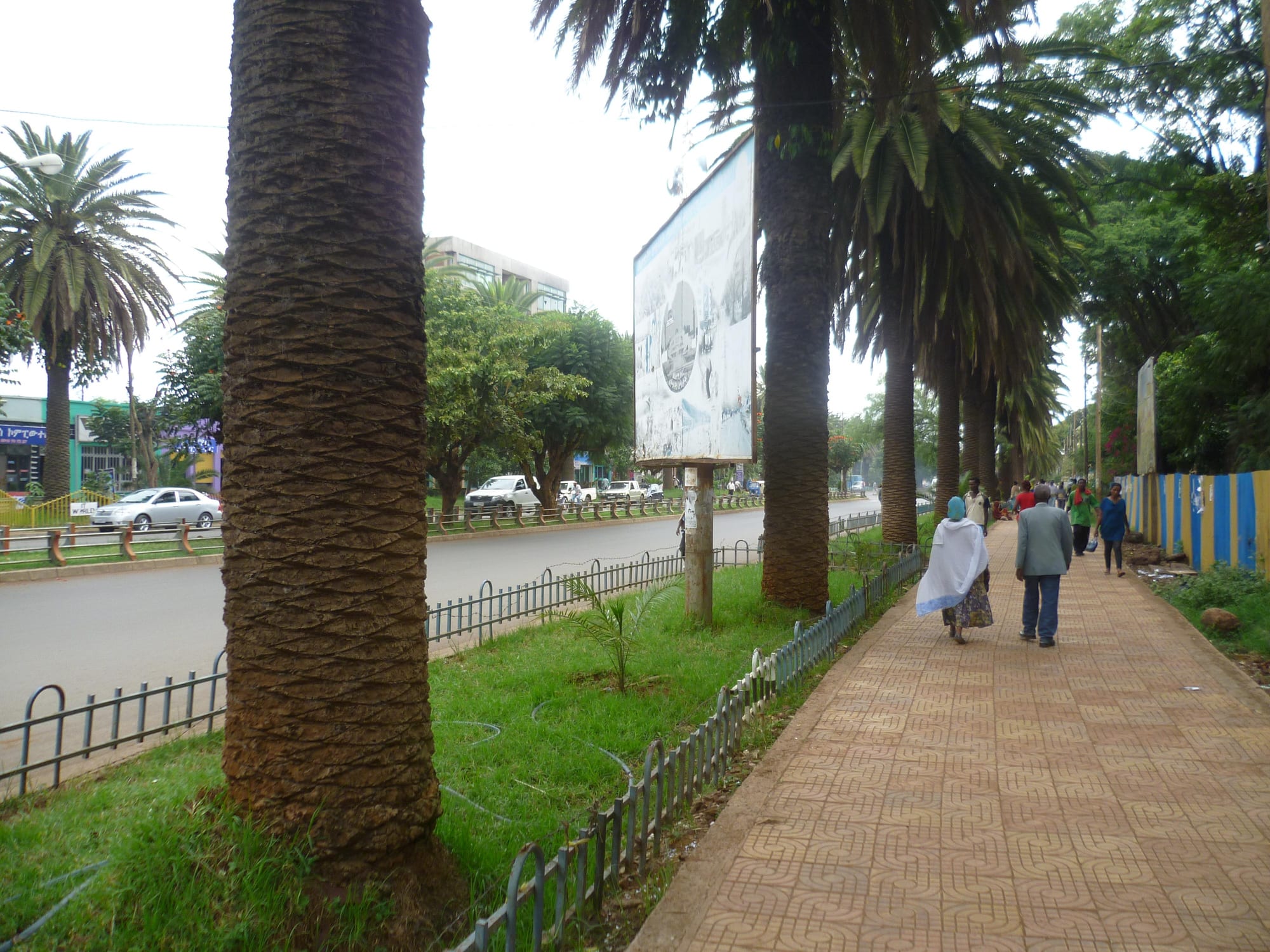
A pavement beside a wide road in Bahir Dar lined with tall palm trees, with people walking and green verges between the carriageways

Lalibela, Gondar & the North, Ethiopia

Bahir Dar

One of the palm-lined avenues of Bahir Dar, on the southern shore of Lake Tana. (Radosław Botev / Wikimedia Commons · CC BY 3.0 pl)

The capital of Ethiopia's Amhara region, on the southern shore of Lake Tana where the Blue Nile leaves the lake. A planned city of wide palm-lined avenues rather than an ancient one, it is the base for the painted monasteries on the lake's islands and peninsulas and for the Blue Nile Falls downstream.

Neighbourhoods

  • The lakeshore
    • First-time visitors
    • Views
    • Quiet and residential

    The strip between the main avenue and the water, where hotels, gardens and cafés look across Lake Tana and the boats for the monasteries leave from the jetties. Fishermen bring in catches in papyrus tankwa boats, and pelicans and kingfishers work the shallows.

    Open in Maps
  • The centre and the main avenue
    • Best for food
    • Close to public transport
    • Local life

    The wide palm-lined streets of the planned city, with banks, shops, restaurants, bus offices and most of the everyday business of the Amhara capital. It is flat, busy with bajaj taxis and bicycles, and the easiest part of the city to walk.

    Open in Maps
  • The market quarter
    • Markets
    • Local life

    Inland from the centre, a dense area of stalls, grain traders, spice sellers and workshops where farmers from the lake plain come to trade. Weaving, basketwork and the reed goods of the lake villages are sold here.

    Open in Maps
  • Bezawit and the southern hills
    • Views
    • Quiet and residential

    The rising ground south of the centre above the Blue Nile outlet, where an unfinished palace stands on a hilltop that gives a wide view over the river and the lake. The area beyond is open farmland and university buildings.

    Open in Maps

Things to do

On the lake

  • Ura Kidane Mehretlandmark

    A round monastery church on the Zege peninsula whose walls and drum are covered in bright paintings of biblical and Ethiopian scenes, reached by boat through coffee forest.

    Open in Maps
  • Zegeattraction

    A wooded peninsula of monasteries, shade-grown coffee and forest paths on the lake's south-western shore, and the most visited boat trip from the city.

    Open in Maps
  • Kebran Gabriellandmark

    An island monastery close to the city, known for its manuscripts, though its church is no longer open to the public; boats pass it on the way to the other islands.

    Open in Maps
  • Debre Maryamlandmark

    A small monastery on an island near the point where the Blue Nile flows out of Lake Tana, a short boat ride from the city.

    Open in Maps

In and around the city

  • Bezawit Hillviewpoint

    The hill south of the centre, topped by an unfinished palace, looking down on the Blue Nile as it swings away from the lake.

    Open in Maps
  • The Blue Nile outletviewpoint

    The point where the river leaves Lake Tana under the city bridge, with reed beds along the banks and fishermen working from papyrus tankwa boats.

    Open in Maps
  • Bahir Dar marketmarket

    The city's main trading ground for grain, chillies, spices, baskets and reed goods, busiest on market days when villagers come in from the lake plain.

    Open in Maps
  • Bahir Dar Universityattraction

    One of Ethiopia's largest universities, with campuses beside the lake and the river that give the city a big student population.

    Open in Maps

Short trips from the city

  • Blue Nile Fallsattraction

    Known in Amharic as Tis Issat, the smoking water, a broad curtain of falls on the Blue Nile about 30 kilometres downstream, much of its water taken since 2003 by a hydroelectric station except in the rainy season.

    Open in Maps
  • Lake Tanaattraction

    Ethiopia's largest lake and a source of the Blue Nile, nominated as a UNESCO biosphere reserve in 2015, with monasteries scattered across its islands.

    Open in Maps
  • Dek Islandattraction

    The largest island in Lake Tana, a full day out by boat, with farming villages, coffee gardens and monasteries.

    Open in Maps

Seasonal events

  • TimkatJanuary

    Epiphany, on 19 January, when the tabots are carried in procession to water and the city fills with white-robed crowds and drumming.

  • GennaJanuary

    Orthodox Christmas on 7 January, kept with night services in the churches and monasteries and a family meal afterwards.

  • FasikaApril

    Orthodox Easter, the end of the long Lenten fast, the biggest family feast of the year.

  • MeskelSeptember

    The feast of the Finding of the True Cross, celebrated as the rains end with a bonfire of branches and yellow Meskel daisies on the hillsides.

Eat and drink

Long-standing places and food districts in Bahir Dar. Hours, ratings and directions come from your maps app, always current.

Bahir Dar classics

  • Lakeside fish restaurantsrestaurant

    Kitchens along the shore serve Lake Tana tilapia and catfish fried whole, grilled, or made into asa wat, a spiced fish stew, and asa lebleb, fish cooked with onion and chilli.

    Open in Maps
  • The main avenue restaurantsneighborhood

    Injera with doro wat, tibs and fasting platters are served all along the central streets, with pasta and grilled meat on most menus as well.

    Open in Maps
  • Bahir Dar marketmarket

    Chillies, teff, spices, honey, butter and vegetables from the lake plain, with reed baskets and mats from the villages on the shore.

    Open in Maps

Cafés and bars

  • Lakeshore caféscafe

    Gardens and terraces looking over Lake Tana where macchiato, fruit juice layered in glasses and the full coffee ceremony are all served.

    Open in Maps
  • Tej and tella housesrestaurant

    Small bars pouring honey wine and home-brewed barley beer, often with an azmari improvising verses on the masenqo.

    Open in Maps

Experience Bahir Dar

History

Bahir Dar is a young city in an old landscape. Its name means, roughly, sea shore, and for centuries the site was a cluster of fishing and farming villages at the point where the Blue Nile leaves Lake Tana, overshadowed by the monasteries on the lake's islands and by the imperial capital at Gondar to the north. European travellers in the 19th century described it variously as a village or a small town, but no place of any size grew up.

The modern city dates from May 1936, when the Italians occupied it, gave it its first modern urban features and made it the administrative centre of the southern Lake Tana territories. In the early 1950s it was considered the best site for an alternative national capital, and it was provided with a water supply, hydroelectric power, better lake-port facilities, the Abbay bridge over the Blue Nile, textile mills, a hospital and the colleges that grew into Bahir Dar University, while German experts drew up a comprehensive master plan with new zoning. The hydroelectric scheme on the river brought power and industry, and since 2003 it has taken much of the water out of the falls downstream.

After the fall of the Derg Bahir Dar became the capital of the Amhara region, and it has grown very fast since, with a large university, an airport and a tourist trade built on the lake and the falls. In 2002 UNESCO awarded the city its Cities for Peace Prize. The fighting in Amhara since 2023 has brought disruption and a sharp fall in visitor numbers.

Culture & Customs

Lake Tana is the centre of the city's cultural life. Its islands and peninsulas hold monasteries founded from the 14th century onwards, some of them older still in tradition, where monks keep illuminated manuscripts on parchment, silver crosses and crowns said to have belonged to emperors. The round churches, with their conical roofs and painted inner drums, are among the best examples of the Ethiopian religious painting tradition, and several remain closed to women by long-standing rule.

On the water the tankwa, a canoe made by binding papyrus stems, is still used for fishing and for carrying firewood and reeds, though motorboats now do the longer work. Reed and basket weaving, cotton weaving and the coffee grown in the shade of the Zege forest are the traditional crafts of the lake villages, and the shade coffee forest is itself treated as something to be protected.

City culture is Amhara and Orthodox, with the same festival calendar as the rest of the highlands: Timkat processions, Meskel bonfires, night services at Genna and Fasika. The university keeps a young, mixed population in town, and evenings in the bars belong to the azmari and to Ethio-jazz and modern Amharic music. Bahir Dar has a reputation within Ethiopia as a relaxed, orderly city, and its avenues of palms and jacarandas are a local point of pride.

Daily Life

The 2007 census counted about 222,000 people in the Bahir Dar special zone, and the city has grown by more than five per cent a year since, one of the fastest rates in Ethiopia. The centre is a grid of wide avenues with mid-rise blocks, banks and shops; older single-storey compounds and newer condominium estates spread inland, and lakeside plots hold hotels and gardens. As the regional capital it is full of government offices, and the university, spread over several campuses, is among the largest employers.

Work on the lake and the plain around it — fishing, farming teff, rice, maize and chickpeas, and trading what comes in — supports much of the population, alongside textiles, food processing, construction and the tourist trade. Bicycles are more common here than in most Ethiopian cities because the ground is flat, and bajaj taxis fill the avenues from early morning.

The rhythm is unhurried: church before dawn for many, offices and markets through the morning, a long coffee break in the afternoon, and evenings spent walking the lakeshore or sitting in the garden bars. The war in Amhara has made itself felt in displaced families, periods of curfew, closed roads and cuts to internet and banking services, and inflation has pushed up the cost of food and fuel.

Food

Fish makes Bahir Dar different from the rest of the highlands. Tilapia and catfish from Lake Tana are fried whole, grilled over charcoal, or cooked as asa wat, a stew with berbere and onion; asa lebleb, fish sautéed with chilli, onion and tomato, is the dish most often ordered by the water, and a thin fish soup is served as a starter in many places. Because fish is permitted on Orthodox fasting days, these dishes are eaten year-round.

Everything else is classic Amhara cooking. Injera of fermented teff carries doro wat, the chicken stew of feast days, tibs of lamb or beef fried with onion and rosemary, and the fasting platter beyaynetu, in which shiro, lentils, split peas, greens, cabbage and beetroot are set out in small mounds. Kitfo, minced beef warmed in spiced butter with mitmita chilli, is eaten with injera or with the crumbly cheese ayib.

The lake and its forests supply the drinks as well. Zege's shade-grown coffee is roasted and brewed in a jebena in the standard three rounds; honey from the lake plain becomes tej, the wine served in a rounded berele; tella, the cloudy barley beer, is brewed at home with gesho leaves. Fresh juices layered in tall glasses — avocado, mango, guava and papaya — are a speciality of the cafés.

Planning tools

Budget

Bahir Dar is good value by Ethiopian standards. Hotels, including those on the lakeshore, cost less than their equivalents in Addis Ababa, and local food is cheap. The costs that mount are boat hire on Lake Tana, entry fees at each monastery, and transport to the Blue Nile Falls.

Daily Budget Midrange
USD 100–200 (lakeshore hotel, a domestic flight, private boat and guide)
Daily Budget Shoestring
USD 25–45 (basic hotel, local food, shared boat, minibuses)

Share a boat with other travellers to cut the biggest single cost, and carry small notes for the separate entrance fee at each monastery.

Best Time to Visit

October to March is dry, clear and warm, with calm water for boat trips and the lake still high after the rains. The falls are at their fullest from about August to October, at the cost of wet roads. April and May are hot before the rains arrive in June.

Suggested Number of Days

Two days are enough for the city, the lake shore and a boat trip. Three or four suit anyone adding the falls downstream and the more distant islands, each of which takes most of a day.

First Visit
2 days
With Surroundings
3–4 days

Transportation

The city is flat and compact, and bajaj taxis, bicycles and shared minibuses cover it cheaply. Boats for the monasteries are hired at the jetties by the hour or the day, in small motorboats rather than scheduled services, and hired cars or minibuses run out to the Blue Nile Falls.

Agree a boat's route, waiting time and price in full before leaving the jetty, and take a hat and sunscreen, as the lake offers no shade.

Airport & Station Connections

Bahir Dar Airport is about 8 kilometres west of the centre, near the lake, with flights from Addis Ababa and the other northern circuit towns; a new passenger terminal opened there in 2026. By road, Gondar is a few hours north around the lake and Addis Ababa a long day's drive south, though journeys across Amhara have been affected by the fighting in the region.

Walkability

One of the easiest Ethiopian cities to walk. The grid of wide avenues is flat, shaded by palms and jacarandas, with pavements along the main streets, and the lakeshore promenade runs for a couple of kilometres past hotels and gardens. Only Bezawit hill and the outlying campuses call for a bajaj.

Safety

Bahir Dar is the capital of the Amhara region, where fighting between federal forces and Fano militias has affected much of the countryside and many roads since 2023, with periods of curfew and interrupted banking and internet services. Many governments advise against travel to the region. Within the city the usual risks are petty theft and bag-snatching in crowded places.

Check current advisories closely and route around conflict-affected regions, travel the Danakil and remote parks only with a licensed operator and escort, and avoid political demonstrations. Use a licensed boat operator on the lake, and be ready to change plans at short notice. Check current official travel advice before travelling.

Climate

Warm all year at about 1,800 metres, a little lower and hotter than Gondar or Lalibela, with the lake moderating the extremes. The main rains fall from June to September, when the city is green and the falls are at their strongest.

Summer
wet and humid from June to September, with heavy afternoon storms and days around 22–26°C
Winter
dry and sunny from October to March, about 26–30°C by day with mild nights

Local Customs

The monasteries set the rules that matter most: shoes come off at the church door, shoulders and knees are covered, and women are not admitted to some of the island churches. Fasting days shape restaurant menus. Greetings are unhurried and the coffee ceremony is a courtesy, not a performance for visitors.

Ask before photographing monks, manuscripts or people at work on the water, dress modestly for the island churches, and expect to pay a small entrance fee at each monastery.

Common Payment Methods

The currency is the Ethiopian birr. A few of the larger lakeshore hotels take cards, but almost everything else — boats, bajaj taxis, monastery fees, restaurants and the market — is cash. ATMs are in the centre and can run out of notes, and banks and some hotels change US dollars.