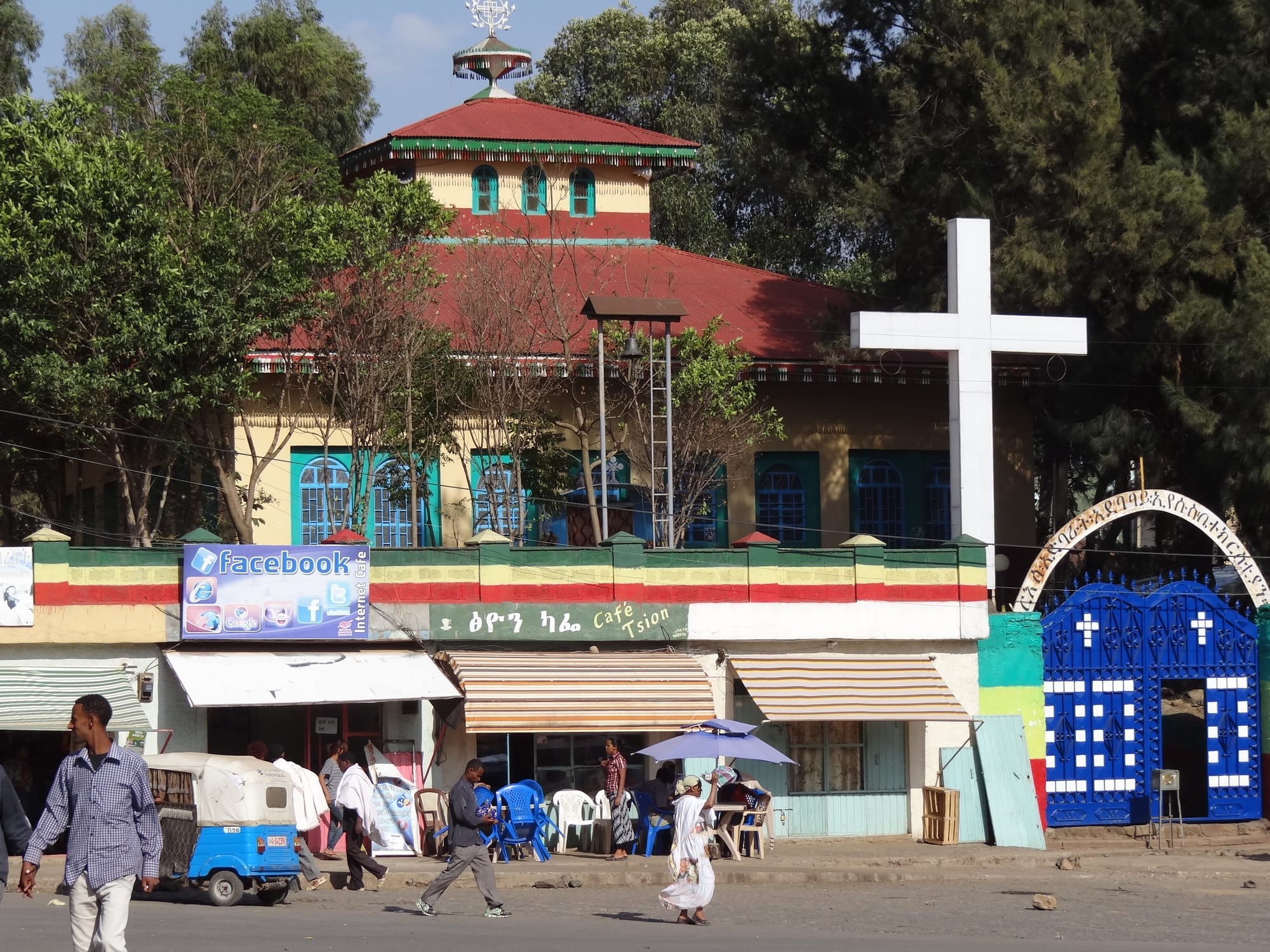
A painted Ethiopian Orthodox church with a red roof behind a street wall, a white cross and a blue gate, with people and a blue taxi passing

Lalibela, Gondar & the North, Ethiopia

Gondar

A church and café on a street in Gondar, northern Ethiopia. (Adam Jones from Kelowna, BC, Canada / Wikimedia Commons · CC BY-SA 2.0)

A highland city north of Lake Tana, founded as an imperial capital by Emperor Fasilides in 1636 and the seat of Ethiopia's emperors for more than two centuries. Its walled royal compound of stone castles and palaces is a UNESCO World Heritage Site, and the city is also the usual approach to the Simien Mountains.

Neighbourhoods

  • The Piazza
    • First-time visitors
    • Best for food
    • Close to public transport

    The commercial centre, laid out as a retail district beside the castle compound under the Italian administration after 1936 and still lined with arcaded shopfronts, cafés, banks and hotels. Most of the city's restaurants and bus connections are within a few streets, and the walls of the royal compound stand just below.

    Open in Maps
  • Around the Fasil Ghebbi
    • Historic district
    • Museums

    The old royal quarter, where the walled compound of castles, halls and libraries sits in open grass behind its stone perimeter. Churches, souvenir workshops and quiet lanes surround it, and Fasilides' Bath lies a short way to the north-west.

    Open in Maps
  • Azezo and the southern approach
    • Quiet and residential
    • Close to the airport

    The lower ground on the road towards the airport and Lake Tana, a spread of workshops, garages, small markets and housing. It is less scenic than the centre, but it is where much of the city's everyday trade and transport happens.

    Open in Maps
  • The university quarter
    • Students and nightlife
    • Local life

    The area around the University of Gondar, the country's oldest medical school, with student cafés, juice bars, bookshops and cheap food. It is busy in term time and gives the city a young population.

    Open in Maps

Things to do

The royal city

  • Fasil Ghebbilandmark

    The compound of castles, palaces, libraries and banqueting halls built by Fasilides and his successors, about 70,000 square metres enclosed by a 900-metre wall pierced by twelve gates, inscribed as a UNESCO World Heritage Site in 1979.

    Open in Maps
  • Fasilides' Bathlandmark

    A rectangular pool with a stone pavilion in the middle, beside the Qaha river north-west of the compound, blessed once a year and then opened for bathing at the Timkat celebration.

    Open in Maps
  • Debre Berhan Selassielandmark

    A church on a hill above the city, known for a ceiling painted with rows of winged angel faces and walls covered in biblical scenes.

    Open in Maps
  • Qusquamlandmark

    The hilltop palace and church complex built by Empress Mentewab in the 18th century, standing in ruins above the city with long views over the plateau.

    Open in Maps

Around the city

  • University of Gondarattraction

    The oldest medical school in Ethiopia, grown from the Public Health College founded in 1954, whose campuses give the city a large student population.

    Open in Maps
  • Wollekaattraction

    The main centre of the Beta Israel, the Ethiopian Jews, just north of the city, still known for its synagogue, its cemetery and its pottery, although most of the community emigrated to Israel in the 1980s and 1990s.

    Open in Maps

Short trips from the city

  • Simien Mountains National Parkpark

    A park of escarpments, gelada troops and the walia ibex, a wild goat found nowhere else, inscribed as a World Heritage Site in 1978 and on the danger list from 1996 to 2017; treks start from Debark on the road north of Gondar.

    Open in Maps
  • Gorgoraattraction

    A small port on the northern shore of Lake Tana with old churches and monastery islands offshore, at the end of the road south from Gondar.

    Open in Maps
  • Lake Tanaattraction

    Ethiopia's largest lake and the source of the Blue Nile, with painted island monasteries reached by boat from its shores.

    Open in Maps

Seasonal events

  • TimkatJanuary

    Epiphany, on 19 January, the city's greatest festival, when the tabots are carried in procession and crowds gather for the blessing of the water at Fasilides' Bath.

  • GennaJanuary

    Orthodox Christmas on 7 January, kept with long night services in the churches and a meal of doro wat afterwards.

  • AshendaAugust

    An August festival celebrating girls and young women, known in the Amhara area as Ashendeye, with singing, drumming and grass skirts.

  • MeskelSeptember

    The feast of the Finding of the True Cross, marked at the end of the rains with a tall bonfire and processions.

Eat and drink

Long-standing places and food districts in Gondar. Hours, ratings and directions come from your maps app, always current.

Gondar classics

  • The Piazza restaurantsneighborhood

    The arcaded centre holds most of the city's kitchens, serving injera with doro wat, tibs and fasting platters, alongside the pasta and lasagne that survive from the Italian years.

    Open in Maps
  • Gondar marketmarket

    The main trading ground for grain, chillies, spices, butter and livestock brought in from the surrounding highlands, busiest on the main market day.

    Open in Maps
  • Azmari betsrestaurant

    Music houses where an azmari improvises teasing verses over the one-stringed masenqo while tej is served in rounded glass flasks.

    Open in Maps

Cafés and bars

  • Cafés around the Piazzacafe

    Espresso machines and pastry counters share the street with traditional coffee ceremonies, a combination that dates from the Italian occupation.

    Open in Maps
  • Tella and tej housesrestaurant

    Neighbourhood bars pouring tella, the home-brewed barley beer, and tej, the honey wine, usually with roasted barley or nuggets of dabo kolo.

    Open in Maps

Experience Gondar

History

Ethiopia's emperors had no fixed capital for centuries, moving between tented camps, until Fasilides chose Gondar as his royal camp in 1636 and began building in stone. His castle, with its round towers and battlements, was followed by the palaces, libraries, banqueting halls and stables of his successors within a walled compound of about seventy thousand square metres, the Fasil Ghebbi. The style that developed there mixed Ethiopian building traditions with ideas carried from Portugal, India and the Arab world, and it is known simply as Gondarine.

For more than two centuries the city was the political and religious centre of the empire, with a population estimated at more than 60,000 in the reign of Iyasu I, dozens of churches, a court and a trade in gold, ivory and coffee. Theological disputes within the Orthodox church were argued out here, and Empress Mentewab built her own palace and church at Kuskuam on the hill above. Decline set in during the Zemene Mesafint, the Era of the Princes, when regional lords held real power and the emperors in Gondar became figureheads.

The court withdrew in the 19th century and the city was sacked more than once; some observers put its population at only about 8,000 by the 1870s. Italian troops occupied Gondar without a fight on 1 April 1936 and laid out the piazza, a retail district in 1930s modernist style beside the castle compound; British and Italian forces fought here from 13 to 17 November 1941, in the last withdrawal of Italian forces from Italian East Africa. The compound was inscribed as a World Heritage Site in 1979. Gondar grew again in the later 20th century around its university and its trade, and has been affected by the fighting in Amhara since 2023.

Culture & Customs

Gondar thinks of itself as the keeper of Ethiopian court culture. The Gondarine style in architecture has a counterpart in painting: the church of Debre Berhan Selassie, with its ceiling of winged angel faces looking down on the congregation, is the best-known survival of a school of religious art that spread from the city. Illuminated manuscripts, hand crosses and the sung liturgy in Ge'ez are all part of the same inheritance.

Timkat is the city's defining event. The tabots are carried from the churches in procession to Fasilides' Bath, the pool is filled for the occasion, and at dawn the water is blessed and the crowd enters it, before the tabots are escorted back with drumming, chanting and dancing. Genna, Meskel and Fasika fill the churches at other points of the year, and in August girls and young women mark Ashendeye with singing, drumming and grass skirts.

Gondar was also, for centuries, a centre of the Beta Israel, the Ethiopian Jewish community, whose villages lay around the city and whose craftspeople were known for pottery and metalwork; most emigrated to Israel in airlifts in the 1980s and 1990s. The azmari, a singer accompanying himself on the one-stringed masenqo, remains a fixture of the city's bars, improvising verses that praise and mock the people in the room.

Daily Life

Gondar had an estimated population of 443,156 in 2021, making it one of the largest cities in the Amhara region. People live in a mix of old stone and mud houses on the ridges near the centre, tin-roofed compounds down the slopes, and newer blocks of flats along the wider roads out towards Azezo and the airport. Amharic is the language of the street, and the Orthodox church, with a Muslim minority of long standing, shapes the week.

The economy rests on trade, government, the university and its teaching hospital, which is one of the largest medical centres in northern Ethiopia, and on the farmland around the city, which grows teff, barley, oilseeds and chillies. Tourism was a major employer for two decades — hotels, guides, drivers and craft workshops — and lost most of its business during the conflicts of the 2020s.

Days begin early with church bells and chanting, the bajaj taxis fill the streets by seven, and business stops for the long afternoon coffee. Market days bring farmers and livestock in from the highlands. The conflict in Amhara has brought displaced families into the city, along with periods of closed roads, curfews and interrupted banking and internet services, and food and fuel prices have risen sharply with national inflation.

Food

Gondar eats the classic highland diet, built on injera made from teff and a rotation of stews. Doro wat, the chicken stew cooked with berbere and served with a hard-boiled egg, is the feast dish; tibs, cubes of lamb or beef fried with onion and chilli, is what is ordered when there is something to celebrate; and kitfo, minced beef warmed with spiced butter and the chilli blend mitmita, is eaten raw or lightly cooked. Raw beef, tere siga, cut from a carcass hanging in a butcher's shop and eaten with mustard and awaze sauce, has a particular following in the northern cities.

Fasting days, which cover most Wednesdays and Fridays and the long seasons of Lent and Advent, bring beyaynetu, a platter of shiro, lentils, split peas, cabbage, greens and beetroot arranged in small mounds on injera. Chickpea shiro from the surrounding farmland is a staple, and the hot, thin porridge genfo is a breakfast of the highlands.

Italian influence is still visible in the Piazza's cafés, where macchiato, pasta and layered lasagne appear beside Ethiopian dishes. To drink there is tej, the honey wine served in a berele, tella, the barley beer brewed at home with gesho, and coffee roasted, ground and brewed in a jebena as the centre of the afternoon.

Planning tools

Budget

Gondar is one of the better-value stops on the northern circuit: hotels are cheap for what they offer and local food costs very little. The main expenses are the entry ticket to the royal compound, guides, and anything connected with the Simien Mountains, where park fees, scouts, guides and transport from Debark are charged separately.

Daily Budget Midrange
USD 100–200 (mid-range hotel, a domestic flight, private guide and site entry)
Daily Budget Shoestring
USD 25–45 (basic hotel, local food, minibuses, shared guide)

Buy site tickets at the official office, agree guide fees in advance, and budget a Simien trek as a separate, larger cost.

Best Time to Visit

October to March brings dry roads, clear air and the best views towards the Simien escarpment. Timkat in January is the reason many people choose Gondar over other towns and fills the city for several days. The rains from June to September are heavy in these highlands and make mountain roads slow.

Suggested Number of Days

Two days are enough for the city and its historic sites. Five or six suit anyone adding the mountains to the north or the lake to the south, since both need transport and at least a night away from the city.

First Visit
2 days
With Surroundings
5–6 days

Transportation

Three-wheeled bajaj taxis are the standard way of moving around, with shared minibuses on the longer routes out to Azezo and the airport road. Cars with drivers are hired for Debark and the Simien. Buses to Bahir Dar, Debark and Addis Ababa leave from the main bus station early in the morning.

Agree a bajaj fare before getting in, and book long-distance bus seats the day before, as departures are early.

Airport & Station Connections

Gondar Airport, also known as Atse Tewodros Airport, lies about 18 kilometres south of the city near Azezo, with flights from Addis Ababa and other towns on the northern circuit. By road, Bahir Dar is a few hours' drive south around Lake Tana and Debark about three hours north, though long journeys across Amhara have been affected by the fighting in the region.

Walkability

The centre is walkable and most of the main sights are within a couple of kilometres of the Piazza, but Gondar is built across ridges at about 2,100 metres and several of those walks are steep — Debre Berhan Selassie and Kuskuam both sit on hills above the town. Pavements are uneven and traffic is mixed with livestock and bajaj taxis.

Safety

Gondar is in the Amhara region, where fighting between federal forces and Fano militias has affected much of the countryside and many roads since 2023, and where curfews, road closures and interruptions to banking and internet services have occurred. Many governments advise against travel to the region. In the city itself the everyday risks are pickpocketing in crowded markets and at festival gatherings.

Check current advisories closely and route around conflict-affected regions, travel the Danakil and remote parks only with a licensed operator and escort, and avoid political demonstrations. Travel with an operator that tracks the local situation and be ready to change plans at short notice. Check current official travel advice before travelling.

Climate

A mild highland climate at around 2,100 metres, warmer than Lalibela and cooler than the lowlands. The main rains fall from June to September and a shorter wet spell can come in February or March; the rest of the year is dry and sunny.

Summer
wet and green from June to September, with cloud, heavy afternoon rain and days around 20–24°C
Winter
dry and clear from October to March, around 23–27°C by day with cool nights

Local Customs

Gondar is a conservative Orthodox city with a long Muslim community as well. Shoes are removed at church doors, shoulders and knees are covered at religious sites, and the white cotton shamma is worn to services. Fasting days shape what is served in restaurants. Greetings are drawn out, and handshakes are often accompanied by a touch of the right shoulder.

Ask before photographing people, priests or festival processions, dress modestly at churches, and keep to the Ethiopian habit of using the right hand when eating from a shared platter.

Common Payment Methods

The currency is the Ethiopian birr. Cash rules in Gondar: a handful of hotels take cards, but ATMs are the practical source of money and can run empty or lose their connection. Banks and some hotels change US dollars, and site tickets and guides are paid in cash.