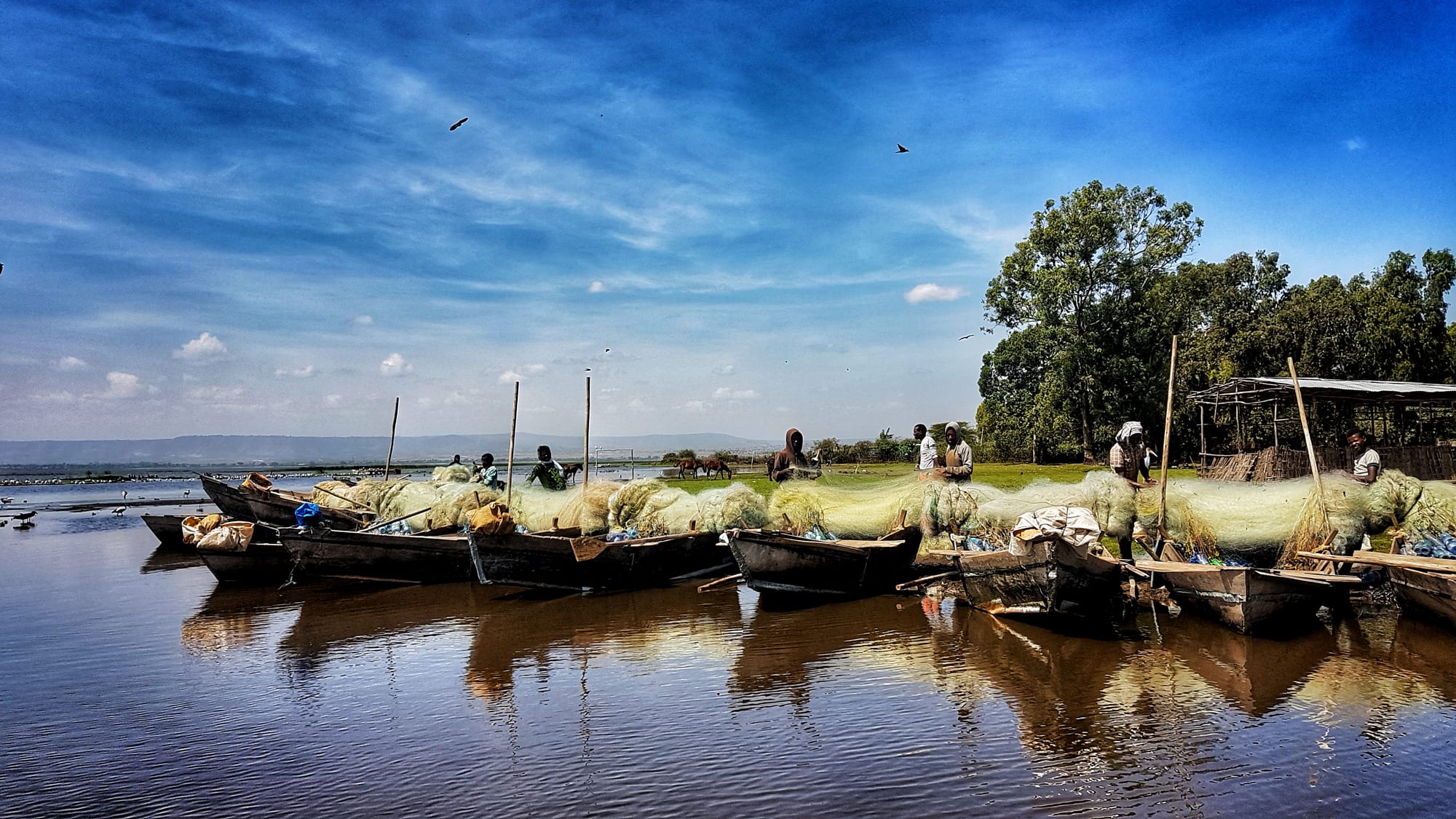
Wooden fishing boats loaded with pale nets drawn up along the shore of Lake Hawassa under a blue sky

The Omo Valley & the South, Ethiopia

Hawassa

Fishing boats and nets on the shore of Lake Hawassa. (Mohanad Ayman / Wikimedia Commons · CC BY-SA 4.0)

A lakeside city in Ethiopia's Rift Valley, about 270 kilometres south of Addis Ababa, laid out on a grid beside Lake Hawassa. Founded as a planned town in the imperial period, it became the administrative capital of the Sidama region in 2020 and is known for its fish market, lakeshore walks, birdlife, university and industrial park.

Neighbourhoods

  • The lakeshore
    • First-time visitors
    • Walks
    • Birdwatching

    The green strip between the city grid and the water, with the fish landing, a promenade of paths and benches under fig trees, and rows of hotels and cafés facing the lake. Waterbirds along the shore are part of the scene.

    Open in Maps
  • The city centre
    • Markets
    • Shopping
    • Close to transport

    The grid of broad streets inland from the lake, holding the main market, banks, offices, bus terminals and most of the shops. It is the busiest part of the city and where most everyday business is done.

    Open in Maps
  • Tabor
    • Views
    • Quiet and residential

    The residential slopes on and around the hill of the same name at the edge of the city, with churches, schools and houses climbing the rise. The ground gives a view back over the grid and the lake.

    Open in Maps
  • The university quarter
    • Students
    • Cafés
    • Budget stays

    The districts around Hawassa University's campuses, with student cafés, cheap lunch places, bookshops and rented rooms. Its character changes with the academic year.

    Open in Maps
  • The industrial park area
    • Local life
    • Working city

    The newer eastern edge of the city, where the industrial park and its workers' housing, transport services and small shops have grown quickly. It is a functional part of town rather than a place visitors seek out.

    Open in Maps

Things to do

The lake and the shore

  • Lake Hawassaattraction

    A freshwater Rift Valley lake without an outlet, fringed with reeds and fig trees, fished from wooden boats, with waterbirds along its reedy shore.

    Open in Maps
  • The fish marketmarket

    The landing at the lake's edge where the night's catch of tilapia and catfish is brought in, gutted, filleted and fried on the spot, watched over by scavenging birds, with a small park beside it.

    Open in Maps
  • The lakeshore promenadetrail

    The paths and open ground running along the water at the city's edge, busiest in the early morning with runners and in the late afternoon with families.

    Open in Maps

In the city

  • Hawassa Universityattraction

    A large public university with seven campuses, grown from the agriculture college beside the lake, strong in agriculture, forestry and health sciences, and a major employer.

    Open in Maps
  • St Gabriel Churchattraction

    An Orthodox church counted among the city's landmarks, busiest on its saint's day and at the great feasts of the church year, when the compound fills with white-shawled worshippers.

    Open in Maps
  • Tabor hillviewpoint

    The rise at the edge of the city, climbed for the view over the grid of streets and the lake, with churches on its slopes.

    Open in Maps
  • The main marketmarket

    The central trading ground for coffee, enset, grain, vegetables, spices, household goods and basketry brought in from the Sidama countryside.

    Open in Maps

Short trips from the city

  • Wondo Genetattraction

    A resort town known for its hot springs, set among forest in hills east of the city, with a college of forestry founded in 1977, an arboretum and a research centre for spices and aromatic plants.

    Open in Maps
  • Shashamaneattraction

    A highway market town in the Oromia Region, known for its Rastafari community, settled on land the emperor Haile Selassie set aside from 1948 for people of the African diaspora.

    Open in Maps
  • Lake Ziwayattraction

    A Rift Valley lake with five islands, one holding an old monastery, known for its birds and hippopotamuses and for a busy fishing industry.

    Open in Maps

Seasonal events

  • Fichee-Chambalaallamid-year, on a date set each year by Sidama elders

    The Sidama New Year, inscribed on UNESCO's list of intangible cultural heritage in 2015, marked by clan gatherings, the preparation of buursaame porridge and processions of song and dance.

  • Meskellate September

    The Orthodox feast of the Finding of the True Cross, marked with a bonfire of branches, singing and processions.

  • TimkatJanuary

    Epiphany, when priests carry the tabot in procession to water for a blessing, drawing crowds to the churches and the lakeside.

Eat and drink

Long-standing places and food districts in Hawassa. Hours, ratings and directions come from your maps app, always current.

Hawassa classics

  • The fish market grillsmarket

    The lakeside landing where tilapia is filleted and fried in batter as asa cutlet or cooked as a peppery stew, eaten at plastic tables looking over the water.

    Open in Maps
  • Lakeside restaurantsrestaurant

    The line of places along the shore serving whole grilled fish, tibs, injera platters and cold beer, with the lake and its birds in front of them.

    Open in Maps

Coffee and markets

  • Sidama coffee housescafe

    Cafés and coffee ceremonies serving the washed arabica grown in the hills around the city, one of Ethiopia's best-known coffee origins.

    Open in Maps
  • The main marketmarket

    Enset, coffee, honey, chillies, butter and fresh produce from the Sidama highlands, with roasted grains and snacks sold along the aisles.

    Open in Maps

Experience Hawassa

History

Hawassa is a modern city on ancient ground. The Sidama have farmed the hills east of the lake for centuries, organised in clans under the gadaa-like system of generational grades and led by clan elders, with enset and coffee as the basis of a dense rural society. Sidama territory was brought into the Ethiopian empire in the 1890s, in the same wave of southern conquests that absorbed Kaffa and Wolaita, and northern landlords and administrators were settled on the land.

The town itself was laid out from the late 1950s as a planned settlement beside the lake, part of imperial efforts to develop the Rift Valley; a municipality was founded in 1962, and the grid of wide streets it was given still distinguishes it from older Ethiopian towns. It became the administrative seat of the surrounding province and then, after the 1995 constitution, the capital of the Southern Nations, Nationalities and Peoples' Region, which gave it government offices, a university and a steady flow of investment.

Sidama campaigning for a region of its own intensified in the 2010s and was settled by a referendum in November 2019; the Sidama regional state was formally established in June 2020, with Hawassa as its capital. The city kept its administrative weight when the rest of the old southern region was divided in 2021 and 2023. An industrial park for textiles and garments, opened in 2016 on the edge of the city, drew tens of thousands of workers and made the city a centre of Ethiopia's export manufacturing, though it lost factories and jobs after Ethiopia was removed from the United States' duty-free AGOA scheme in 2022.

Culture & Customs

Hawassa is a Sidama city with a mixed population drawn from across the south and from the northern highlands. Sidaamu Afoo, a Cushitic language, is heard everywhere alongside Amharic, and Sidama identity is expressed most publicly at Fichee-Chambalaalla, the New Year fixed by clan astronomers, which is inscribed on UNESCO's intangible heritage list. Families prepare buursaame, a porridge of enset flour, milk and butter, share it with neighbours, and gather for songs, dances and the reconciliation of disputes.

Coffee is more than a crop here. Sidama is one of the great arabica origins, and the ceremony — green beans roasted over charcoal, pounded, brewed in a clay jebena and served in three rounds with incense and popcorn — is performed in homes, offices and cafés. Guests are expected to stay for all three rounds.

Protestant churches, very strong across southern Ethiopia, fill on Sundays with long services and choirs; Orthodox parishes keep the fasts and mark Meskel and Timkat; and a Muslim minority has mosques in the city. Life is lived outdoors more than in most Ethiopian cities: running and football on the lakeshore in the early morning, families walking under the fig trees at dusk, and a nightlife of azmari-style music, Ethio-jazz bands and bars that is unusually busy for a city of its size, supported by weekenders from Addis Ababa.

Daily Life

The 2007 census counted 157,879 people in Hawassa, one of the larger cities in southern Ethiopia, and it has grown quickly since through migration from the Sidama countryside and the arrival of industrial work. Employment is in government — regional, zonal and municipal offices — in Hawassa University and its hospital, in trade along the highway, in fishing and fish processing on the lake, in hotels and conference business, and in the industrial park, whose garment factories employ large numbers of young people, many of them women from rural districts, though their numbers fell after 2022.

Around the city the countryside is among the most densely settled in Ethiopia: smallholdings of enset, coffee, khat, maize and vegetables, with households depending on coffee prices that move with the world market. The lake supports a fishing cooperative economy, and its health — falling water quality, rising levels and pressure from the growing city — is a recurring public concern.

The day starts early at the fish landing and on the shore, where people run and walk before work. The middle of the day is for trade and offices; the late afternoon for coffee, football and the promenade. Rising rents, factory wages that have not kept pace with inflation, water and power interruptions, and the management of a young and fast-growing population are the issues that occupy the city.

Food

Fish is what Hawassa is known for. Tilapia from the lake is filleted, battered and deep-fried as asa cutlet, grilled whole, or cooked into asa wat with berbere and onion; a raw fish dish, asa kitfo, is eaten by those who want it, and the fried fish sold at the landing, wrapped in paper with a wedge of lemon and a scatter of chilli, is the city's most characteristic meal. Because fish is permitted during Orthodox fasts, it is on tables all year.

Inland, the food is Sidama. Enset, the 'false banana', is fermented for weeks and baked as kocho, a dense flatbread, or made into the finer bulla; buursaame, the porridge of enset flour with milk and butter, belongs to Fichee and to occasions of welcome. Kitfo, minced beef warmed with spiced butter and mitmita, is eaten with kocho and ayib cheese. The national repertoire is everywhere as well: injera with shiro, lentils and greens, tibs, and the vegetarian beyaynetu platter on fasting days.

Coffee is the city's pride, grown in the hills above the lake and drunk several times a day, sometimes with a pinch of salt or butter in the countryside. Tella, the home-brewed barley beer flavoured with gesho, and tej, the honey wine, are the traditional drinks, while thick layered fruit juices of avocado, mango and papaya are the everyday alternative in the cafés along the shore.

Planning tools

Budget

Hawassa is inexpensive and good value: fried fish at the lake, injera platters in town and modest hotels all cost little, and many of the best things to do — the shore, the birdlife, the markets — cost nothing. Lakeside hotels and boat trips are the main extras, and prices rise when conferences or holiday weekends fill the city.

Daily Budget Midrange
USD 85–170 (a lakeside hotel, restaurant meals, a hired car with driver for trips out)
Daily Budget Shoestring
USD 20–35 (basic hotel, local eateries, minibuses and bajaj)

Book a lakeside room ahead around Ethiopian holidays and long weekends, when the city fills with visitors from Addis Ababa.

Best Time to Visit

December to February is the driest and clearest period, good for the lake and for trips into the Sidama hills. The heavier rains fall from about March to May, with lighter rains around October and November. Coffee is harvested in the highlands from about October to January, and Fichee, the Sidama New Year, falls on a date set each year by Sidama elders from their reading of the stars.

Suggested Number of Days

One or two days are enough for the lake, the markets and the shore. Three or four suit a slower stay with trips into the surrounding hills and along the Rift Valley lakes. Many people stop here for a night while travelling further south.

First Visit
1–2 days
With Surroundings
3–4 days

Transportation

Bajaj three-wheelers are the standard way to move around the city and are everywhere on the grid streets; shared minibuses run the longer routes and out to nearby towns. Long-distance buses and minibuses leave from the terminals for Addis Ababa, Shashamane, Arba Minch, Dilla and the south. Cars with drivers are hired through hotels for trips into the hills.

Agree the bajaj fare before getting in, and expect the main highway through the city to be busy with long-distance lorry traffic.

Airport & Station Connections

Hawassa lies on the main highway south from Addis Ababa, about 270 kilometres away — roughly four to five hours by car and longer by bus, with frequent departures. The city has an airport, but almost everyone arrives by road. The road south continues to Dilla, Arba Minch and, eventually, the Omo.

Walkability

One of the easier Ethiopian cities to walk. The grid is flat and regular, the lakeshore paths run for a long stretch, and the centre's market, hotels and restaurants sit within a few blocks of one another. Distances between the outer districts and the lake are longer than they look on a map, and most people use a bajaj for those. Pavements are patchy and street lighting is uneven after dark.

Safety

The south is generally calmer than the north of Ethiopia, but not uniformly so: unrest can close roads at short notice, and armed groups have been active along parts of the boundary with Oromia. In the city itself the usual risks are petty theft and pickpocketing in crowded markets, road accidents, and the lake itself, where swimming is unwise and boating is best done with local boatmen.

Check current advisories closely and route around conflict-affected regions. Avoid demonstrations and political gatherings, keep away from the water's edge after dark, and do not drive between towns at night. Check current official travel advice before travelling.

Climate

Mild all year at about 1,700 metres, with warm days and cool nights and little seasonal variation in temperature. The south has two rainy seasons: heavier rains from about March to May and lighter ones around October and November, when afternoons often cloud over.

Summer
mild and often cloudy, generally 20–27°C by day, with rain in the wetter months
Winter
dry and clear, about 25–28°C by day with cool nights

Local Customs

This is the Sidama capital, and Sidaamu Afoo is the language of the region, with Amharic used in administration and trade and English common at the university and in hotels. Protestant churches are strong here alongside Orthodox and Muslim communities. Greetings and enquiries after family come before business, and the coffee ceremony, in the heartland of Sidama coffee, is the social frame for any visit.

Ask before photographing people, particularly at the fish market and in the markets, dress modestly in churches and in rural areas, and use the right hand when eating from a shared platter.

Common Payment Methods

The currency is the Ethiopian birr. Cash is used for the markets, bajaj fares, small restaurants and most hotels, while larger hotels may take cards. Banks and ATMs are common in the centre but can run out of notes or be offline, so it is sensible to keep a reserve of cash and small denominations.