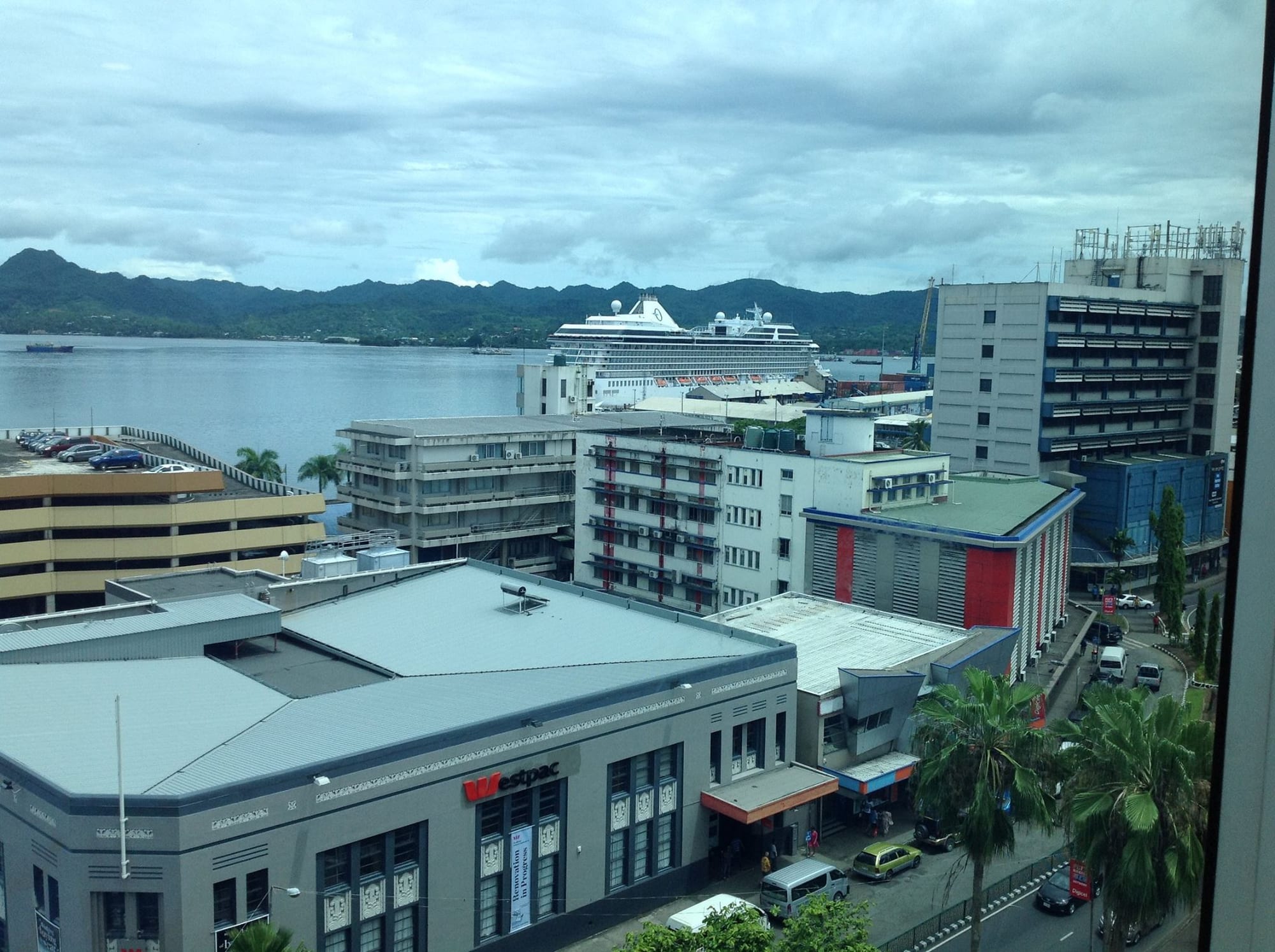
Rooftops and low office blocks of central Suva above a grey harbour with ships at the wharf and green hills beyond

Suva, Levuka & the Eastern Islands, Fiji

Suva

Central Suva looking across the harbour towards the wharf and the hills behind Lami. (Stemoc / Wikimedia Commons · CC0)

Fiji's capital and largest city, on a peninsula on the wet south-east coast of Viti Levu. Chosen over Levuka in the 1870s because it had room to grow, it became the country's port, government seat and university town. Colonial stone and timber buildings, a large municipal market and rainforested hills behind it define a working city rather than a resort.

Neighbourhoods

  • City centre and Victoria Parade
    • First-time visitors
    • Best for food
    • Close to public transport

    The compact grid between the harbour and Albert Park, where the banks, airline offices, cinemas, curry houses and most of the city's hotels stand. Victoria Parade is the main street; the narrow shops of Cumming Street and the municipal market sit at its northern end, and the bus stand is beside the market.

    Open in Maps
  • The Domain and Thurston Gardens
    • Historic district
    • Museums
    • Quiet and residential

    The government quarter at the southern end of the centre, with the colonial Government Buildings, the seafront Grand Pacific Hotel, the botanical garden of Thurston Gardens and the Fiji Museum inside it. Wide lawns, old trees and official residences make it the calmest part of central Suva.

    Open in Maps
  • Toorak and Flagstaff
    • Local life
    • Best for food

    Hillside streets immediately north-east of the centre, one of Suva's older mixed residential areas, with small shops, places of worship, cheap eating houses and views down over the city. Busy, steep and within walking distance of the market.

    Open in Maps
  • Nasese and the seawall
    • Quiet and residential
    • Walks by the water

    A leafy embassy and residential district on the eastern side of the peninsula. Queen Elizabeth Drive runs along the seawall here, and in the evenings the road fills with walkers, joggers and families watching the tide over the mudflats towards Suva Point.

    Open in Maps
  • Laucala Bay and Suva Point
    • Students and nightlife
    • Sport

    The university end of the peninsula, built around the main campus of the University of the South Pacific, which occupies a former Royal New Zealand Air Force flying-boat base. Student flats, cheap canteens and sports grounds give it a younger feel than the centre.

    Open in Maps
  • Samabula and Nabua
    • Local life
    • Close to public transport

    Inland suburbs strung along Ratu Mara Road towards Nasinu, holding much of the city's housing, temples and mosques, shopping centres and light industry. Buses run constantly along the corridor, and this is where a large share of Suva's working population actually lives.

    Open in Maps
  • Lami
    • Quiet and residential
    • Views

    A separate town a few kilometres north-west along the coast, incorporated in 1977, looking out over the Bay of Islands. It has hotels and restaurants, mangrove shoreline and, on its outskirts, the wartime Bilo Battery built to guard the reef passage into Suva; commuters fill the road into the capital each morning.

    Open in Maps

Things to do

Colonial Suva and landmarks

  • Government Buildingslandmark

    The Art Deco seat of Fiji's government, its foundation stone laid in 1937 and formally opened in May 1939, home to the parliament from independence in 1970 until the 1987 coups and again since 2014.

    Open in Maps
  • Grand Pacific Hotellandmark

    A white colonial hotel on the Victoria Parade seafront, built in 1914 for the Union Steamship Company of New Zealand to serve its transpacific passengers, left to deteriorate for decades and reopened after restoration in 2014.

    Open in Maps
  • Sacred Heart Cathedrallandmark

    The Roman Catholic cathedral on Pratt Street, built in 1902 of sandstone brought from quarries near Sydney, with a crypt below and stained glass throughout.

    Open in Maps
  • Albert Parkpark

    The green rectangle facing the Government Buildings, named after Queen Victoria's consort and used for rugby and hockey, where the Australian aviator Charles Kingsford Smith landed in 1928 during the first trans-Pacific flight and where Fiji's new flag was first raised on 9 October 1970.

    Open in Maps

Museums and gardens

  • Fiji Museummuseum

    The national museum, founded in 1904, whose centrepiece is the thirteen-metre double-hulled canoe Ratu Finau and whose collection includes the rudder of HMS Bounty and objects recording the colonial period.

    Open in Maps
  • Thurston Gardenspark

    Suva's botanical garden, once the Suva Botanical Gardens and renamed after Sir John Bates Thurston, governor from 1888 to 1897, with a clock tower and bandstand of 1918 and the Fiji Museum at its centre.

    Open in Maps
  • University of the South Pacificattraction

    The main Laucala Bay campus of the university owned by the governments of twelve Pacific island countries, established in 1968 on a former Royal New Zealand Air Force seaplane base.

    Open in Maps

Markets and streets

  • Suva Municipal Marketmarket

    The city's main produce market, where root crops, fruit, fish and bundles of kava are sold from early morning.

    Open in Maps
  • Suva Flea Marketmarket

    Rows of stalls selling handicrafts, clothes, sulu wraps and local ware, next to the shops of Terry Walk.

    Open in Maps
  • Cumming Streetneighborhood

    A narrow street of small traders behind the market, historically the heart of Indo-Fijian and Chinese commerce in the capital.

    Open in Maps

Walks, parks and viewpoints

  • Queen Elizabeth Drive seawalltrail

    The coastal road along the peninsula's eastern shore, the city's favourite walking and running route, with views over the reef flats to the mountains.

    Open in Maps
  • Colo-i-Suva Forest Parkpark

    Rainforest reserve in the hills north of the city, part of the Queen's Commonwealth Canopy, with walking trails, birdwatching and places to swim.

    Open in Maps

Short trips from the city

  • Joske's Thumbviewpoint

    A precipitous volcanic plug about fifteen kilometres west of Suva, a landmark on the skyline and a demanding climb that defeated Edmund Hillary on his first attempts while he was stationed in the city.

    Open in Maps
  • Navuaattraction

    A river town west along the Queens Road, the starting point for boat and raft trips up the Navua River into the forested interior.

    Open in Maps
  • Beqaattraction

    An island about ten kilometres south of Viti Levu whose lagoon is known for shark diving, and whose Sawau people keep the firewalking tradition of vilavilairevo.

    Open in Maps
  • Pacific Harbourattraction

    A small resort and marina town west along the coast, twelve kilometres beyond Navua, the base for shark diving and river trips and the way out to Beqa.

    Open in Maps
  • Nausoriattraction

    A town of some 58,000 people on the Rewa River north-east of the capital, linked to it by the 425-metre Rewa Bridge of 2006 and home to Fiji's second international airport.

    Open in Maps

Seasonal events

  • Hibiscus FestivalMid-year

    Suva's own annual carnival, held at Albert Park, with rides, food stalls, marching bands and the Miss Hibiscus pageant, whose winner goes on to the national contest.

  • Coca-Cola GamesAutumn

    The national secondary schools athletics championships, held at the HFC Bank Stadium and described as the world's largest secondary school athletics meet.

  • DiwaliOctober or November

    The Hindu festival of lights, a public holiday in Fiji, when homes and shops in the city are lit and sweets are shared between neighbours.

  • Fiji Day10 October

    A double anniversary — the cession of Fiji to Britain in 1874 and independence in 1970 — closing the week of religious ceremonies and cultural performances known as Fiji Week.

Eat and drink

Long-standing places and food districts in Suva. Hours, ratings and directions come from your maps app, always current.

Markets and street food

  • Suva Municipal Marketmarket

    Produce from the delta and the islands — dalo, cassava, rourou, chillies, tropical fruit, freshwater shellfish and bundles of kava — with fish sold nearby.

    Open in Maps
  • Flea market food stallsmarket

    Cheap cooked lunches beside the bus stand: curry and rice, roti parcels, chop suey, fried fish and cassava.

    Open in Maps

Food streets and districts

  • Cumming Street and the market end of townneighborhood

    Small Indo-Fijian eating houses and sweet shops in the lanes behind the market, known for goat and fish curries, dhal and roti.

    Open in Maps
  • Victoria Paradeneighborhood

    The main street's cafés, bakeries, Chinese restaurants and bars, where much of the city's office lunch trade and evening drinking happens.

    Open in Maps
  • Chinese restaurants of central Suvaneighborhood

    A long-established Chinese community supports many restaurants in the centre, serving chop suey and seafood alongside Fijian staples.

    Open in Maps

Experience Suva

History

Suva was still a small village in 1868, when the Bauan chief Seru Epenisa Cakobau granted a very large block of land to the Australian-based Polynesia Company in exchange for its promise to pay off debts he owed to the United States. The company meant to grow cotton, and failed: the land and climate proved unsuitable, and the little town its settlers laid out nearly emptied again.

What saved it was Levuka's lack of space. After the Deed of Cession made Fiji a British colony in 1874, the administration looked for a capital with room to expand and a deep, sheltered harbour. The move from Levuka began in 1877 and was completed in 1882, the year the peninsula's original iTaukei inhabitants were moved across the bay to Suvavou, "New Suva", to make room for the capital. Suva grew as the colony's port and government seat, with stone and timber offices along Victoria Parade and Indo-Fijian and Chinese traders opening shops around Cumming Street. It became a municipality in 1910 and in 1952 annexed the Muanikau and Samabula wards.

Suva has since been the stage for national politics. Fiji's new flag was raised for the first time at Albert Park on 9 October 1970. Soldiers seized power twice in 1987, in May and again in September; in 2000 an armed group stormed parliament and held the prime minister and members of the government hostage from May until July, while shops in the centre were looted, and soldiers mutinied at the Queen Elizabeth Barracks that November. A further coup followed in December 2006. Through it all the capital kept growing, spreading inland across Nasinu towards Nausori.

Culture & Customs

Suva is the most mixed place in Fiji and the meeting point of the wider Pacific. Fijian, Fiji Hindi and English are all heard in the same street; iTaukei, Indo-Fijian, Chinese, Part-European, Rotuman and other Pacific communities live in the city, and the University of the South Pacific, owned by twelve Pacific countries, brings students and staff from Kiribati to Tonga. Regional bodies such as the Pacific Islands Forum Secretariat and the Pacific Community give the capital a diplomatic character no other Fijian town has.

Churches, temples and mosques are all prominent, and Sunday is genuinely quiet: choirs in Methodist churches are part of the sound of the city, while Diwali, Holi and the Prophet's Birthday are marked publicly. Kava, drunk in the evening from a communal bowl, is as much a Suva habit as a village one, and the market is where the country's kava trade meets.

Rugby union is followed with intensity, and the national stadium at Laucala Bay fills for internationals and for the schools competitions that supply the game, most of them at the HFC Bank Stadium. The city also carries most of Fiji's arts life: the national museum, the university, art galleries, theatre groups, string bands and a hip hop and reggae scene. Suva people are conscious of being more formal and more political than the resort west, and proud of it.

Daily Life

Some 94,000 people live inside the city boundary, about 187,000 in the built-up area that runs on into Nasinu, and around 268,000 in the wider metropolitan area taking in Lami and Nausori — comfortably the largest in Fiji. The city works on government, the port, trade, banking, education and regional organisations: the ministries are in the Domain, the container and cargo wharves and light industry are at Walu Bay, and thousands of students commute to Laucala Bay.

The day starts early. Produce lorries and island boats reach the market before dawn, buses fill the corridor roads from six, and offices and schools begin early and finish in the middle of the afternoon, leaving the seawall busy with walkers by five. Rain punctuates everything, and umbrellas and covered walkways are part of the city's design.

Housing is the pressure point. Formal suburbs give way on the edges to informal settlements built by families who have moved in from the islands and the cane belt, often on land with poor drainage; flooding in the Rewa and Nasinu areas is a recurring problem, and so are traffic congestion on the single corridor into town and the cost of living. Remittances from relatives in Australia, New Zealand and further afield support many households.

Food

Suva eats across all its communities, and eats cheaply. Indo-Fijian cooking is the everyday default in the centre: goat, chicken, fish and vegetable curries with roti, dhal and rice, roti parcels wrapped for lunch, and snacks such as bhajia and samosa sold from stalls, with barfi and gulab jamun in the sweet shops at festival time. Chinese restaurants are long established in the centre, and chop suey has become so common that it appears at Fijian family meals.

iTaukei food is at the market and at feasts. Dalo (taro) and cassava are the staples, with rourou, taro leaves cooked in coconut cream, and palusami, parcels of leaves baked with coconut cream. Kokoda, raw fish marinated in lime juice and coconut cream, is the dish visitors meet first, the fish "cooked" in lime or lemon juice with coconut milk, tomato and chilli added. Lovo, food wrapped and cooked for hours on hot stones under earth and sacks, marks weddings, church events and Christmas. From the Rewa delta come freshwater shellfish and river prawns; from the reefs, fish, octopus and crab.

Local drinks are kava, drunk in the evening from a tanoa bowl, and Fiji Bitter, brewed in the city. Bakeries sell long loaves and coconut buns, roadside stalls sell cassava chips and fried dough eaten with tea, and the market supplies pineapple, papaya, mango and breadfruit in season.

Planning tools

Budget

Suva is a government and university city rather than a resort, so it is one of the cheaper places to spend time in Fiji. Guesthouses and business hotels cost less than the western resorts, market and curry-house meals are very cheap, and city buses cost little. The larger costs are the transfer from Nadi, taxis after dark and any boat or dive trip taken from the coast west of the city.

Daily Budget Midrange
USD 110–220 (city hotel, restaurant dinners, taxis, museum entry and a day trip out of town)
Daily Budget Shoestring
USD 35–65 (guesthouse or hostel bed, city buses, market and curry-house meals)

Draw cash in the city before heading to the islands or villages, where cash machines are scarce, and keep small notes for buses and market stalls.

Best Time to Visit

May to October is drier, cooler and less humid, and coincides with calmer seas for trips to the islands. Suva can be showery in any month, so rain alone is not a reason to choose a season. The Hibiscus Festival fills the city in the second half of the year, while the November to April wet season brings heavy downpours, higher humidity and the risk of cyclones.

Suggested Number of Days

The central sights and museums sit within walking distance of each other, so a day or two covers the city. Allow three or four to add the forest above town, a river trip or a boat day off the coast. Heavy rain slows everything down and is worth allowing for.

First Visit
1–2 days
With Surroundings
3–4 days

Transportation

Buses are the backbone of the city: open-sided vehicles and newer coaches run constantly from the stand beside the market out along the Samabula and Nasinu corridors, and minibuses cover the same routes faster. Taxis are plentiful, metered in the city and cheap by international standards. Long-distance express coaches to Nadi and the west also leave from the main stand.

Buses are much the cheapest way along the corridor roads, and taxis the easiest way between districts after dark; agree a price with a taxi driver if the meter is not used.

Airport & Station Connections

Most visitors arrive from Nadi International Airport on the other side of Viti Levu, about four hours away by road on the Queens Road, or a short hop by domestic flight. Nausori International Airport, the country's second international airport, is about twenty-three kilometres north-east of the city and handles mainly domestic flights. Passenger and cargo ships to the outer islands leave from the wharves in the harbour, and cruise ships call at Kings Wharf.

Walkability

Central Suva is easily walked: the market, Victoria Parade, Albert Park, the museum and the seafront are all within about twenty minutes of one another on flat ground. Pavements are uneven in places, the hills behind the centre are steep, and the frequent heavy rain means an umbrella matters more than good shoes. The seawall road is the most pleasant long walk.

Safety

Suva is a working capital rather than a resort, and petty street crime is the main concern for visitors. Bag snatching and opportunistic robbery happen in the centre, around the market and on quieter streets after dark, and there have been occasional political protests and periods of unrest in the capital. Violent crime against visitors is uncommon, and the main practical risks are petty theft, poorly lit streets and flash flooding in heavy rain.

Take a taxi rather than walk between districts after dark, leave valuables in the hotel, avoid political gatherings, and stay out of flooded streets and swollen creeks. Check current official travel advice before travelling.

Climate

A wet tropical climate, warm all year and one of the rainiest places in Fiji: the city faces the trade winds and receives roughly three metres of rain a year, with showers possible in any month and cloud common over the hills behind town. Being in the southern hemisphere, summer falls in December to February.

Summer
hot and very humid — November to April brings daytime highs near 30°C, heavy downpours, thunderstorms and the cyclone season
Winter
warm and a little drier — May to October brings highs of about 26–28°C and nights near 20°C, with south-easterly winds and showers that clear quickly; July is the driest month

Local Customs

Greetings matter: 'bula' is used with everyone, and conversation before business is normal. Dress is modest away from resorts, with shoulders covered and shorts kept long; many men wear a sulu, the wrapped skirt, including with a shirt and tie to the office. Sunday is quiet, with heavy church attendance and many shops shut. Visiting a village means bringing kava for a sevusevu ceremony, taking off hats and sunglasses and removing shoes before entering a house.

Tipping is not expected, though it is appreciated; ask before photographing people, church services or ceremonies; and accept kava with both hands and a clap if it is offered.

Common Payment Methods

The currency is the Fijian dollar. Cards are accepted in hotels, supermarkets, larger restaurants and shops in the centre, and cash machines are easy to find in the city, though some charge fees for foreign cards. Markets, buses, taxis and small eating houses run on cash, and mobile money is widely used by residents. Cash is essential before leaving for the outer islands.