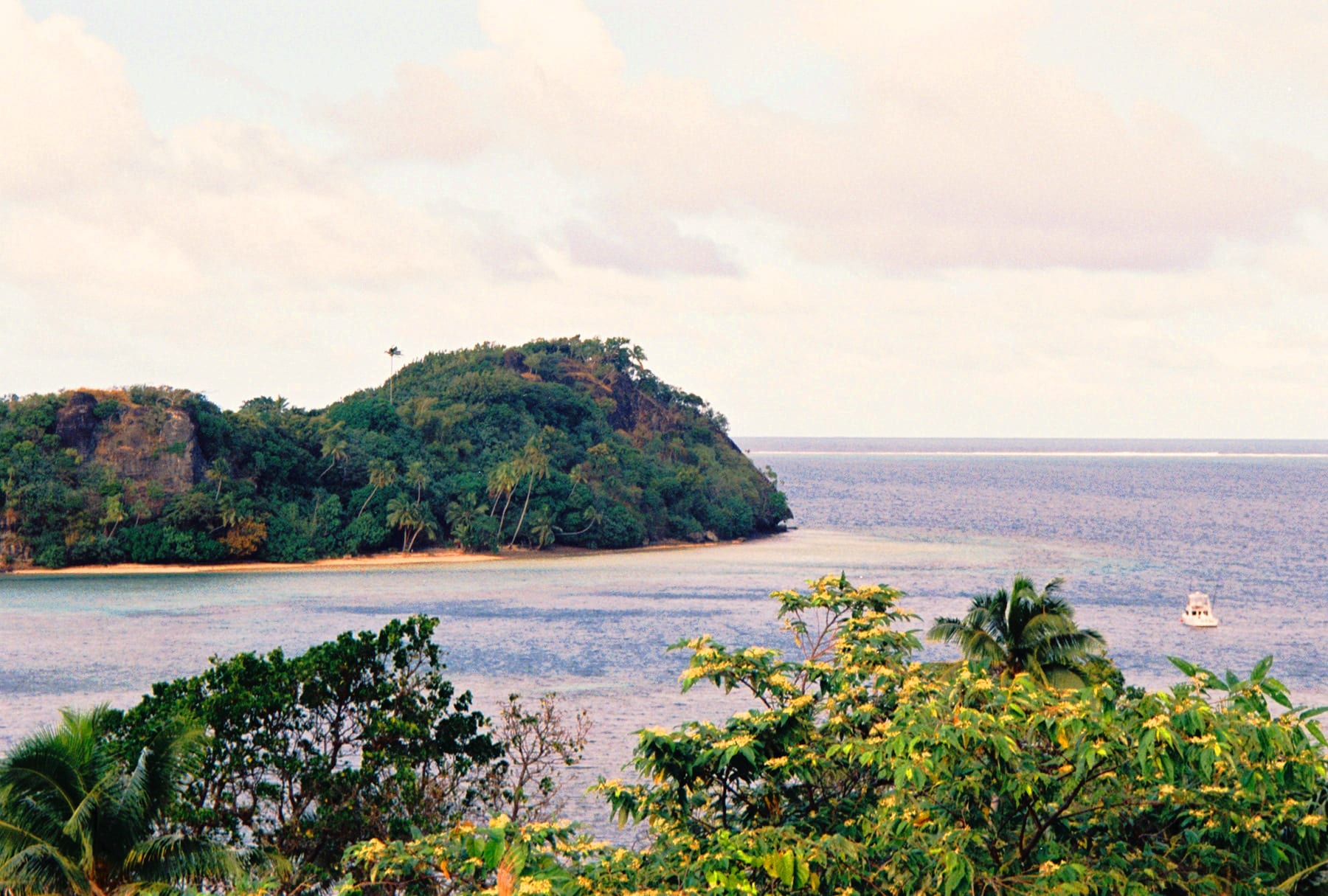
A forested headland and calm bay seen through flowering shrubs, with a line of surf on a distant reef on the horizon

Fiji

Suva, Levuka & the Eastern Islands

The south coast of Kadavu seen from Matava, with the Great Astrolabe Reef breaking on the horizon. (Duncan Wright / Wikimedia Commons · CC BY-SA 3.0)

Fiji's Central and Eastern Divisions and the dependency of Rotuma — the wet south-east of Viti Levu with the capital Suva, the Rewa delta and Pacific Harbour, and the scattered islands of Lomaiviti, Kadavu and Lau, plus Polynesian Rotuma far to the north. It is the country's political centre and its least-touristed outer reaches.

Explore Suva, Levuka & the Eastern Islands

History

The south-east of Viti Levu was the centre of Fijian power in the 19th century. The tiny island of Bau, off the Tailevu coast, became the seat of the most powerful confederacy, and its chief Seru Epenisa Cakobau claimed the title of Tui Viti, king of Fiji. To the east, Lau fell under strong Tongan influence, and from the late 1840s the Tongan noble Enele Maʻafu built a power base there, later ruling from Lomaloma on Vanua Balavu.

European traders settled at Levuka on Ovalau from the early 19th century, and the beach town became the capital of Cakobau's short-lived kingdom in 1871. The Deed of Cession to Britain was signed at Levuka in 1874, and the capital moved to Suva, with more room to grow, from 1877, officially in 1882. Rotuma, a Polynesian island far to the north, was ceded separately in 1881 and has been governed with Fiji ever since.

Suva has been the stage for the country's political crises since independence in 1970. In 1987 soldiers led by Sitiveni Rabuka twice seized power, removing an elected government backed largely by Indo-Fijian voters. In 2000 a group led by George Speight held the prime minister, Mahendra Chaudhry, and members of his government hostage in parliament for weeks while shops in central Suva were looted, and a mutiny followed at the city's barracks later that year. Frank Bainimarama's 2006 coup was also launched from Suva, and Rabuka returned to office in 2022 as an elected prime minister.

Culture & Customs

This region holds the chiefly heart of iTaukei society. Bau's dialect is the basis of standard Fijian, and chiefly titles from Bau, Rewa and Lau carry weight across the country; Ratu Sir Kamisese Mara, Fiji's first prime minister, was the paramount chief of Lau. Lauans are known for wood carving, above all on the island of Kabara, and for painted masi, the bark-cloth of Fiji.

On Beqa the Sawau people keep a tradition of firewalking, crossing hot stones barefoot, and Diwali and the Prophet's Birthday are public holidays. Suva is also the most mixed place in the country, with Chinese, Part-European, Rotuman and other Pacific Islander communities, and it is the Pacific's main university and diplomatic centre.

Rotuma is culturally distinct. Rotumans are Polynesian, speak their own Rotuman language and live under district chiefs who sit on the Council of Rotuma, and most now live on Viti Levu rather than on the island. Their fara, weeks of house-to-house singing and dancing over the Christmas season, is the high point of the year.

Daily Life

The Central Division has about 380,000 people and the Eastern Division fewer than 40,000. Suva, with about 95,000 people inside city limits, merges with Lami, Nasinu and Nausori into Fiji's largest urban area. Rain, hills, colonial buildings and glass office blocks give it a different feel from the west: this is a city of civil servants, students, traders, diplomats and regional organisations such as the Pacific Islands Forum Secretariat and the University of the South Pacific's main campus.

The city runs on government, the port, trade and services, and the day starts early at the municipal market, where produce, fish and bundles of kava root come in from the Rewa delta and the islands. Around it, villages along the Rewa and Navua rivers farm dalo, cassava and vegetables, and Pacific Harbour lives from tourism and adventure sports.

The islands move at a different pace. Levuka, with about 1,000 people, depends on its tuna cannery, the Pacific Fishing Company. Kadavu, Lau and Rotuma live from fishing, gardens, copra and kava, with money sent home from Suva and overseas, and the ships from Suva bring fuel, food and news. Cyclone recovery, falling island populations and the cost of transport are the constant issues.

Food

Suva eats across all its communities: Indo-Fijian curry houses and roti parcels, Chinese restaurants in the centre, and iTaukei food at the market stalls. The Rewa delta supplies dalo, cassava, rourou (taro leaves, often cooked in coconut cream) and freshwater clams from the river. Fish comes in from the islands, and kokoda, raw fish in lime and coconut cream, is served everywhere.

On the islands the lovo is still the centrepiece of feasts, and palusami, taro leaves wrapped around coconut cream and baked, is its standard companion. Yaqona is Kadavu's main commercial crop, and on Lau, as across the islands, coconut, fish and root crops are at the heart of family meals.

Rotuma's cooking draws on the same island staples of root crops, coconut and fish. Fiji Bitter beer is brewed in Suva, and Rewa Dairy collects milk from dairy farms in Tailevu and Naitasiri.

Attractions & Natural Wonders

Suva's sights sit close together: the Fiji Museum in Thurston Gardens, whose collection includes a 13-metre double-hulled canoe and the rudder of HMS Bounty; the colonial Government Buildings and the Grand Pacific Hotel on the seafront; and the municipal market. Behind the city, Colo-i-Suva Forest Park has walking trails, native birds and natural swimming holes, while Bau island and the Rewa delta lie to the north-east.

West along the coast, Pacific Harbour is the base for dives in the Beqa Lagoon, where shark dives bring close encounters with the eight shark species found in the lagoon. Beqa island itself is the home of firewalking, and the Navua river offers rafting and boat trips into the forested interior.

Off the east coast, Levuka on Ovalau is the Historic Port Town of Levuka, a UNESCO World Heritage Site: a single street of timber shopfronts along the sea, the Royal Hotel, churches, and the site at Nasova where the cession was signed.

Kadavu, south of Viti Levu, is mountainous with few roads, with eco-lodges along the Great Astrolabe Reef, one of the largest barrier reefs in Fiji, manta dives and birds found nowhere else, such as the crimson shining-parrot. Further east, the Lau group scatters small islands, among them Lakeba and Vanua Balavu with its island-studded bay. Rotuma, several hundred kilometres north, has white beaches and a quiet village life seen by few visitors.

Cities in Suva, Levuka & the Eastern Islands

Planning basics

Budget

Suva is a working city rather than a resort, so it has business hotels, cheap guesthouses and inexpensive market and curry-house food, and costs less day to day than the west's resort areas. Pacific Harbour has a few mid-range resorts, and shark dives are a significant extra. Kadavu and Ovalau rely on small eco-lodges and guesthouses, where meal plans are usual. Lau and Rotuma have very little tourist accommodation; stays are arranged through families or local contacts, and flights or ships are the main cost.

Daily Budget Midrange
USD 110–220 (Suva hotel or Kadavu eco-lodge with meals, domestic flight, a dive or shark trip)
Daily Budget Shoestring
USD 35–65 (Suva guesthouse or Levuka homestay, buses, market and curry-house meals)

Stock up on cash in Suva before heading to Ovalau, Kadavu or the outer islands, where there are few or no cash machines.

Safety

Suva has more street crime than the rest of the country: bag snatching and robbery happen in the centre and on quieter streets at night, and taxis are the safer way home after dark. Political gatherings have occasionally turned into unrest in the capital, most seriously in 2000. On the islands the concerns are distance from medical care, small boats in open water and reef currents; flash floods affect the Rewa and Navua areas in heavy rain.

Take a taxi after dark in Suva, choose licensed operators for shark dives and boat trips, and carry any medicines needed for a stay on a remote island. Check current official travel advice before travelling.

Climate

The south-east faces the trade winds, so this is the wettest part of Fiji. Suva gets roughly twice as much rain as Nadi, with cloud and showers in any month, and the forested hills behind it are wetter still. The outer islands are drier and breezier, though fully exposed to the cyclones that track through the east in the wet season; Koro and the Lau islands were badly hit by Cyclone Winston in 2016.

Summer
November–April: hot and very humid, around 30–31°C, with frequent heavy rain and cyclone risk
Winter
May–October: warm, around 23–28°C, still showery in Suva but drier on the islands

Transportation

Suva is about four hours by road from Nadi along the Queens Road, or a short flight into Nausori Airport, which mainly handles domestic flights. Buses and minibuses cover the Suva–Nausori corridor and Pacific Harbour. Ovalau is reached by boat from Viti Levu. Ships from Suva to Kadavu, Lau and Rotuma run on irregular schedules and take from several hours to several days.

Treat outer-island ferry schedules as provisional and build in spare days; for Lau and Rotuma the flight is the practical option for most visitors.

Best Time to Visit

May to October brings the least rain in Suva and the calmest seas for Kadavu, Ovalau and the shark dives off Pacific Harbour. Suva holds its Hibiscus Festival each year, and Rotuma's fara season of dancing falls in the summer holiday period around Christmas.