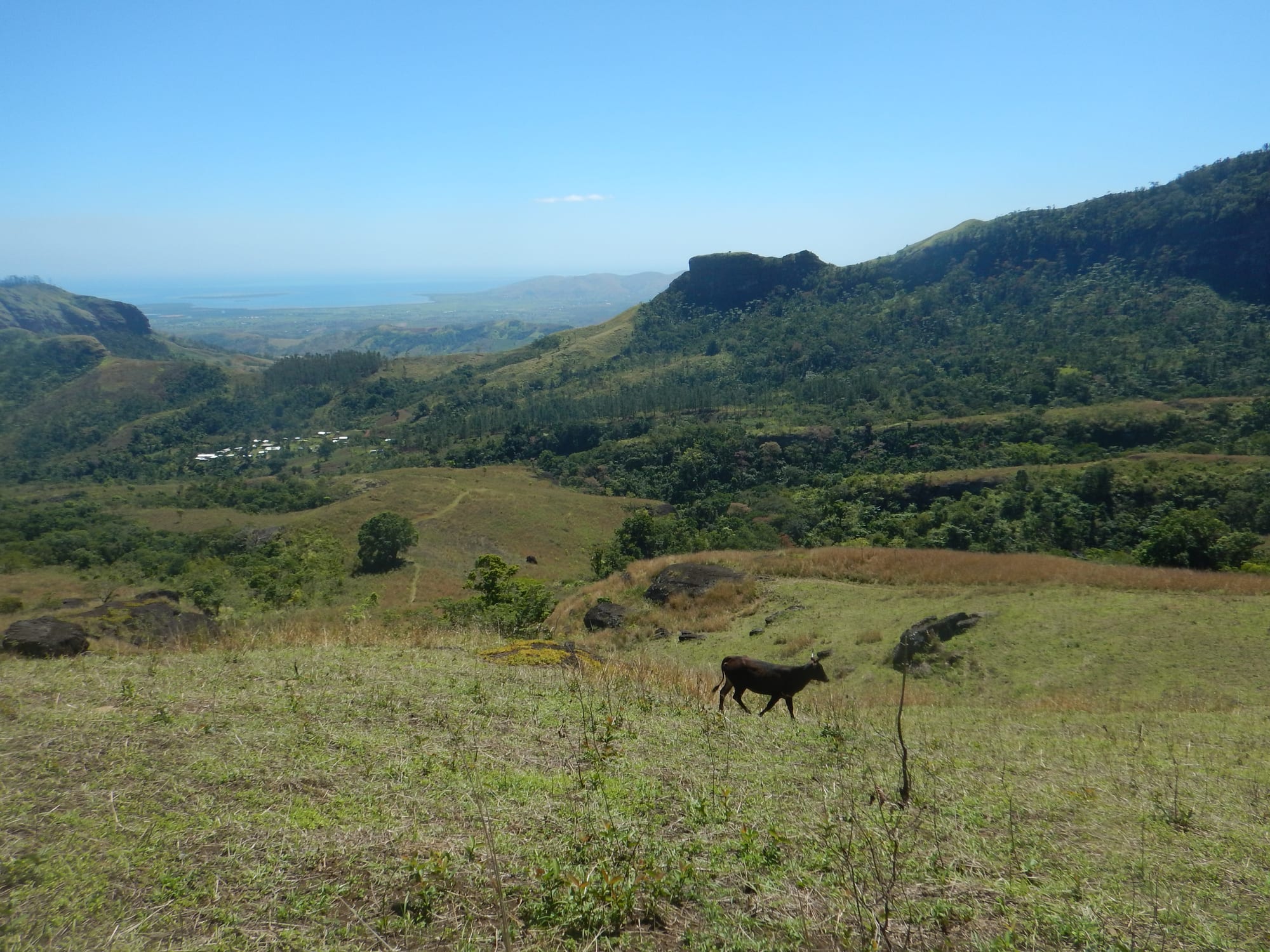
Grassy slopes and forested ridges above a small village, with the coast and sea in the distance

Fiji

Nadi, the Coral Coast & the Mamanucas

Abaca village seen from Mount Batilamu in Koroyanitu National Heritage Park, in the hills of western Viti Levu. (Rickard Törnblad / Wikimedia Commons · CC BY-SA 4.0)

Fiji's Western Division — the dry, leeward half of Viti Levu with Nadi, Lautoka and the sugar-cane belt, the Coral Coast along the south shore, and the Mamanuca and Yasawa island chains offshore. It is where most visitors land and stay, and the heartland of the country's sugar industry and Indo-Fijian farming communities.

Explore Nadi, the Coral Coast & the Mamanucas

History

The west holds some of the oldest evidence of people in Fiji. The Sigatoka dunes have yielded pottery more than 2,600 years old, along with one of the largest burial sites in the Pacific. Fortified hilltop villages guarded the river valleys inland; Tavuni Hill Fort above the Sigatoka River, an old Tongan fortified settlement, is the best known. Oral tradition places the arrival of the first Fijian ancestors, led by Lutunasobasoba, at Vuda near Lautoka.

The interior stayed beyond outside control long after the coast accepted Christianity. In 1867 the Methodist missionary Thomas Baker was killed at Nabutautau in the Navosa highlands, and in 2003 the village held a ceremony of apology with his descendants. After cession in 1874, the hill peoples of the upper Sigatoka resisted colonial rule, and the British crushed them in the "Little War" of 1876.

Sugar then remade the region. Mills at Ba, Lautoka and Rakiraki, run for decades by the Australian Colonial Sugar Refining Company, drew indentured labourers from India onto the western cane lands, and their descendants became the majority in many western towns. Nadi's airfield was built during the Second World War and became the country's international gateway. Western politics shaped the national story too: the Labour-led government ousted in the first 1987 coup was headed by Timoci Bavadra, from Viseisei near Lautoka, and the expiry of cane-land leases displaced many Indo-Fijian tenant farmers.

Culture & Customs

The west is where Fiji's two main communities live most closely together. iTaukei villages of the provinces of Ba, Nadroga-Navosa and Ra sit among Indo-Fijian cane farms, and towns such as Nadi, Lautoka and Ba have large Indo-Fijian populations, Hindu temples and mosques alongside Methodist and Catholic churches. Diwali lights up houses and shops across the cane belt in October or November, and Nadi's Sri Siva Subramaniya temple, built in the South Indian Dravidian style, draws worshippers and visitors alike.

Many western villages speak dialects belonging to the West Fijian language group, which differs noticeably from the Bauan-based standard Fijian of the east. Village life follows the same rules as elsewhere: a visitor brings yaqona root for a sevusevu, is received by the chief or his spokesman, removes hats and shoes, and dresses modestly. In the Yasawas and on the Coral Coast many lodges and resorts are owned by, or lease land from, the local mataqali, and villagers work in them, so meke performances, lovo feasts and kava sessions for guests are a real meeting point between tourism and village life.

Towns hold annual carnival-style festivals, among them Lautoka's Sugar Festival, named for the city's main industry. Rugby is played everywhere, from village fields to the provincial competitions in which Nadroga is a traditional power.

Daily Life

The Western Division has about 340,000 people, spread across Viti Levu's western half and the islands. Lautoka, the "Sugar City", is Fiji's second city and main western port; Nadi is the tourism town that grew around the airport; Ba, Tavua, Rakiraki and Sigatoka are market towns serving the farms around them.

The economy rests on two pillars. Tourism centres on Denarau, the Coral Coast and the islands, where resorts are the largest employers and most village families have at least one member working in hospitality. Sugar cane covers the plains from Sigatoka round to Rakiraki, and the crushing season fills the roads with cane trucks and the small cane-train lines with wagons bound for the mills. The Sigatoka valley grows vegetables for the whole country, Fiji Water is bottled in the Yaqara valley in Ra, and gold has long been mined at Vatukoula near Tavua.

Days start early with the market and the minibus to work; Sundays are quiet, with church in the villages and family gatherings in Indo-Fijian homes. Current issues include the long decline of the sugar industry, secure access to leased land, flooding in Nadi, cyclone recovery and the pull of work in Australia and New Zealand.

Food

Western food is the most thoroughly Indo-Fijian in the country. Nadi, Lautoka and Ba are full of curry houses serving roti with chicken, goat, fish or vegetable curries, dhal and chutneys, and rice, dhal and a meat or vegetable curry are everyday home food.

iTaukei cooking in the villages and resorts centres on the lovo, an earth oven of hot stones in which pork, chicken, fish, root crops and palusami — taro leaves wrapped around coconut cream — are steamed under leaves and earth for a feast. Kokoda, raw fish marinated in lime and finished with coconut cream, chilli and onion, is on every menu. Fresh reef fish is widely eaten, and markets sell duruka, the young, unopened flower head of a wild sugarcane, nicknamed Fiji asparagus.

The Sigatoka valley supplies tomatoes, cabbages, eggplant and other vegetables to markets across Viti Levu. Yaqona is drunk in the villages and at every welcome, and in town the local beers and cold coconuts do the rest.

Attractions & Natural Wonders

Most visitors pass through Nadi, whose best-known sight is the Sri Siva Subramaniya temple, the largest Hindu temple in the Southern Hemisphere. Denarau, a resort development reached by a short causeway north-west of Nadi, has the big hotels, a golf course and Port Denarau marina, the departure point for most island boats.

Offshore, the Mamanuca Islands are the closest resort group to Nadi: small islands of white sand and reef such as Malolo, Malolo Lailai, Mana and Tokoriki, day-trip beaches, and Monuriki, where the film "Cast Away" was shot. Near Tavarua lie Cloudbreak and Restaurants, surf breaks of international reputation. Further north the Yasawa Islands run in a line of steep volcanic islands — Waya, Naviti, Nacula and others — with village-run lodges and the beaches around Nanuya Levu, where the film "The Blue Lagoon" was made.

South of Nadi the Coral Coast follows the Queens Road past Natadola Beach, one of the finest on Viti Levu, and a string of resorts and villages behind a fringing reef. The Sigatoka Sand Dunes National Park rises at the river mouth, and inland the Sigatoka valley leads to Tavuni Hill Fort. Inland, the Koroyanitu heritage park rises between Nadi and Lautoka, the Ba highlands hold the thatched village of Navala, and Rakiraki faces the reefs and islands of the north coast.

Cities in Nadi, the Coral Coast & the Mamanucas

Planning basics

Budget

The west holds both ends of Fiji's price range. Denarau hotels and the island resorts of the Mamanucas are among the most expensive places to stay in the country, and boat transfers and resort meals add up fast. At the other end, Nadi backpacker hostels, the village-run lodges of the Yasawas and Indo-Fijian curry houses in Nadi, Lautoka and Sigatoka keep costs low for anyone willing to live simply.

Daily Budget Midrange
USD 130–270 (Coral Coast or Mamanuca resort, island transfers, a dive or reef trip)
Daily Budget Shoestring
USD 45–75 (Nadi hostel or Yasawa dorm with meals, local buses, market food)

Yasawa lodges usually charge a daily meal plan on top of the room, so compare totals rather than bed prices, and bring cash from Nadi.

Safety

The west is the most visited and among the safest parts of Fiji. Petty theft and opportunistic break-ins happen in Nadi and at unattended beaches, and touts work the town centre. The serious risks are in the water — strong currents in reef passages, the heavy waves at Cloudbreak and other outer breaks, which are for experienced surfers only, and small boats crossing open water — plus flash flooding in Nadi and cyclones in the wet season.

Surf and swim the outer reefs only with a local guide, check that island boats carry life jackets and a radio, and follow village dress codes by covering shoulders and knees. Check current official travel advice before travelling.

Climate

This is the dry side of Fiji. The mountains of central Viti Levu block the moist south-east trade winds, so Nadi, Lautoka and the islands offshore get far less rain than Suva and many more sunny days; the grassy, burnt-looking hills of the west reflect that. The Coral Coast sits in between and is wetter than Nadi. Heavy rain in the wet season can still flood Nadi town, and cyclones pass through the area in some years.

Summer
November–April: hot and humid, around 30–32°C, with heavy showers and cyclone risk
Winter
May–October: dry and sunny, around 26–29°C by day, cooler nights and lighter winds

Transportation

Nadi International Airport is the gateway for the whole country. The Queens Road runs from Nadi south along the Coral Coast towards Suva, and the Kings Road north through Lautoka, Ba and Rakiraki; express and local buses and minibuses use both. Catamarans and resort boats leave Port Denarau for the Mamanucas and up the Yasawa chain, and seaplanes and helicopters serve some resorts. Nadi to the Coral Coast takes roughly one to two hours by road.

Buy island transfers together with the accommodation where possible, and allow a spare day at Nadi before an international flight in case boats are cancelled by weather.

Best Time to Visit

May to October is the settled season and the time the Yasawa boats and Mamanuca resorts are busiest, peaking in the Australian and New Zealand school holidays of July and September. The big surf at Cloudbreak and the other outer reefs arrives with southern swells in the same months. April and November are quieter and still mostly dry in the west.