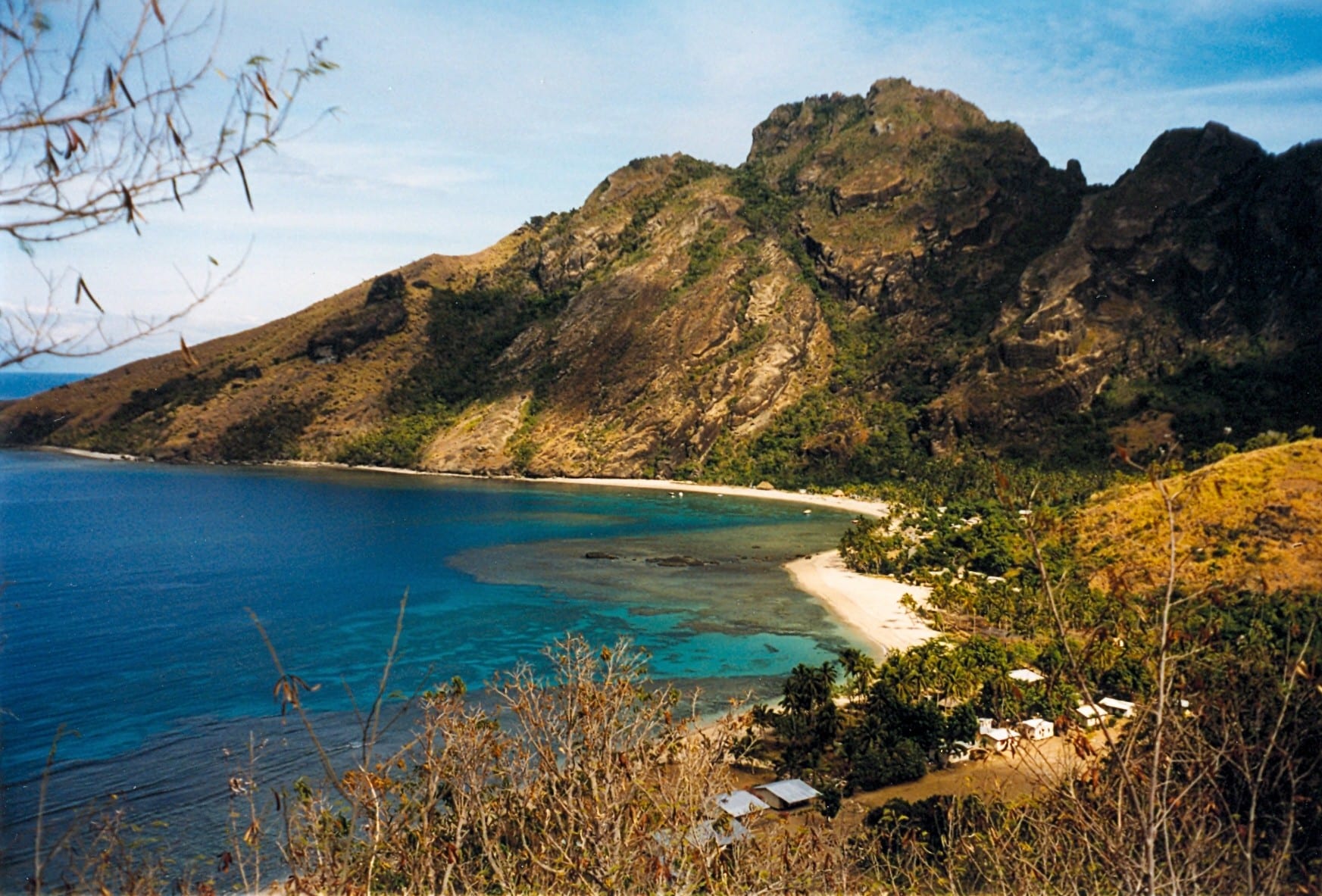
A village of small houses behind a white beach in a reef-fringed bay, with dry grassy slopes and a jagged volcanic peak rising behind

Nadi, the Coral Coast & the Mamanucas, Fiji

Yasawa Islands

The village and bay of Yalobi on Waya, at the southern end of the Yasawa chain. (Doron / Wikimedia Commons · CC BY-SA 3.0)

A chain of about twenty steep volcanic islands running north-east for more than eighty kilometres, from a point some forty kilometres north-west of Lautoka at the western end of Viti Levu. Dry, grassy ridges drop to white beaches and reef lagoons, there are no roads or towns, and life centres on Fijian villages and the small lodges and resorts they host, reached by a daily catamaran from Port Denarau near Nadi.

Neighbourhoods

  • Waya and the southern islands
    • Hiking
    • Villages
    • Closest to the mainland

    The southernmost large islands, and the most dramatic, with sharp volcanic peaks above villages such as Yalobi and a mix of village-run lodges and one or two resorts. Waya lies about 40 kilometres from Lautoka, the shortest boat ride from the mainland, and the group is the best of the chain for walking.

    Open in Maps
  • Naviti and the middle islands
    • Snorkelling
    • Backpackers
    • Manta rays

    The largest island of the group, rising to 388 metres, with several villages, the chain's only high school and budget lodges on its beaches; reef manta rays are sometimes seen in the channels nearby. Boats also stop at smaller neighbours.

    Open in Maps
  • Nacula, Nanuya and the Blue Lagoon
    • Beaches
    • First-time visitors
    • Range of prices

    The northern cluster where the chain's best-known beaches lie, around the stretch of pale, shallow water called the Blue Lagoon. Village-owned lodges, mid-range hotels and one private-island resort share a few kilometres of sand and reef.

    Open in Maps
  • Sawa-i-Lau and Yasawa
    • Caves
    • Quiet
    • Remote stays

    The far north of the chain, with the limestone island of Sawa-i-Lau and its swimmable caves, a handful of villages and the long island of Yasawa itself, which gives the group its name. It is the furthest from the mainland and the least visited.

    Open in Maps

Things to do

Beaches and lagoons

  • The Blue Lagoonbeach

    The shallow, pale-blue stretch of water between the northern islands, named after the film made at Nanuya Levu beside it and the usual anchorage for cruises and small boats.

    Open in Maps
  • Nanuya Lailai beachesbeach

    A small island beside the Blue Lagoon with beaches on both sides — the western one leased by Blue Lagoon Cruises, the eastern one backed by the settlement of Enendala and its family-run hostels — and a short walk over the ridge between them.

    Open in Maps
  • Yalobi Baybeach

    A wide reef-fringed bay on Waya with a village at its head and the island's peaks rising directly behind the sand.

    Open in Maps

Caves, walks and viewpoints

  • Sawa-i-Lau cavesattraction

    Limestone caverns inside a small island at the north of the chain, entered from the water and swum in; visits are arranged with the nearby village.

    Open in Maps
  • Waya ridge walkstrail

    Steep tracks climb from the villages on Waya and its southern neighbour to rocky summits, some of them several hundred metres above the sea, with views along the chain and across to the Mamanucas.

    Open in Maps
  • Naviti village visitsneighborhood

    Walks along the trails between the villages, gardens and schools of the largest island — the chiefly village is Soso — usually arranged through a lodge and beginning with a sevusevu presentation of yaqona.

    Open in Maps

In the water

  • Manta ray snorkellingattraction

    Reef manta rays, which are among the species seen in Fijian waters, feed on plankton carried through the passages between the middle islands, and lodges take snorkellers out by boat when rays appear.

    Open in Maps
  • Reef snorkelling and divingattraction

    Coral gardens, drop-offs and caves lie within swimming distance of many beaches, and dive operators based at the lodges run trips to reefs and wrecks along the chain.

    Open in Maps
  • Blue Lagoon cruisesattraction

    Small cruise ships and sailing boats have worked their way up the chain from Lautoka and Denarau for decades, anchoring off beaches and villages.

    Open in Maps

Short trips in the chain

  • Nanuya Levuattraction

    A privately owned island beside the Blue Lagoon, used as the location for the 1980 film The Blue Lagoon and now the single resort of Turtle Island.

    Open in Maps
  • Viwaattraction

    An island about 70 kilometres north-west of Denarau, west of the main chain and outside the usual boat route, with three villages and a reef known to divers.

    Open in Maps

Seasonal events

  • Dry-season peakJune to September

    The busiest and driest months, when the catamaran runs full, lodges fill with travellers moving up and down the chain, and the sea is clearest.

  • Manta ray sightingsDry season

    Reef manta rays pass through the channels of the middle islands when the water is clearest, and lodges take snorkellers out when rays are sighted.

  • Village church and festival daysThroughout the year, especially Sundays and Christmas

    Methodist church services with unaccompanied harmony singing are central to village life, and Christmas and community fundraising days bring feasting, meke dancing and sport.

Eat and drink

Long-standing places and food districts in Yasawa Islands. Hours, ratings and directions come from your maps app, always current.

Island eating

  • Lodge and resort meal plansrestaurant

    Almost every bed in the chain comes with a meal plan, because there are no restaurants outside the lodges: fish from the reef, curries, cassava and taro, soups, fresh fruit and simple baking, eaten communally at set times.

    Open in Maps
  • Village lovo and kavaneighborhood

    Feast food cooked in a lovo earth oven — fish, chicken, cassava, taro and palusami steamed under leaves — usually shared with a bowl of kava after a village visit or on a lodge's feast night.

    Open in Maps
  • Coconuts, fish and garden producemarket

    What the islands themselves supply: green coconuts, reef fish and shellfish, cassava, taro, breadfruit, papaya and mangoes in season, sometimes sold to lodges by village families.

    Open in Maps

Provisions

  • Stock up in Nadi or Lautokamarket

    There are no shops of any size in the chain and a village canteen may stock little more than biscuits and tinned fish, so snacks, sunscreen, alcohol, medicines and cash should be bought on the mainland.

    Open in Maps

Experience Yasawa Islands

History

The Yasawas were settled long before European contact by people whose descendants still live in the chain's villages, farming the thin soils, fishing the reefs and organising life around chiefly title and the landowning kin group. The islands sit within the wider province of Ba, and their oral traditions link them to the western Viti Levu mainland and to Tonga, whose canoes reached these waters.

The first European to sight the Yasawas was William Bligh, who sailed past in 1789 in the Bounty's open launch after the mutiny and chose not to land; the body of water he crossed, east of the chain, still carries his name. Later came sandalwood traders, bêche-de-mer collectors, missionaries and, after Fiji's cession to Britain in 1874, copra plantations. The islands remained one of the most isolated parts of the colony, served by sailing boats and, later, small motor vessels from Lautoka, with no roads and little cash economy.

Tourism came slowly and by sea. Small cruise vessels ran up the chain to anchor off the northern beaches long before there was anywhere to stay ashore, and the area's name spread further when The Blue Lagoon was filmed at Nanuya Levu in 1979 and released the next year. Government policy kept the group closed to land-based tourism until 1987, after which resorts and village lodges opened on the beaches, and backpacker routes and a regular catamaran from Denarau followed in the 1990s. Cyclone Winston in 2016 and the closure of borders during the pandemic both hit the islands hard, since almost every family depends on visitors in some way.

Culture & Customs

Village life, not resort life, sets the tone in the Yasawas. Households belong to a mataqali that owns land and reef, decisions are taken by the chief and village council, and a stranger becomes a guest through the sevusevu, in which yaqona root is presented, accepted and then pounded and drunk from a shared bowl. Kava sessions run long into the evening, accompanied by guitar and singing, and visitors staying at a village-run lodge are often drawn into them.

Christianity, above all Methodism, is woven through daily life. Sunday means church in the morning, best clothes and a quiet afternoon, with hymns sung in close harmony and without instruments — one of the most memorable sounds of the islands. Meke, the sung and danced recounting of stories, is performed at celebrations and for guests, and the lali, a slit wooden drum, still calls people to church and to meetings.

Manners are specific and easily learned. Modest dress is expected away from the beach, a sulu wrapped around the waist covers the knees, hats and sunglasses come off in a village, and it is polite to speak to the village headman before walking through gardens or up a hill. Rugby is the shared passion, played on any level ground, and schools and churches are funded partly by community fundraising days with food stalls and sport. The relationship with tourism is close and consciously managed: lodges are often village businesses, and their income pays school fees, boats and generators.

Daily Life

A few thousand people live in the chain, spread across villages on Waya, Naviti, Nacula, Nanuya Lailai, Yasawa and their neighbours, with numbers falling as young people leave for Lautoka, Nadi, Suva and work overseas. Villages are compact settlements of concrete and timber houses behind a beach, with a church, a primary school, a meeting house and a small canteen.

The economy is fishing, subsistence gardening and tourism. Families grow cassava, taro, breadfruit and vegetables on hillside plots, fish the reef with nets and lines, and take wages or lease income from lodges and resorts; handicrafts, copra and remittances from relatives on the mainland make up the rest. There is no electricity grid: power comes from solar panels, batteries and generators, and fresh water from rainwater tanks and a few wells, which makes drought a serious problem in the dry season.

The day begins at first light with fishing and gardens, slows in the heat, and ends with kava and singing. Boats are the lifeline — the daily catamaran brings guests, supplies and mail, and village punts carry children to school and patients to the nearest nursing station. The persistent issues are water supply, the cost and reliability of transport, cyclone damage to houses and reefs, the single high school for the whole chain on Naviti, and how evenly tourism income is shared between and within the villages.

Food

Food in the Yasawas is what the reef, the gardens and the supply boat provide. Reef fish, walu, tuna and shellfish are grilled, curried or served as kokoda, raw fish cured in lime juice with coconut cream, chilli and onion. Coconut is everywhere: cream in almost every dish, grated flesh in puddings, and the water drunk straight from a green nut cut down beside the path.

Root crops are the staple. Cassava and dalo, boiled or baked, take the place of bread at nearly every meal, with breadfruit in season and rice brought in by boat. The lovo, an earth oven of hot stones, is the festive way of cooking, and under its layers of banana leaf go fish, chicken, pork, root crops and palusami — taro leaves folded around coconut cream and onion until they collapse into something rich and soft. Indo-Fijian cooking reaches the islands as curries, dhal and roti on the lodge menus.

Sweet things come from the garden and the lodge kitchens: papaya, mango, pineapple, bananas and watermelon, alongside scones, pancakes and cakes turned out by lodge kitchens for afternoon tea. Yaqona is the drink of consequence, pounded and strained and drunk from a shared bilo, or coconut cup; Fiji-brewed lager appears at the resorts, but alcohol is restricted in many villages, and tea is the everyday alternative.

Planning tools

Budget

Costs here are unusual because everything is bundled. Beds run from village-owned dormitories to one of the most expensive private-island resorts in the Pacific, and nearly all of them charge a compulsory meal plan, which often exceeds the price of the bed. The catamaran up the chain and any island-hopping are the other fixed costs, and boat transfers to individual lodges may be extra.

Daily Budget Midrange
USD 140–290 (mid-range lodge or small resort with meals, boat transfers, and a dive or manta snorkelling trip)
Daily Budget Shoestring
USD 55–95 (village-run dormitory with a meal plan, catamaran pass, snorkelling from the beach)

Compare the total of bed plus meal plan plus transfers rather than the room rate, bring enough Fijian dollars in cash for the whole stay, and check whether a multi-stop boat pass is cheaper than separate tickets.

Best Time to Visit

May to October brings dry, sunny weather, calm crossings and the clearest water, and also the largest crowds in July, August and September. November to April is hotter and wetter, with heavy showers, choppier seas and the risk of cyclones, when some small lodges close or run with few guests.

Suggested Number of Days

Three or four nights on one or two islands is a reasonable first stay, given a long boat journey at each end. A week or more suits travellers moving up the chain from island to island with a boat pass. Weather and boat timings, rather than a list of sights, determine how the days fall.

First Visit
3–4 days
With Surroundings
6–8 days

Transportation

There are no roads or vehicles of any consequence. A catamaran runs daily from Port Denarau near Nadi up the chain, taking roughly two hours to the southern islands and four to five to the far north, with lodge boats meeting it offshore to take guests ashore. Small boats, village punts and seaplanes and light aircraft to a few airstrips and resorts cover the rest, and on the islands themselves people walk or go by boat.

Crossings are open-water and can be rough, transfers are sometimes cancelled in bad weather, and travellers should allow a spare day at Nadi before an international flight.

Airport & Station Connections

Access is from Nadi. The international airport is about 20 minutes by road from Port Denarau, where the Yasawa catamaran and cruise boats leave, generally once a day in the morning. Some resorts arrange seaplane or helicopter transfers from Nadi, taking under an hour, and a few island airstrips take light aircraft. Cargo and village boats also run from Lautoka, though they are not set up for visitors.

Walkability

Each island is walked rather than driven. Beaches, villages and lodges are connected by sand and by footpaths over the ridges, some of them steep, rough and unshaded, and a walk between bays can take an hour or more. There is no street lighting and few signposts, so a torch is essential after dark and a local guide is worth having for the hill tracks.

Safety

Crime is very rare and villages are safe, but the setting is remote. The risks are water and isolation: currents in reef passes, coral cuts, sunburn and dehydration on dry, shadeless islands, and open-water boat crossings in small craft. Medical care is limited to village nursing stations, and anything serious means evacuation to Lautoka or Nadi. Cyclones between November and April can cut the islands off for days.

Confirm that boats carry life jackets and a radio, carry water and sun cover on every walk, snorkel with a companion and on local advice about currents, and take insurance that covers medical evacuation. Check current official travel advice before travelling.

Climate

Tropical, and on the dry leeward side of Fiji, so the chain has low rainfall, brown grassy hillsides for much of the year and plenty of sun. Seasons are reversed from the northern hemisphere: the hot, wet summer runs December to February and the cooler, dry winter June to August, when the south-east trade winds are steadiest. Fresh water is scarce and droughts occur.

Summer
hot and humid, generally about 24–32°C, with heavy showers, warm seas and cyclone risk from November to April
Winter
warm and dry, around 22–29°C by day, sunny and breezy with cooler nights

Local Customs

The Yasawas are village islands, and land, beaches and reefs belong to the landowning kin groups, so visitors are guests throughout. A village visit begins with a sevusevu, the presentation of yaqona root, received by the chief or his spokesman; shoulders and knees are covered, hats and sunglasses come off, and swimwear stays at the beach. Shoes are removed before entering a house, and it is impolite to touch a person's head or to walk in front of someone seated. Sunday is for church and rest.

Bring yaqona root from a Nadi market as a gift when visiting a village, ask before photographing people or houses, do not take coral or shells, and note that alcohol is restricted or unwelcome in many villages and tipping is not expected.

Common Payment Methods

The currency is the Fijian dollar. There are no banks or cash machines in the chain, and while larger resorts take cards and bill to the room, many village lodges, boat crews, handicraft sellers and village fees are cash only, and card machines depend on a connection that often fails. Cash for the whole stay should be drawn in Nadi or Lautoka beforehand.