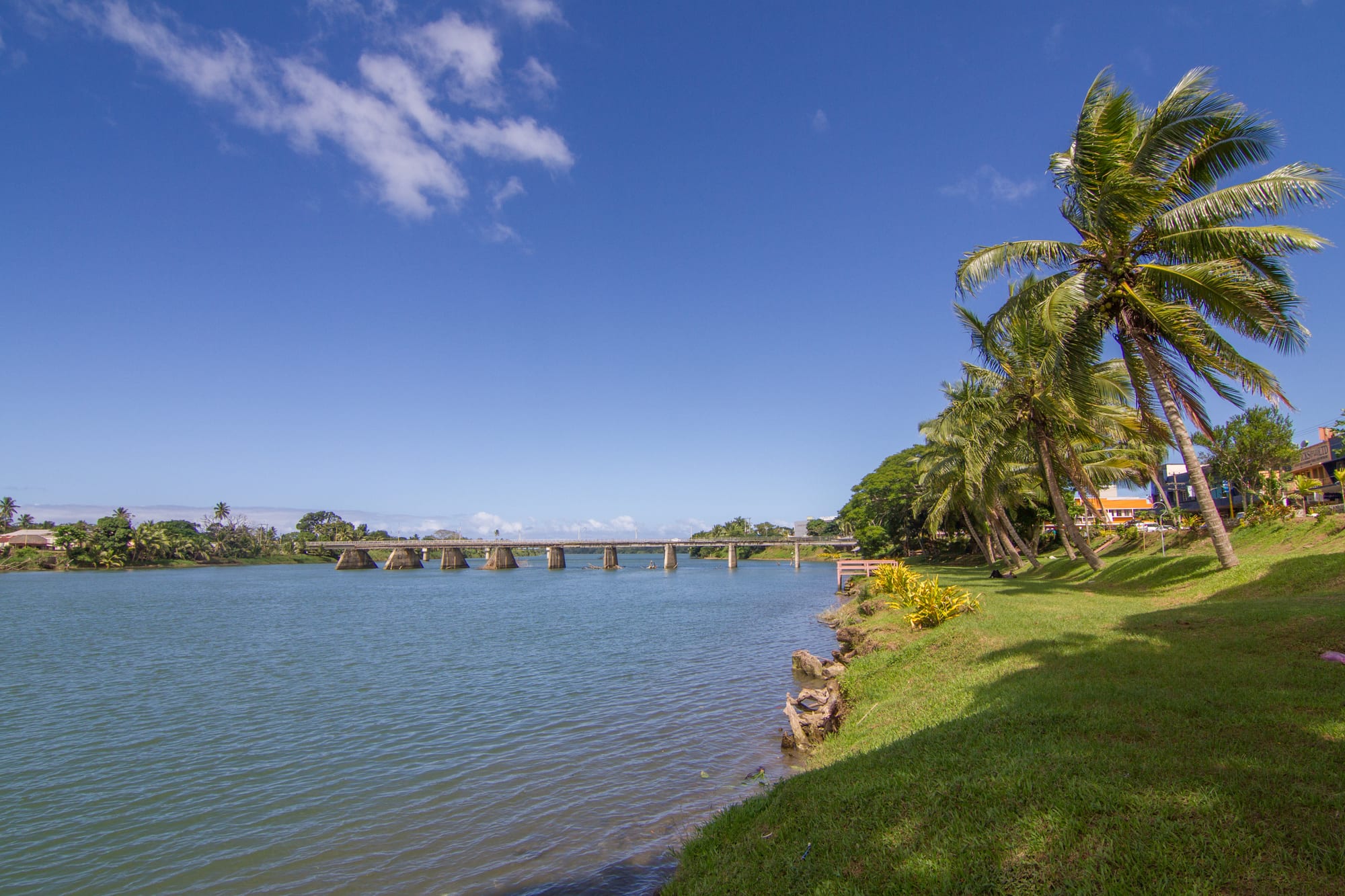
The wide green Sigatoka River seen from a grassy bank lined with coconut palms, with a long low road bridge crossing it under a blue sky

Nadi, the Coral Coast & the Mamanucas, Fiji

Sigatoka

The Sigatoka River and its road bridge at Sigatoka. (Maksym Kozlenko / Wikimedia Commons · CC BY-SA 4.0)

The market town at the mouth of the Sigatoka River on the south coast of Viti Levu, the service centre for the Coral Coast resorts and for one of Fiji's most productive farming valleys. Sugar cane, vegetables and tourism support it, and the sand dunes and ancient burial ground at the river mouth hold some of the oldest evidence of human settlement in the country.

Neighbourhoods

  • Town centre and the market
    • First-time visitors
    • Markets and shopping
    • Best for food

    A compact grid of shops, banks, bakeries and curry houses either side of the Queens Road, built around a large produce market and the bus stand. It is the busiest place on the Coral Coast and where resort guests come for cheaper food, groceries and handicrafts.

    Open in Maps
  • Kulukulu and the river mouth
    • Beaches
    • Walks
    • Surf

    The village and farmland downstream of the town where the river meets the sea, and the gateway to the sand dunes. The beach is grey-sand and windswept, with strong surf and rips, and the dune ridges behind it give long views along the coast.

    Open in Maps
  • Korotogo and the resort strip
    • Resorts
    • Families
    • Quiet and residential

    The stretch of the Queens Road east of the town, where hotels, guesthouses and restaurants sit behind a fringing reef, with the Kula wildlife park nearby. It is the most visitor-oriented part of the district and a short bus or taxi ride from the market.

    Open in Maps
  • The Sigatoka Valley
    • Local life
    • Villages
    • River trips

    The broad river valley running inland from the town, a patchwork of vegetable plots, cane and Fijian villages backed by steep hills. Tavuni Hill Fort stands above the river here, and jet boats and minibuses take visitors up to the villages.

    Open in Maps

Things to do

Landmarks and history

  • Sigatoka Sand Dunespark

    Grass-anchored dunes up to 60 metres high at the river mouth, covering 650 hectares and protected since 1989 as Fiji's first national park, where pottery more than 2,600 years old and one of the largest ancient burial sites in the Pacific have been excavated.

    Open in Maps
  • Tavuni Hill Fortlandmark

    An ancient Tongan fortified settlement on a hilltop above the river a few kilometres inland, with terraces, house platforms and a view over the valley.

    Open in Maps
  • Sigatoka Marketmarket

    The town's covered produce market, supplied by the valley's farms and piled with vegetables, root crops, fruit, spices and yaqona.

    Open in Maps
  • Sigatoka Riverattraction

    A river of 120 kilometres that rises on Mount Victoria and has long been the chief way into parts of the interior, used for jet-boat and longboat trips to valley villages and prone to flooding in heavy rain.

    Open in Maps

Beaches and the coast

  • Korotogo beaches and reefbeach

    Shallow, reef-protected water and small beaches along the resort strip east of town, good for wading, kayaks and snorkelling at high tide.

    Open in Maps
  • Kulukulu Beachbeach

    A long open beach at the river mouth where surfers ride a beach break; currents are strong and it is not a safe place for casual swimming.

    Open in Maps
  • Natadola Beachbeach

    A wide curve of white sand west along the coast, one of the best-known beaches on Viti Levu, with a reef lagoon behind it.

    Open in Maps

Villages and nature

  • Sigatoka valley village visitsneighborhood

    Boat and road trips upriver to Fijian villages, where visitors present yaqona for a sevusevu, see everyday farming life and are often given a kava welcome and a meal.

    Open in Maps
  • Kula WILD Adventure Parkattraction

    A privately run wildlife park and ecological preserve at Korotogo, begun as a bird park in the 1980s, with walkways among Fijian birds, reptiles and the Fiji flying fox, the country's only native mammal.

    Open in Maps
  • Lawaqa Parkattraction

    The town's rugby ground, holding some 12,000 people, home to Nadroga, one of Fiji's strongest provincial sides, and to the town's football club.

    Open in Maps

Short trips from the town

  • Nadiattraction

    Fiji's gateway town some 60 kilometres west, with the international airport, the Sri Siva Subramaniya temple and the boats to the offshore islands.

    Open in Maps
  • Coral Coast Railwayattraction

    A tourist train that has run since 1986 on an old cane line, carrying visitors between Yanuca on the coast west of the town, Natadola Beach and Sigatoka itself.

    Open in Maps
  • Pacific Harbour and the Coral Coast eastattraction

    The road east towards Suva passes further resorts and villages on the way to Pacific Harbour, known for shark diving and river rafting, and the reefs of Beqa.

    Open in Maps

Seasonal events

  • Cane crushing seasonJune to November

    Harvest fills the roads around the town with cane trucks and trailers bound for the mills, the busiest working months of the year in the district.

  • DiwaliOctober or November

    A public holiday in Fiji, when Indo-Fijian households and shops in the town are lit with lamps and sweets are shared with neighbours.

  • Rugby seasonRoughly mid-year

    Provincial and club matches at Lawaqa Park, where Nadroga's following is among the most passionate in Fiji.

  • Dry-season peak for visitorsJune to September

    The driest, sunniest months, when the Coral Coast resorts are fullest and river trips and village tours run most often.

Eat and drink

Long-standing places and food districts in Sigatoka. Hours, ratings and directions come from your maps app, always current.

Sigatoka classics

  • Sigatoka market and its food stallsmarket

    The produce market and the stalls around it sell roti parcels, samosas, fried fish, cassava chips, fresh coconuts and the valley's vegetables — the cheapest and best eating in town.

    Open in Maps
  • Town curry housesneighborhood

    Indo-Fijian kitchens along the main street serve roti with chicken, goat, fish or vegetable curry, dhal and pickles, alongside Chinese restaurants and bakeries selling buns and sweets.

    Open in Maps
  • Korotogo restaurantsneighborhood

    The resort strip east of the town has a scattering of independent restaurants and cafés serving seafood, curries and Western dishes to hotel guests and residents.

    Open in Maps

Local produce

  • Valley vegetables and fruitmarket

    The Sigatoka valley is sometimes called Fiji's salad bowl, supplying tomatoes, cabbages, eggplant, cucumbers and beans to markets across the country, and mangoes, papaya and pineapple in season.

    Open in Maps
  • Reef fish and seafoodmarket

    Fish, octopus, crabs and shellfish from the coast and the river mouth are sold at the market and cooked as kokoda, curries and grills in the town's kitchens.

    Open in Maps

Experience Sigatoka

History

The land around the mouth of the Sigatoka River holds some of the oldest traces of settlement in Fiji. Excavations in the dunes have recovered Lapita and later pottery more than 2,600 years old, along with one of the largest ancient burial grounds in the Pacific, layered between sand deposits laid down by floods and storms. The valley behind was farmed and fortified for centuries: hilltop settlements guarded the river route inland, and Tavuni Hill Fort above the water a few kilometres upstream is an ancient Tongan fortified settlement.

The upper Sigatoka was among the last parts of Fiji to come under outside control. After Fiji was ceded to Britain in 1874, the inland Kai Colo communities of the upper valley and the hills resisted the new administration and its demands, and in 1876 colonial forces and their Fijian allies defeated them in the campaign known as the Little War. Missionary work, Christian conversion and colonial taxation followed, and the province of Nadroga-Navosa took its modern shape.

The town itself grew as a crossing point and a trading post. The Colonial Sugar Refining Company's cane lines and the coast road met here, the river was bridged, and Indo-Fijian shopkeepers and farmers, descendants of indentured labourers brought from India between 1879 and 1916, built the commercial centre. Sigatoka was incorporated as a town in 1959. From the 1960s the Coral Coast's hotels opened along the shore on either side, and in July 1989 the dunes at the river mouth were declared Fiji's first national park. Vegetable farming in the valley expanded until it supplied markets across the country, and Sigatoka became what it remains: a working town serving farms on one side and resorts on the other.

Culture & Customs

Sigatoka is a two-community town, and the mixture is plain on the main street: Indo-Fijian shops, bakeries and curry houses, Hindu temples and a mosque within walking distance of Methodist and Catholic churches, and iTaukei villages a short way along the coast and up the river. Diwali lights the town in October or November, Holi brings coloured powder in the wet season, Eid is marked in the Muslim community, and Sunday morning belongs to church, when the streets empty and singing carries from the village halls.

Rugby is close to a civic religion. Nadroga, the province of which Sigatoka is the main town, has long been one of the strongest sides in Fiji, and match days at the town ground fill the stands and the surrounding streets, to the point that Sigatoka is commonly called Rugby Town; sevens tournaments and village competitions run through the year. Kava is the other constant: yaqona root is sold in bundles at the market and pounded for evening sessions in which news, disputes and plans are worked through over a shared bowl.

Village protocol governs the valley. Visitors are received with a sevusevu, the formal presentation of yaqona, and behave as guests on land that belongs to the landowning kin group: modest dress, no hats in the village, shoes off indoors, and the chief's spokesman speaking for the community. Tourism and farming sit side by side without much friction, and many families have members working in both, one in a resort along the coast and another on a vegetable plot upriver.

Daily Life

The town had 17,622 residents at the 2017 census, with many more in the villages and farming settlements of the valley and along the coast, and it is the principal urban centre of Nadroga-Navosa province. Indo-Fijian families make up much of the town's population and iTaukei communities most of the surrounding villages, and the district as a whole is one of the more densely settled parts of western Viti Levu.

Work divides between farming and tourism. The valley's market gardens are worked intensively, sugar cane covers the flatter land, and lorries and buses carry produce to Nadi, Lautoka and Suva; the Coral Coast hotels employ housekeepers, cooks, drivers, gardeners and guides, many of them commuting from villages nearby. Shops, transport, schools, a hospital and government offices serve both, and remittances from relatives working overseas or on cruise ships support many households.

The day begins early, with the market trading soon after dawn and buses full by seven; the heat slows the middle of the day, and evenings are for kava, rugby training and church groups. Recurring problems are flooding of the Sigatoka River and its effect on crops and low-lying streets, the long decline of the sugar industry, coastal erosion along parts of the Coral Coast, water supply in dry years, and the dependence of so many jobs on the arrival of aircraft at Nadi.

Food

Sigatoka eats from its own valley. The farms upriver supply tomatoes, cabbages, eggplant, cucumbers, beans and chillies to the market, and the town's kitchens turn them into Indo-Fijian curries eaten with roti or rice — chicken, goat, fish or vegetable, with dhal, chutney and pickles alongside. Roti parcels wrapped around curry are the standard quick meal, sold at the market and from small shopfronts, and Indo-Fijian bakeries sell buns, sweets such as burfi and gulab jamun, and strong, sweet tea.

iTaukei cooking is the other half of the local diet. Cassava and dalo take the place of bread; lovo, an earth oven of hot stones, steams fish, chicken, pork and root crops under banana leaves for feasts; and palusami, taro leaves folded around coconut cream and onion, goes in with them. Kokoda, raw fish cured in lime juice with coconut cream, chilli and onion, is made with reef fish landed on the coast, and fresh coconuts are drunk straight from the nut.

The market is the centre of it all: pyramids of produce, dried and fresh fish, spices sold by the scoop, bundles of yaqona root, and seasonal mangoes, papaya, pineapple and watermelon. Duruka, the young flower head of a wild cane sometimes called Fiji asparagus, appears in the wetter months. Drinks are juices and coconuts, Fiji-brewed lager and rum in the town's bars, and kava wherever people gather.

Planning tools

Budget

Sigatoka itself is one of the cheapest places to stay and eat on the Coral Coast, with small hotels in town and guesthouses at Korotogo, market food and local buses. Costs rise quickly at the beach resorts nearby, where meals, drinks and activities are charged at resort prices. River trips, village tours and taxis to the dunes and the hill fort are the main extras.

Daily Budget Midrange
USD 130–270 (Coral Coast resort room, restaurant meals, taxis, and a river trip or village tour)
Daily Budget Shoestring
USD 45–75 (town guesthouse or Korotogo budget room, market and curry-house food, local buses)

Use the local buses and minibuses along the Queens Road rather than taxis for longer hops, and buy food and supplies in town, where prices are a fraction of resort ones.

Best Time to Visit

May to October is drier, sunnier and less humid, and coincides with the cane harvest and the fullest schedule of tours; July and September are busiest at the resorts. November to April is hot and wet, with heavy showers, the risk of cyclones and the chance of river flooding, but the valley and hills are at their greenest and prices are lower.

Suggested Number of Days

A day or two covers the town, the market and the sites at the river mouth. Three or four suit a stay on the Coral Coast with time for the valley villages, the beaches west along the coast and a trip upriver. The pace depends mainly on the heat and on whether a hire car is available.

First Visit
1–2 days
With Surroundings
3–4 days

Transportation

The Queens Road runs straight through the town, and frequent local buses, express coaches and shared minibuses connect it with Nadi, Lautoka and Suva as well as the resorts on either side. Taxis are plentiful and cheap for short hops to Korotogo, the dunes or the hill fort. Village roads inland are rough and often need a four-wheel drive, and boats and jet boats carry people up the river. Hire cars are available at Nadi, and driving is on the left.

Buses do not keep precise timetables and fill up at peak times, so allow extra time, and agree a taxi fare or ask for the meter before setting off.

Airport & Station Connections

Nadi International Airport is about 70 kilometres west, the town of Nadi some 60, roughly an hour to an hour and a half by road, and most visitors arrive by hire car, resort transfer, express coach or local bus along the Queens Road. Suva is about 120 kilometres east, some two and a half to three hours by bus. There is no railway service for passengers, although cane lines cross the district.

Walkability

The town centre is small and easily walked, with the market, shops, bus stand and river bank within a few hundred metres, though heat, humidity and busy traffic on the Queens Road make it tiring in the middle of the day and footpaths are uneven. Korotogo, the dunes and the hill fort are several kilometres away and need a bus, taxi or car; the dunes themselves are explored on foot along marked trails.

Safety

The town is busy and generally safe by day, with petty theft and bag snatching the main concerns, particularly around the market and bus stand and after dark. The serious risks are in the water: strong rips and currents at the river mouth and on the open beaches, and reef edges that look calmer than they are. Dengue fever occurs, heavy rain can flood the river and the low parts of town, and cyclones are possible between November and April.

Keep valuables out of sight in the market crowds, avoid unlit streets and the beaches at night, swim only where resorts or villagers advise, use insect repellent, and heed flood and cyclone warnings. Check current official travel advice before travelling.

Climate

Tropical, on the south coast where the Coral Coast sits between the dry west and the wet south-east, so Sigatoka gets more rain than Nadi and less than Suva. Seasons are reversed from the northern hemisphere: the hot, wet summer runs December to February and the cooler, drier winter June to August, when the trade winds blow steadily onshore.

Summer
hot and humid, generally around 24–31°C, with heavy showers, thunderstorms and cyclone risk from November to April
Winter
warm and drier, about 20–29°C by day, with breezy, sunny weather and cooler nights

Local Customs

The town is shared between Indo-Fijian and iTaukei communities, with Hindu temples, mosques and churches within a short distance of one another, and 'bula' as the universal greeting. Dress modestly in town and especially in villages, covering shoulders and knees; a sulu wrapped over shorts is the usual solution. A village visit begins with a sevusevu, the presentation of yaqona root, and hats and sunglasses are removed inside a village. Sunday is quiet, with church services and many shops closed.

Ask before photographing people, market traders or ceremonies, bring yaqona when invited to a village, bargain politely at handicraft stalls but not for market produce, and note that tipping is not expected.

Common Payment Methods

The currency is the Fijian dollar. Banks and cash machines are in the town centre, and cards are accepted by supermarkets, hotels and resorts, but the market, buses, taxis, village fees and small kitchens all run on cash. Drawing money in Sigatoka is easier than anywhere else on the Coral Coast, so it is a sensible stop before heading inland or to an island.