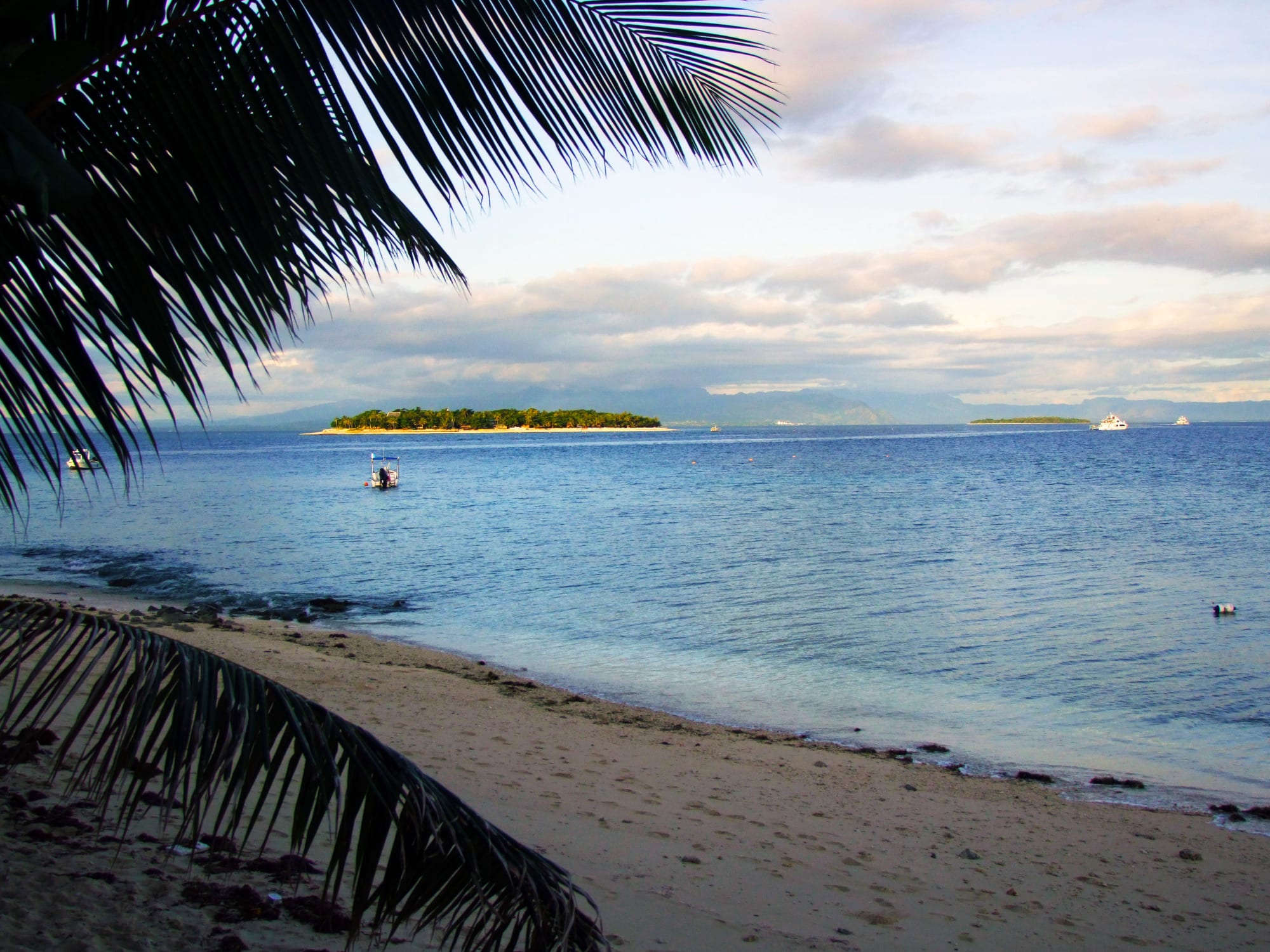
A quiet sandy beach framed by palm fronds, looking across calm water to a small wooded island with boats moored offshore

Nadi, the Coral Coast & the Mamanucas, Fiji

Mamanuca Islands

A beach in the Mamanuca Islands, looking across the lagoon to one of the group's small islands. (Isderion / Wikimedia Commons · CC BY-SA 3.0 de)

A group of about twenty volcanic and coral islands in the warm, sheltered water west of Nadi, some of them small enough to be covered at high tide. Fijian villages on the larger islands share the group with resorts of every price, reached by catamaran from Port Denarau, and the surrounding reefs hold both easy snorkelling lagoons and surf breaks that many surfers rank among the best in the world.

Neighbourhoods

  • Malolo and Malolo Lailai
    • First-time visitors
    • Families
    • Range of prices

    The two largest islands of the group, side by side about 20 kilometres west of Nadi. Malolo has two Fijian villages, hills and a fringe of resorts; flatter Malolo Lailai, also called Plantation Island, has a marina, a golf course, an airstrip and four long-established resorts, and only a shallow channel separates the two.

    Open in Maps
  • Mana and the day-trip islands
    • Snorkelling
    • Backpackers
    • Short stays

    Mana, where the American series Survivor has been filmed since 2016, has beaches on either shore, a village and both resort and budget accommodation, while tiny neighbours such as Beachcomber and Treasure are barely larger than the buildings on them and take day visitors as well as overnight guests. Boats from Denarau call through the day.

    Open in Maps
  • Tokoriki, Matamanoa and the northern islands
    • Couples
    • Quiet
    • Diving

    The outer, smaller islands at the northern end of the chain, an hour or more from the mainland, with a handful of low-rise resorts, steep wooded slopes and clear water. There is little to do beyond swimming, diving and walking a beach, which is the point.

    Open in Maps
  • Tavarua and Namotu
    • Surf
    • Diving
    • Experienced water users

    Two small islands at the southern edge of the group, close to the reef passes. They are known internationally for the waves that break on the outer reef nearby, among them Cloudbreak, and for fishing and diving in deep water; the surf here is for experienced riders only.

    Open in Maps
  • Monuriki and the uninhabited outliers
    • Day trips
    • Film location
    • Snorkelling

    Small uninhabited islands and sandbanks on the western side of the group, visited by boat for a few hours at a time. Monuriki, a rocky island of palms and pine forest with small white beaches, was the setting for the film Cast Away and is the best known of them.

    Open in Maps

Things to do

Reef and water

  • The outer reef and Wilkes Passageattraction

    The barrier reef along the western edge of the group, with coral gardens, drop-offs and passes through it — among them Wilkes Passage — dived and snorkelled from most of the islands.

    Open in Maps
  • Cloudbreakattraction

    A powerful left-hand wave breaking over coral reef about 1.5 kilometres off Tavarua, ranked by many surfers among the best waves in the world and a serious, hazardous one.

    Open in Maps
  • Sandbank snorkelling tripsattraction

    Boats run to bare sandbanks and coral heads that appear at low tide between the islands, used for snorkelling stops and picnics.

    Open in Maps
  • Sailing and day cruisesattraction

    Catamarans, yachts and small motorboats cross the group all day, and sunset sails and multi-island cruises leave from the marina on Malolo Lailai and from Port Denarau.

    Open in Maps

Islands and beaches

  • Monurikibeach

    An uninhabited island of volcanic rock, palms and pine forest with small white-sand beaches, used as the desert island in the film Cast Away and now a regular boat excursion.

    Open in Maps
  • Malolo Lailaiattraction

    The most developed island in the group and the flat, low home of its marina and airstrip, easy to walk across and the practical hub for yachts and inter-island boats.

    Open in Maps
  • Mana Islandbeach

    The island used for filming the television series Survivor, with beaches on either shore, a village at one end and resorts and backpacker lodges at the other.

    Open in Maps
  • Tokorikibeach

    A small island at the northern end of the chain, east of Yanuya, with a beach, clear water and quiet resorts set back among the palms.

    Open in Maps

Villages and walks

  • Malolo's villagesneighborhood

    Malolo, the largest island of the group, holds two Fijian villages, where visitors are received with a sevusevu of yaqona and can see everyday island life away from the resorts.

    Open in Maps
  • Yanuyaneighborhood

    A village island west of Tokoriki whose people are the custodians of Monuriki, and whose community receives the boat trips that visit the western Mamanucas.

    Open in Maps
  • Island ridge walksviewpoint

    Short, steep tracks climb the wooded spines of Malolo, Mana and Tokoriki to viewpoints over the lagoon, the reef and the mountains of Viti Levu.

    Open in Maps

Seasonal events

  • Southern swell surf seasonApril to October

    Swells generated in the Southern Ocean arrive on the outer reefs, bringing the largest and most consistent waves of the year to Cloudbreak and the neighbouring breaks.

  • Dry-season peakJune to September

    The busiest months on the islands, coinciding with the driest weather and Australian and New Zealand school holidays, when transfers and resorts run full.

  • Clear-water diving seasonMay to October

    The dry months bring cooler, calmer and clearer water over the reefs, and with it the best underwater visibility of the year for diving and snorkelling.

Eat and drink

Long-standing places and food districts in Mamanuca Islands. Hours, ratings and directions come from your maps app, always current.

Island eating

  • Resort dining rooms and beach barsrestaurant

    On most islands the resort kitchen is the only option, serving reef fish, kokoda, curries, grills and tropical fruit, often with a weekly lovo feast and meke performance by staff from nearby villages.

    Open in Maps
  • Musket Cove marina restaurantsrestaurant

    The marina on Malolo Lailai has a small cluster of eating places serving yachts and guests from several hotels, the closest thing in the group to a choice of restaurants.

    Open in Maps
  • Village lovo and kavaneighborhood

    Village visits often include food from a lovo earth oven — fish, chicken, cassava and taro steamed under leaves — and a bowl of kava shared with the hosts.

    Open in Maps

Provisions

  • Stock up in Nadi or at Port Denaraumarket

    Shops on the islands are tiny and expensive where they exist at all, so snacks, drinks, sunscreen and cash are best bought in Nadi or at the marina before boarding a boat.

    Open in Maps

Experience Mamanuca Islands

History

The Mamanucas have been part of the sea territory of western Viti Levu for thousands of years, fished and gardened by communities whose descendants still hold the land. The islands lie within the chiefly districts of the Nadi and Malolo area, and villages on Malolo, Mana and Yanuya sit on ground that has been continuously occupied, with garden plots behind the beaches and fishing grounds marked on the reef.

The group's best-documented episode came with the United States Exploring Expedition under Charles Wilkes in July 1840. A gun was fired during negotiations over food and two of the expedition's officers were killed on Malolo, after which crewmen from the expedition's ships destroyed the island's villages, killed 87 people and laid waste to the crops, in what is remembered as the Battle or Massacre of Malolo; the reef pass west of the group still carries Wilkes's name. Through the colonial period from 1874 the islands were a quiet backwater of copra plantations, Malolo Lailai among them, with people travelling by boat to Lautoka and Nadi.

Tourism arrived in the 1960s and 1970s, once Nadi's airport was carrying jet aircraft. The first small hotels opened on Malolo Lailai, Plantation Village in 1969 and Musket Cove in 1975; backpacker lodges came to the tiny islands, and the growth of Port Denarau and its catamaran services put the whole chain within a short boat ride of the airport. Film and television gave the group a wider fame — much of Cast Away, released in 2000, was shot on Monuriki, and the American series Survivor has filmed here since 2016 — and surfers made Cloudbreak internationally known. Land is leased from the landowning units rather than sold, and resort development has been shaped, and sometimes contested, through those agreements.

Culture & Customs

Two ways of life sit side by side here: the resort and the village. Guests experience a hospitality culture of welcome songs on the jetty, kava bowls at sunset, meke dance performances and weekly lovo feasts, almost all of it staffed by people from the islands themselves or from villages on the mainland who work rotations offshore. The Fijian greeting bula is constant, and the tone is warm, unhurried and personal in a way that regular visitors return for.

In the villages, custom governs everything. Land and fishing rights belong to the mataqali, the landowning kin group, and a visitor comes as a guest: yaqona root is presented for the sevusevu, the chief's spokesman receives it, and the kava that follows opens the meeting. Dress is modest away from the beach, hats and sunglasses come off in a village, and Sunday belongs to church, with Methodist singing carrying across the water. Rugby is played on any flat piece of ground.

The relationship with tourism is practical and long established. Lease payments, wages and tour work fund school fees and boats, and many families have worked in the same resort for two or three generations, but there are tensions too: access to beaches, the pressure of day-trip numbers on small reefs, and the fragility of an economy that stops entirely when planes do not fly, as it did during the pandemic. Marine conservation, including locally managed no-take areas on the reef, has become part of island life.

Daily Life

Only a handful of the islands have permanent villages — Malolo, the largest island, has two, and Yanuya is a village island — and most of the group's residents are either villagers or resort staff living in accommodation behind the beach. Numbers rise and fall with the boats: a small island may hold a few dozen people in a quiet week and several hundred when the resorts are full.

Work is tourism, fishing and gardening. Resorts employ cooks, housekeepers, guides, boat crews and gardeners; village families fish the reef, grow cassava, taro and vegetables, and sell handicrafts and coconut products to guests; and a constant traffic of supply boats brings food, fuel, water and building materials from Viti Levu. Fresh water is the limiting factor on most islands, collected from rain and roofs or produced by desalination, and electricity often comes from generators and increasingly from solar panels.

The day begins before dawn with the tide and the fishing, and the main boats come through mid-morning and mid-afternoon, which is when islands feel busiest. Children from the villages attend island primary schools and travel to the mainland for secondary education, and serious medical care, banking and shopping all mean a trip to Nadi or Lautoka. The recurring concerns are cyclone damage, coastal erosion and coral bleaching, the cost of imported supplies, and how fairly tourism revenue reaches the landowning communities.

Food

Eating in the Mamanucas is mostly eating what the resort kitchen or the village cooks, and both draw on the reef. Kokoda, raw fish cured in lime juice and dressed with coconut cream, chilli and onion, is the dish visitors meet first; grilled or curried reef fish, walu and tuna follow, along with prawns and, at feasts, freshwater and reef shellfish. Coconut in every form — cream, milk, grated flesh and the water drunk straight from a green nut — underpins the cooking.

The lovo is the centrepiece of any celebration: a pit of hot stones in which fish, chicken, pork, cassava, taro and palusami, parcels of taro leaves filled with coconut cream and onion, steam under banana leaves and earth for hours. Root crops take the place of bread, dalo and cassava appearing at almost every meal, and breadfruit, papaya, pineapple and mango come in with the seasons. Indo-Fijian influence reaches the islands too, in curries, roti and dhal on most menus.

Drinks are simple and local: green coconuts, fresh juices, Fiji-brewed lager and rum at the beach bars, tea in the villages, and yaqona, the peppery kava infusion drunk from a shared bowl in a ceremony that is both welcome and evening entertainment. Because everything else is shipped in, imported food and wine are expensive across the group, and the best meals are usually the ones built around fish landed the same day.

Planning tools

Budget

The islands cover a wide range. Backpacker lodges on Mana and the small islands include simple meals and dormitory beds for relatively little, while the resorts on Tokoriki, Matamanoa and Malolo are among the most expensive accommodation in Fiji. Because there is nowhere else to eat or shop, meal plans and drinks make up a large share of the bill, and catamaran or seaplane transfers are charged per person each way.

Daily Budget Midrange
USD 140–290 (mid-range island resort room, meal plan, boat transfers, and a dive or reef excursion)
Daily Budget Shoestring
USD 60–100 (dormitory bed with a simple meal plan, catamaran transfer, shared snorkelling trips)

Compare the total of room, meal plan and transfers rather than the room rate alone, and buy transfers with the accommodation where possible.

Best Time to Visit

May to October is the dry season, with sunny days, cooler nights, clear water for diving and the most reliable boat schedules; July and September are the busiest. November to April is hotter and more humid, with heavy showers, the chance of cyclones and occasional cancelled transfers, but lower prices and warm seas.

Suggested Number of Days

Three or four nights on one island suit most visits, allowing for the travel at each end and a slow pace once there. A week works for anyone island-hopping through the group or adding the Yasawas to the north. Boat timetables and weather, rather than a list of sights, set the rhythm.

First Visit
3–4 days
With Surroundings
5–7 days

Transportation

Everything moves by boat. Catamarans from Port Denarau near Nadi call at the main islands through the day, taking from roughly half an hour to the nearest to about two hours to the furthest, and resorts run their own launches and transfers. Seaplanes and helicopters serve some islands, and Malolo Lailai has a short airstrip with light-aircraft flights from Nadi. On the islands themselves there are no roads to speak of, and walking, kayaks and small boats cover the distances.

Crossings can be rough and are sometimes cancelled in bad weather, so anyone prone to seasickness should take precautions and everyone should leave a spare day before an international flight.

Airport & Station Connections

Access is from Nadi, where the international airport is about 20 minutes by road from Port Denarau, the marina from which almost all island boats leave. Catamaran services run several times a day and connect with resort launches; seaplane, helicopter and light-aircraft transfers are quicker and dearer. Day trips from Denarau make it possible to see the nearer islands without staying overnight.

Walkability

Each island is its own small world. The little ones can be walked around in minutes on sand, and Malolo Lailai is flat enough to cross on foot, while Malolo, Mana and the outer islands have steep, rough tracks over wooded hills between beaches. There are no pavements, street lighting or vehicles beyond a few resort buggies, so a torch and footwear that copes with coral and sand are useful.

Safety

The islands are quiet and crime is rare, and the real risks are in the water: strong currents in the reef passes, coral cuts, sunburn and dehydration, and the very heavy waves on the outer reefs, which are for experienced surfers with local guidance only. Medical facilities on the islands are limited to first aid or a nurse, and anything serious means evacuation by boat or air to Nadi. Cyclones are possible between November and April.

Swim and snorkel where resort staff advise, wear reef shoes and a rash vest, drink plenty of water, confirm that boats carry life jackets and a radio, and take out insurance that covers medical evacuation. Check current official travel advice before travelling.

Climate

Tropical maritime, on the dry western side of Fiji, so the group has more sunshine and less rain than the east of Viti Levu. Seasons are reversed from the northern hemisphere: the hot, wet summer runs from December to February and the cooler, dry winter from June to August, with steady trade winds through the dry months and cyclone risk from November to April.

Summer
hot and humid, generally about 24–32°C, with heavy showers, warm sea temperatures and the chance of cyclones
Winter
warm and dry, around 22–29°C by day, sunny, breezier and cooler at night

Local Customs

Resort life is informal, but the surrounding villages are traditional and the land and reef belong to them. A visitor to a village brings yaqona root for the sevusevu ceremony, covers shoulders and knees, removes hats and sunglasses, and follows the host's lead; swimwear belongs on the beach only. Touching a person's head is impolite, and shoes come off before entering a home or church. Sunday is a day of rest and church in the villages, and 'bula' is the greeting everywhere.

Ask before photographing villagers, take a small gift or yaqona when invited to a village, do not stand on or collect coral or shells, and note that tipping is not expected though many resorts keep a shared staff fund.

Common Payment Methods

The currency is the Fijian dollar. Resorts take cards and generally bill everything to the room, but there are no banks and effectively no cash machines on the islands, so cash should be drawn in Nadi or at Port Denarau beforehand for village visits, handicrafts, boat crews and small lodges that do not accept cards.