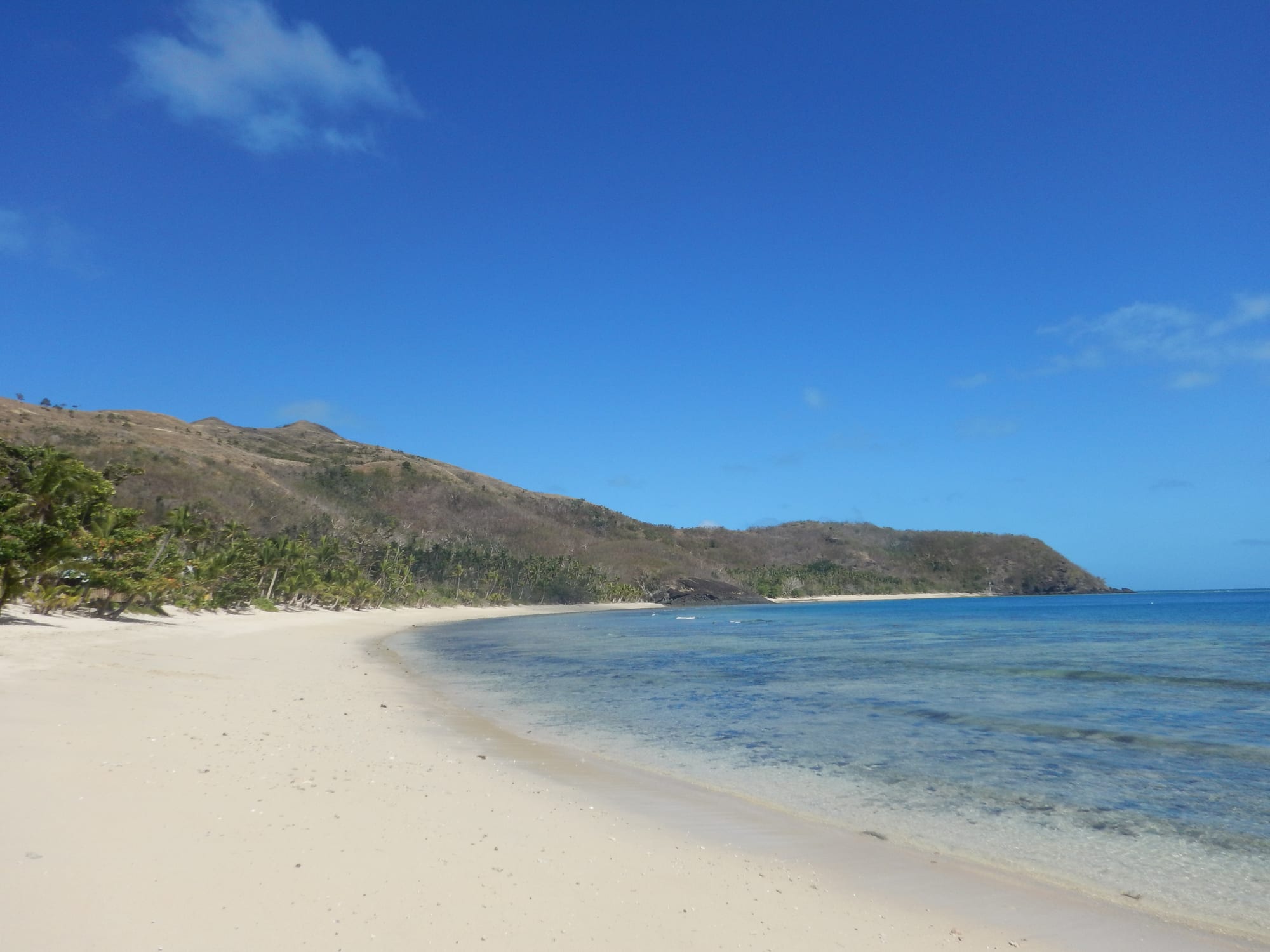
A curved white-sand beach backed by palms and green hills, meeting calm pale-turquoise water

Fiji

A beach on Naviti in the Yasawa Islands, a chain of volcanic islands off the west of Fiji's main island. (Rickard Törnblad / Wikimedia Commons · CC BY-SA 4.0)

An archipelago of around 330 islands in the South Pacific — the hub of the region — with a mixed Indigenous Fijian and Indo-Fijian society, a history of coups, and a tourism economy built on reefs and resorts.

Explore Fiji

History

Fiji was settled around 3,000 years ago by the Lapita people, whose distinctive pottery marks the spread of Austronesian voyagers across the Pacific. Over centuries a society of chiefdoms developed, with a fearsome reputation among early European sailors — the islands were long called the "Cannibal Isles" — and a complex politics of alliance and war among rival confederacies.

European traders came for sandalwood and sea cucumber in the early 1800s, followed by missionaries and settlers. After a period of instability, the paramount chief Cakobau ceded Fiji to Britain in 1874. The colonial government protected Indigenous land ownership but, to work the sugar plantations, brought more than 60,000 indentured labourers from India between 1879 and 1916, whose descendants became a large part of the population.

Fiji became independent in 1970. Tension between Indigenous Fijian political dominance and the large Indo-Fijian community erupted into military coups in 1987, a civilian putsch in 2000, and another coup in 2006 led by Frank Bainimarama, who then governed for years and introduced a 2013 constitution. The December 2022 election brought a change of government: Sitiveni Rabuka, who had led the 1987 coups and was prime minister in the 1990s, has led a coalition government as prime minister since 24 December 2022.

  • Fiji: Two Peoples, One Archipelago — A Melanesian island world of chiefs and war canoes, ceded to Britain in 1874, remade by Indian indentured labour, and shaken by four coups over who the country belongs to

Culture & Customs

Fijian society has two main communities. Indigenous Fijians (iTaukei) live largely in villages organised around the mataqali (landowning clan) and the chief, hold communal title to most of the land, and are predominantly Methodist Christian. Indo-Fijians, mostly Hindu with a Muslim minority, are concentrated in the sugar-cane belt and the towns and dominate small business and the professions.

Kava (yaqona), a mildly sedative drink made from a pounded pepper root, is the social and ceremonial glue of iTaukei life; a sevusevu — presenting a bundle of kava to the village headman — is the proper way to enter a community. The meke (chant and dance), the lovo earth oven, and mat-and-tapa-cloth making are living traditions.

Rugby, especially rugby sevens, is a national passion and a source of huge pride — Fiji won Olympic gold in the sport at Rio in 2016 and Tokyo in 2021, and silver in Paris in 2024. Warmth toward visitors is genuine.

  • Fiji: The Kava Bowl and the Whale's Tooth — Village protocol built on the chief and the shared bowl, a culture of sharing summed up in one word, Hindu, Muslim and Christian holidays on one national calendar, and firewalkers, drums and dances that keep old traditions alive

Daily Life

About three-quarters of Fijians live on Viti Levu, the main island, split between Nadi and Lautoka in the drier west, where tourism and sugar are based, and Suva, the capital, a wetter, hillier city on the southeast coast that is the largest city in the Pacific Islands.

The economy leans heavily on tourism, the leading foreign-exchange earner, along with sugar, bottled water, fisheries, and remittances from Fijians working overseas. Cyclones and their damage to crops and resorts are a recurring economic shock.

Village life runs on subsistence farming and fishing, the church, and communal obligations; town life on wage work, the market, and the bus. Sunday is widely observed as a day of rest, especially in iTaukei areas.

  • Fiji: Two Communities, One Island Time — Village mornings organised around the mataqali and the church, cane-belt towns built by generations of Indo-Fijian farmers and traders, and a shared, unhurried pace that both call island time

Food

Fijian food combines Melanesian roots crops, Indian curries, and Chinese and Western influences. The iTaukei staple is starchy "provisions" — taro (dalo), cassava, and breadfruit — with fish, and palusami, taro leaves baked in coconut cream, often cooked in a lovo earth oven for feasts. Kokoda, raw fish "cooked" in lime juice and coconut milk, is the signature dish.

Indo-Fijian cooking has become part of the everyday national diet: roti and curry, dhal, and lolo (coconut) dishes, sold cheaply at markets and roadside stalls. Chinese-style stir-fries and fried rice are common in the towns.

Kava is the drink of ceremony and socialising, sipped from a coconut-shell bowl with a clap before and after. Fiji's bottled water is a major export, and Fiji Bitter, brewed since 1958, is the best-known local beer.

  • Fiji: Food and the National Dish — Raw fish cured in coconut milk and citrus, a whole feast cooked underground in banana leaves, and a peppery ceremonial drink that opens almost every important gathering

Attractions & Natural Wonders

Most visitors head straight from Nadi to the islands. The Mamanuca group, close offshore, holds the day-trip and resort islands and calm lagoons, and Cloudbreak, the reef break off the small island of Tavarua nearby, is rated by many surfers as the best wave in the world. The Yasawas, a chain of about 20 volcanic islands to the northwest, are more rugged and lower-key, with backpacker lodges and the beaches of Nanuya Levu, where the film "The Blue Lagoon" was shot.

Viti Levu itself offers the Coral Coast resorts on the south shore, the Sigatoka Sand Dunes and river valley, the Navua River and its narrow gorge in the central highlands, and the highland village and forest walks of the interior. Suva has the excellent Fiji Museum, colonial architecture, and a big produce-and-craft market.

For diving and remoteness, Taveuni, Fiji's third-largest island, has the Bouma waterfalls in Bouma National Heritage Park, the coast around Lavena, and the soft-coral Rainbow Reef in the Somosomo Strait; Kadavu has the Great Astrolabe Reef; and the Lau group far to the east and the Lomaiviti islands in the centre, where the old capital Levuka stands, remain quiet and little visited.

  • Fiji: Nine Attractions and Natural Wonders — Three hundred islands of white sand and reef, a valley of thatched chiefly houses, a colonial port town frozen in the 1870s, and a lagoon where divers hand-feed bull sharks

Planning basics

Budget

Fiji covers a wide range: backpacker "bures" and village homestays in the Yasawas are cheap, while the resort islands of the Mamanucas and the Coral Coast can be very expensive. Inter-island boat transfers and domestic flights are the hidden costs. Cards work at resorts and in Nadi and Suva; carry cash for villages and buses.

Daily Budget Midrange
FJD 250–500 (mid-range resort or hotel, transfers, tours, diving)
Daily Budget Shoestring
FJD 90–150 (backpacker dorm, self-catering or village meals, local buses and ferries)

Visa Requirements

Citizens of the EU, the UK, the US, Canada, Australia, New Zealand, and many other countries can enter without a visa for up to four months; everyone else needs an Online Visa arranged before travel. Your passport must be valid for at least six months, and proof of onward travel and funds may be requested.

Typical Stay
Up to 4 months on arrival for most Western passports

Safety

Fiji is generally safe and welcoming, with low levels of violent crime, though petty theft and burglary occur in Nadi, Suva, and around some resorts. The real hazards are in the water — strong currents, reef cuts, and boat safety — and, in season, cyclones and flash floods. Political history includes four coups, but these have not targeted tourists.

Don't leave valuables unattended on the beach, ask locally about currents, choose boat operators with life jackets and radios, and follow village etiquette when visiting communities.

Climate

Tropical, warm and humid year-round. The wetter, hotter season runs November to April and includes the South Pacific cyclone season; the drier, slightly cooler season from May to October is the main travel window. The windward (southeast) sides of the big islands are much wetter than the leeward sides, where most resorts are.

Dry Season
May–October, cooler (averaging about 22°C), lower humidity, less rain
Wet Season
November–April, hotter, humid, heavy showers, cyclone risk

Transportation

Nadi International Airport, on the main island Viti Levu, is an important regional hub for the South Pacific. Fiji Airways and smaller carriers fly to Suva, the second big island Vanua Levu, Taveuni, Kadavu, and others. Catamarans run daily from Denarau to the Mamanuca and Yasawa islands; local ferries and buses cover Viti Levu.

The Yasawa Flyer catamaran hops up the island chain, letting backpackers island-hop with a single pass.

Best Time to Visit

May to October for the driest, most reliable weather, with July and August the peak (and Australian and New Zealand school holidays). The shoulder months of April and November can offer good weather and lower prices. Avoid the peak cyclone months if you can.

Currency

The currency is the Fijian dollar (FJD). ATMs are in Nadi, Suva, and the larger towns but not on most small islands, so withdraw cash before heading out to the Yasawas or Kadavu.

Cards
Accepted at resorts and in the main towns; cash needed elsewhere
Symbol
$ (FJ$)
Currency Code
FJD — Fijian dollar

Language

English, Fijian (iTaukei), and Fiji Hindi are Fiji's main national languages. English is the language of government, business, and tourism and is very widely spoken. Fijian is the first language of Indigenous Fijians; Fiji Hindi, a distinct variety, is spoken by the Indo-Fijian community.

English
Very widely spoken
Official Languages
English, Fijian (iTaukei), Fiji Hindi