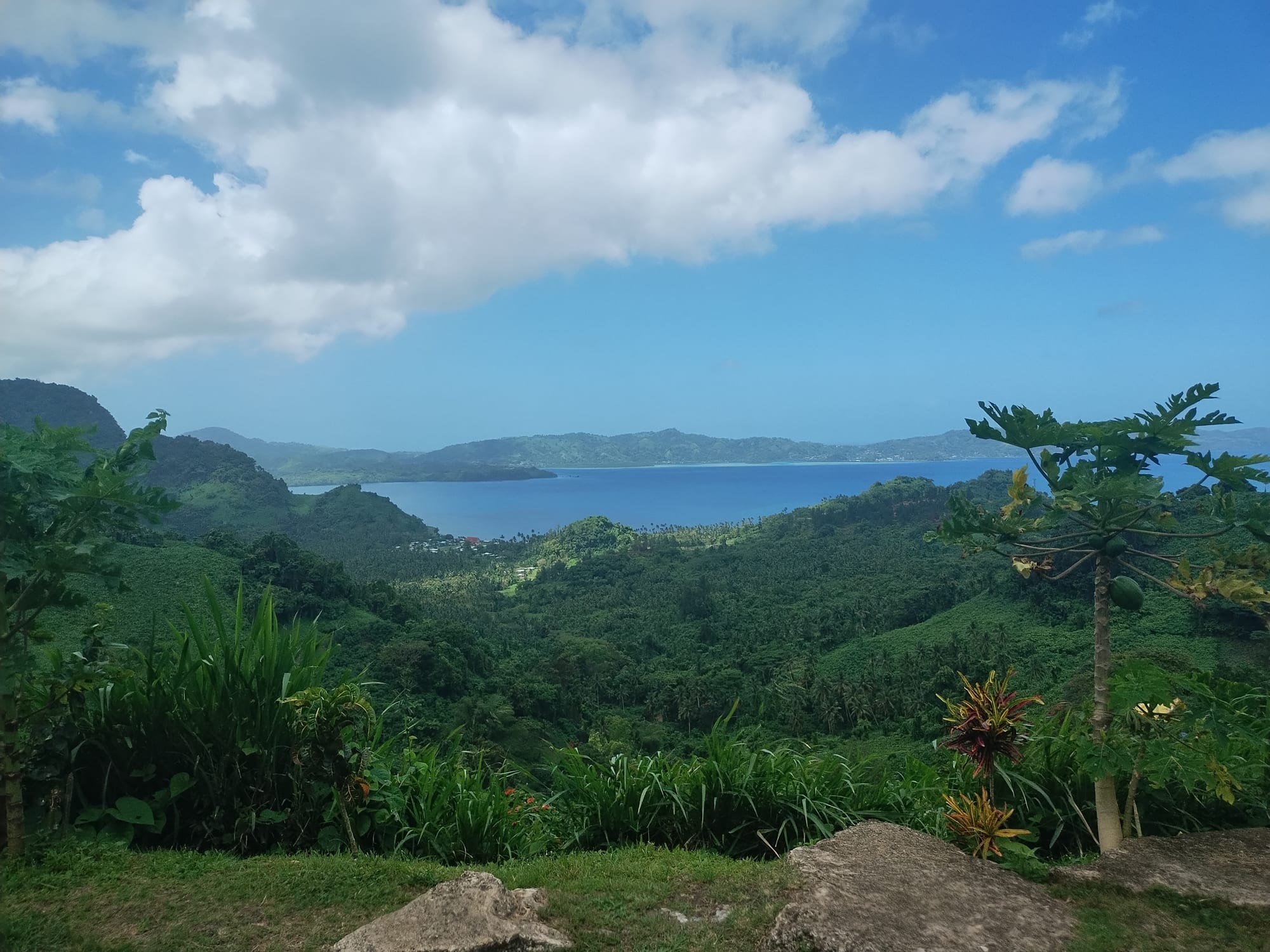
Green forested hills and a papaya tree in front of a wide blue bay ringed by low mountains under white clouds

Fiji

Vanua Levu, Taveuni & the North

The view over the hills and the bay from Urata Lookout near Savusavu on Vanua Levu. (Spicy / Wikimedia Commons · CC BY 4.0)

Fiji's Northern Division — Vanua Levu, the country's second-largest island, with the sugar town of Labasa and the sheltered yacht harbour of Savusavu, plus the rainforest island of Taveuni and smaller islands such as Rabi and Kioa. It is quieter and less developed than Viti Levu, known for its reefs, rainforest and farming.

Explore Vanua Levu, Taveuni & the North

History

Vanua Levu and Taveuni were long divided among chiefdoms, of which Cakaudrove, with its seat at Somosomo on Taveuni, was the most powerful; Macuata and Bua held the north-east and west of Vanua Levu. Cakaudrove's paramount chief, the Tui Cakau, remains one of the country's senior chiefly titles.

The north was the first part of Fiji drawn into the outside world's trade. From around 1805, ships came to the Bua Bay area for sandalwood. In the 1860s settlers from Australia and New Zealand set up coconut plantations around Savusavu, and after cession a sugar mill opened at Labasa in the 1890s, drawing Indian indentured labourers to the cane lands of the northern plain. Their descendants remain the majority in and around Labasa.

In the 20th century the north became a refuge for displaced Pacific peoples. In 1945 the British resettled the Banabans on Rabi island after phosphate mining had devastated their home island of Banaba, now part of Kiribati, and from 1947 people from Vaitupu in present-day Tuvalu bought and settled neighbouring Kioa. The national crises reached the north as well: during the coup of 2000, soldiers at the army barracks in Labasa mutinied in support of George Speight's group. Cyclone Winston in 2016 caused heavy damage in parts of the north.

Culture & Customs

The north has its own identity within Fiji. Cakaudrove, Macuata and Bua each have their own chiefly structures, and the Tui Cakau's village of Somosomo remains an important ceremonial centre. Visitors to any village bring yaqona for a sevusevu, dress modestly and keep hats off, and on Taveuni much of the land used for walks and waterfalls belongs to villages that manage it themselves.

Labasa and the cane belt are strongly Indo-Fijian. Hindu temples, mosques and churches stand in the town, Fiji Hindi is the everyday language on the farms, and Diwali and Holi are celebrated widely. Football, rather than rugby, is the favourite sport of many Indo-Fijians, and Labasa is one of the country's traditional football strongholds.

Rabi and Kioa add communities that are neither iTaukei nor Indo-Fijian. The Banabans of Rabi use Gilbertese as their everyday language and still hold Kiribati passports alongside Fijian citizenship; Kioa's people speak Tuvaluan and keep Tuvaluan customs.

Daily Life

The Northern Division has about 130,000 people. Labasa, with about 28,000 in the town and its surroundings, is the commercial centre, where farmers come to the market and the sugar mill runs through the crushing season. Savusavu is a small town of shops, marinas and government offices, and Taveuni's main settlements are Somosomo, Waiyevo and Matei.

Sugar cane dominates the Labasa plain and the north coast. Elsewhere the economy runs on copra, fishing and small farms, and Taveuni's farmers have turned from copra to dalo, yaqona, vanilla and tropical fruit. Tourism is smaller than on Viti Levu and focused on diving, the Savusavu marinas and a handful of resorts.

Life is slower than on Viti Levu. Buses and carriers link the villages, stores close early, and Sundays are for church. The main concerns are the ageing sugar industry, poor roads and power in rural areas, young people moving to Suva or abroad, and rebuilding after cyclones.

Food

Labasa's food is Indo-Fijian first: curries of chicken, goat, fish and vegetables, roti and dhal, and snacks such as bhajia and samosa from market stalls, with Indian sweets for festivals. Sugar cane is chewed fresh in the harvest season, and roadside stalls sell tropical fruit from papaya and pineapple to mango.

On Taveuni and in the iTaukei villages the base is dalo, cassava, breadfruit and yams, with rourou, taro leaves cooked in coconut cream, and fresh reef fish. Kokoda, raw fish marinated in lime and coconut cream, is on every menu, and lovo feasts mark church events, weddings and visits by chiefs.

Coconut is everywhere: in cooking, as fresh drinking nuts, and as copra, the dried flesh that was long the mainstay of Taveuni's economy. Yaqona grown on Taveuni and in the hills of Vanua Levu is drunk every evening in the villages and at the sevusevu that welcomes every guest. Seafood such as lobster, crab and octopus reaches the markets in Savusavu and Labasa from the reefs.

Attractions & Natural Wonders

Savusavu, on the south coast of Vanua Levu, is a favoured stop for yachts, with moorings, a yacht club in the old Copra Shed Marina and hot springs steaming along the waterfront. East along the Hibiscus Highway lie Natewa Bay and the coast towards Buca Bay. Across the mountains, Labasa is worth a visit for its market, temples and sugar-mill town atmosphere, and off the north coast lies the Great Sea Reef, a long barrier reef system.

Taveuni, across the Somosomo Strait, is known for its rainforest. The Bouma National Heritage Park, set up in 1990 by landowning clans concerned about logging, holds the Bouma Falls, Fiji's best-known waterfalls. In the mountains lies Lake Tagimaucia, and the island's highland rainforest is the only home of the tagimoucia flower. The 180th meridian crosses the island.

In the strait itself, the Rainbow Reef, with its Great White Wall of soft corals, is one of Fiji's best-known dive areas. South of Vanua Levu, the reef around Namenalala island, an outlier of Vanua Levu with a nature reserve and an Important Bird Area, was badly damaged, reef included, by Cyclone Winston in 2016.

Cities in Vanua Levu, Taveuni & the North

Planning basics

Budget

The north has a narrower price range than the west. Labasa is cheap, with simple hotels and inexpensive curry houses, while Savusavu and Taveuni have guesthouses and backpacker cottages alongside a small number of expensive boutique and island resorts. Diving is the main extra, and the domestic flight or ferry from Viti Levu is a significant part of any budget.

Daily Budget Midrange
USD 110–250 (mid-range resort or dive lodge, a day's diving, taxis or a hire car)
Daily Budget Shoestring
USD 40–65 (guesthouse or backpacker cottage, local buses, market and curry-house food)

Cash machines are found in Labasa, Savusavu and near Taveuni's airstrip and ferry landing but not in villages, so carry enough cash for rural stays.

Safety

The north is generally calm and crime is low, with occasional theft in Labasa and Savusavu. The main hazards are natural: strong tidal currents in the Somosomo Strait, remote dive sites far from medical help, slippery rainforest trails and river crossings after rain, and cyclones and flooding in the wet season.

Dive the Somosomo Strait only with experienced local operators who know the tides, walk the Taveuni trails in daylight with water, and ask permission before entering village land. Check current official travel advice before travelling.

Climate

Like the rest of Fiji the north is tropical all year, but there is a sharp split between the wet windward and drier leeward sides. Taveuni's eastern side and mountains are among the wettest places in the country, which feeds its rainforest and waterfalls, while Labasa and the northern coast of Vanua Levu are drier and suited to sugar cane. Cyclones cross the area in some wet seasons; Cyclone Winston caused heavy damage in 2016.

Summer
November–April: hot and humid, around 30–32°C, with heavy rain on Taveuni and cyclone risk
Winter
May–October: warm and drier, around 25–29°C, with the best diving visibility

Transportation

Domestic flights link Nadi and Suva with Labasa, Savusavu and Taveuni, and are the quickest way in. Car ferries run from Viti Levu to Vanua Levu and on to Taveuni, taking the better part of a day. On Vanua Levu a road links Labasa and Savusavu across the mountains, buses run between the towns, and the Hibiscus Highway continues east from Savusavu towards Buca Bay. Taveuni has one coastal road, partly unsealed, with buses and taxis.

Allow a full day for any ferry leg, and choose flights when time is short; hire cars with high clearance for Vanua Levu's unsealed roads.

Best Time to Visit

May to October is the drier season and the main time for diving the Rainbow Reef and Namena, when seas are calmer. Savusavu fills with cruising yachts in the middle of the year, and many leave before the cyclone season; the wet months bring greener landscapes and fuller waterfalls but more rain and rougher crossings.