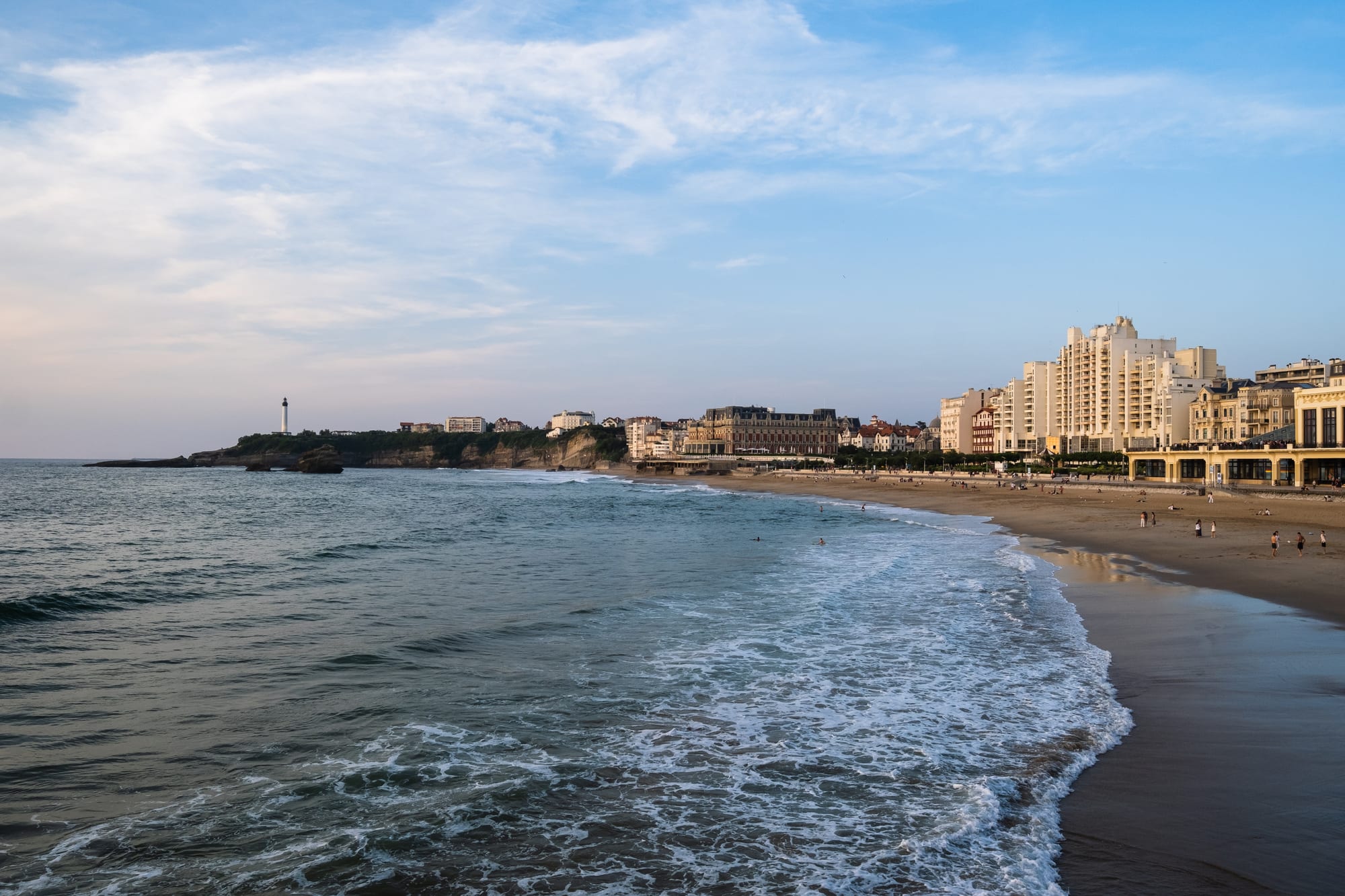
Waves breaking on a wide sandy beach lined with pale seafront buildings at sunset

Nouvelle-Aquitaine: Bordeaux, Dordogne & the Basque Coast, France

Biarritz

The Grande Plage of Biarritz at sunset. (Christian David / Wikimedia Commons · CC BY-SA 4.0)

A resort on the Bay of Biscay in the French Basque Country, 35 km from the Spanish border. A whaling village that became a fashionable bathing town after Empress Eugénie built a palace on its beach in 1854, it later became the place where surfing arrived in Europe, and it now mixes Belle Époque villas, casinos and rocky headlands with surf beaches.

Neighbourhoods

  • Centre-ville and the Grande Plage
    • First-time visitors
    • Beaches
    • Nightlife

    The town centre runs from the seafront, with the Grande Plage and its casinos, back to the covered market and the shopping streets. Much of it has been reworked to favour pedestrians, and it holds most of the restaurants, bars and shops.

    Open in Maps
  • Port des Pêcheurs and the Rocher de la Vierge
    • Historic seafront
    • Views
    • Best for food

    The old fishermen's harbour below the Atalaye plateau, with seafood restaurants. The Rocher de la Vierge, the aquarium and the sheltered Port-Vieux beach are all close by.

    Open in Maps
  • Côte des Basques and Beaurivage
    • Surfing
    • Beaches
    • Local life

    Beaurivage sits on the slope above the Côte des Basques, the long surf beach of the town, and was long a working-class quarter where sailors and tourists mixed. Further south are the Marbella and Milady beaches and the Cité de l'Océan.

    Open in Maps
  • Saint-Charles and the Phare
    • Quiet and residential
    • Villas
    • Views

    The northern district on the boundary with Anglet; the Phare quarter is named after the lighthouse inaugurated on the Pointe Saint-Martin in 1834. A golf course founded by British residents in 1888 lies beside it.

    Open in Maps
  • Saint-Martin
    • Historic district
    • Quiet and residential

    One of the original settlements of Biarritz, on a small hill inland around the 12th-century church of Saint-Martin, the oldest in town. Mostly residential and well away from the summer crowds.

    Open in Maps
  • La Négresse and the station
    • Close to public transport
    • Budget stays

    A residential district on both sides of the main road south, grouped around a small business park and the railway station, about 3 km from the seafront. Its name has been the subject of controversy for several years.

    Open in Maps

Things to do

Landmarks and headlands

  • Rocher de la Viergeviewpoint

    The rocky promontory at the heart of the seafront, from which the beaches of Port-Vieux, the Côte des Basques, Marbella and Milady spread out to the south.

    Open in Maps
  • Biarritz lighthouseviewpoint

    A 44-metre white lighthouse on the Pointe Saint-Martin, built in 1834, at the northern end of the town's seafront.

    Open in Maps
  • Plateau de l'Atalayeviewpoint

    The high ground above the fishermen's harbour, once a whale-watching post, with views north along the coast.

    Open in Maps
  • Chapelle impérialelandmark

    The chapel built in 1864–66 at the request of Empress Eugénie, mixing Romanesque-Byzantine and Hispano-Moorish styles.

    Open in Maps
  • Russian Orthodox churchlandmark

    A 19th-century church with a blue dome, built for the Russian aristocrats who spent seasons in Biarritz.

    Open in Maps
  • Église Saint-Martinlandmark

    The oldest church in Biarritz, built in the 12th century and restored in the mid-16th.

    Open in Maps

Museums

  • Biarritz Aquariummuseum

    The Musée de la Mer, an Art Deco building of 1933 on the Atalaye rock with tanks of fish, sharks and seals and displays on the town's whaling past.

    Open in Maps
  • Cité de l'Océan et du Surfmuseum

    A museum of the ocean opened in 2011, designed by Steven Holl under a curving roof that tilts towards the sea.

    Open in Maps
  • Asiaticamuseum

    A museum of Asian art, chiefly from India, Nepal, Tibet and China.

    Open in Maps
  • Museum of the History of Biarritzmuseum

    The town's story told inside St Andrew's, a deconsecrated Anglican church.

    Open in Maps

Beaches

  • Grande Plagebeach

    The main beach in front of the casinos, once called the 'côte des Fous' when the sea was prescribed as a cure.

    Open in Maps
  • Côte des Basquesbeach

    The long surf beach below Beaurivage, home of the Biarritz Surf Festival since 1993; at high tide the sand almost disappears.

    Open in Maps
  • Plage du Port-Vieuxbeach

    A small, sheltered cove beside the Rocher de la Vierge, often good for swimming when the surf beaches are rough.

    Open in Maps
  • Plage du Miramarbeach

    The northern extension of the Grande Plage, reached only on foot, with a pierced rock offshore where gulls nest.

    Open in Maps

Sport and nights out

  • Biarritz Olympiqueattraction

    The rugby union club, five times French champions, plays at the Parc des Sports Aguiléra.

    Open in Maps
  • Municipal casinoattraction

    The Art Deco casino on the Grande Plage, one of two large casinos on the waterfront.

    Open in Maps

Short trips along the Basque coast

  • Bayonneattraction

    The neighbouring historic port city, in the French Basque Country and the southern part of Gascony, that gives its name to Bayonne ham.

    Open in Maps
  • Saint-Jean-de-Luzattraction

    A fishing harbour town further down the coast towards Spain.

    Open in Maps
  • Espeletteattraction

    The inland Basque village known for its dried red peppers, which carry a protected designation and are used in Bayonne ham.

    Open in Maps
  • Larrunviewpoint

    La Rhune, a 905-metre mountain at the western end of the Pyrenees on the border with Spain.

    Open in Maps
  • San Sebastiánattraction

    The Spanish Basque city across the border, reached along the coast by bus.

    Open in Maps

Seasonal events

  • FIPADOCJanuary

    An international festival of documentary and non-fiction film, held in Biarritz since 1997.

  • Cesta punta tournamentsJuly and August

    Amateur and professional Basque pelota tournaments in the jai alai court, the Euskal-jaï, each summer.

  • Summer fireworkssummer

    Fireworks set off over the sea from the Rocher le Basta, the Grande Plage and the Cité de l'Océan.

  • Saint Martin's DayNovember

    The feast of the town's oldest parish, when a new member of the Confrérie de l'Operne, whose emblem is the barnacle, is proclaimed.

Eat and drink

Long-standing places and food districts in Biarritz. Hours, ratings and directions come from your maps app, always current.

Biarritz classics

  • Les Halles de Biarritzmarket

    The covered central market on the rue des Halles, selling fresh food.

    Open in Maps
  • Port des Pêcheursneighborhood

    Seafood restaurants around the little harbour below the Atalaye.

    Open in Maps
  • Miremontcafe

    A sweet shop counted among the town's notable civil buildings.

    Open in Maps

Basque food districts

  • Centre-ville restaurantsneighborhood

    Restaurants around the market and the streets behind the Grande Plage serve Basque cooking — axoa, piperade and gâteau basque — alongside bars and nightclubs.

    Open in Maps

Experience Biarritz

History

Stone tools from the Middle Palaeolithic show that people lived around Biarritz long before the town first appears in writing, as Bearids, in a cartulary of Bayonne in 1186. For centuries it lived from the sea and above all from whaling: watchers on the Atalaye headland burned wet straw to signal a whale, and the town's coat of arms still shows a rowing boat of Basque sailors with a harpoon above a whale. When the whales moved away in the 16th century, whalers from Labourd followed them across the Atlantic to Labrador and Newfoundland and later turned to cod.

In the 18th century doctors began to claim that the sea at Biarritz had healing powers, and in the 19th century sea-bathing became fashionable. Napoleon bathed here in 1808, Victor Hugo praised the place in 1843 and feared it would become fashionable, and in 1854 Empress Eugénie, wife of Napoleon III, built a palace on the beach. Queen Victoria, Edward VII, Alfonso XIII of Spain and a long line of other royals followed, the casino opened in 1901, and the railway from Paris helped to make it one of Europe's leading resorts; the population rose from 5,000 to 18,000.

After the Second World War the hotels and casinos housed a short-lived American university for demobilised soldiers. In 1957 a Californian friend of the film-maker Peter Viertel rode a surfboard off Biarritz, recognised as the first surfing in Europe, and the town became one of the continent's best-known surf spots. It hosted the G7 summit in August 2019.

Culture & Customs

Biarritz sits on the old cultural border between Gascony and the Basque Country, in the traditional province of Labourd, and it is uncertain whether Basque or Gascon was its historic language; French became the main language in the 20th century. Since the 1990s the town has promoted Basque language and culture, and Basque pelota is a popular sport, with tournaments of cesta punta at the Euskal-jaï court every summer.

Rugby is followed closely: Biarritz Olympique has won five French championships and two European Cups. Surfing has shaped the town's image and nightlife since the 1950s; the first surf club was founded in 1959 and the Biarritz Surf Festival at the Côte des Basques, founded in 1993, is one of Europe's leading surf events. A golf course near the lighthouse was laid out by British residents in 1888, a reminder of the old British colony.

The arts are strong for a town of its size. The Ballet of Biarritz is an important centre of French dance, the Oldarra choir dates from 1946, and the town hosts the Biarritz Festival Latin America, held annually since 1979, and the FIPADOC documentary festival in January. On Saint Martin's Day in November the Confrérie de l'Operne, whose emblem is the barnacle, proclaims a new member.

Daily Life

About 26,200 people lived in Biarritz at the 2023 census. The population passed 30,000 in 1999 and then fell back as fewer people moved in, and it has a high proportion of older residents. Biarritz forms one urban area with Bayonne and Anglet.

Tourism and spa treatments drive the economy, together with sport — golf, surfing and rugby — and some industry, including a Dassault Aviation plant, named after Biarritz though it stands in neighbouring Anglet, that assembles fuselages for Falcon jets. The fishing economy that built the town has gone.

The town has six official districts, from the villas of Saint-Charles and the lighthouse quarter to the hill of Saint-Martin and the residential area around the station. Life follows the seasons: crowded and lively in summer, much quieter in winter. Since July 2022 the Tram'Bus has linked the town with Bayonne and Anglet. About 40 per cent of the town's homes are second homes, and the town has raised the housing tax on them by up to 60 per cent.

Food

Biarritz eats as the Basque Country does. Piperade is onions, green peppers and tomatoes sautéed and flavoured with red Espelette pepper, often with egg added; its colours match those of the Basque flag. Axoa is minced veal with onions and tomatoes, seasoned with the same pepper, once a fair-day dish. Bayonne ham, a cured ham with protected status named after the neighbouring city, appears on every menu.

The sea supplies the rest. Basque cooking favours fish and meat grilled over hot coals, salt cod and stews such as marmitako, a tuna, potato and pepper stew traditionally eaten by tuna fishermen on their boats in the Bay of Biscay. Restaurants around the fishermen's harbour serve seafood beside the boats, and the covered market in the centre sells fresh food; among Basque cheeses is Ossau-Iraty, made from sheep's milk.

For dessert, gâteau basque — in Basque etxeko bixkotxa, "cake of the house" — is a pastry filled with black cherry jam or pastry cream. The town's chocolate tradition has its own museum, and the Miremont sweet shop is one of its historic buildings. To drink there is txakoli, a slightly sparkling, very dry white wine, and Basque cider.

Planning tools

Budget

Biarritz is one of the more expensive resorts in south-west France, above all in July and August, when rooms are scarce and prices high. Food can be kept affordable with the market and Basque bars, and the beaches, headlands and coastal paths are free. Spring and autumn are noticeably cheaper.

Daily Budget Midrange
USD 170–320 (mid-range hotel, restaurant dinners, museum or aquarium tickets, surf lessons)
Daily Budget Shoestring
USD 80–120 (hostel or surf-hostel bed, market food, local buses)

Book summer accommodation early; the free electric shuttles and the bus network make a car unnecessary in town.

Best Time to Visit

May, June and September offer warm weather and calmer beaches; July and August bring the crowds, the summer fireworks and pelota tournaments. The autumn swell draws surfers, and winter is mild but wet — Biarritz is one of the wettest towns in metropolitan France — and quiet, with the documentary festival in January.

Suggested Number of Days

Two or three days cover the town and its beaches. Adding the neighbouring towns, the villages inland and the Spanish side of the Basque coast stretches that to a week; time spent surfing or a run of rainy days makes the number grow.

First Visit
2–3 days
With Surroundings
5–7 days

Transportation

The centre is compact and largely pedestrian-friendly. Since July 2022 the Tram'Bus has linked Biarritz with Anglet and Bayonne, alongside the TXIK TXAK bus network, and two free electric shuttle lines serve the centre, one of them running to the Côte des Basques and Port-Vieux beaches. Buses run along the coast to Saint-Jean-de-Luz, Hendaye and into Spain. A car helps for the villages inland, but parking in summer is difficult.

Leave the car at the accommodation in summer and use the shuttles and buses around town.

Airport & Station Connections

Biarritz Pays Basque Airport is about 4 km from the town, mostly within Anglet, with flights from France and other European countries. Biarritz station, on the Bordeaux–Irun line about 3 km from the centre, has high-speed TGV trains from Paris in about five hours, night trains and regional services; buses link it with the seafront.

Walkability

The centre, the harbour and the main beaches are close together and easy on foot, linked by seafront promenades, though the town is hilly and some streets climb steeply from the beaches. The station and the airport are too far to walk.

Safety

France is a safe country overall, with violent crime against visitors uncommon. In Biarritz the main hazards are the sea: strong Atlantic surf and rip currents, and winter storms.

Swim only between the flags at lifeguarded beaches, keep away from the seafront rocks in heavy swell, and leave nothing visible in parked cars. Check current official travel advice before travelling.

Climate

A temperate oceanic climate, mild and wet in every season. The nearest weather station, in Anglet, records an annual average of about 14.5°C and around 1,470 mm of rain a year, which makes Biarritz one of the wettest towns in metropolitan France.

Summer
warm, with sea breezes and occasional heatwaves; the record at the nearest station is 42.9°C, set in June 2022
Winter
very mild and rainy; in the Atlantic Pyrenees climate zone, lowland winters average about 7.5°C

Local Customs

Biarritz is a French town in the Basque Country: French is spoken everywhere, while Basque appears on signs and is promoted by the town. A 'bonjour' on entering shops is expected. Service is included in restaurant bills, so tipping is optional, with small change left for good service. Swimwear belongs on the beach rather than in shops and cafés in town.

Cover up away from the beach, and respect Basque symbols and the local pelota and rugby culture, which matter a great deal here.

Common Payment Methods

The currency is the euro. Cards and contactless payment are accepted almost everywhere, and cash machines are easy to find in the centre. A little cash is useful at the market and for small purchases.