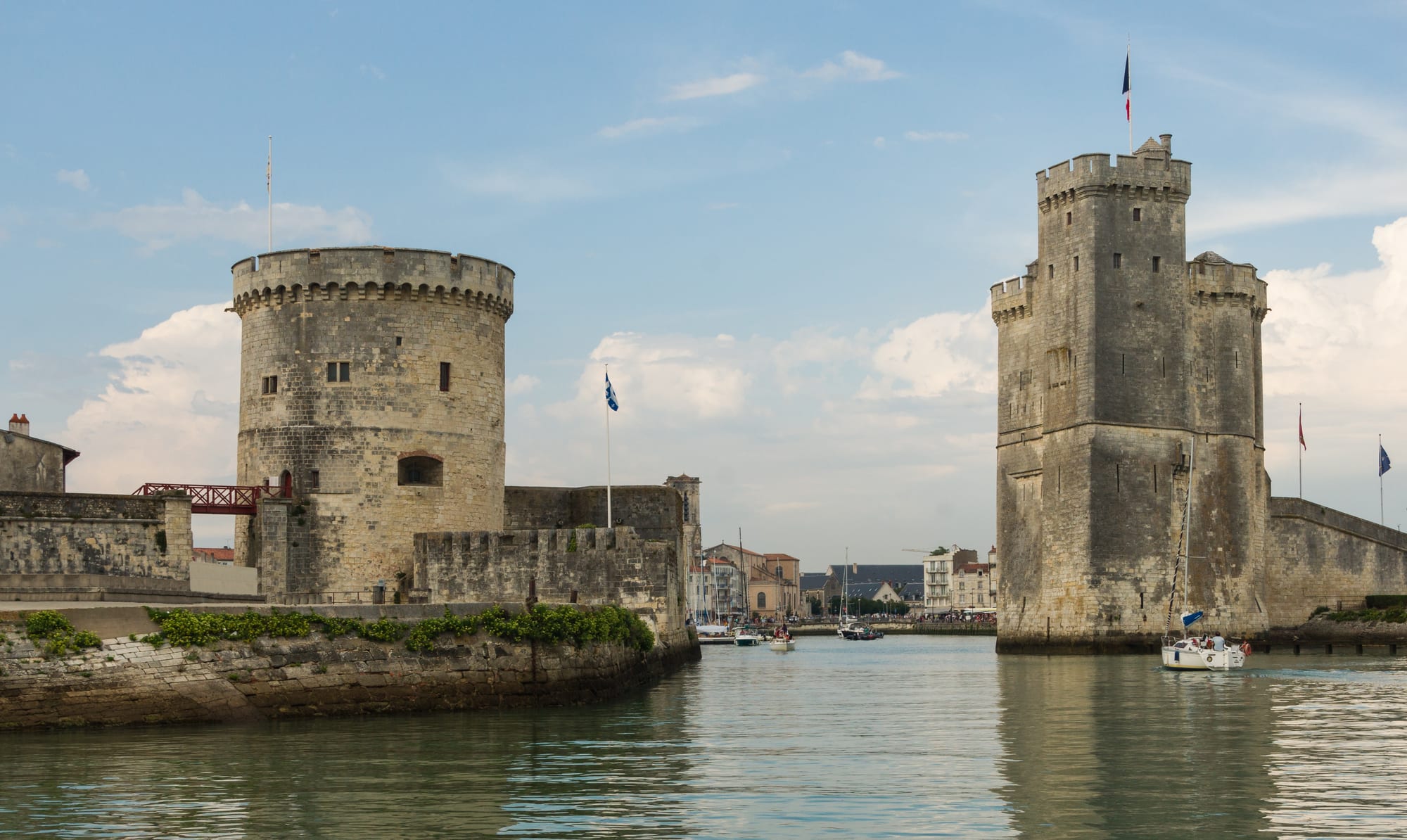
Two medieval stone towers, one round and one square, facing each other across calm water at a harbour entrance

Nouvelle-Aquitaine: Bordeaux, Dordogne & the Basque Coast, France

La Rochelle

The Chain Tower and the Saint Nicolas Tower at the entrance to the old harbour of La Rochelle. (Jebulon / Wikimedia Commons · CC0)

The capital of Charente-Maritime, an Atlantic port on the Bay of Biscay whose old harbour is guarded by three medieval towers. Once the largest French port on the Atlantic and a Huguenot stronghold broken by Richelieu's siege of 1627–28, it is now a university and sailing city of pale limestone arcades, linked by bridge to the Île de Ré.

Neighbourhoods

  • Vieux-Port and the old town
    • First-time visitors
    • Historic district
    • Best for food

    The old harbour at the heart of the city, lined with seafood restaurants and guarded by its towers, with the Grosse Horloge gate leading into arcaded streets of pale limestone around the town hall, the market and the cathedral. Well preserved and largely walkable.

    Open in Maps
  • Saint-Nicolas
    • Local life
    • Bars and cafés

    The quarter across the canal from the old town, reached by several bridges including a footbridge by the harbour lock, beside the Saint Nicolas Tower.

    Open in Maps
  • Le Gabut
    • Families
    • Waterfront

    The waterfront district between the old harbour and the station, where the aquarium has stood since 2001.

    Open in Maps
  • Les Minimes
    • Sailing
    • Students
    • Beaches

    Reclaimed land south of the centre built around one of the largest pleasure-boat marinas in Europe, with university campuses, a student village, shops, restaurants, a cinema and a town beach. A passenger boat links it with the old harbour.

    Open in Maps
  • La Pallice
    • Industrial heritage

    The deep-water commercial port to the west, home to the fishing fleet since the 1980s and to the huge submarine pens built during the Second World War, near the bridge to the Île de Ré.

    Open in Maps
  • Mireuil and Villeneuve-les-Salines
    • Quiet and residential
    • Local life

    Large residential districts built from the 1970s, partly by workers who came from the Maghreb, and home to much of the city's everyday population, with their own community festivals.

    Open in Maps

Things to do

The harbour towers and old town

  • Saint Nicolas Towerlandmark

    One of the three medieval towers guarding the harbour entrance, dated to 1384 and a historic monument since 1879.

    Open in Maps
  • Chain Towerlandmark

    The tower opposite, also dated to 1384 and named after the chain that was stretched across the harbour entrance from it to stop ships passing.

    Open in Maps
  • Lantern Towerlandmark

    A 15th-century tower that served as a lighthouse and a prison.

    Open in Maps
  • Grosse Horlogelandmark

    The Gothic great gate and clock tower that connects the harbour quays with the old streets behind.

    Open in Maps
  • Hôtel de Villelandmark

    The town hall, a historic monument since 1861, rebuilt after a fire in 1486 and badly damaged by another in 2013.

    Open in Maps
  • La Rochelle Cathedrallandmark

    The neoclassical cathedral of Saint-Louis, begun in 1742, with paintings by William Bouguereau in its cupola and the late-medieval Gothic bell tower of the earlier church of Saint-Barthélemy.

    Open in Maps

Museums and the aquarium

  • Aquarium de La Rochellemuseum

    A large family-owned aquarium with 3 million litres of seawater and more than 12,000 animals of 600 species, visited by around 800,000 people a year.

    Open in Maps
  • Maritime Museummuseum

    A museum on the quay with eight 20th-century ships moored in the Bassin des Chalutiers.

    Open in Maps
  • Muséum d'Histoire naturellemuseum

    The natural history museum, reopened in 2007 after a major renovation, with about 10,000 objects collected by naturalists and ethnographers since the 18th century.

    Open in Maps
  • Musée du Nouveau Mondemuseum

    The New World Museum, in the network of old streets behind the harbour.

    Open in Maps
  • Le Bunkermuseum

    A museum in a real bunker, open since 2013, on the history of La Rochelle and its surroundings during the Second World War.

    Open in Maps

Parks, beaches and the marina

  • Jardin des plantespark

    A small botanical garden in the city centre.

    Open in Maps
  • Port des Minimesattraction

    One of the largest pleasure-boat marinas in Europe and the largest in France, home to some 5,000 vessels.

    Open in Maps
  • Plage de la Concurrencebeach

    The town beach whose opening turned La Rochelle into a seaside resort.

    Open in Maps
  • Plage des Minimesbeach

    The town beach beside the marina, opened in 1978.

    Open in Maps

Sport and nights out

  • Stade Marcel-Deflandreattraction

    The home ground of Stade Rochelais, the city's rugby union club, which plays in the Top 14.

    Open in Maps

Short trips from the city

  • Île de Réattraction

    The resort island across the strait, about 30 km long, with beaches and the fortified port of Saint-Martin-de-Ré, reached by a 2.9-km toll bridge opened in 1988.

    Open in Maps
  • Île-d'Aixattraction

    A small island in the bay, reached by boat trips from the harbour.

    Open in Maps
  • Fort Boyardlandmark

    A sea fort built between 1801 and 1857 on a sandbank between the Île-d'Aix and the Île d'Oléron, seen on boat trips from La Rochelle and famous from television.

    Open in Maps
  • Rochefortattraction

    A town to the south, the usual way across to the Île d'Oléron.

    Open in Maps

Seasonal events

  • Les FrancofoliesJuly

    One of the largest music festivals in France, founded in 1985 to promote French-language music.

  • Festival de la FictionSeptember

    A festival of television drama, with free screenings of new series before they are broadcast.

  • La Rochelle Jazz FestivalOctober

    A jazz festival held in the city each autumn.

  • Marathon de La RochelleNovember

    Held every year since 1991, one of the most popular marathons in France.

Eat and drink

Long-standing places and food districts in La Rochelle. Hours, ratings and directions come from your maps app, always current.

La Rochelle classics

  • Vieux Marchémarket

    The main market, with its market hall, on the north side of the old town.

    Open in Maps
  • Fish market in the old Carmelite churchmarket

    A fish market housed in the former church of the Carmelites, on a street just behind the harbour.

    Open in Maps
  • Vieux-Port seafood restaurantsneighborhood

    The quays of the old harbour are lined with seafood restaurants serving mussels, oysters and fish.

    Open in Maps

Food districts

  • Les Minimesneighborhood

    Restaurants and bars around the marina and the university campus, popular with students and sailors.

    Open in Maps

Experience La Rochelle

History

The Romans developed salt production along this coast, and Roman villas have been found at Saint-Éloi and Les Minimes. The name first appears in 961 as Rupella, "little rock". The port rose after Duke Guillaume X of Aquitaine defeated the lord of nearby Châtelaillon in 1130, and in 1137 he made it in effect a free port with the rights of a commune. Through Eleanor of Aquitaine's marriage to Henry Plantagenet the town came under English rule, the Knights Templar made it their largest base on the Atlantic, and until the 15th century it was the biggest French harbour on that coast, trading in wine, salt and cheese. Louis VIII captured it in 1224, and it changed hands again during the Hundred Years' War until the townspeople expelled the English in 1372.

During the Renaissance La Rochelle turned Protestant. From 1568 it was the Huguenot capital, declaring itself an independent Reformed republic on the model of Geneva, and it withstood a royal siege in 1572–73. Under Louis XIII, Cardinal Richelieu blockaded the city for 14 months in 1627–28 until it surrendered and lost its privileges, the setting for later chapters of Dumas' The Three Musketeers. Many Huguenots emigrated, some founding New Rochelle near New York in 1689.

The city then prospered on the New World: ships sailed for New France with soldiers and the Filles du Roi, and its shipowners were deeply involved in the triangular trade in enslaved Africans, sugar and furs until the Revolution. In the Second World War Germany built a submarine base at La Pallice, and La Rochelle was the last French city liberated, in May 1945. Since 1988 a bridge has linked it to the Île de Ré.

Culture & Customs

La Rochelle is known in France as a liveable, progressive city. It was the first town to protect its historic centre with a safeguarded zone, in 1971, it pioneered free shared bicycles in the 1970s, and it held the first car-free day. Seen from the sea the town looked so white that foreigners, the English above all, nicknamed it "la ville blanche", the white city.

Music and screen festivals give the year its shape. The Francofolies, founded in 1985 by Jean-Louis Foulquier to promote French-language music, is one of the largest music festivals in France, and its founder went on to create the Montreal edition. The Festival de la Fiction shows new television drama, and the jazz festival comes in autumn. The submarine pens of La Pallice appeared in Das Boot and Raiders of the Lost Ark. The French Socialist Party has held its summer convention here since 1983.

Sport means sailing and rugby. The Minimes marina is among the largest in Europe, and the Grand Pavois boat show is held there each year, while Stade Rochelais play in the Top 14 at the Stade Marcel-Deflandre. The marathon, run since 1991, is one of the most popular in France. A museum of Protestant history shows objects from the Huguenot past of the city and region.

Daily Life

About 80,000 people lived in La Rochelle at the 2023 census, making it the largest commune in Charente-Maritime. It is the department's capital and the most important coastal city between the Loire and Gironde estuaries, with a mix of port, industrial, administrative and service work. The university and business school bring more than 10,000 students, many of them housed around the Minimes campus.

The commercial port of La Pallice handles oil and tropical wood and is home to the fishing fleet, which moved out of the old harbour in the 1980s. Tourism and the services of a regional capital supply many of the remaining jobs.

The old town and harbour are the city's showpiece, but most people live in the newer districts — Tasdon, which formed the first neighbourhood committee in 1903, Port-Neuf, Mireuil and Villeneuve-les-Salines among them. Cycling accounts for about a tenth of journeys, and the urban area aims to double that by 2030 with new safe routes. The summer brings festival crowds and island traffic; in winter the city returns to its students and residents.

Food

La Rochelle's own dish is the mouclade, also called mouclade rochelaise or moules à la charentaise: mussels with crème fraîche, butter, white wine and saffron. Along the coast of Charente-Maritime the éclade is another way with mussels, a speciality that comes from the Île d'Oléron and the Royan area. Oysters from Marennes-Oléron and mussels from the Charente coast fill the menus.

The quays of the Vieux-Port are lined with seafood restaurants, and the main market on the north side of the old town has its own market hall; a fish market occupies the former church of the Carmelites near the harbour.

To drink there is Pineau des Charentes, a regional aperitif made by adding Cognac eau-de-vie to fresh or lightly fermented grape juice and then maturing it. It is popular in its home region but little known abroad. Inland lies the country of Cognac and Pineau, whose distilleries are within reach for a day out.

Planning tools

Budget

La Rochelle is moderately priced for a French coastal city, though rooms cost more in July and August and during the Francofolies. The Île de Ré is much more expensive in summer. Walking, the shared bicycles and the buses keep transport costs low, and the harbour, ramparts and beaches are free.

Daily Budget Midrange
USD 160–290 (mid-range hotel, seafood dinners, the towers and aquarium, a boat trip)
Daily Budget Shoestring
USD 75–115 (hostel or budget room, market food, buses and shared bikes)

Book well ahead for festival weeks and summer weekends; the old town's arcaded streets and the evening walk on the ramparts cost nothing.

Best Time to Visit

May to September, when the sunny, relatively dry summers bring the boat trips and the beaches into their own; July has the Francofolies and the biggest crowds. Autumn brings the drama and jazz festivals, and winter is mild and wetter but quiet.

Suggested Number of Days

Two or three days cover the old town, the harbour and its museums. The islands and coast around the bay add several more, and a boat trip or a cycling day on the island stretches the stay further.

First Visit
2–3 days
With Surroundings
4–6 days

Transportation

La Rochelle has a long tradition of cycling: it launched one of the first free shared-bicycle schemes in the 1970s, and cycling makes up about a tenth of trips in the city. The Yélo network combines buses, bike hire and electric car hire, and a passenger boat links the old harbour with Les Minimes. Buses run from near the station to the Île de Ré, which is reached by road over a toll bridge that is free for cyclists and pedestrians.

Use a bike or the harbour boat rather than a car in the centre, where parking is limited.

Airport & Station Connections

La Rochelle station has TGV services to Paris and trains to Poitiers, Nantes, Bordeaux and regional towns. La Rochelle–Île de Ré Airport lies immediately north of the city, with direct flights to some European destinations; the nearest larger international airports are Nantes, 137 km north, and Bordeaux-Mérignac, 191 km south-east.

Walkability

The old town and harbour are compact and best explored on foot, with arcaded pavements that give shelter from sun and rain. The station, the aquarium and the towers are all within an easy walk of each other; the ramparts make an evening promenade. Les Minimes and La Pallice are better reached by bike, bus or boat.

Safety

France is a safe country overall, with violent crime against visitors uncommon. La Rochelle is a calm city; the main hazards are ocean storms, and strong winds on the water.

Lock bikes securely and swim only at supervised beaches in summer. Check current official travel advice before travelling.

Climate

An oceanic climate softened by the sea, with relatively warm, dry and sunny summers and mild, wet winters. Rain is moderate at about 755 mm a year, falling mostly in autumn and winter; sunshine, about 2,119 hours a year, is close to that of Carcassonne in the south.

Summer
relatively warm and sunny, cooled by afternoon sea breezes; the record high is 40.5°C, set in June 2019
Winter
mild and wet, with about four days of snow a year; across Charente-Maritime winter extremes average around −5°C

Local Customs

A 'bonjour' on entering shops and cafés is expected. Service is included in restaurant bills, so tipping is optional, with small change left for good service. The city has a Protestant church as well as Catholic ones, a reminder of its Huguenot past; both are places of worship.

Respect cycle lanes, which are busy, and keep quiet in churches during services.

Common Payment Methods

The currency is the euro. Cards and contactless payment are accepted almost everywhere, and cash machines are easy to find. A little cash is handy at the market stalls.