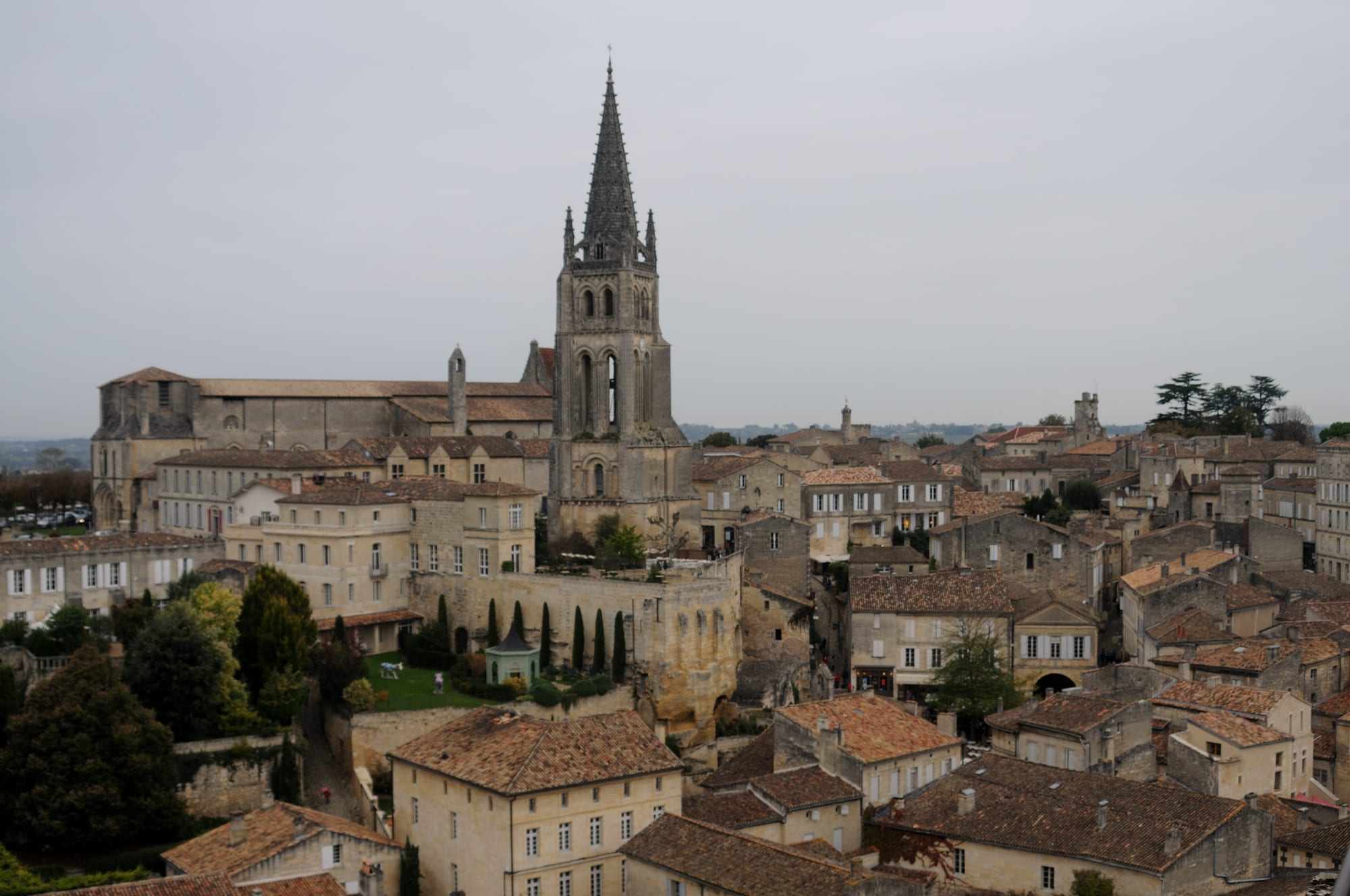
Honey-coloured stone houses with tiled roofs climbing a hillside below a tall Gothic church spire

Nouvelle-Aquitaine: Bordeaux, Dordogne & the Basque Coast, France

Saint-Émilion

The historic centre of Saint-Émilion, dominated by the bell tower of the monolithic church. (Josep M. Gracia / Wikimedia Commons · CC BY-SA 4.0)

A medieval wine village on a limestone hill 35 km east of Bordeaux, named after an 8th-century hermit monk whose followers began making wine here. Its steep lanes, a church carved out of the rock and the surrounding vineyards form a UNESCO World Heritage Site, and its Merlot-led red wines draw around a million visitors a year.

Neighbourhoods

  • The medieval village
    • First-time visitors
    • Historic district
    • Wine bars

    An amphitheatre of stone houses on the southern slope of the limestone plateau, crossed by steep lanes called tertres. The market square, the monolithic church, the cloisters and dozens of wine shops and restaurants are all within a ten-minute walk; large vehicles are kept outside.

    Open in Maps
  • The vineyards and châteaux
    • Wine tasting
    • Quiet and rural

    Vines cover more than two-thirds of the commune, dotted with wine châteaux of the 18th and 19th centuries and villages of modest one-storey stone houses. The railway station lies among them, about a kilometre below the village.

    Open in Maps

Things to do

The village

  • Monolithic churchlandmark

    An 11th- to 12th-century church carved entirely out of the limestone cliff, one of the largest underground churches in Europe, with catacombs beneath.

    Open in Maps
  • Hermitage of Saint-Émilionlandmark

    The rock shelter where the Breton monk Émilion is said to have lived until his death in 767, around which the first houses gathered.

    Open in Maps
  • Tour du Royviewpoint

    A limestone keep of 1237, almost 15 metres high, climbed for a view over the village, from which the Jurade proclaims its wine judgements.

    Open in Maps
  • Cordeliers Cloisterlandmark

    The ruined 14th- and 15th-century church and cloister of a Franciscan convent, with underground cellars beneath.

    Open in Maps
  • Collegiate church and cloisterlandmark

    The collegiate church and its cloister, protected since 1840, with an organ built in 1892 by Gabriel Cavaillé-Coll.

    Open in Maps
  • Chapelle de la Trinitélandmark

    An early Gothic chapel, listed as a historic monument in 1889.

    Open in Maps
  • Porte de la Cadène and the rampartslandmark

    An old town gate and the remains of the walls that enclosed Saint-Émilion from the early 13th century.

    Open in Maps

Short trips among the vineyards

  • Pomerolattraction

    The neighbouring Right Bank wine commune just west of Saint-Émilion, known for Merlot-based reds.

    Open in Maps
  • Libourneattraction

    The nearby sub-prefecture on the Dordogne, the wine-trading capital of northern Gironde.

    Open in Maps
  • Castillon-la-Batailleattraction

    A town on the Dordogne beside the site of the Battle of Castillon of 1453, the last battle of the Hundred Years' War.

    Open in Maps

Seasonal events

  • Portes ouvertes des châteauxearly May

    An open weekend when wine estates around the village welcome visitors.

  • Fête de PrintempsJune

    The Jurade's spring festival, when red-robed jurats process through the village and, from the Tour du Roy, give their judgement on the new wine.

  • Saint-Émilion Jazz Festivallate July

    A jazz festival held in the village since 2012.

  • Ban des vendangesSeptember

    The Jurade proclaims the start of the grape harvest from the top of the Tour du Roy after a procession in red robes.

Eat and drink

Long-standing places and food districts in Saint-Émilion. Hours, ratings and directions come from your maps app, always current.

Saint-Émilion classics

  • Macarons de Saint-Émilioncafe

    The village's almond macaroons, made continuously since 1620 to a recipe handed down by Ursuline nuns, sold in its pastry shops.

    Open in Maps
  • Wine shops and wine barsneighborhood

    The lanes around the market square are lined with wine shops and bars pouring the local reds by the glass.

    Open in Maps
  • Place du Marchéneighborhood

    The market square below the monolithic church, ringed by café and restaurant terraces.

    Open in Maps

Experience Saint-Émilion

History

People lived on the site at least 35,000 years ago, and in Gaulish times an oppidum stood on the hill above the present town. After Augustus annexed the region in 27 BC, the Romans planted vines here as early as the 2nd century AD, and in the 4th century the poet Ausonius praised the local vine. The place, then called Ascumbas, took its name from Émilion, a Breton monk who, according to tradition, had been a baker for the Count of Vannes. He carved out a hermitage in a rock shelter and lived there until his death in 767, and the monks who followed him began commercial wine production.

The town lay on the pilgrim route to Santiago de Compostela, and monasteries and churches multiplied, among them the vast church cut into the cliff in the late 11th and early 12th centuries, probably to hold the saint's body. In 1199, under Plantagenet rule, King John of England granted the town its charter and created the Jurade, which controlled the quality of the wine shipped to England from a port on the Dordogne. Walls enclosed the town from the early 13th century, and the Tour du Roy was built in 1237.

The wars of religion damaged the vineyards, and much of the religious heritage was destroyed during the Revolution, when the Jurade also lost its powers. The vineyards recovered only in the late 19th century. Wine growers revived the Jurade as a brotherhood in 1948, the first official classification of Saint-Émilion wines followed in 1955, and in 1999 the town and its vineyards became a UNESCO World Heritage Site.

Culture & Customs

Life here revolves around wine, and the Jurade is its emblem. Its 140 jurats, in traditional red robes, parade through the village twice a year. In June, after mass and inductions in the cloister of the collegiate church or in the monolithic church, they climb the Tour du Roy to give their judgement on the new wine; on the third Sunday of September they proclaim the start of the harvest from the same tower. The brotherhood promotes Saint-Émilion wines around the world and hosts wine receptions and induction ceremonies.

The village is one of France's leading tourist sites, with around a million visitors a year, and its stone lanes, underground monuments and wine shops are shaped by that traffic. Its underground excavations are extensive, and the stone for its houses came from the limestone plateau it stands on.

The calendar follows the vineyard: estates open their doors at the beginning of May, the jazz festival has filled the village at the end of July since 2012, and the harvest runs into autumn. The classification of the estates is revised roughly every ten years. The town's Gascon name is Sent Milion.

Daily Life

About 1,600 people lived in the commune at the 2023 census, and the village itself is far quieter than its fame suggests once the day visitors leave. Vineyards cover more than 67 per cent of the commune's land, and most work is tied to wine: growing, harvesting, cellar work, sales and the hospitality trade that serves visitors.

The Saint-Émilion appellation covers about 5,200 hectares of vines across its eight communes and is dominated by Merlot and Cabernet Franc. The commune belongs to the urban unit of Libourne, a group of ten communes. Libourne, the nearby sub-prefecture and wine-trading capital of northern Gironde, provides the larger shops, schools and services, and Bordeaux, 35 km away, is within reach by train or car.

The year has two peaks — the summer tourist season and the harvest in September and October, when the vineyards fill with pickers and tractors — and a quiet winter.

Food

Saint-Émilion's own speciality is the macaron, made continuously since 1620 to a recipe handed down by Ursuline nuns: a simple traditional macaroon of ground almonds, sugar and fresh egg whites. The pastry shops of the village sell them in boxes, and they are the classic souvenir after wine.

The wine is red and mostly blended. The Right Bank estates of Saint-Émilion and neighbouring Pomerol are dominated by Merlot and Cabernet Franc, with only limited Cabernet Sauvignon, in contrast to the Médoc and Graves across the river system. Saint-Émilion was left out of the 1855 Bordeaux classification; its own list, introduced in 1955, is revised periodically, and wine shops on every lane sell bottles from small growers to classified estates.

Restaurants follow the cooking of the Bordeaux area: entrecôte à la bordelaise, a steak with a red-wine and shallot sauce, and canelés, small caramelised cakes flavoured with rum and vanilla, alongside the duck and walnuts of the nearby Périgord. Café and restaurant terraces fill the market square below the monolithic church.

Planning tools

Budget

Saint-Émilion is expensive for its size: rooms in and around the village are few and in demand, especially in summer and at harvest time, and wine tours and tastings at well-known estates charge. Staying in Bordeaux or Libourne and visiting for the day keeps costs down.

Daily Budget Midrange
USD 180–320 (chambre d'hôte or small hotel, restaurant meals, a guided underground tour and château tastings)
Daily Budget Shoestring
USD 80–120 (room in Libourne or Bordeaux, picnic lunch, train fare, a cellar tasting)

Many smaller estates offer tastings by appointment; the lanes, views and market square cost nothing.

Best Time to Visit

May, June and September are the most pleasant months, with the châteaux open weekend in May, the Jurade's spring festival in June and the harvest proclamation in September. July and August are hot and crowded, with the jazz festival in late July; winter is quiet and some places close.

Suggested Number of Days

The village itself is small enough to see in a day, and many visitors come on a day trip from Bordeaux. Staying two or three nights gives time for several estate visits and tastings, which need booking and a driver who is not drinking.

First Visit
1 day
With Surroundings
2–3 days

Transportation

Large vehicles are kept outside the walls and park about ten to fifteen minutes' walk from the centre; smaller cars may park closer but may enter the village only at night. The estates are spread across the vineyards, so a car, a bicycle, a taxi or an organised tour is needed for tastings.

Wear shoes with grip: the stone lanes are steep and slippery when wet.

Airport & Station Connections

Local TER trains run from Bordeaux to Saint-Émilion station in about 45 minutes, stopping about a kilometre — a ten-minute walk — below the village; the line continues towards Bergerac and Sarlat. Buses from Bordeaux take about twice as long. By car the village is a 35–40 minute drive from Bordeaux, which has the nearest airport and high-speed trains from Paris.

Walkability

The village is crossed in under ten minutes on foot, but it is built on a slope, and the tertres are steep, cobbled and uneven, which makes them hard going for anyone with limited mobility or a pushchair. Walking out to the nearer vineyards is easy along country roads.

Safety

France is a safe country overall, with violent crime against visitors uncommon. Saint-Émilion is a quiet village; the main hazards are falls on the steep, slippery lanes, summer heat, and drink-driving after tastings.

Spit or share at tastings if driving, and carry water on hot days. Check current official travel advice before travelling.

Climate

An oceanic climate with warm summers and no dry season. The village's weather station records an annual average of about 13.9°C and around 800 mm of rain a year, with extremes of 41.6°C in August 2025 and −12°C in February 2012.

Summer
warm to hot, with occasional heatwaves; in nearby Bordeaux the record summer average, in 2003, was 23.3°C
Winter
mild and damp with some frost; the coldest month on record at Bordeaux's airport, February 1956, averaged −2.0°C

Local Customs

Greet shopkeepers and cellar staff with 'bonjour'. At tastings it is normal to spit, and to ask before photographing inside private cellars. Service is included in restaurant bills, so tipping is optional. The tourist office runs guided tours of the underground monuments.

Book estate visits in advance, arrive on time, and keep voices low in the churches and underground sites.

Common Payment Methods

The currency is the euro. Cards and contactless payment are accepted in shops, wine merchants and restaurants. A little cash is useful for small purchases.