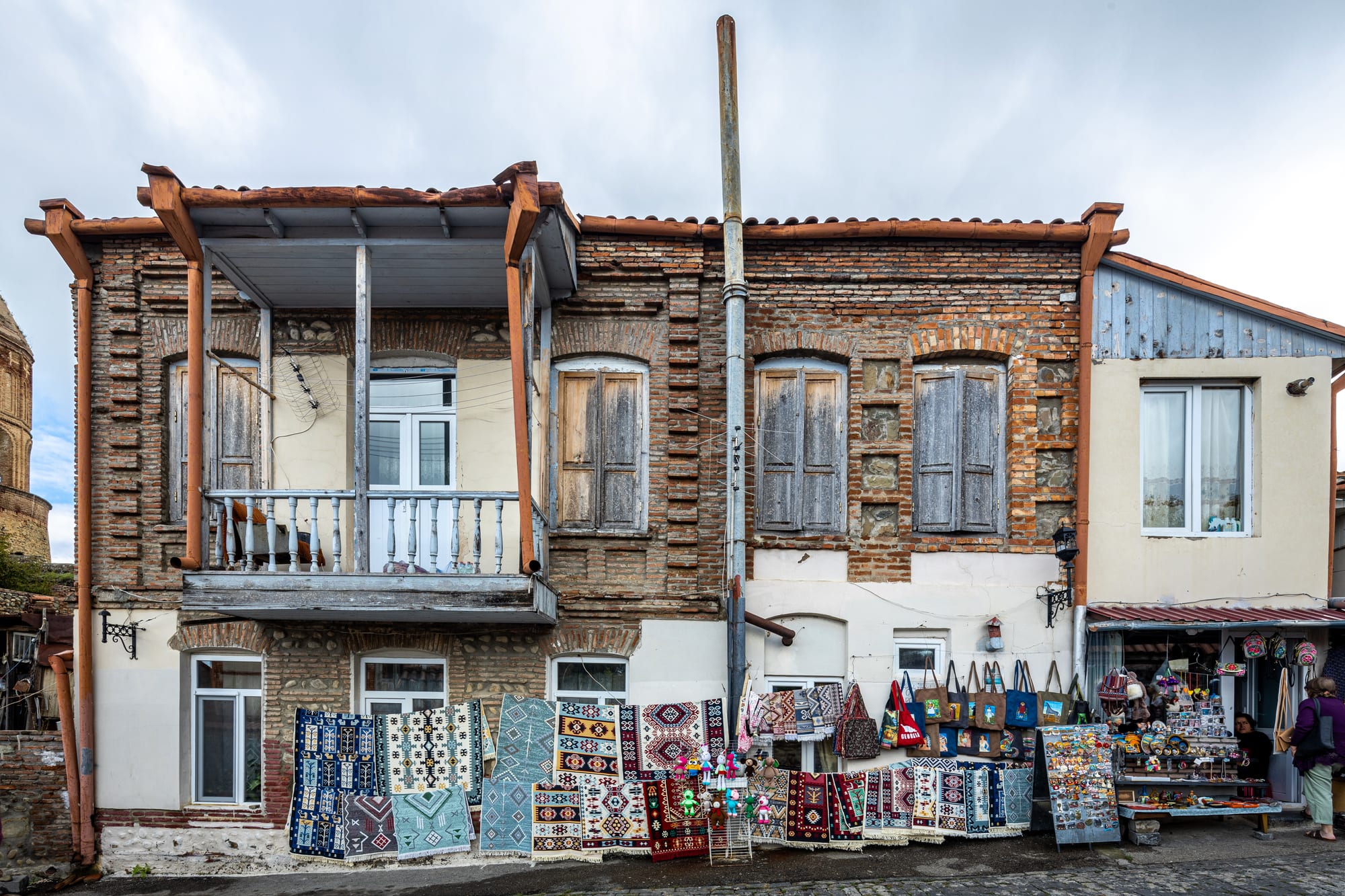
A brick and stone house in Sighnaghi with a wooden balcony and shutters, carpets and bags for sale along the pavement below

Tbilisi, Kakheti & the East, Georgia

Sighnaghi

A balconied house and souvenir stall on a street in Sighnaghi, Kakheti. (Supanut Arunoprayote / Wikimedia Commons · CC BY 4.0)

A small walled town on a ridge in Kakheti, eastern Georgia, looking north over the Alazani valley to the wall of the Greater Caucasus. King Erekle II fortified it in the eighteenth century against raids from the south; a state restoration programme in the 2000s rebuilt its streets of red-roofed, balconied houses, and it now lives largely from wine and visitors.

Neighbourhoods

  • The old town around the central square
    • First-time visitors
    • Historic district
    • Best for food

    The restored core of the town, a few blocks of cobbled streets and two-storey houses with carved wooden balconies around the square and the town hall with its clock tower. Guesthouses, wine cellars, restaurants and craft shops are concentrated here, and everything is within a few minutes' walk.

    Open in Maps
  • The walls and the northern rim
    • Views
    • Walks
    • Quiet

    The streets along the northern edge of the ridge, where the eighteenth-century wall and its towers run above the slope. Houses here look straight out over the Alazani valley to the Caucasus, and a path follows the fortifications past several of the surviving towers.

    Open in Maps
  • The Bodbe road
    • Quiet and residential
    • Close to the monastery

    The lane running south-east out of town towards Bodbe Monastery, about two kilometres away, lined with vineyards, family houses and a scattering of larger guesthouses and small hotels, with the walk itself an easy one.

    Open in Maps
  • Tsnori
    • Budget stays
    • Transport connections

    The plain working town on the valley floor a few kilometres below Sighnaghi, on the main road through Kakheti. It has the bus connections, shops and markets that the hill town lacks, and cheaper rooms, but none of the views.

    Open in Maps

Things to do

In the town

  • Sighnaghi town wallslandmark

    The eighteenth-century defensive wall built under King Erekle II, running around the ridge with towers along it, parts of which can be walked.

    Open in Maps
  • Sighnaghi Museummuseum

    The town's historical and ethnographic museum, holding Kakhetian archaeology and sixteen paintings by Niko Pirosmani, who was born in a village nearby.

    Open in Maps
  • Saint George's Churchlandmark

    The town's main church, standing within the old walled area among the restored streets.

    Open in Maps

Around the town

  • Bodbe Monasterylandmark

    A convent in cypress woods about two kilometres from the town, built over the grave of Saint Nino, who brought Christianity to Georgia in the fourth century; a spring below it is a place of pilgrimage.

    Open in Maps
  • Khornabujilandmark

    The ruins of an ancient fortress on a steep rock above the Alazani plain south of the town, reached by a short climb.

    Open in Maps

Short trips into the wine country

  • Tsinandali Estateattraction

    The house, garden and historic cellar of the Chavchavadze family, where European winemaking methods were introduced to Georgia in the nineteenth century.

    Open in Maps
  • Gremilandmark

    The citadel and church of the sixteenth-century royal capital of Kakheti, razed by the army of Shah Abbas I of Persia in 1615, standing on a hill in the valley.

    Open in Maps
  • Nekresilandmark

    A monastery founded in the sixth century, standing on a wooded slope above the north side of the Alazani valley, with early Christian remains excavated on the flat ground below.

    Open in Maps
  • Lagodekhi Protected Areaspark

    Forested mountain reserve at the eastern end of the valley, Georgia's oldest protected area, with waterfall walks and long climbs to alpine lakes.

    Open in Maps

Seasonal events

  • RtveliSeptember to October

    The grape harvest, when families and wineries across Kakheti pick and press, and guesthouses invite visitors to take part; it is the busiest and most sociable season in the town.

  • NinoobaJanuary and May

    The feast days of Saint Nino, marked with services and pilgrimage at Bodbe Monastery, where she is buried.

Eat and drink

Long-standing places and food districts in Sighnaghi. Hours, ratings and directions come from your maps app, always current.

Kakhetian classics

  • Guesthouse suprasrestaurant

    Family guesthouses in and around the town serve home cooking with their own wine — mtsvadi grilled over vine cuttings, chakapuli, pkhali and cheese from the valley — often at a shared table.

    Open in Maps
  • Restaurants on the central squareneighborhood

    The square and the streets leading off it hold most of the town's restaurants, many with terraces facing the valley, serving Kakhetian dishes and local wine by the jug.

    Open in Maps

Wine and markets

  • Town wine cellarsneighborhood

    Small marani cellars in the old town pour qvevri-made Saperavi, Rkatsiteli and amber wines, usually with bread, cheese and churchkhela alongside.

    Open in Maps
  • Sighnaghi marketmarket

    A modest daily market for fruit, vegetables, herbs, cheese and churchkhela; the larger produce market for the area is down the hill in Tsnori.

    Open in Maps

Experience Sighnaghi

History

The ridge above the Alazani was settled long before the present town, and a medieval fortress stood in the area, but Sighnaghi as it exists now dates from the middle of the eighteenth century. King Erekle II of Kartli-Kakheti had a wall built around the hill in the 1760s to shelter the people of the surrounding villages from raids by Dagestani and other bands that crossed the Caucasus into the valley. The wall, with towers set along it, enclosed far more ground than the town ever filled, so that livestock and refugees could be taken inside; the name is usually derived from a Turkic word for a place of shelter.

Under Russian rule from the early nineteenth century the town became a district centre, with Armenian and Georgian merchant families trading wine, carpets and leather, and it acquired the two-storey balconied houses that still line its streets. The painter Niko Pirosmani was born in 1862 in the nearby village of Mirzaani, and the region's tavern culture shaped his work.

The Soviet period left Sighnaghi a quiet administrative town living from wine and agriculture, and by the 1990s many of its houses were decaying. In the 2000s the government carried out a large restoration programme, repaving streets, rebuilding facades, restoring the wall and turning the town into a showpiece of the Kakheti wine route. The rebuilding was criticised by some conservationists as too heavy, but it brought visitors, guesthouses and money back to a town that had been emptying. Sighnaghi is also known in Georgia as the city of love, and many couples come to the town to marry.

Culture & Customs

The town's identity is bound to wine. Almost every household in the district has a marani, a cellar with qvevri, large clay vessels buried to the neck, in which grapes ferment with their skins and stalks — a method inscribed by UNESCO on its list of intangible cultural heritage. The rtveli harvest in September and October is the high point of the year, when families gather to pick and press, and guests are drawn into the work and the meals that follow.

The supra, the formal Georgian feast, is taken seriously in Kakheti. A tamada directs the toasts through a fixed sequence, the table answers each one, and polyphonic singing, another UNESCO-listed tradition, often accompanies the eating. Kakhetians have a reputation elsewhere in Georgia for generosity and plain speaking, and hospitality towards strangers is regarded as an obligation rather than a courtesy.

Religious life centres on Bodbe, the convent below the town where Saint Nino, who converted the Georgian kingdom in the fourth century, is buried; her feast days bring pilgrims from across the country. Pirosmani's naive paintings of feasts, animals and shopkeepers are the region's best-known contribution to Georgian art, and copies of them decorate cellars and restaurants throughout the valley. Carpet weaving, once a local trade, survives mainly as a craft sold to visitors.

Daily Life

Sighnaghi itself is one of the smallest towns in Georgia, and several thousand more people live in the surrounding municipality of villages and in Tsnori on the valley road below. Many households combine a small vineyard or orchard with work in tourism, and the number of guesthouses, restaurants and wine cellars per resident is unusual for a Georgian town of this size.

Agriculture remains the base of the wider economy: grapes above all, along with wheat, sunflowers, fruit and livestock in the Alazani plain. Wineries range from family cellars selling a few hundred litres to substantial commercial producers, and the harvest sets the rhythm of the year. Seasonal work, low wages and the departure of young people for Tbilisi or abroad are familiar problems here as in much of rural Georgia, though restoration and tourism have slowed the decline.

The day begins early with vineyard and garden work and pauses in the heat of the afternoon. Shops, the museum and the square are busy in the middle of the day when buses and tour groups arrive from Tbilisi; in the evening the town empties and belongs to residents again, with families out on the rim looking at the mountains. Water supply, winter mist and the state of the roads to the villages are common complaints.

Food

Kakhetian cooking is meatier and less spicy than the food of western Georgia, and Sighnaghi eats what the valley produces. Mtsvadi, chunks of pork or lamb skewered and grilled over dried vine cuttings, is the centrepiece of a feast, served with raw onion and pomegranate seeds. Chakapuli, lamb or veal stewed with tarragon, spring onion and sour green plums, appears in spring, and chanakhi, lamb baked in a clay pot with aubergine, tomato and herbs, in colder months.

Starters are vegetarian and walnut-heavy: pkhali, chopped spinach, beetroot or cabbage ground with walnuts, garlic and coriander; badrijani nigvzit, fried aubergine rolled around walnut paste; and lobio, beans stewed with herbs and eaten with cornbread. Cheese from the valley, hot shotis puri baked against the wall of a clay tone oven, and khinkali, pleated dumplings of spiced meat and broth, complete the table. In autumn churchkhela is made everywhere: walnuts threaded on string and dipped repeatedly in thickened grape juice until they set.

The wine is the point of the place. Saperavi, a dark-skinned red grape, and the white Rkatsiteli are the mainstays, and the named appellations of the valley — Tsinandali, Mukuzani, Napareuli and the semi-sweet Kindzmarauli — come from vineyards within sight of the town. Amber wine, made by fermenting white grapes on their skins in qvevri, is the traditional style that has drawn international attention, and chacha, a clear spirit distilled from the pressings, ends the meal.

Planning tools

Budget

Sighnaghi is cheap to eat and drink in but has become one of the pricier places in Kakheti to sleep, because so many of its restored houses are now guesthouses and boutique hotels aimed at visitors. Wine tastings cost little, and the main extra expense is transport: a hired car or driver for the day to reach cellars and monasteries around the valley.

Daily Budget Midrange
USD 70–130 (boutique hotel or good guesthouse, restaurant dinners with wine, a driver for a day around the wine country)
Daily Budget Shoestring
USD 30–50 (simple guesthouse or hostel bed, bakery and market food, marshrutkas to and from Tbilisi)

Guesthouse rates often include a home-cooked dinner and house wine, which is usually better value than eating out; rooms are scarce and dearer during the September and October harvest.

Best Time to Visit

May and June bring green vineyards, wild flowers and clear views to the mountains; September and October bring the harvest, warm days and the town at its busiest. July and August are hot on the valley floor, though the ridge catches a breeze. Winter is quiet and often misty, with some guesthouses and restaurants closed.

Suggested Number of Days

The town itself is small enough to see in a day, and many people come from Tbilisi and return the same evening. Staying two or three nights makes sense for the wine country around the valley, and an overnight stay is the only way to see the town empty in the early morning.

First Visit
1 day
With Surroundings
2–3 days

Transportation

The town is small and walked end to end in twenty minutes. Marshrutkas run to and from Tbilisi and to Telavi, and local minibuses and taxis connect with Tsnori on the main valley road. There is no local bus network; taxis wait near the square, and most wineries and monasteries in the valley are reached by car, hired driver or organised tour.

Agree a taxi price before setting off, and arrange a driver through a guesthouse for a day around the cellars if the group is drinking.

Airport & Station Connections

Sighnaghi lies about 113 kilometres south-east of Tbilisi, roughly two hours by road. Marshrutkas leave Tbilisi's eastern bus stations several times a day, and shared taxis and tours cover the same route; Telavi is about 60 kilometres away across the valley. The nearest airport is Tbilisi International.

Walkability

Everything in the town is walkable, but the streets are cobbled, steep and uneven, and the ridge drops away sharply on the northern side, so sensible shoes matter more than distance. Bodbe Monastery is a walk of about two kilometres along a road with little shade.

Safety

The town is quiet and crime against visitors is rare. The practical hazards are slippery cobbles and steep steps, unfenced drops along parts of the town wall, summer heat on the exposed ridge, and the drive up from the valley, which is winding.

Take care on the wall walks and on wet cobbles, carry water in summer, and do not drive after wine tastings — hire a driver instead. Check current official travel advice before travelling.

Climate

A moderate continental climate, drier than western Georgia and a little cooler on the ridge than on the valley floor below. Spring and autumn are mild, and rain falls mainly in late spring and autumn.

Summer
hot, with July and August days commonly 30–35°C in the valley and evenings that cool on the ridge
Winter
cold but not severe, with days around 0–5°C, some snow, and frequent low cloud over the ridge

Local Customs

Kakhetian hospitality is strong, and guests are often pressed to eat and drink more than they intended; toasts at a supra are led by a tamada and answered by the table, and wine is drunk down at the toast rather than sipped. Modest dress is expected at Bodbe Monastery — covered shoulders and knees, and a headscarf and skirt for women, which are lent at the gate.

Tipping is not obligatory; rounding up the bill is usual. Ask before photographing people at work in the vineyards or at services in the monastery.

Common Payment Methods

The currency is the Georgian lari. Restaurants, hotels and larger wineries take cards, and there are ATMs in the town, but small cellars, market sellers, guesthouses and marshrutkas often want cash, so carry enough for the day.