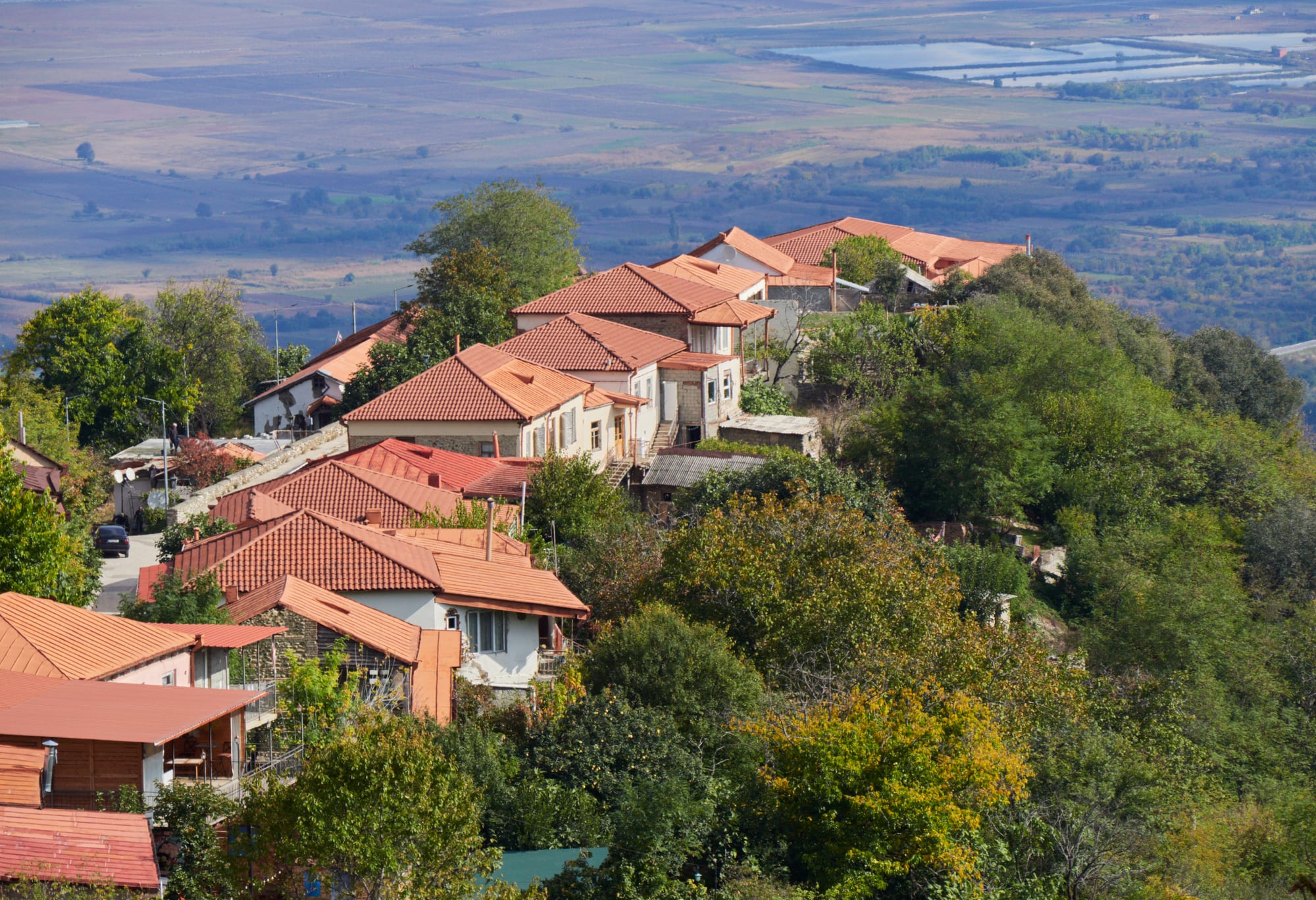
Red-roofed houses of a hilltop town among autumn trees, with the flat farmland of a wide valley far below

Georgia

Tbilisi, Kakheti & the East

The rooftops of Sighnaghi in Kakheti, looking down over the Alazani valley. (lumoplank / Wikimedia Commons · CC0)

Eastern Georgia, from the capital Tbilisi on the Mtkvari River east into the Kakheti wine country of the Alazani valley and north up the Georgian Military Highway to Kazbegi — the historic heartland of the Kartli and Kakheti kingdoms, with the old royal seat of Mtskheta and the desert monasteries of David Gareja.

Explore Tbilisi, Kakheti & the East

History

Eastern Georgia was the ancient kingdom of Kartli, which the Greeks and Romans called Iberia, with its capital at Mtskheta where the Aragvi joins the Mtkvari. It was here that King Mirian III accepted Christianity from Saint Nino in the early fourth century. In the fifth century King Vakhtang Gorgasali founded a new settlement by the hot springs downstream, and his successors moved the capital to Tbilisi, whose name comes from the Georgian word for warm. The city spent centuries under outside rule, as an Arab emirate from the eighth century, until David the Builder took it in 1122 and made it the capital of a united medieval Georgia.

After the Mongol invasions and the collapse of the united kingdom in the fifteenth century, Kakheti became a separate kingdom with its capital first at Gremi and later at Telavi. Persian campaigns under Shah Abbas in the early seventeenth century devastated it, killing or deporting much of the population. King Erekle II reunited Kartli and Kakheti in 1762, built Sighnaghi's walls, and signed the Treaty of Georgievsk with Russia in 1783; Russia failed to defend him when a Persian army sacked Tbilisi in 1795.

Under Russian rule Tiflis, as it was then officially called, became the administrative capital of the whole Caucasus, a multi-ethnic city of Georgians, Armenians, Persians and Russians, and the Georgian Military Highway was built over the mountains to connect it with the empire. In the Soviet period Rustavi grew as a steel town and Tbilisi sprawled into housing estates. The capital was the stage for the fighting of 1991–92, the Rose Revolution of 2003 and the mass protests of recent years, while Akhalgori, in the Mtskheta-Mtianeti region, has been held by South Ossetia's Russian-backed authorities since 2008.

Culture & Customs

The east is the heartland of Georgian wine culture, and Kakhetians are known across the country for their generosity at table, their long supras and a reputation for plain-spoken directness. Almost every village house has a marani, a wine cellar with qvevri set into the floor, and the rtveli harvest in September and October is the high point of the year. Alaverdoba, the feast of Alaverdi Cathedral near Telavi in September, is an old harvest festival that still draws crowds.

The mountain peoples north of Tbilisi — the Mokhevians around Kazbegi, the Mtiuls, Pshavs and Khevsurs of the Aragvi valleys, and the Tushetians — kept their own dialects, clan structures and shrines, called khati, where Christian and older traditions blend. Khevsur embroidery, Tushetian felt and wool, and the summer migration of Tushetian shepherds and their flocks to the high pastures continue today.

Tbilisi has always been the most mixed part of Georgia. The old town has Georgian and Armenian churches, a synagogue and a mosque within a few streets of each other, and Kvemo Kartli, south of the capital, has large Azerbaijani and Armenian communities; the Pankisi Gorge in Kakheti is home to the Kists, who are related to the Chechens. The capital's autumn city festival, Tbilisoba, and a thriving scene of galleries, electronic music clubs and natural-wine bars sit alongside a strong Orthodox Christian presence.

Daily Life

Greater Tbilisi has more than 1.3 million people, almost a third of the country, and dominates its economy, government, universities and media. The city stretches for kilometres along the Mtkvari, from the old town and the grand avenues of the nineteenth century to Soviet districts such as Saburtalo and Gldani. Rustavi, with about 130,000 people, is the region's second city and still an industrial centre; Telavi, Gurjaani, Sagarejo and Marneuli are the main market towns.

Kakheti lives mainly from grapes, and much of the country's wine, both from large producers and family cellars, comes from the Alazani valley and the slopes of the Gombori range. Kvemo Kartli grows vegetables, and the mountain districts depend on sheep, tourism and the heavy truck traffic heading for the Upper Lars crossing into Russia.

In Tbilisi the day starts late and finishes later, with bakeries selling shotis puri from dawn and restaurants busy until midnight. Rising rents, traffic, the influx of Russian newcomers since 2022 and the country's political direction are everyday topics of conversation, while many rural villages are losing young people to the capital and abroad.

Food

The east has its own cooking tradition, meatier and less spicy than that of western Georgia. Mtsvadi, pork or lamb skewers grilled over vine cuttings, is the centrepiece of a Kakhetian supra, eaten with raw onion and pomegranate seeds. Chakapuli, a spring stew of lamb or veal with tarragon and sour green plums, and chanakhi, lamb baked in a clay pot with aubergines and tomatoes, are eastern classics. Shotis puri, a canoe-shaped bread slapped onto the walls of a round clay oven called a tone, is sold hot on every street.

Khinkali, the pleated meat dumplings now eaten across Georgia, are credited to the mountain peoples north of Tbilisi, such as the Mtiuls and Khevsurs. Tushetian guda, a sharp sheep's cheese matured in a sheepskin sack, comes from the eastern Caucasus, and Kakheti makes churchkhela, walnut strings dipped in thickened grape juice, at harvest time.

Kakheti's wines are the country's best known: dry red Saperavi, white Rkatsiteli and Mtsvane, and appellations such as Tsinandali, Mukuzani, Napareuli and the semi-sweet red Kindzmarauli. Amber wines, white grapes fermented on their skins in qvevri, have become a speciality of the new natural-wine producers, and chacha, grape spirit distilled from the pressings, ends the meal.

Attractions & Natural Wonders

Tbilisi's old town fills the gorge below the Narikala fortress, reached by cable car from Rike Park: the brick domes of the Abanotubani sulphur baths, Sioni Cathedral, the sixth-century Anchiskhati Basilica, Metekhi church on its cliff and the Kartlis Deda statue on the ridge. Rustaveli Avenue holds the Georgian National Museum and the opera house, while the glass Bridge of Peace, the Holy Trinity Cathedral, the Dry Bridge flea market and the Mtatsminda funicular round out the city. Mtskheta, half an hour north, is a UNESCO World Heritage Site for Svetitskhoveli Cathedral, Samtavro and the hilltop Jvari Monastery.

Kakheti's wine country centres on Telavi, with the royal palace of Erekle II, and Sighnaghi, a walled hill town above the Alazani valley with Bodbe Monastery, the burial place of Saint Nino, just outside. Nearby are Alaverdi Cathedral, the Gremi citadel, Ikalto Academy, Nekresi Monastery, the Tsinandali estate of the Chavchavadze family and the forests of Lagodekhi Protected Areas. Tusheti's tower villages of Omalo and Dartlo lie beyond the Abano Pass.

The Georgian Military Highway runs north past Ananuri fortress on the Aragvi, the ski resort of Gudauri and the Jvari Pass to Kazbegi, now officially Stepantsminda, where Gergeti Trinity Church stands below Mount Kazbek and the Dariali Gorge, Juta and the Truso valley offer hiking. Khevsureti's fortified village of Shatili lies to the east. South-east of Tbilisi, David Gareja's cave monasteries, founded in the sixth century, stand in semi-desert hills at Lavra and Udabno, and Kvemo Kartli has the Dmanisi archaeological site, where early human fossils around 1.8 million years old were found.

Cities in Tbilisi, Kakheti & the East

Planning basics

Budget

Tbilisi is the most expensive place in Georgia to sleep and eat out, with boutique hotels and wine bars in the old town priced close to European levels, but hostels and guesthouses remain cheap. Kakheti's family guesthouses usually include a home-cooked dinner and house wine, and winery tastings are modestly priced. Kazbegi fills up in summer and prices rise accordingly; a hired driver is the main extra cost for David Gareja.

Daily Budget Midrange
USD 70–130 (boutique hotel or good guesthouse, restaurant dinners with wine, a driver for day trips)
Daily Budget Shoestring
USD 30–50 (hostel or guesthouse, bakeries and khinkali houses, marshrutkas and the Tbilisi metro)

Share a driver for Kakheti or David Gareja with other travellers; Tbilisi's metro uses a rechargeable Metromoney card, and fares on it and the buses are very low.

Safety

The east is safe for visitors, and petty crime in Tbilisi is low by European standards, though pickpockets work crowded areas and political demonstrations gather on Rustaveli Avenue. The main hazards are traffic and fast driving on the highways, winter conditions on the Military Highway, summer heat and snakes at David Gareja, and the frontier there with Azerbaijan, which runs through the monastery complex.

Stay on marked paths at David Gareja, keep clear of demonstrations in Tbilisi, and carry warm layers to Kazbegi even in summer. Check current official travel advice before travelling.

Climate

Drier and more continental than western Georgia. Tbilisi and the Kakheti lowlands have hot summers and cold, fairly dry winters, while the semi-desert around David Gareja is hotter and drier still. Up the Military Highway the climate turns alpine: Gudauri and Stepantsminda have deep winter snow and cool summers.

Summer
hot, 30–35°C in Tbilisi and the Alazani valley; cooler at Kazbegi, where nights stay fresh
Winter
near freezing in Tbilisi and Kakheti with occasional snow; heavy snow and sub-zero temperatures in the high Caucasus

Transportation

Tbilisi's international airport and main railway station link the region to the rest of the country. Marshrutkas leave Tbilisi's bus stations for Telavi and Sighnaghi, about two hours away, and for Stepantsminda, about three hours up the Military Highway; Mtskheta is a short ride from the capital. David Gareja has little public transport, so most visitors go on a tour or with a hired driver, and Tusheti and Khevsureti need a 4x4.

The Jvari Pass above Gudauri can close in snowstorms or avalanche danger; check the road status before setting out for Kazbegi in winter.

Best Time to Visit

Late spring and September–October suit the lowlands best, with the grape harvest in Kakheti from mid-September into October. David Gareja is most comfortable in spring and autumn, before and after the summer heat. Kazbegi, Khevsureti and Tusheti are at their best from June to September, and Gudauri's ski season runs through the winter.